

A New Direction for the Evolution Nameplate
The Mitsubishi e-Evolution Concept signals an unmistakable shift in direction for Mitsubishi Motors. Carrying one of the most storied nameplates in rally history, the study redefines the Evolution ethos not as a turbocharged, petrol-drinking homologation saloon, but as an all-electric, high-performance SUV coupé. Premiering at the 45th Tokyo Motor Show in late 2017, the concept car represents Mitsubishi’s vision under its newly unveiled global brand strategy, aiming to fuse robust crossover styling, zero-emission electric propulsion, and advanced electronic chassis governance.
Rather than looking back to the rally stages of the 1990s and 2000s, Mitsubishi is projecting its performance identity into an era dominated by electrification and connected vehicle ecosystems. The e-Evolution Concept is engineered as a low-slung, aerodynamically honed crossover that stands tall enough to clear rough pavement while maintaining the aggressive visual stance of a dedicated grand tourer. The vehicle serves as a technical beacon for what the automaker envisions for future production flagships, drawing together three decades of four-wheel-drive engineering with battery-electric powertrains.

Triple-Motor 4WD Architecture and Dual Motor AYC
Beneath the sculpted composite skin of the Mitsubishi e-Evolution Concept lies a purpose-built EV platform driven by a unique triple-motor four-wheel-drive system. Mitsubishi has engineered the driveline with a single electric motor powering the front axle, while the rear axle incorporates an advanced Dual Motor Active Yaw Control (AYC) system. The rear unit mounts two independent electric motors linked through an electronically controlled torque-vectoring mechanism, allowing precise distribution of drive torque and regenerative braking force between the left and right rear wheels.
This layout represents a direct evolution of the Super All-Wheel Control (S-AWC) philosophy that defined the Lancer Evolution road cars, but with the instantaneous control and throttle response that only electric motors can deliver. Because electric motors can modulate torque output in milliseconds without the rotational lag of mechanical differentials, the AYC unit can induce turn-in rotation or suppress power oversteer with microsecond precision. Whether navigating congested urban streets, tracking along motorways, or attacking tight hairpin corners, the triple-motor setup keeps the vehicle planted, matching torque delivery to surface grip across wet asphalt, unpaved gravel, or snow.
Energy for the triple-motor system comes from a high-capacity traction battery pack positioned low down in the floor pan between the axles. Centralising the heavy battery pack creates a low center of gravity and reduces yaw inertia, delivering handling balance and chassis agility uncommon in traditional high-riding sport utility vehicles. Large electric brake calipers replace conventional hydraulic clamps at the wheels, providing direct deceleration control and working seamlessly alongside the regenerative motor circuits to slow the vehicle while recapturing kinetic energy.
Design Philosophy: Dynamic Shield and Aerodynamic Crossover Proportions
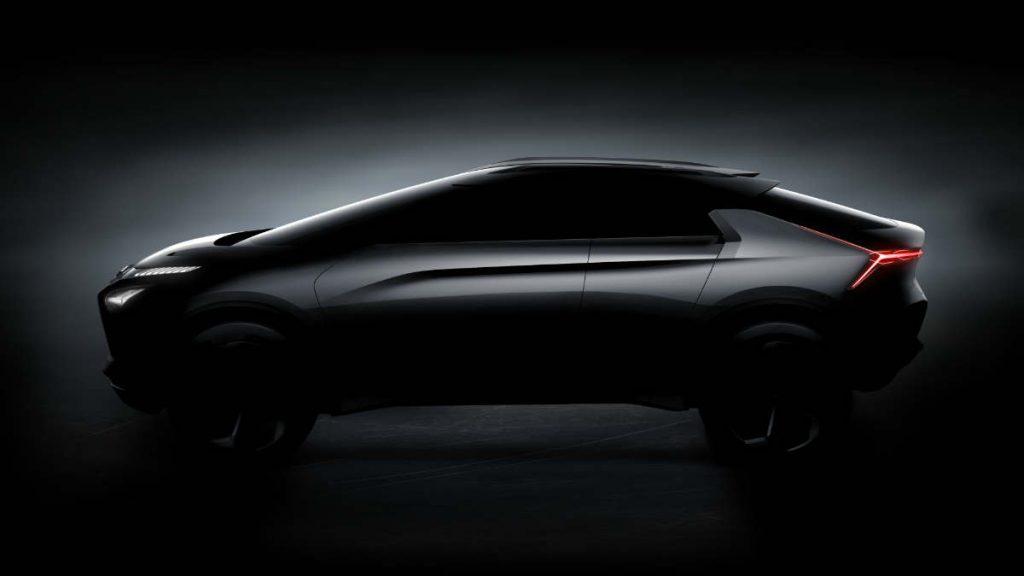
Visually, the Mitsubishi e-Evolution Concept develops Mitsubishi’s corporate “Dynamic Shield” front design language into an EV-specific format. Because an all-electric vehicle does not require the massive radiator intake of an internal combustion engine, the traditional radiator grille is sealed behind a glass face. Beneath this glass fascia, cameras and sensors are tucked away behind tinted panes, highlighted by subtle blue accents that identify the vehicle’s electric running gear. Sweeping air intakes sit below the headlamps, channelling incoming air past the front calipers before venting it down the body sides to reduce turbulence around the wheel wells.
The windshield is steeply raked, transitioning into a tapering roofline that meets a distinctive hexagonally framed rear tailgate—a styling touch meant to recall the tailgate-mounted spare tire of the legendary Mitsubishi Pajero. Sharp greenhouse styling, pronounced haunches over the rear wheels, and muscular cladding convey genuine SUV ground clearance alongside athletic proportions. Short front and rear overhangs deliver capable approach and departure angles, demonstrating that despite its show-car luster, the concept is conceived with genuine cross-country capability in mind.
Artificial Intelligence as an Onboard Driving Companion
Beyond its electric hardware, the headline technological feature of the e-Evolution Concept is its integrated Artificial Intelligence brain. Rather than pursuing an isolated autonomous taxi model, Mitsubishi’s AI concept focuses on driver augmentation. An intricate array of cameras, radar units, and optical sensors reads changes in road surfaces, traffic conditions, and vehicle dynamics in real time. Simultaneously, internal sensors monitor the driver’s steering inputs, throttle modulation, braking force, and physical posture to assess intent and driver confidence.
By comparing environmental conditions with driver inputs, the AI system adapts vehicle control parameters so that the car faithfully executes what the driver intends, even when road conditions deteriorate. When traction drops or a turn tightens unexpectedly, the system adjusts torque delivery across the four wheels to prevent instability before the driver feels uneasy. The goal is an intuitive driving experience where the electronics assist subtly, making control simpler and safer across varying skill levels.
For drivers looking to hone their performance skills, the system features a dedicated coaching function. After observing the driver’s driving style and competence across different road conditions, the AI formulates an unobtrusive training program. Through natural voice dialogue and graphic prompts displayed across the wide dashboard screens, the system provides real-time coaching tips. The driver learns how to smooth out cornering transitions, brake more effectively, and extract the maximum agility from the triple-motor platform, turning each commute or mountain pass run into a collaborative learning experience.
AI Personal Assistant and Connected Cockpit
Inside the cabin, the Mitsubishi e-Evolution Concept trades conventional switchgear for an open, airy cockpit focused on expansive visibility and seamless connectivity. A floating horizontal dashboard houses a flat display panel spanning the full width of the instrument binnacle, bordered by two auxiliary screens displaying feeds from external rearview cameras. This screen array provides clear panoramic views of vehicle telemetry, external traffic hazards, and high-definition navigation mapping without cluttering the driver’s line of sight.
Central to the cabin’s operation is the Mitsubishi AI Personal Assistant. Using voiceprint analysis and facial recognition technology, the system recognizes individual vehicle occupants as they enter, retrieving their personal seating preferences, preferred climate settings, and entertainment profiles. To ensure rapid and dependable operation, the speech recognition system uses a hybrid architecture, combining local onboard compute with cloud-based natural language processing. Even when driving through underground parking decks, tunnels, or remote mountainous terrain where cellular reception is unavailable, the local processor handles voice commands without delay.
The AI assistant processes conversational speech, screening out road hum and wind noise to accept instructions for climate control, window operation, windshield wipers, and satellite navigation. In addition, the system provides proactive vehicle diagnostics, alerting the driver immediately to low tire pressure, driveline faults, or scheduled servicing requirements.
Connectivity also extends to external hardware. The system is designed to interface with an overhead drone, allowing occupants to deploy an aerial camera to inspect traffic congestion ahead or capture bird’s-eye views of scenic landscapes. At the 2017 Tokyo Motor Show, Mitsubishi is highlighting its MITSUBISHI CONNECT ecosystem, demonstrating integration with home smart speakers such as Amazon Echo with Alexa and Google Home with Google Assistant. Through these linked devices, owners can check vehicle status from their living room, pre-condition the interior temperature, switch headlamps on or off, and manage door locks using everyday voice commands.
Vehicle data
| Field | Value |
|---|---|
| Make | Mitsubishi |
| Model | e-Evolution Concept |
| Generation / chassis code | Concept vehicle (First generation) |
| Model year(s) covered | 2017 |
| Body style | High-performance SUV Coupé |
| Powertrain / engine | All-electric triple-motor EV system (1 front motor, 2 rear motors) |
| Power / torque | Not stated in sources |
| Transmission | Direct-drive electric transmission with electronically controlled torque vectoring |
| Drivetrain | Triple Motor 4WD with Dual Motor Active Yaw Control (AYC) |
| Key performance figures | Not stated in sources |
| Price (as stated) | Not stated in sources (Concept study) |
| On-sale / announcement period | October 2017 (45th Tokyo Motor Show premiere) |
| Market | Global concept showcase (Tokyo debut) |