

Lamborghini’s Virtual Single-Seater Concept
When Automobili Lamborghini pulled the covers off the Lambo V12 Vision Gran Turismo at the World Finals of the 2019 FIA Certified Gran Turismo Championships in Monte Carlo, the crowd in Monaco was looking at something that existed in two worlds at once. On the floor stood a full-scale physical model — sculpted, painted, lit, and photographed as though it were bound for a Geneva show stand. In digital form, it was a purpose-built racing machine destined for the garages of Gran Turismo Sport players on PlayStation 4, scheduled to arrive in spring 2020.
The concept sits at the intersection of Lamborghini’s design ambitions and Polyphony Digital’s long-running Vision Gran Turismo program, which since 2013 has invited the world’s most celebrated marques to sketch the cars they would build if the only constraint were imagination. Lamborghini Centro Stile accepted that brief and ran with it, producing a single-seater that distills the brand’s visual language down to its most concentrated form.

A Pure Visionary Concept for the Digital Grid
The Lambo V12 Vision Gran Turismo is not a thinly veiled production preview, nor is it a styling exercise destined for the crusher once the auto-show cycle ends. It was conceived from the outset as a virtual racing car — a machine whose aerodynamics, proportions and packaging could push beyond the compromises that road regulations impose on every production Lamborghini.
Stefano Domenicali, Chairman and CEO of Automobili Lamborghini S.p.A., framed the project around the brand’s demographic ambitions: “Lamborghini is a very young brand, and this is why we are here today to present our newest virtual vision in the form of a real model, with a highly futuristic and cool design to be enjoyed by the young generation of racing game and super sports car enthusiasts.”
That statement carries weight. Lamborghini has spent the better part of a decade courting a younger, more digitally connected audience. The Vision Gran Turismo platform — previously used by marques including Bugatti, Aston Martin and Peugeot — gives each participating brand a sandbox free from crash-test mandates, emissions targets or pedestrian-safety legislation. For Lamborghini’s design team, the freedom was absolute.

Centro Stile and the Single-Seat Silhouette
Mitja Borkert and the Centro Stile team in Sant’Agata Bolognese built the Lambo V12 Vision GT around a single organizing principle: the centerline. Every Lamborghini, from the Miura to the Aventador, carries a strong longitudinal axis when viewed from above. This concept takes that philosophy to its logical extreme by eliminating the passenger seat entirely.
The result is a narrow, focused cabin pod flanked by aggressive bodywork that widens dramatically toward the rear. The main body shell is physically disconnected from the fenders — a deliberate visual separation that lets each aerodynamic surface do its work independently. There are no fender-to-door shut lines here; the panels float, creating air channels that feed the radiators and ground-effect tunnels beneath the floor.
Seen in profile, the most striking detail is the hexagonal motif in the side windows. Lamborghini’s design team reached back to the 1968 Lamborghini Marzal — Marcello Gandini’s extraordinary Bertone concept that previewed the Espada and introduced the hexagonal window geometry that became a recurring Lamborghini signature. Fifty-one years later, Centro Stile reinterpreted that shape in the Lambo V12 Vision GT’s glazing, linking a mid-century design landmark to a twenty-first-century virtual racer.

Aerodynamics and the Y-Signature
The rear end dominates the car’s visual presence. A substantial wing rises from the bodywork, housing a prominent Y-shaped taillight that reads as the Lamborghini signature from several car-lengths back. Every surface on the Lambo V12 Vision GT was shaped as a high-performance aerodynamic element, with the design and aero teams working in parallel rather than in sequence — an approach possible only when the car exists in a virtual environment where wind-tunnel hours cost nothing.
At the front, the same Y-signature appears in the headlight clusters. Lamborghini has used the forked light motif across its production range for several years, but in this concept the treatment is cleaner and more graphic. The nose tapers sharply, feeding air under the car and around the front wheel arches, which stand proud of the main body in a style reminiscent of 1970s Group 5 sports prototypes.
Borkert described the design philosophy in his own words: “It is an opportunity for the design talent within Lamborghini to stretch its wings and visualize a car that, like every Lamborghini, is a head-turner and the best driving experience, but also mirrors Lamborghini’s push on future technologies, particularly in the arena of lightweight materials and hybridization.”

The Sián FKP 37 Powertrain
In its virtual form, the Lambo V12 Vision Gran Turismo draws its powertrain from the Lamborghini Sián FKP 37 — the limited-run hybrid supercar that Lamborghini unveiled at the Frankfurt Motor Show (IAA) in September 2019. That production car pairs a naturally aspirated 6.5-litre V12 with a 48-volt electric motor integrated directly into the gearbox, fed by a supercapacitor rather than a conventional lithium-ion battery pack.
The Sián FKP 37 produces a combined output of 819 hp (602 kW), making it the most powerful Lamborghini road car at the time of its launch. The supercapacitor energy-storage system is three times more powerful than a battery of equivalent weight, and it recovers energy under braking symmetrically — meaning the capacitor charges and discharges with equal speed. That characteristic suits a racing environment where every braking zone is a chance to top up electrical boost.
In the Gran Turismo Sport simulation, the Lambo V12 Vision GT is configured with 6,498 cc of displacement and four-wheel drive. The game’s data lists maximum output at 774 HP (roughly 818.5 BHP when converted), placing the virtual car in the top tier of the Vision Gran Turismo roster. Players will be able to exploit that output on every circuit in the game’s library, from the Nürburgring Nordschleife to Tokyo Expressway.
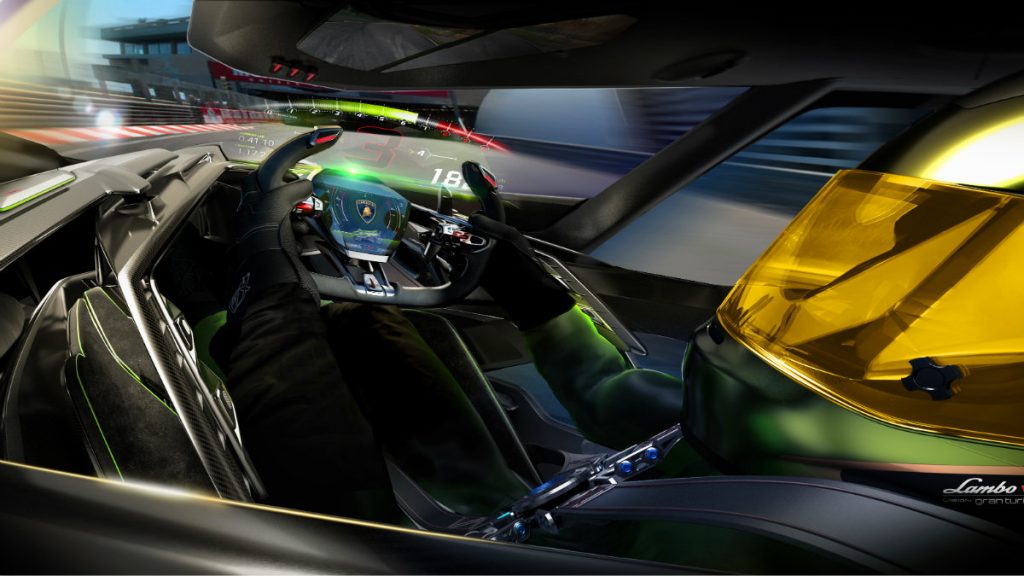
The Cockpit: Entering Like a Fighter Pilot
Lamborghini designed the Lambo V12 Vision GT’s interior around a single occupant, and the entry method reflects that focus. The driver climbs in from the front of the car, stepping over the nose section in a manner more familiar to jet-fighter pilots than to road-car drivers. There is no conventional door, no B-pillar, no folding seatback — just an open cockpit aperture shaped to the driver’s frame.
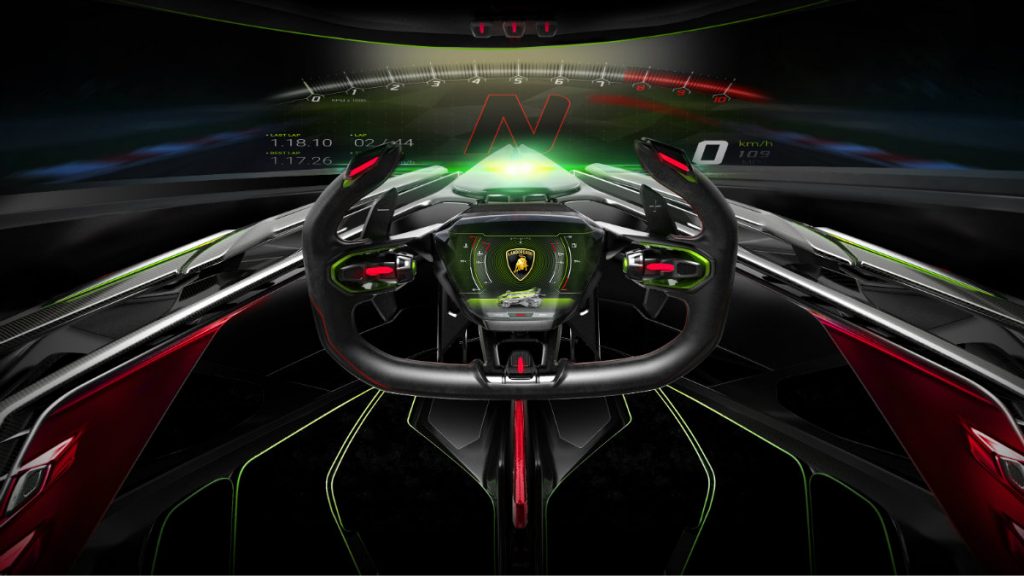
Once seated, the driver grips a futuristic steering wheel that houses the main driving controls. All relevant information — speed, revs, lap times, hybrid-energy status — is projected onto the windscreen area via a virtual head-up display. There are no physical instrument dials. The cabin strips away everything that does not contribute to the act of driving a racing car around a circuit.
This approach mirrors what Lamborghini’s Centro Stile calls a “visionary concept” for the interior — one that looks ahead of its time while staying anchored in the functional purity that racing demands. A passenger seat would have widened the cabin, compromised the centerline silhouette and added mass the virtual regulations did not require. Removing it entirely sharpened every other design decision.
The Vision Gran Turismo Program
The Vision Gran Turismo initiative launched in 2013 to celebrate the fifteenth anniversary of the Gran Turismo franchise. Kazunori Yamauchi, the series creator, invited manufacturers to design cars unconstrained by production realities — vehicles that could exist only inside the game but would be rendered with the same engineering rigour as their real-world counterparts. Over the years, contributions have ranged from Alpine’s lightweight sports coupé to Bugatti’s 1,650-hp traccoupépon.
Lamborghini’s entry into the program reflects the brand’s broader engagement with digital motorsport. The FIA Certified Gran Turismo Championships, sanctioned by the Fédération Internationale de l’Automobile, treat the game as a legitimate competitive discipline. The 2019 World Finals in Monte Carlo brought together the season’s top sim-racers to contest manufacturer and individual titles, and the Lambo V12 Vision GT reveal served as the event’s headline moment.
For Lamborghini, the stakes extend beyond gaming. The company has tracked how virtual car ownership influences real-world brand loyalty — young players who spend hundreds of hours tuning and racing digital Lamborghinis often become the brand’s most vocal advocates, and in some cases its future customers. Domenicali’s reference to “the young generation of racing game and super sports car enthusiasts” was not idle marketing language; it described a measurable pipeline from PlayStation controller to showroom appointment.
Lightweight Materials and Hybridisation
Borkert’s mention of lightweight materials and hybridization points to two technologies that Lamborghini has placed at the centre of its engineering roadmap. The Sián FKP 37 — the Lambo V12 Vision GT’s donor car — introduced the supercapacitor-based hybrid system to Lamborghini’s production lineup, and the company has signalled that electrification will feature across future models. By embedding that powertrain in a virtual concept, Lamborghini gives millions of players a chance to experience the technology in a context where its benefits — instantaneous torque fill, symmetrical energy recovery, reduced weight versus a battery pack — are immediately tangible.
The lightweight dimension is equally deliberate. The physical model displayed in Monte Carlo showcased extensive carbon-fibre construction, and the virtual car’s kerb weight in Gran Turismo Sport reflects the kind of mass figures achievable only with a full carbon monocoque and body panels. In the real world, Lamborghini’s forged-composite technology — a proprietary process that compresses carbon fibre into complex shapes in minutes rather than hours — has already appeared in production components. The Lambo V12 Vision GT extends that thinking to every panel.
A Concept That Bridges Two Worlds
What makes the Lambo V12 Vision Gran Turismo interesting beyond its pixel count is the dual existence Lamborghini has given it. The physical model that stood under the lights in Monaco is a hand-built sculpture — fully trimmed, fully painted, and detailed to concept-car standards. It will likely appear at future design exhibitions and Lamborghini events, giving enthusiasts a chance to walk around it and study the hexagonal glazing and Y-signature lighting in three dimensions.
The virtual car, meanwhile, will reach a global audience that no physical concept can match. When Gran Turismo Sport makes the Lambo V12 Vision GT available in spring 2020, millions of players worldwide will be able to start its V12 hybrid, feel the four-wheel-drive traction off the line, and chase lap times on circuits from Brands Hatch to Suzuka. For many of those players, the Lambo V12 Vision GT will be the first Lamborghini they ever “drive” — and that first impression carries more brand-building weight than any billboard.
Lamborghini has never been shy about blending physical and digital experiences. From its early adoption of augmented-reality configurators to its presence in racing simulators, the company understands that the boundary between the showroom and the screen is dissolving. The Lambo V12 Vision Gran Turismo is the most concentrated expression of that philosophy to date: a car conceived in Sant’Agata Bolognese, unveiled in Monaco, and destined to live its competitive life on PlayStation servers around the world.
Vehicle data
| Make | Lamborghini |
| Model | Lambo V12 Vision Gran Turismo |
| Model year(s) covered | 2019 (concept car) |
| Body style | Single-seater concept car |
| Powertrain / engine | 6.5-litre naturally aspirated V12 with 48V supercapacitor hybrid system (from Lamborghini Sián FKP 37) |
| Power / torque | 819 hp combined (Sián FKP 37 figure); 774 HP listed in Gran Turismo Sport (818.5 BHP) |
| Transmission | Not stated in sources |
| Drivetrain | Four-wheel drive |
| Key performance figures | Not stated in sources (virtual concept; performance figures game-dependent) |
| Price (as stated) | Not applicable (virtual concept car) |
| On-sale / announcement period | Unveiled November 2019; available in Gran Turismo Sport from spring 2020 |
| Market | Global (virtual; Sony PlayStation 4) |