

High-Definition Projection and Night-Driving Safety
Automotive headlamp engineering has reached an inflection point where forward illumination is no longer just about casting light onto dark pavement. With the unveiling of its production-ready DIGITAL LIGHT system at the Geneva Motor Show, Mercedes-Benz and Mercedes-Maybach have shifted the headlamp from a passive visibility tool into an active driving assistance and communication device. Engineered to deliver a virtually dazzle-free high beam in high-definition quality, the setup relies on a resolution exceeding one million pixels per lamp, delivering more than two million individual light points across the front of the vehicle. Following its premiere on the updated Mercedes-Maybach S-Class flagship, small-series production units are being prepared for initial handover to selected fleet customers in 2018.
Ola Källenius, Daimler AG Board Member for Group Research and Mercedes-Benz Cars Development, framed the development as a natural bridge between illumination hardware and active vehicle intelligence: with over one million addressable pixels per headlight unit, DIGITAL LIGHT creates optimal light conditions across differing environments while extending the real-time visual support provided by on-board driving assistance suites.

The Micro-Mirror Core: Two Million Pixels on the Asphalt
Underneath each headlamp lens sits a semiconductor chip populated by more than a million micro-reflectors. Working together across both sides of the vehicle, more than two million microscopic mirrors manipulate incoming light with micrometer precision. This layout functions much like a video projector, dividing the beam into minute light pixels rather than relying solely on traditional LED clusters or mechanical shutters.
The system is integrated directly into the broader vehicle architecture. Monocular and stereo camera setups, front radar sensors, and digital HD navigation mapping continuously stream driving parameters into dedicated electronic control units. These computers evaluate surrounding environmental data in single-digit milliseconds, calculating commands that reposition the micro-mirrors and adjust diode intensity to fit roadway geometry, oncoming vehicles, and ambient visibility.
Earlier MULTIBEAM LED assemblies brought notable progress to selective shading, employing an array of individual diodes to blank out specific zones around other vehicles. DIGITAL LIGHT refines this concept by several orders of magnitude. The pixel pitch is so granular that the blanked-out area around approaching cars or oncoming cyclists can be sculpted tightly around the vehicle outline, preserving maximum high-beam illumination over every remaining centimeter of road surface without dazzling other motorists.
Integration with Mercedes-Benz Intelligent Drive
For decades, lighting and electronic driver aids developed along separate tracks. Headlamps dealt with lumen output, while active safety relied on audible chimes, instrument cluster icons, and haptic feedback through steering wheels. DIGITAL LIGHT unites these domains under the INTELLIGENT DRIVE umbrella, turning the road surface ahead into a direct optical interface.
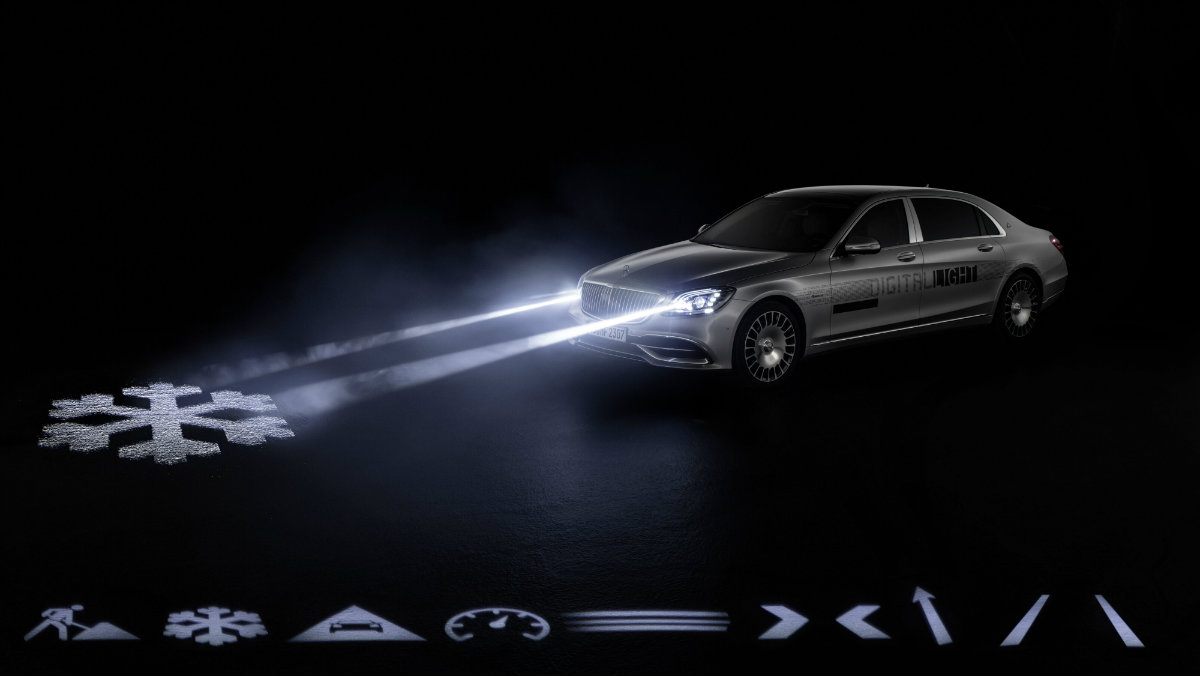
Because the light beam possesses high definition, software can render crisp graphical symbols directly within the driver’s forward field of view. This minimizes head movement away from the road, reducing reliance on conventional head-up displays or central dashboard screens during critical maneuvers. The guidance appears directly where the hazard exists, giving drivers intuitive warnings in dark, wet, or unfamiliar terrain.
Assistance Functions and Road-Surface Projection
At the start of small-series production for the Mercedes-Maybach S-Class, Daimler engineers calibrated several specific projection routines designed to alleviate common nighttime hazards:
Guide Lines: Narrow lanes through highway construction zones rank among the most stressful driving scenarios after dark. When entering these tight passages, DIGITAL LIGHT projects two parallel trails of light matched exactly to the track width of the car. These luminous lines show the driver precisely whether the car fits within the barricades, preventing rim curb damage and steering over-corrections.
Extended Pedestrian Mark: If night-vision sensors or front-mounted stereo cameras spot a person near the travel lane in an unlit zone, the lighting computer commands a targeted beam to highlight the pedestrian. Working beyond the existing Adaptive Highbeam Assist spotlight, an arrow icon is rendered directly on the asphalt pointing towards the person, highlighting their position without shining blinding light directly into their eyes.
Distance Mark: Setting and verifying follow distances often requires glancing down at the instrument panel. When the driver activates the DISTRONIC PLUS proximity control or alters the gap settings, an intuitive graphic marker projects onto the lane ahead, helping the driver visually confirm appropriate separation intervals for prevailing vehicle speeds.
Hazard Warning Symbols Rendered on the Asphalt
Beyond guidance lines and distance indicators, DIGITAL LIGHT communicates environmental hazards that the driver might otherwise fail to notice until traction or clearance is lost. A suite of six distinct symbols comes pre-programmed for initial production cars:
- Low-Grip Surface Symbol: When ambient sensors, ABS wheel speed differentials, and stability controllers register sudden drops in friction coefficients—such as black ice, packed snow, or standing surface water—a distinct snowflake icon appears in the driver’s lane ahead.
- Construction-Site Symbol: Drawing on navigation updates and forward cameras, the vehicle projects an alert icon ahead of unexpected lane closures, scaffolding, or shifted lane markings.
- Rear-End Collision Symbol: If closing velocities on traffic ahead reach critical deceleration thresholds, an unmistakable collision warning glyph is projected forward to prompt prompt braking intervention.
- Lane-Keeping Symbol: If the vehicle drifts toward lane boundaries or approaches oncoming traffic without an active turn indicator, a corrective lane-marking symbol beams onto the pavement.
- Blind-Spot Symbol: When an indicator is engaged while radar units detect a neighboring vehicle in the blind zone, a warning graphic displays immediately on the driving line.
- Speed Symbol: When camera-based speed limit detection reads a reduced posted limit or speed alert, the corresponding speed number appears on the road surface to remind the driver to decelerate.
Communication with the Vehicle Surroundings
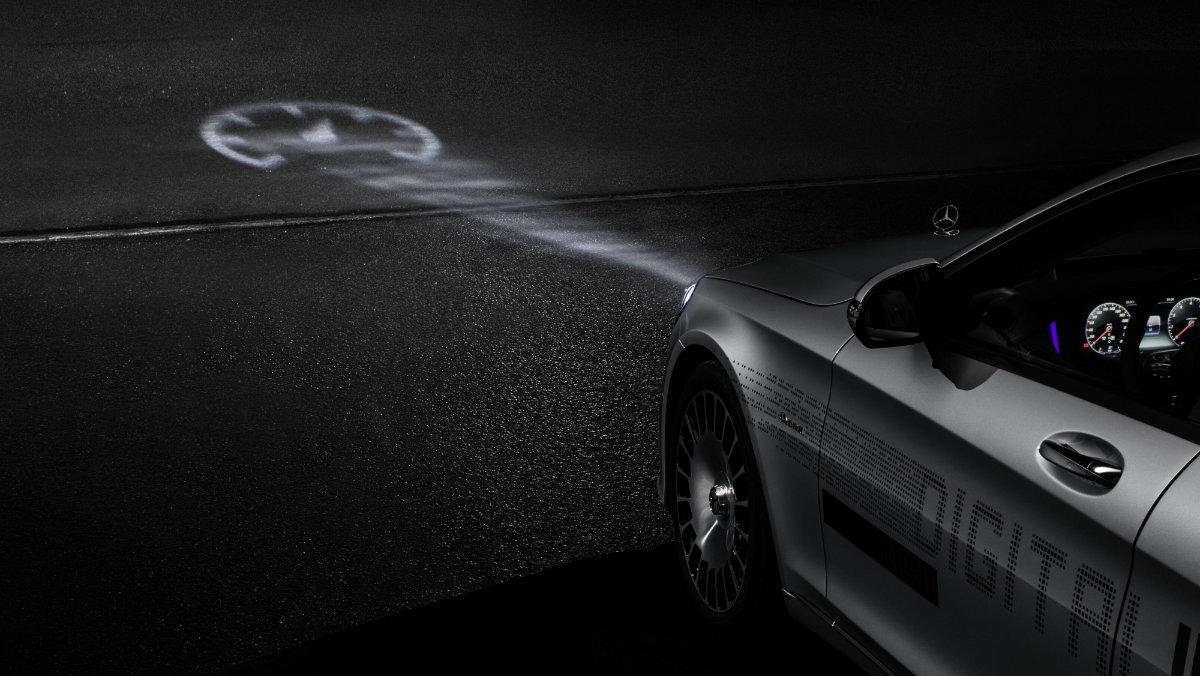
Daimler’s development roadmap for DIGITAL LIGHT looks beyond assisting the person behind the steering wheel. As automated and autonomous driving systems evolve, the headlamp becomes a primary vehicle-to-human communication medium. In experimental setups, the vehicle can project a pedestrian crosswalk onto the tarmac, signaling to waiting pedestrians that the car has come to a full halt and that it is safe to cross in front of the vehicle. Such non-verbal cues bridge the gap between machine decision-making and human trust on urban streets.
Initial customer deliveries of DIGITAL LIGHT remain deliberately limited. Regulatory frameworks across key global markets—most notably North America—place rigid restrictions on headlight brightness distribution, adaptive beam shaping, and road-surface projection symbols. Mercedes-Benz has therefore directed initial availability toward selected European fleet operators and luxury buyers who can operate the system under regional homologation permissions. As safety benefits gain empirical backing on public motorways, this high-definition micro-mirror technology provides the template for how headlights will operate across the premium automotive sector.
By blending microscopic projection hardware with millisecond camera processing, Mercedes-Benz demonstrates that illumination can be both an active protector and a subtle visual guide. Through dark backroads and narrow construction zones, DIGITAL LIGHT proves that clarity at night involves far more than merely illuminating the road—it is about understanding the environment and illuminating what matters most.