
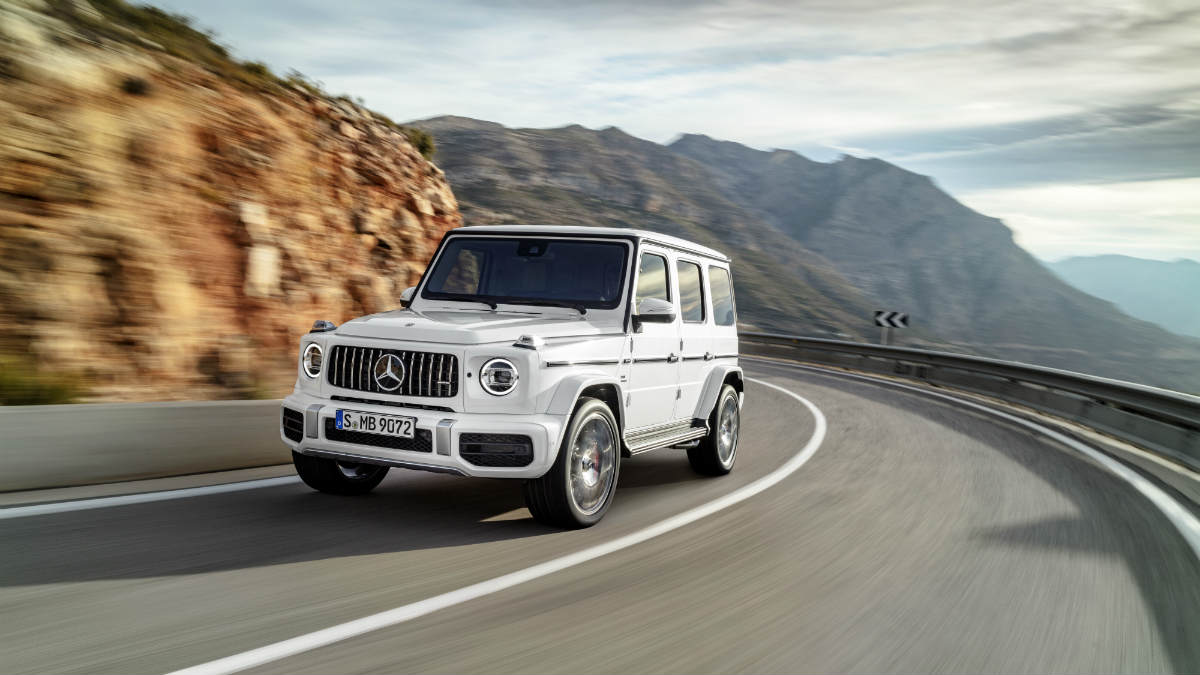
High-Performance Off-Road Reinvention
Few vehicles carry the cultural weight of the Mercedes-Benz G-Class, and when Affalterbach prepares a ground-up rework of the iconic Geländewagen, the stakes are exceptionally high. The new Mercedes-AMG G 63 marks the most comprehensive mechanical and architectural transformation in the model line’s history. Rather than merely modernizing trim or bolting on cosmetic updates, Mercedes-AMG has reimagined the underlying chassis, powertrain, and cabin architecture while deliberately retaining the unmistakable upright profile, ladder-frame toughness, and locking differentials that define the vehicle.
Anchoring this modern reinvention is a fundamental shift under the bonnet: the outgoing 5.5-liter twin-turbo V8 steps aside for AMG’s current 4.0-liter biturbo V8 engine, paired with an AMG SPEEDSHIFT TCT 9-speed automatic transmission. Crucially, the engineering overhaul extends deep into the running gear. For the first time on a production G-Class, the live front axle gives way to an independent double-wishbone front suspension mounted directly to the steel ladder frame, teamed with an all-new electromechanical rack-and-pinion steering rack. The result is an uncompromising luxury performance off-roader designed to deliver precise high-speed road manners without blunting the extreme all-terrain competence buyers demand.
As Tobias Moers, CEO of Mercedes-AMG GmbH, explained at the vehicle’s introduction, preserving the cult character was paramount: “The new Mercedes-AMG G 63 brings driving performance to the segment of unadulterated off-road vehicles in an unexpected form. It was important for us to tie in with the original character on account of the cult status the G 63 enjoys with our customers and fans. The vehicle has nevertheless reached a completely new dimension in terms of technology with the 4.0 liter V8 bi-turbo engine as well as in combination with the off-road characteristics, the agility, and the vehicle dynamics achieved.”
Powertrain: 4.0-Liter ‘Hot Inside V’ Biturbo V8
Replacing the previous generation’s 5.5-liter twin-turbo V8, the 4.0-liter biturbo V8 (internal code M177) brings Affalterbach’s premier sports car engineering into the upright engine bay of the G-Class. Generating 430 kW (585 hp) at 6,000 rpm and an immense 850 Nm of torque across an elastic plateau from 2,500 to 3,500 rpm, the engine delivers effortless propulsion. It catapults this boxy heavyweight from zero to 100 km/h in just 4.5 seconds. Top speed is electronically limited to 220 km/h, which can be raised to 240 km/h when optioned with the AMG Driver’s Package.
Central to the V8’s responsiveness is the layout of the turbochargers. Instead of mounting the blowers outboard alongside the cylinder heads, AMG places the twin-scroll turbochargers directly inside the 90-degree cylinder ‘V’. This ‘hot inside V’ architecture drastically reduces the distance exhaust gases travel before driving the turbine wheels, sharpens throttle response, and keeps the overall engine package exceptionally compact. Moreover, situating the turbochargers inboard permits direct, compact packaging of the catalytic converters close to the engine, speeding up warm-up cycles and reducing emissions.
Each turbocharger features a twin-scroll turbine housing divided into two parallel flow channels. Paired with separate exhaust runners in the exhaust manifold, the arrangement channels exhaust gas pulses from cylinders one and four into one duct, and cylinders two and three into the second. By keeping alternating exhaust gas impulses isolated, the manifold avoids mutual pressure interference during valve overlap cycles, reducing backpressure and maximizing volumetric efficiency across all engine speeds.

Efficiency Engineering and AMG Cylinder Management
Despite the immense thrust on tap, AMG has incorporated extensive measures to curb fuel consumption. The G 63 utilizes third-generation spray-guided direct petrol injection operating via centrally positioned piezo injectors. An all-aluminum sand-cast crankcase, four valves per cylinder with variable camshaft timing, and an efficient air-to-water charge-air intercooling circuit ensure high thermal stability under prolonged loads.
To reduce pumping losses under light load, the engine features the AMG Cylinder Management cylinder deactivation system. When the driver selects the Comfort transmission mode, the engine computer seamlessly deactivates cylinders two, three, five, and eight within an operating window spanning 1,000 to 3,250 rpm. The transition between four-cylinder and eight-cylinder firing happens in milliseconds, undetectable to vehicle occupants without looking at the AMG main menu on the digital instrument cluster. Combined fuel consumption is rated at 13.1 liters per 100 km, corresponding to combined CO2 emissions of 299 g/km, supported by alternator management, an ECO start/stop system, and high-speed gliding mode.
Transmission: AMG SPEEDSHIFT TCT 9G
Power is routed through an AMG SPEEDSHIFT TCT 9G (Torque-Clutch Transmission) automatic. Tailored with AMG-specific control software, the nine-speed unit delivers lightning-quick shifts and spontaneous kick-down capabilities. The multi-gear downshift function allows the transmission to skip ratios directly—for instance, dropping straight from eighth to fifth gear or seventh to third—to unleash instant passing power.
In Sport and Sport+ drive programs, the software engages an automated double-declutching rev-matching function on downshifts, injecting acoustic drama into the cabin while stabilizing the driveline. Fast gear shifts are further achieved through precise, momentary ignition cut-offs during full-throttle upshifts. Across all standard driving modes, the G 63 pulls away in first gear to ensure immediate responsiveness off the line. Gear selection can also be managed via the repositioned DIRECT SELECT steering column stalk or taken over entirely in Manual (“M”) mode via galvanized paddle shifters, where the gearbox holds the selected ratio without forcing an automated upshift at the redline.
Driveline: AMG Performance 4MATIC and Triple Differential Locks
Off-road capability remains the non-negotiable soul of the G-Class. Standard equipment includes the AMG Performance 4MATIC permanent all-wheel-drive system, which now adopts a permanent rear-biased torque split of 40 percent to the front axle and 60 percent to the rear. This rear bias replaces the previous model’s neutral 50:50 distribution, generating greater on-road agility, reduced understeer on turn-in, and sharper directional stability under hard acceleration.
When the tarmac ends, the two-stage transfer case provides substantial crawling capability. The off-road low-range gear ratio has been dramatically deepened to 2.93:1, compared to 2.1:1 on the outgoing predecessor. The LOW RANGE setting can be activated at vehicle speeds up to 40 km/h, shifting the transfer case reduction from 1.00:1 to 2.93:1 to multiply wheel torque on steep inclines, while returning to HIGH RANGE is possible at speeds up to 70 km/h.
Traction management is anchored by an intelligent, electronically controlled multiplate clutch integrated into the transfer case, functioning like an automated limited-slip differential. This clutch preserves steering agility on loose terrain by distributing torque automatically before mechanical lockup is required. For extreme conditions, the iconic trio of 100 percent mechanical differential locks remains intact. Operated via chrome-accented dashboard rocker switches, the dog-clutch differential locks engage electromechanically in strict sequence: center differential first, followed by the rear axle, and finally the front axle. Each lock engages rapidly while the vehicle is in motion, in both high and low ranges, with status displayed on the instrument cluster.
Chassis Dynamics: Independent Front Wishbones and AMG RIDE CONTROL
The defining technical leap of this generation is the complete chassis redesign developed under AMG’s leadership. Abandoning the traditional live front axle, engineers designed an independent double-wishbone front suspension mounted directly to the ladder-type frame without an isolating subframe. Locating the lower wishbones as high as possible protects suspension geometry during rock crawling while providing sports-sedan level steering precision on the street. A beefy suspension bridge connects the front strut towers, substantially increasing front-end torsional rigidity.
At the rear, the G 63 retains a robust rigid axle, now controlled by four longitudinal trailing arms per side and a Panhard rod. This configuration yields exceptional wheel articulation: rear spring compression reaches 82 mm, with 142 mm of rebound, alongside a generous 241 mm of ground clearance beneath the rear axle housing. Transverse anti-roll bars front and rear control body lean, while the standard AMG RIDE CONTROL suspension incorporates electronically controlled adaptive damping. Operating continuously across Comfort, Sport, and Sport+ calibrations, the dampers adjust compression and rebound forces individually at every wheel based on steering angle, road surface roughness, and lateral acceleration.

Steering performance undergoes an equally radical shift with the introduction of an electromechanical speed-sensitive rack-and-pinion setup. Dispensing with the vague recirculating-ball steering of previous generations, the new system employs a variable steering ratio that provides effortless maneuvering in tight urban quarters while tightening up with communicative heft at highway velocities. Drivers can toggle steering assistance between Comfort and Sport profiles independently or tie steering behavior to the broader drive programs.

Drive Programs: Five On-Road, Three Off-Road Modes
To orchestrate its newfound versatility, the Mercedes-AMG G 63 introduces AMG DYNAMIC SELECT with eight distinct drive programs. On paved roads, drivers can select between Slippery, Comfort, Sport, Sport+, and a custom Individual mode. Each program alters throttle sensitivity, shift mapping, damper stiffness, and steering weight to transform the vehicle from a supple long-distance tourer into an aggressive backroad handler.
Off-road capability is governed by three dedicated all-terrain modes accessed when the central differential lock is engaged: Sand, Trail, and Rock. Trail mode optimizes throttle and braking responses for slippery mud, wet grass, and loose surfaces. Sand mode adjusts electronic stability and traction thresholds to sustain forward momentum and directional control across dunes. Rock mode primes the chassis for severe, highly technical terrain with massive axle articulation, ensuring smooth power delivery even when wheels lift clear of the ground.
Body Structure and Weight Reduction
Beneath the skin lies a newly developed high-strength steel ladder-type frame mated to a composite-construction bodyshell. As the lowest structure on the vehicle, the steel ladder frame maintains a low center of gravity and shields the fuel tank, mechanical assemblies, and exhaust system from jagged terrain impact. Digital prototype simulations allowed engineers to optimize material gauges throughout the vehicle, trimming curb weight while enhancing strength.
The resulting intelligent material mix incorporates various grades of high-strength steel for structural safety cells, while the bonnet, front wings, and doors are pressed from lightweight aluminum. To preserve the characteristic vault-like door closing sound and distinct external hinges, the door hardware was specially re-engineered for aluminum skinning. Crucially, the torsional rigidity of the ladder frame, body shell, and body mount assemblies jumps by roughly 55 percent, rising from 6,537 Nm/deg to 10,162 Nm/deg. Laser welding replaces spot welding on the roof for a seamless joint, and fixed glass panels are adhesively bonded to the structure, boosting body stiffness and corrosion resistance.

Exterior Styling and Iconic Details
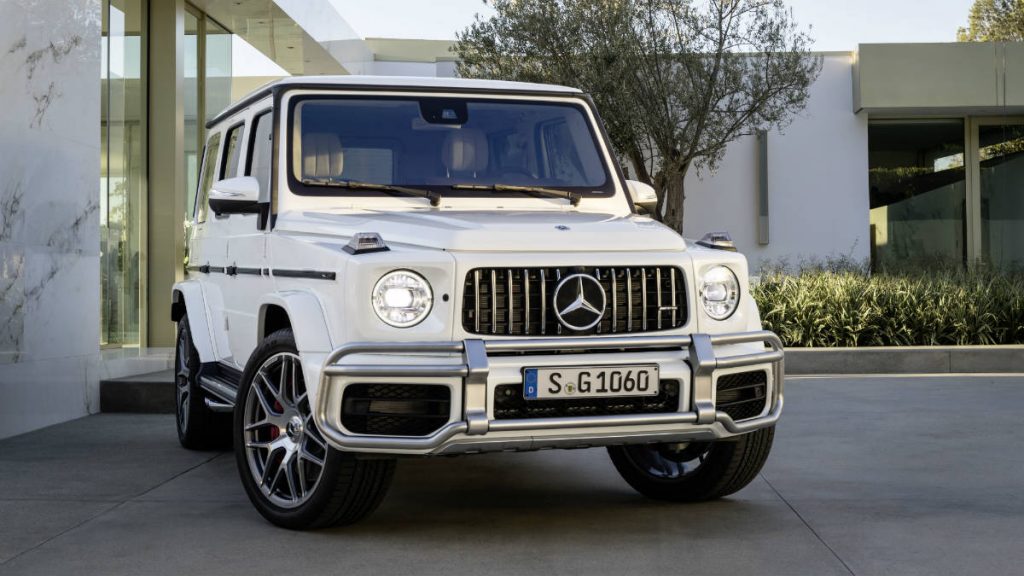
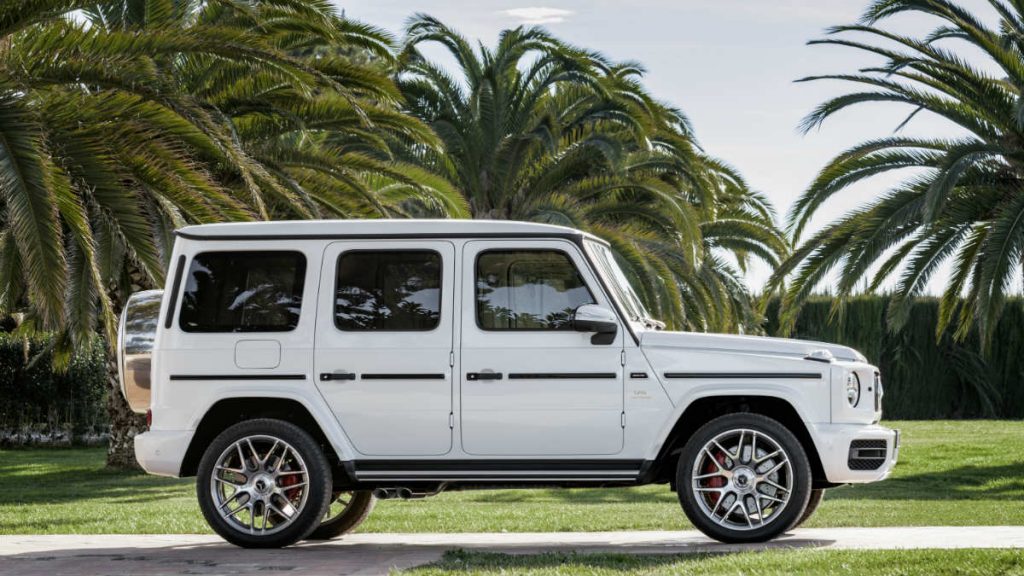
Visually, the Mercedes-AMG G 63 preserves every beloved hallmark of the 1979 original: the two-box silhouette, exposed door hinges, robust mechanical pull handles, upright windscreen, bonnet-top indicators, and external tailgate-mounted spare wheel with its stainless-steel ring. Yet every exterior panel is fresh, tightly executed, and aerodynamically refined.
The front fascia is identified by the AMG-specific radiator grille with vertical chrome slats—the Panamericana design—framed by an AMG bumper featuring oversized outer cooling intakes finished in matte iridium silver. LED High-Performance headlights, daytime running lights, and tail lamps come standard, with MULTIBEAM LED lighting available as an option. The MULTIBEAM system deploys 84 individually controlled LED modules per headlight to dynamically shape high-beam coverage around traffic without dazzling other motorists.
Muscular flared wheel arches accommodate broader track widths and expansive wheel packages, offering alloy wheels up to 22 inches in diameter for the first time. The front wings display proud “V8 BITURBO” chrome lettering, while high-gloss black body rubbing strips carry silver AMG badging. Beneath the rear doors emerge the defining acoustic signature of the G 63: twin chrome side-exit exhaust pipes on each side. Equipped with electronically controlled exhaust flaps, the dual-flow exhaust system can toggle between an understated rumble and an unfiltered, thunderous AMG V8 roar.
Interior Architecture and Digital Luxury
Step inside, and the cabin represents a clean break from the cramped, utilitarian ergonomics of older G-Class models. Overall dimensions expand considerably: total body length grows by 101 millimeters, overall width broadens by 121 millimeters, and height expands by 40 millimeters. These enlarged proportions translate directly into genuine cabin space, granting front and rear occupants significantly more shoulder room, elbow room, and rear-seat legroom.
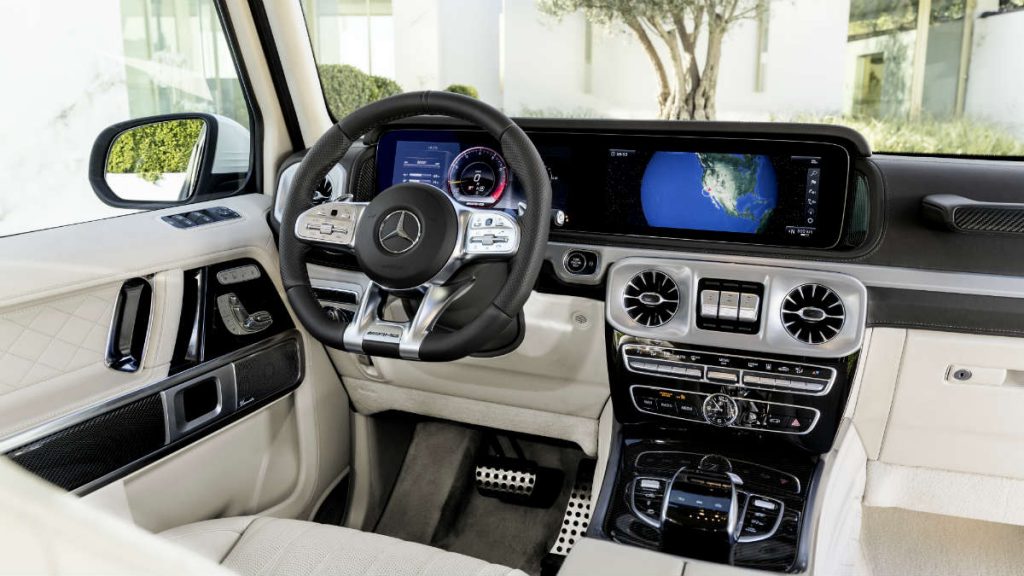
The dashboard styling pays clever homage to exterior hardware. The circular climate vents mirror the round headlights, while the dash-top speaker tweeters reflect the shape of the bonnet turn indicators. The front passenger retains the iconic leather-trimmed grab handle, framed alongside the three central differential lock pushbuttons finished in brushed metal. Analog tube gauges remain standard, while the optional Widescreen Cockpit integrates two 12.3-inch high-resolution displays beneath a continuous glass panel. Drivers can toggle the digital cluster between Classic, Sporty, and Progressive instrument views.
Comfort seating features memory settings, front and rear heating, and luxury front head restraints as standard. The available Active Multicontour Seat package upgrades the front chairs with active pneumatic bolsters that inflate dynamically in corners to brace occupants, alongside integrated massage functions, active ventilation, and electric lumbar support. Steering control is managed via the AMG Performance steering wheel in nappa leather, sporting a flat-bottom rim, perforated side grips, and smartphone-style capacitive Touch Control buttons on the spokes.
Edition 1 Launch Model
To celebrate the market arrival, Mercedes-AMG offers the exclusive “Edition 1” special model during the first production year. The Edition 1 pairs exclusive exterior paints—including designo night black magno, obsidian black, and iridium silver—with matte graphite grey sport stripes along the lower flanks and bold red accent striping on the side mirror caps. It rides on matte-black 22-inch forged cross-spoke wheels with red-painted rim flanges.
The red performance theme carries through to the Edition 1 interior, featuring black and red pepper nappa leather sports seats with diamond quilting and red contrast stitching. Red pepper carbon-fiber trim embellishes the center console and dashboard, paired with a DINAMICA microfiber AMG Performance steering wheel featuring a red 12-o’clock centering stripe and galvanized shift paddles. Together with the included AMG Night Package, the Edition 1 establishes the benchmark aesthetic for the redesigned performance off-roader.
Vehicle data
| Field | Value |
|---|---|
| Make | Mercedes-AMG |
| Model | G 63 |
| Generation / chassis code | W463 (Second Generation / 2018 redesign) |
| Model year(s) covered | 2018 / 2019 |
| Body style | 5-door luxury off-road SUV |
| Powertrain / engine | 4.0-liter (3,982 cc) twin-scroll biturbo V8 (M177) |
| Power / torque | 430 kW (585 hp) @ 6,000 rpm / 850 Nm (627 lb-ft) @ 2,500–3,500 rpm |
| Transmission | 9-speed automatic (AMG SPEEDSHIFT TCT 9G) |
| Drivetrain | Permanent all-wheel drive (AMG Performance 4MATIC, 40:60 rear-biased) with 3 locking differentials and low-range transfer case (2.93:1) |
| Key performance figures | 0–100 km/h in 4.5 seconds; Top speed 220 km/h (240 km/h with AMG Driver’s Package) |
| Price (as stated) | Not stated in sources |
| On-sale / announcement period | Announced March 2018 (Geneva Motor Show debut) |
| Market | Global / Europe / North America |