
Gothenburg’s Executive Six-Cylinder Gamble
While other parts of the world were in a state of political and cultural upheaval in 1968, revolution was far from the drawing boards at Volvo in Gothenburg, Sweden. Instead, Swedish engineers and product planners were directing their energy toward the launch of an uncharacteristic prestige machine: the Volvo 164. The notion of designing a larger, more exclusive model had lived inside Gothenburg for years. In the late 1950s, Volvo had seriously explored a big, luxurious executive car under Project 358, complete with a proposed V8 powerplant and an upright, vertical front grille. That project was ultimately shelved around 1960 when market surveys signaled that compact, sensible dimensions represented the true direction of volume sales, particularly in the critical United States export market.
Yet the executive ambition never fully dissipated in Torslanda. When the sharp-edged, clean-lined 140 series arrived in 1966, it opened an ingenious backdoor for the engineering department. Rather than funding a bespoke wide-body platform from scratch, Volvo realized it could drop an in-line six-cylinder engine straight into the 140 architecture. The strategy gave Gothenburg an immediate shortcut: a car offering executive prestige, six-cylinder silkiness, and solid compact exterior dimensions without the unwieldy footprint of traditional American or German luxury cruisers.
Jan Wilsgaard’s Front-End Architecture and the Return of the Iron Mark
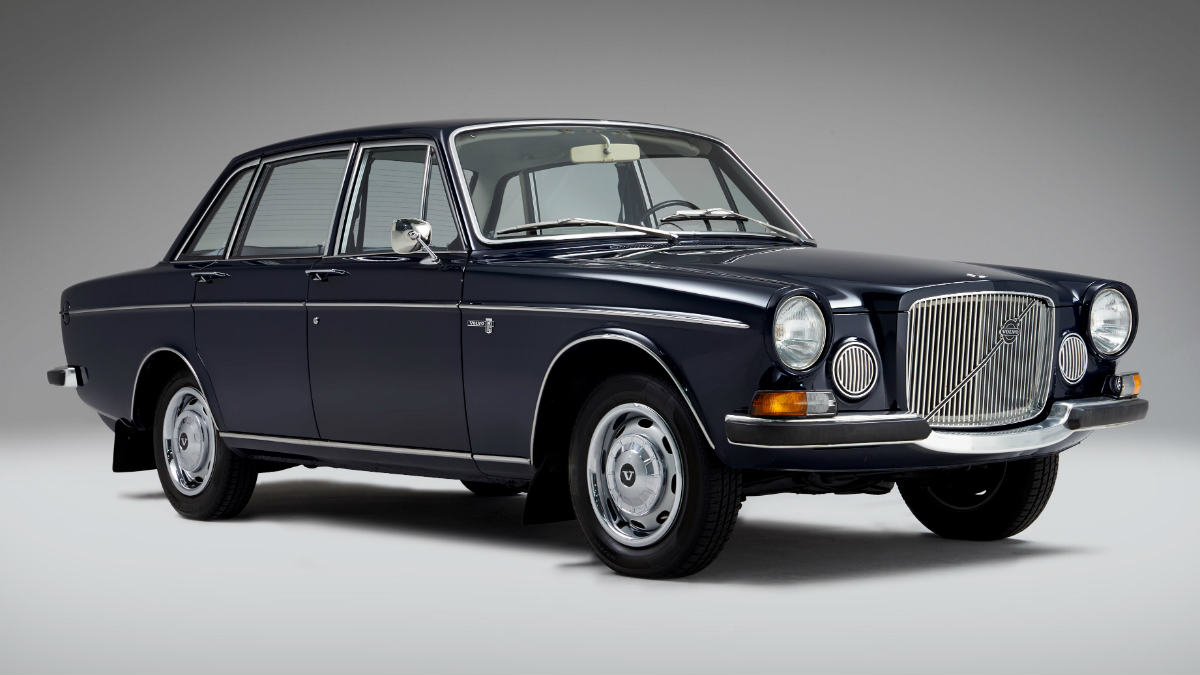
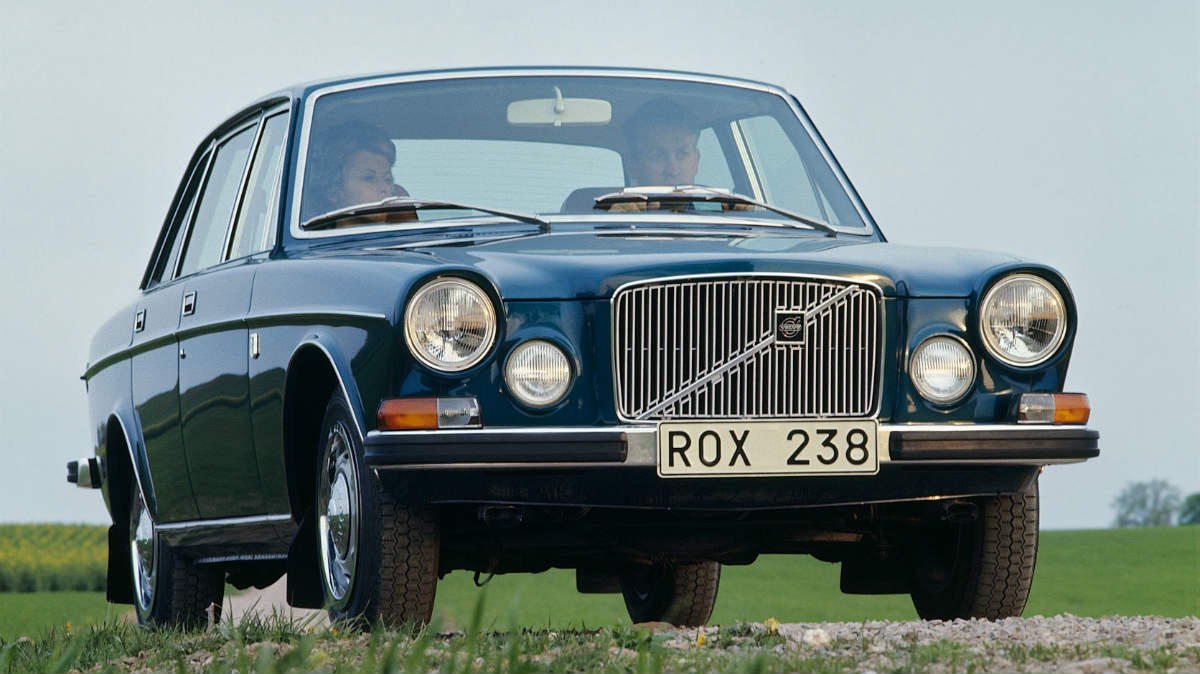
Chief Designer Jan Wilsgaard took charge of blending the utilitarian bones of the 140 with the stately presence required for an executive flagship. Wilsgaard kept the cabin architecture and floorpan of the 140 series intact, but he reached into Volvo’s styling vault, reviving the proud front end originally drawn for the 1950s Project 358. The centerpiece of this frontal rework was an upright, classical chrome radiator grille that set the car apart at first glance from any everyday family four-cylinder.
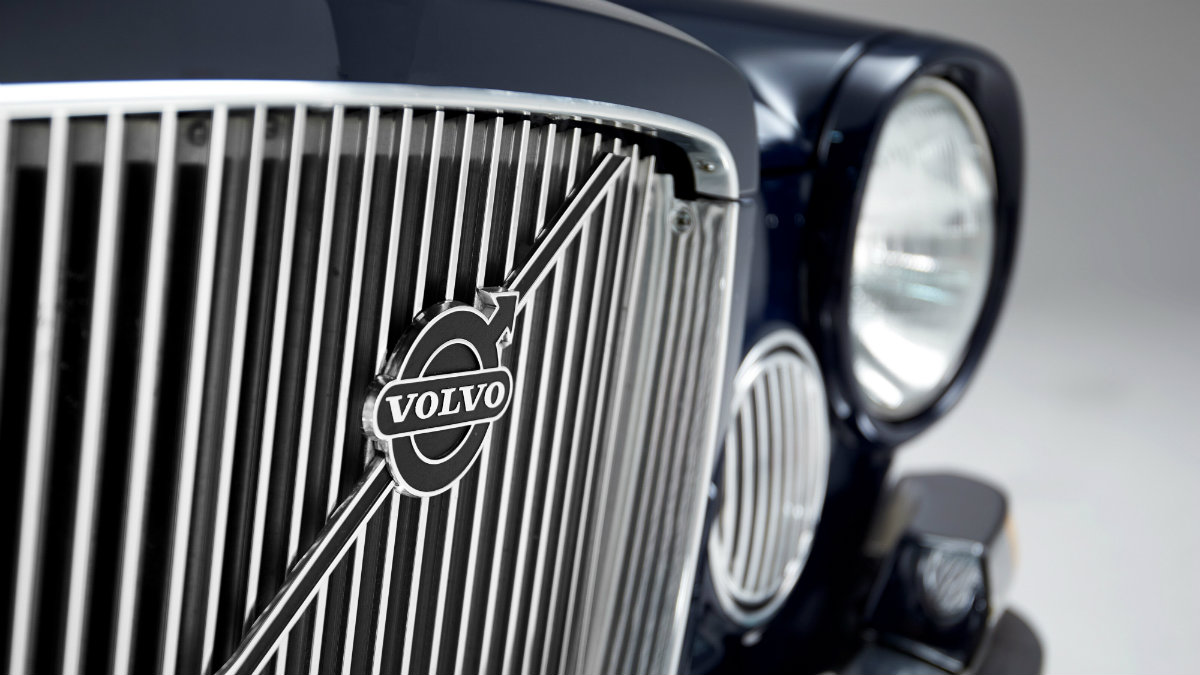
Across that imposing vertical grille, the historic Volvo iron mark took on a dominant position, mounted on a bold diagonal sash just as it had appeared on Volvo’s inaugural model back in 1927. It was an intentional visual nod to Gothenburg’s manufacturing heritage. To clear adequate room for two extra cylinders, Wilsgaard stretched the 140 chassis by 10 centimeters forward of the windscreen. That subtle front-end stretch gave the 164 a proud, longer hoodline, fundamentally shifting the proportions from sensible family transport to stately European saloon.

The Heart of the Saloon: The B30 Straight-Six and ZF Drivetrain
Under that extended bonnet sat the mechanical core that defined the car: the newly engineered B30 straight-six. Developed as an evolution of Volvo’s durable pushrod four-cylinder engine family, the 3.0-litre inline unit carried an iron block and pushrod valve actuation. Fed by twin Zenith-Stromberg carburettors, the B30 delivered a robust 145 hp, providing quiet low-end torque and unhurried cruising ability that transformed the character of the car on the motorway.
Drivetrain refinement received equal attention. The official August 1968 factory press release proudly noted that the German-sourced ZF gearbox operated via a direct “remote control” mechanism. Rather than a sloppy column-mounted wand or an awkward long-throw rod, the driver operated a relatively short, floor-mounted gear lever positioned on the transmission tunnel right next to the front seats. Power flowed cleanly through the driveline to the rear axle, giving the saloon steady, reassuring road manners.
Cabin Appointments: Scandinavian Comfort Built for the Executive
Inside the cabin, the appointments were considerably more lavish than anything offered in the standard 140 models. The early production sedans were trimmed with thick, high-grade woollen upholstery across the seats, supplemented by deep textile floor mats. The rear seating compartment was purposefully shaped for two passengers, complete with a wide fold-down center armrest that emphasized executive travel over basic mass transit.
Volvo wasted little time stepping up the luxury specification. Following its initial year of production, the 164 gained plush leather upholstery as standard equipment, along with factory headrests and integrated halogen auxiliary driving lamps set into the front fascia. For American buyers, the options roster matched traditional domestic luxury standards, offering power electric windows, an electric sunroof, integrated air conditioning, and full tinted safety glass.

Targeting North American Driveways: The Intelligent Alternative
When the American automotive journal Car and Driver subjected the Volvo 164 to a comprehensive road test in its July 1969 issue, the editors identified the specific clientele Volvo had in its crosshairs. The review pointed out that Gothenburg intended to lure customers away from established domestic luxury showrooms like Buick and Oldsmobile, as well as imported prestige brands like Mercedes-Benz. Car and Driver concluded that the saloon appealed directly to high-earning professionals—doctors, attorneys, and dentists who possessed the financial means to buy an upscale car but deliberately sought an intelligent, understated alternative to domestic Detroit excess.

Volvo leaned into this precise marketing narrative with an ad campaign that resonated across North American dealerships: “The Luxury Car That Shows You Have More Than Money.” The messaging spoke directly to buyers who valued Scandinavian safety engineering and durability over ostentatious tailfins and chromium excess.

Evolution, Fuel Injection, and the Shift to Kalmar
The 164 underwent continuous mechanical and structural refinement throughout its production life. The most notable technical upgrade arrived for the 1972 model year, when Volvo introduced Bosch electronic fuel injection to create the 164E. The electronic injection setup noticeably cleaned up throttle response, heightened high-speed cruising efficiency, and pushed horsepower further, giving the six-cylinder even greater touring legs.
The manufacturing story behind the car was equally pioneering. In 1974, production of the Volvo 164 shifted to Volvo’s newly opened assembly plant in Kalmar. For its era, Kalmar threw out the conventional assembly line rulebook. Instead of forcing workers to perform repetitive, clockwork tasks on a moving conveyor, Kalmar utilized automated, battery-powered trolleys guided by magnetic sensor loops embedded directly in the factory floor. Workers organized into self-managed production teams, rotating through various assembly tasks and taking turns supervising operations, establishing a groundbreaking industrial benchmark for automotive worker ergonomics and manufacturing flexibility.

The Final US Salvo and Forgotten Prototypes
The final chapter for the production 164 came in 1975. By that stage, Volvo had already introduced its next-generation executive flagship, the 264, into European production. Consequently, every single Volvo 164 assembled during the final 1975 model year was shipped across the Atlantic for export exclusively to the United States market, fulfilling remaining North American dealer demand before the 200 series took over the mantle entirely.
Beyond the standard showroom sedans, the 164 generated a fascinating collection of one-off prototypes, coachbuilt experiments, and heavy-duty adaptations throughout its production era:
- The Single Ambulance Prototype: Only one Volvo 164 was ever transformed into an emergency ambulance. Volvo’s special vehicles division engineered a bespoke prototype with a noticeably raised roofline and an extended wheelbase. While mass production was never pursued, this solitary prototype established the design and engineering blueprint for the series production ambulances later built on the Volvo 265 chassis.
- Pioneering Team Assembly at Kalmar: When final production shifted to Kalmar in 1974, the plant’s automated floor-trolley system and self-directed assembly groups offered proof that executive car manufacturing could break away from soul-destroying assembly line monotony without sacrificing build quality.
- The Coggiola 262C Coupe Precursor: The Italian-crafted styling prototype for the future Volvo 262C luxury coupe was constructed on the foundation of a 164. Italian coachbuilder Coggiola re-bodied the platform into a distinctive two-door coupe that carried the low roofline of the eventual production car, but kept the upright, dignified 164 front fascia and grille.
- Military and Marine Service for the B30: The durability of the pushrod B30 straight-six extended far beyond passenger sedans. Volvo adapted the engine for several severe-service all-terrain military vehicles. Simultaneously, Volvo Penta engineered a specialized marine derivative of the B30 equipped with triple carburettors for demanding watercraft duty.
- The Zagato 3000 GTZ Concept: Italian coachbuilding house Zagato highlighted its display stand at the 1970 Geneva Motor Show with the exotic 3000 GTZ sports coupe. Underneath the dramatic aluminum bodywork sat the complete mechanical underpinnings and B30 six-cylinder powerplant of the Volvo 164. The solitary prototype survived its show circuit rounds and remains in existence as a rare piece of coachbuilt Swedish-Italian history.
Looking back from the vantage of the car’s 50th anniversary in 2018, the 164 represents the exact moment Volvo discovered how to turn rugged Swedish engineering into genuine executive prestige. By marrying Jan Wilsgaard’s stately front grille with the smooth, torque-rich character of the B30 straight-six, Volvo established an executive lineage that laid the groundwork for decades of flagship saloons to follow.
Vehicle data
| Field | Value |
|---|---|
| Make | Volvo |
| Model | 164 |
| Generation / chassis code | 164 series (based on 140 platform) |
| Model year(s) covered | 1968–1975 |
| Body style | 4-door saloon / sedan |
| Powertrain / engine | 3.0-litre inline six-cylinder (B30, twin Zenith-Stromberg carburettors; Bosch electronic fuel injection from 1972) |
| Power / torque | 145 hp (carburetted B30); torque not stated in sources |
| Transmission | ZF manual gearbox (“remote control” floor shift); automatic not stated in sources |
| Drivetrain | Rear-wheel drive |
| Key performance figures | Not stated in sources |
| Price (as stated) | Not stated in sources |
| On-sale / announcement period | Announced August 1968; produced through 1975 |
| Market | Europe and North America (US export exclusive for final 1975 model year) |