
PoloStorico Restores Chassis 4846 for the 50th Anniversary
When Automobili Lamborghini decided to mark the 50th anniversary of the legendary Miura, it chose not merely to display museum showpieces or stage ceremonial rallies. Instead, Sant’Agata Bolognese set out to prove the technical capabilities of its in-house heritage department, Lamborghini PoloStorico. The centerpiece of this golden jubilee celebration is a painstaking, ground-up restoration of one of the most historically significant sports cars ever built: the original 1971 Geneva Motor Show preproduction Lamborghini Miura SV, carrying chassis number 4846.
Unveiled as a completed masterpiece at the Amelia Island Concours d’Elegance in Florida, chassis #4846 represents far more than an exquisite show queen. It is the definitive bridge between two distinct eras of mid-engine engineering at Lamborghini. Completed after more than a full year of intensive disassembly, historical research, and artisanal metalwork, this one-off vehicle provides an authentic window into how Ferruccio Lamborghini and Nuccio Bertone prepared the final, ultimate evolution of the supercar that redefined performance motoring in the 1960s.

The Missing Link: Chassis 4846 and the 1971 Geneva Salon
To understand why chassis #4846 commands such revered status among Sant’Agata collectors, one has to revisit the bustling floor of the 1971 Geneva Motor Show. That spring, public attention at the official Lamborghini stand was almost wholly consumed by the startling, razor-edged prototype of the LP500 Countach. Yet across the aisle on Carrozzeria Bertone’s stand sat another revelation: the very first public appearance of the Miura SV (Super Veloce).
Chassis #4846 was not an ordinary production Miura SV, because at that precise moment in early 1971, series assembly of the SV had not yet begun. Instead, this development chassis served as the tangible prototype and engineering mule that tested Nuccio Bertone’s restyled rear clamshell alongside chassis revisions devised by test driver Bob Wallace and chief engineer Paolo Stanzani. As a genuine transitional machine, the car preserved vital mechanical components and exterior trim elements from the earlier Miura S while incorporating the widened track, broader hips, and reworked suspension geometry destined for subsequent production SVs.
The visual distinction was immediate. The delicate cast-aluminum “eyebrows” surrounding the pop-up headlights—a defining styling flourish of the original P400 and P400 S—were deleted on the SV to give the nose a cleaner, more purposeful stance. Around back, the rear fenders bulged out by 130 millimeters to house wider Campagnolo wheels, demanding reshaped rear air intakes and revised taillight clusters. Chassis #4846 brought these styling ideas into physical reality for the first time, establishing the proportions that transformed Bertone’s elegant sports car into an aggressive high-speed grand tourer.

The Genesis of Lamborghini PoloStorico
Automobili Lamborghini officially inaugurated Lamborghini PoloStorico in the spring of 2015 at its historical home base in Sant’Agata Bolognese. For decades, private owners and specialist garages had preserved the marque’s vintage sports cars across Europe and North America, but the factory lacked a centralized, factory-backed operation dedicated solely to protecting its historical portfolio. PoloStorico was established to close that gap through four foundational pillars: comprehensive vehicle restorations, factory archive preservation, spare parts manufacturing, and official vehicle certification.
Archive management proved essential from day one. PoloStorico brought together decades of production ledger books, technical blueprints, electrical schematics, and period photographic evidence under a single curated archive. By referencing these primary technical sources, factory historians can confirm the exact build specification, chassis stamping, exterior paint code, and interior upholstery of virtually every vehicle that cleared the Sant’Agata factory gates. This documentation provides the baseline needed to issue an official certificate of authenticity, verifying whether a matching-numbers chassis retains its factory drivetrain and proper mechanical configuration.
Equally critical is the parts preservation program. PoloStorico currently covers approximately 70 percent of the classic Lamborghini car parc through authentic components sourced from original suppliers, vintage inventory, or newly remanufactured batches fabricated from factory tooling and original blueprints. For owners seeking a concours-grade rebuild, this parts catalog guarantees that body panels, gearbox cogs, suspension bushings, and engine castings adhere strictly to original factory metallurgical standards.
PoloStorico’s Maiden Project: An Uncompromising Disassembly
When the owner of chassis #4846 entrusted the car to PoloStorico for an exhaustive restoration, the department took on the assignment as its inaugural flagship project. Rather than treating the car as just another series-production Miura SV, Enrico Maffeo, Head of PoloStorico, instituted a strict preservation directive: every individual quirk, transitional bracket, and unique styling trait belonging to the 1971 Geneva display car had to be retained or reconstructed exactly as it debuted in Switzerland.
The restoration consumed more than a year of intensive shop floor work. PoloStorico technicians commenced by completely stripping the monocoque chassis, steel subframes, and aluminum front and rear clamshells down to bare metal. Over its decades of road use and collector ownership, several previous repairs had inevitably introduced later-pattern SV components and contemporary hardware. Technicians cross-referenced the original factory assembly sheets, period workshop work orders, and high-resolution show floor photographs taken in Geneva to isolate what belonged to #4846 and what had been retrofitted later.
Every curved aluminum panel was hand-beaten on traditional dollies to restore the precise curvature and panel gaps established by Bertone’s metalworkers in late 1970. No modern universal stampings were permitted to dilute the car’s transitional profile. The tubular steel chassis received thorough rust treatment and realignment on factory jigs, guaranteeing structural rigidity while retaining the original factory welding beads and chassis stampings.
Artisanal Paintwork, Leather, and Period Correctness
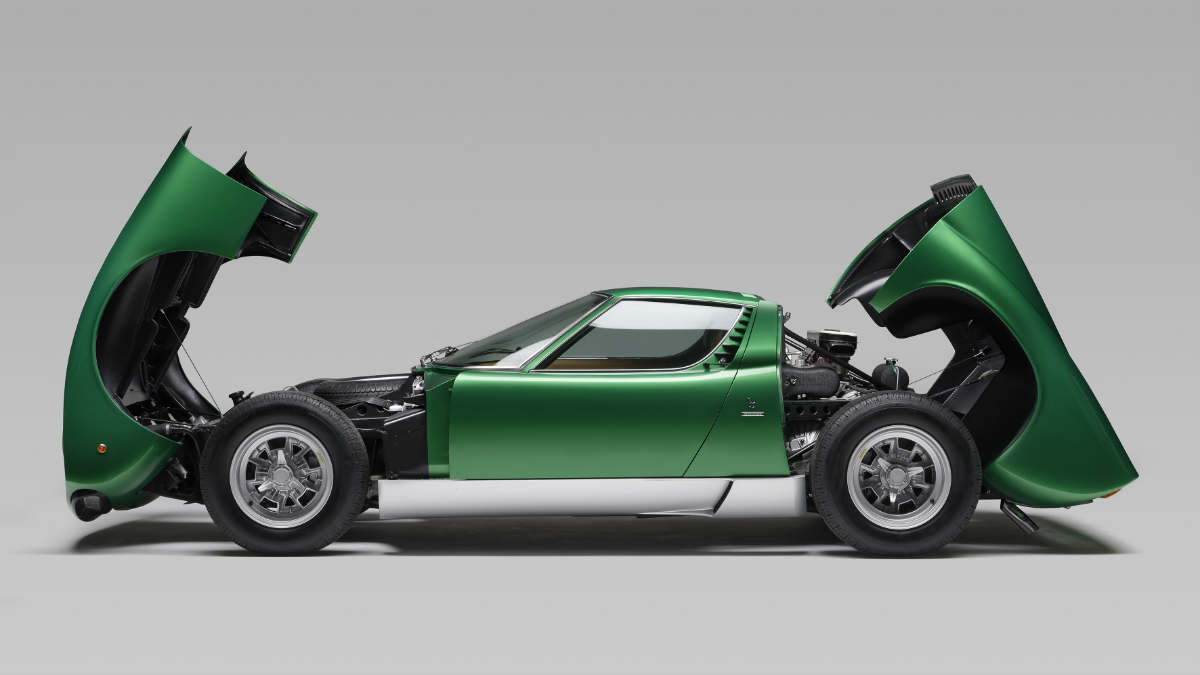
One of the most striking triumphs of the PoloStorico restoration is the accurate formulation of the exterior finish. When unveiled in 1971, chassis #4846 stunned the Geneva salon crowd with its deep, shimmering metallic green hue, cataloged by the factory as Verde Metallizata. Over the ensuing decades, coats of repainting had obscured the true tone and metallic flake distribution of Bertone’s original lacquer.
PoloStorico historians uncovered original pigment samples within the Sant’Agata archives to replicate the precise optical depth of the period paint. Specialist painters applied modern multi-stage primers and clear coats that honor the delicate emerald warmth of the 1971 formula without introducing anachronistic synthetic lusters. Paired with satin gold Campagnolo cast magnesium alloy wheels, the exterior presentation captures the exact stance of the car as photographed on Bertone’s carpeted turntable.
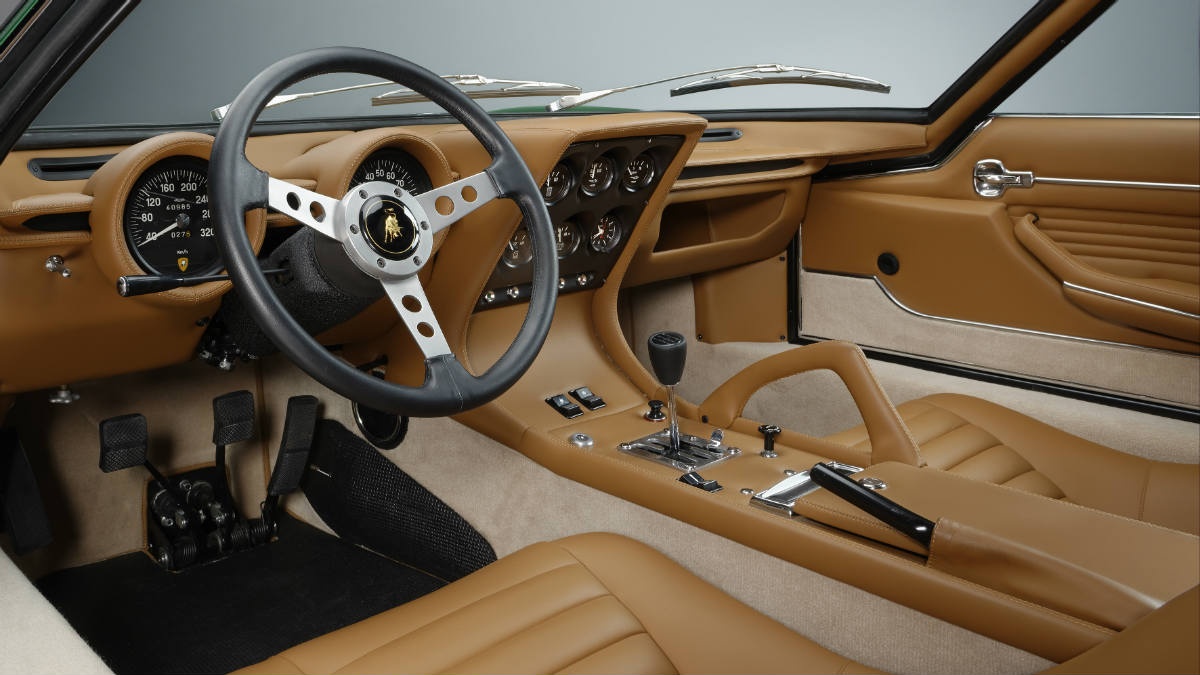
Inside the snug cockpit, PoloStorico craftsmen turned their focus to the patinated surfaces of the dashboard, seats, and central console. Upholstered in rich tan leather, the interior was rebuilt using period-correct grain and stitching geometry sourced to match the original supplier rolls. The low-slung bucket seats, open-gate five-speed gear selector, Veglia Borletti instrumentation, and drilled aluminum pedal box were all meticulously refurbished. The result avoids the sterile, over-restored feeling that often mars vintage sports cars, striking a balance between brand-new factory delivery and historic mechanical soul.
Mechanical Overhaul of the Transverse Quad-Cam V12
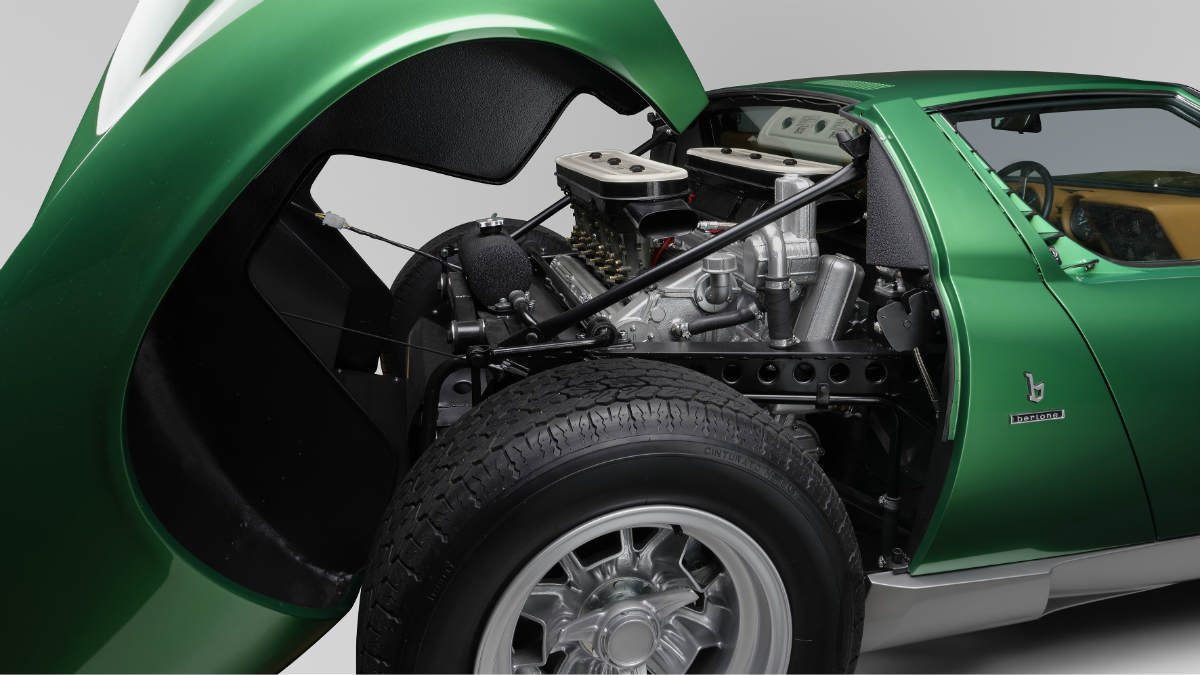
Behind the cockpit bulkhead sits the technical centerpiece of the Miura: the Giotto Bizzarrini-designed 3.9-liter sixty-degree V12 engine, mounted transversely in unit with the five-speed manual transmission and differential. While later production Miura SVs introduced a split-sump lubrication system that separated the engine oil from the gearbox lubricant to improve reliability under severe track cornering, chassis #4846, as an early development prototype, retained the shared-sump layout characteristic of the Miura S.
PoloStorico engine builders executed a complete teardown of the aluminum alloy twelve-cylinder powerplant. The block was thoroughly cleaned, non-destructive crack testing was conducted across all structural webs, and the crankshaft was dynamically balanced. Cylinders were honed to precise factory tolerances, and new pistons, rings, and valves were fitted alongside newly fabricated valve guides. The four triple-choke Weber 40 IDL3C downdraft carburetors were stripped, ultrasonically cleaned, and rebuilt with calibrated jets to deliver crisp throttle response and the distinctive, intake-heavy induction bark that defines the high-revving quad-cam V12.
In SV specification, altered camshaft timing and larger carburetor jets raised power output to 385 brake horsepower at 7,850 rpm, backed by 295 pound-feet of torque at 5,750 rpm. Power flows to the rear wheels through a dry multi-plate clutch and the synchronized five-speed transaxle. On the road, this mid-mounted powerhouse propelled the Miura SV to sixty miles per hour in under 6.5 seconds, on toward a top speed exceeding 175 miles per hour—numbers that placed it at the uncontested summit of production car performance in 1971.

Chassis Refinements and Road Dynamics
Underneath the svelte aluminum bodywork, the transition from the Miura S to the SV brought vital structural and geometry revisions spearheaded by factory test driver Bob Wallace. The early P400 had earned a reputation for aerodynamic lift at high speeds, caused by frontal airflow getting trapped beneath the nose and an accelerating slipstream pulling the lightened front axle upward. Wallace and the engineering team addressed this through revised suspension pickup points and altered spring rates.
Chassis #4846 showcases the reworked independent double-wishbone suspension design, incorporating coil springs, telescopic shock absorbers, and anti-roll bars front and rear. The rear track was widened by 130 millimeters compared to the standard Miura, dramatically improving lateral stability during high-speed cornering and mitigating sudden snap-oversteer transitions under trailing throttle. Braking is handled by Girling ventilated disc brakes at all four corners, housed snugly inside the 15-inch magnesium alloy Campagnolo wheels shod with high-performance period-correct Pirelli rubber.
During the restoration, PoloStorico rebuilt every wishbone, hub carrier, and shock absorber to factory blueprint tolerances. Rather than substituting modern polyurethane suspension components, authentic rubber bushings were molded to preserve the supple, compliant ride quality originally dialed in by Wallace on the rough secondary roads surrounding Bologna and Modena.

Concours Triumph and the Miura Legacy
The global unveiling of the completed restoration of chassis #4846 at the Amelia Island Concours d’Elegance provided an unforgettable sight on the fairways of the Golf Club of Amelia Island. Standing before international collectors, historians, and automotive enthusiasts, the restored Verde Metallizata prototype served as the opening salvo of Lamborghini’s worldwide fiftieth anniversary celebrations for the Miura nameplate.
“This is a very important car, not only for its place in history as the Geneva show car and the forerunner of future Miura SV models built, but as the first completed project of Lamborghini PoloStorico,” noted Enrico Maffeo during the Florida presentation. “We are delighted to be able, with the consent of the owner, to show this car for the first time in its perfectly restored state, at the important Amelia Island event. This is the year in which the Lamborghini Miura celebrates its fiftieth anniversary. This car not only illustrates the iconic appeal of the Miura, widely acknowledged as the forerunner of modern super sports models, but is also a perfect example of the expertise available in Lamborghini PoloStorico in providing the most authentic Lamborghini restorations.”
Fifty years after Marcello Gandini’s intoxicating silhouette shocked the motoring world at the 1966 Geneva salon, the Miura remains the quintessential mid-engine layout benchmark that gave birth to the modern supercar genre. By delivering an unyielding, period-correct restoration of chassis #4846, Lamborghini PoloStorico proved that the factory itself holds the ultimate authority, capability, and passion for keeping Sant’Agata’s mechanical icons roaring exactly as they did in period.
Vehicle data
| Field | Value |
|---|---|
| Make | Lamborghini |
| Model | Miura SV (Super Veloce) Geneva Show Car / Prototype |
| Generation / chassis code | P400 SV (Chassis #4846) |
| Model year(s) covered | 1971 |
| Body style | Two-door mid-engine coupe (Carrozzeria Bertone) |
| Powertrain / engine | 3.9-liter (3,929 cc) naturally aspirated 60-degree V12, quad camshaft, 4 triple-choke Weber 40 IDL3C downdraft carburetors |
| Power / torque | 385 bhp @ 7,850 rpm / 295 lb-ft (400 Nm) @ 5,750 rpm |
| Transmission | 5-speed manual |
| Drivetrain | Transverse mid-engine, rear-wheel drive |
| Key performance figures | 0–60 mph in under 6.5 seconds; top speed ~175 mph (280 km/h) |
| Price (as stated) | Not stated in sources |
| On-sale / announcement period | March 1971 (Geneva Motor Show debut) / March 2016 restoration unveil |
| Market | Global / International |