

A New Chapter for Lamborghini Squadra Corse
Lamborghini Squadra Corse, the dedicated motorsport arm of Automobili Lamborghini, unveiled the Huracán Super Trofeo EVO at an exclusive launch event in Sant’Agata Bolognese, inaugurating an expansive commercial and technical partnership with Swiss luxury watchmaker Roger Dubuis. Arriving three years after the initial world debut of the rear-wheel-drive Huracán LP 620-2 Super Trofeo in Monterey, this evolved racer introduces sweeping improvements across its aerodynamic architecture, mechanical assemblies, electronic controls, and onboard safety systems. The objective behind this thorough overhaul is straightforward: giving customer teams and gentlemen drivers a sharper, more balanced, and safer track machine that matches the lap pace and visceral drama of a dedicated GT3 car while preserving the realistic running costs demanded by one-make racing.
Scheduled to make its competitive track debut across the three continental branches of the Lamborghini Super Trofeo series—Europe, Asia, and North America—starting in the spring of 2018, the EVO is engineered for more than single-marque sprint bouts. With broad international homologation provisions, customer teams can enter the car into global endurance fixtures and Gran Turismo championships under GT Cup regulations. To celebrate the alliance with Roger Dubuis, Lamborghini Centro Stile created a bespoke launch livery finished in a matte Titan Grey base with vibrant yellow accents. The visual identity highlights the car’s aggressive aerodynamic surfaces while reflecting shared engineering values: relentless material innovation, mechanical precision, and uncompromising craftsmanship.
“Lamborghini Squadra Corse is continuing its plan to grow and consolidate its position as a trendsetter on the competition scene. We are proud to work with a prestigious brand such as Roger Dubuis; one which shares our values of ongoing innovation and product uniqueness, while always respecting our heritage.”
Stefano Domenicali, Chairman and Chief Executive Officer of Automobili Lamborghini

The Success of the Single-Marque Series
The original iteration of the Lamborghini Huracán Super Trofeo rewrote expectations for customer racing when it debuted at California’s Monterey Car Week in August 2014. Replacing the Gallardo-based platform, the Huracán LP 620-2 brought contemporary chassis rigidity, advanced electronic systems, and purposeful proportions to the grid. Over the subsequent three seasons, the platform proved commercially and competitively successful, with more than 150 race cars constructed and sold to private teams worldwide. Across the four continental series encompassing Europe, Asia, North America, and the Middle East, the grids averaged around 90 active competitors annually, cementing the Huracán as a benchmark in modern one-make sports car racing.
Customer racing programs thrive on a delicate balance: providing sheer mechanical grip, authentic racecraft feedback, and high top speeds without incurring exorbitant overhaul expenses. Giorgio Sanna, Head of Motorsport at Automobili Lamborghini, emphasized that feedback from privateers, driver development academies, and gentleman drivers shaped the EVO program from the outset. Because the Super Trofeo is a proprietary single-make championship, Squadra Corse faced no regulatory obligation or Balance of Performance handicap requiring a mid-lifecycle redesign. Instead, the team pursued a comprehensive evolution purely to deliver superior dynamic stability, safer operational margins, and greater track speed for their client base.
Aerodynamic Evolution: Dallara Partnership and Carbon Fiber Craft
To execute the dramatic restyling and aerodynamic refinement of the Super Trofeo EVO, Lamborghini Squadra Corse joined forces with Dallara Engineering and Lamborghini Centro Stile. Dallara’s motorsport expertise, honed across international prototype racing and open-wheel formulas, allowed the engineering team to optimize surface airflow using extensive computational fluid dynamics and scale wind tunnel testing. The primary design objective was demanding: preserve the high absolute downforce generated by the previous model while significantly reducing aerodynamic drag and shifting the aero balance forward to cure high-speed understeer.
“Sophisticated aerodynamics and ultralight materials: the Huracán Super Trofeo EVO has been developed based on the two main pillars of the brand’s technology. Like the road version of the Huracán Performante, where the use of composites and the drive to achieve maximum aerodynamic efficiency are the basis of levels of uncompromised performance, the Huracán Super Trofeo EVO also focuses on these elements, continuing as a category benchmark.”
Maurizio Reggiani, Chief Technology Officer of Automobili Lamborghini
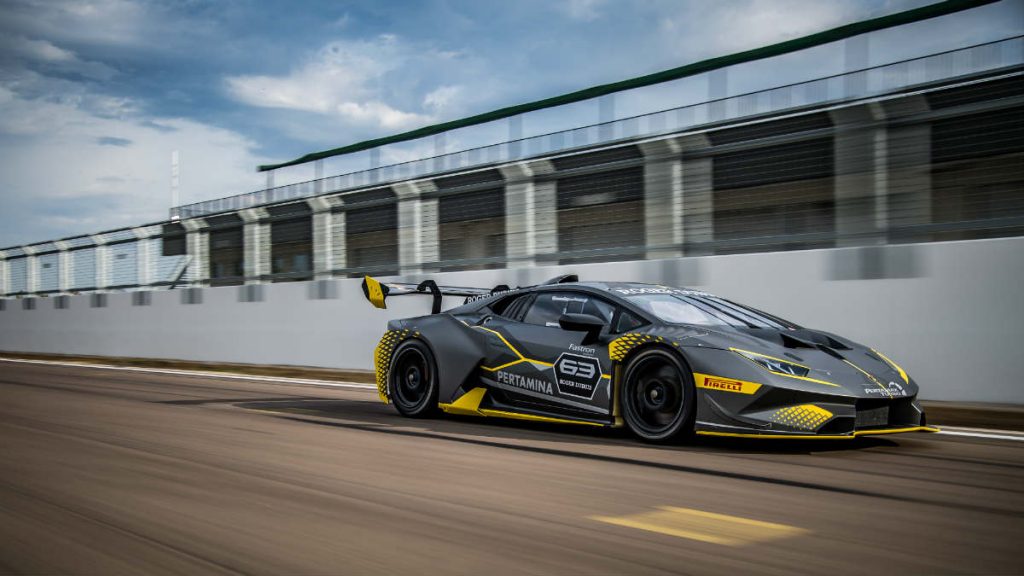
Almost every carbon fiber exterior panel on the Huracán Super Trofeo EVO is completely new. To protect customer teams from prohibitive retrofit expenses, Squadra Corse deliberately retained three key structural underbody elements: the flat floor, the front splitter, and the rear diffuser. Keeping these three components unchanged means existing LP 620-2 Super Trofeo owners can purchase a standalone EVO aerodynamic upgrade kit rather than buying an entirely new car, modernizing their equipment to current factory specifications with minimal capital outlay.
The aerodynamic results speak directly to track performance. The new body kit generates an 8 percent reduction in overall aerodynamic drag compared to the outgoing specification. During initial validation testing conducted by Lamborghini factory development drivers at the Autodromo Nazionale Monza, the Huracán Super Trofeo EVO stopped the clocks at 1:46.3, besting the previous model’s reference lap of 1:47.8 by a full 1.5 seconds. For a customer racing car competing on identical slick tire compounds without an increase in base engine horsepower, cutting 1.5 seconds at a high-speed circuit like Monza demonstrates exceptional aerodynamic efficiency.

LMP1-Style Shark Fin and Roof Airscoop Dynamics
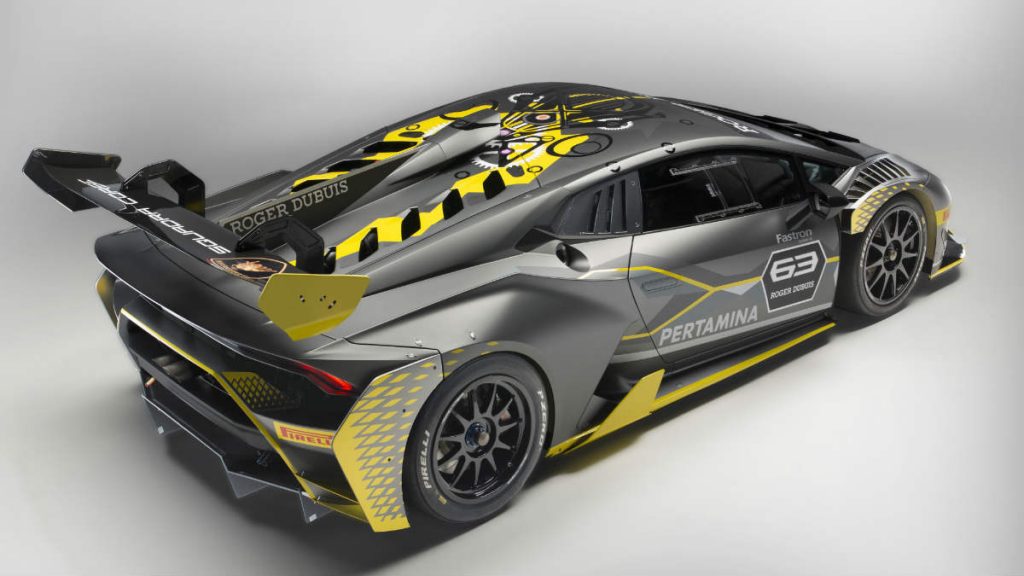
The most visually striking innovations on the EVO sit along its centerline: a prominent longitudinal rear shark fin mounted to the engine decklid and an integrated roof airscoop. The vertical dorsal fin draws directly from aerodynamic solutions perfected on Le Mans LMP1 endurance prototypes and modern Formula One machinery. This marks the first time Lamborghini Squadra Corse has incorporated a dorsal fin onto a Gran Turismo competition car. In high-speed sweepers and transient direction changes, the fin acts as an aerodynamic rudder, generating restoring yaw moments that steady the rear axle, mitigate snap oversteer, and allow drivers to carry substantially higher apex speeds with confidence.
Immediately ahead of the shark fin, the sculpted roof airscoop delivers a dual performance advantage to the mid-mounted V10. First, it creates dynamic ram-air supercharging at racing velocity, funneling high-pressure air directly into the intake plenums to produce 3 percent more engine torque at the car’s electronically limited top speed of 280 km/h (174 mph). Second, relocating the intake induction tract from the body flanks to the roof drop-feeds cooler, undisturbed ambient air across all operating rpm, enhancing volumetric efficiency and sustained torque output compared to the original side-vent arrangement.
Eliminating the original lateral quarter-panel cooling intakes freed Centro Stile and Dallara to reshape the rear half of the chassis entirely. The upper rear fenders are flatter, sharper, and feature twin deep longitudinal aero channels that accelerate airflow directly toward the tail. Lower down, larger rocker cover fins channel clean air into the side-mounted radiators, maintaining stable operating fluid temperatures even during grueling summer endurance rounds.
Front End Restyling and Cockpit Cooling
At the front, the Huracán Super Trofeo EVO features a completely reprofiled front bumper assembly. Larger lower radiator intake openings are flanked by pronounced aerodynamic dive planes (flics) with increased surface area, creating added front downforce that shifts the car’s total aerodynamic balance 3 percent forward. This subtle shift provides positive front-end bite on corner turn-in, quelling understeer and allowing drivers to place the nose with pinpoint precision through medium-speed technical sections.
The front fenders adopt a lower, sharper contour punctuated by negative-slat louvres above the wheel arches, releasing high-pressure air trapped within the wheel tubs and cutting forward drag. At the center of the front luggage lid sits a prominent hexagonal duct. Unlike the engine airscoop above the cabin, this front intake feeds fresh, high-velocity airflow into the cockpit, driving down cabin temperatures during long race stints to alleviate physical fatigue for the driver.

Rear Downforce, Wing Architecture, and Exhaust Engineering
The rear styling of the Super Trofeo EVO balances aerodynamic drag reduction with adjustable downforce. The rear fenders extend rearward with flat, elongated trailing edges, ensuring a clean and uniform aerodynamic detachment whether the car is cornering under heavy lateral load or tracking flat-out down a straightaway. Beneath the massive carbon fiber rear wing sits a revised ducktail spoiler with a flatter, expanded surface area that collects clean airflow spilling off the rear glass, recovering localized static pressure while trimming turbulent drag.
The adjustable multi-element rear wing mounts to reinforced aluminum support uprights that feature increased structural dimensions without any weight penalty. Redesigned endplates direct airflow cleanly around the wing tips, minimizing induced drag vortices. Underneath the rear bumper, enlarged engine bay ventilation outlets evacuate hot air from the exhaust manifolds, while revised wheel-arch trailing flics smooth the wake generated by the rotating rear slick tires.
Mechanically, the exhaust layout received a focused reconfiguration built to Squadra Corse specifications. The catalytic converters are repositioned directly between the exhaust manifolds and tailpipe terminals. This layout lowers ambient temperatures in the crowded engine bay and eases routine maintenance for trackside mechanics working between practice sessions.
Powertrain, Transmission, and Electronic Control Systems
Powering the Huracán Super Trofeo EVO is an evolved iteration of Lamborghini’s naturally aspirated 5.2-liter dry-sump 90-degree V10, derived from the road-going Huracán coupe. Tuned to competition parameters, the engine delivers 620 horsepower at 8,250 rpm to the rear wheels via an X-Trac six-speed transverse sequential gearbox with pneumatic paddle shift actuation. Traction is managed through a lightweight three-disc racing clutch and a dedicated mechanical limited-slip differential.
Chassis dynamics and driver assists receive motorsport-grade hardware. The electronic architecture pairs a Bosch Motorsport M4 ABS unit with a MoTeC traction control system, each offering ten distinct selectable maps adjustable via dedicated rotary switches mounted directly on the multifunction steering wheel. This granular adjustability enables drivers to dial in braking stability and power delivery to match changing tire degradation and wet or dry circuit conditions. The hydraulic power steering pump has also been re-valved to offer greater servo assistance and sharper road-surface feedback through the helm.
Safety Enhancements and Customer Upgrades
Safety improvements represent another core focus of the EVO program. In addition to the enhanced lateral grip and yaw stability provided by the new aerodynamic package, the Super Trofeo EVO incorporates an FIA-specification roof escape hatch. Already introduced on the Huracán GT3 to satisfy global sports car regulations, the emergency roof hatch provides rescue crews with immediate vertical extrication access in the event of an incident. Inside, an FIA-homologated roll cage, six-point racing harness, and competition fuel cell complete the safety suite.
Pricing for the complete, race-ready Lamborghini Huracán Super Trofeo EVO is set at €235,000 in Europe (excluding VAT) and $295,000 in North America. For existing customer squads fielding the current Huracán LP 620-2 Super Trofeo, Lamborghini Squadra Corse offers the complete carbon fiber aerodynamic body kit as a dedicated conversion package, allowing teams to upgrade their machinery seamlessly ahead of the 2018 championship campaign.
Vehicle data
| Field | Value |
|---|---|
| Make | Lamborghini |
| Model | Huracán Super Trofeo EVO |
| Generation / chassis code | Huracán (LP 620-2 EVO) |
| Model year(s) covered | 2018 |
| Body style | Coupé race car |
| Coupétrain / engine | 5.2-liter naturally aspirated 90-degree V10 |
| Power / torque | 620 hp @ 8,250 rpm / Not stated in sources (plus 3% dynamic torque via roof scoop) |
| Transmission | X-Trac 6-speed sequential gearbox with paddle shift |
| Drivetrain | Rear-wheel drive (RWD) |
| Key performance figures | Top speed 280 km/h (174 mph, electronically limited); Monza lap time 1:46.3 (-1.5s vs previous model) |
| Price (as stated) | €235,000 (Europe, excl. taxes) / $295,000 (North America) |
| On-sale / announcement period | Announced September 2017, race debut Spring 2018 |
| Market | Global (Europe, Asia, North America, Middle East customer racing) |