

A Vision for the Electric Super Sports Car
Automobili Lamborghini and the Massachusetts Institute of Technology have joined forces to sketch out an uncompromising blueprint for the future of the electric super sports car. Unveiled at the EmTech conference in Cambridge, Massachusetts, the Lamborghini Terzo Millennio concept explores what happens when radical design thinking collides with cutting-edge material physics and energy storage research. Rather than simply dropping a heavy battery pack into an existing supercar architecture, Lamborghini has approached the project as a systemic reimagining of the breed, framed around five distinct pillars: energy storage systems, innovative materials, propulsion systems, visionary design, and pure emotion.
The academic partnership links Lamborghini’s Centro Stile and research engineers directly with two key laboratories at MIT: the Dinca Research Lab in the Department of Chemistry, steered by Professor Mircea Dinca, and the Mechanosynthesis Group in the Department of Mechanical Engineering, led by Professor Anastasios John Hart. Financially backed by Lamborghini, the multi-year collaboration is tasked with developing fundamental breakthroughs in energy storage chemistry and structural composites that could eventually redefine high-performance motoring for the third millennium.
Rethinking Energy: The Promise of Nanotechnology Supercapacitors
The core motivation behind the Terzo Millennio is a refusal to accept the compromises inherent in modern lithium-ion batteries. For high-performance sports cars, conventional chemical batteries carry severe handicaps: punishing curb weight, sluggish recharge rates, and a tendency to overheat when subjected to repeated cycles of brutal acceleration and heavy braking. When pushed hard on a racetrack, chemical battery cells suffer rapid thermal throttling, dragging down output just when the driver demands absolute peak performance.
Lamborghini’s proposed solution centers on high-rate supercapacitor technology. The company is no stranger to the concept; five years ago, Sant’Agata Bolognese began fitting low-voltage supercapacitors into the V12 Aventador to manage stop-start operations and power auxiliary systems. The leap envisioned for the Terzo Millennio, however, operates on an entirely different scale. The goal is a high-voltage, high-capacity electrical storage system capable of symmetrical charging and discharging—absorbing massive kinetic energy during deceleration and releasing ferocious bursts of electric power on corner exit without thermal fade.
Closing the energy density gap between traditional batteries and supercapacitors is the direct mission handed to Professor Mircea Dinca’s chemistry laboratory. Supercapacitors naturally excel at power density, meaning they can dump and ingest power almost instantaneously. Their historical weakness has always been volumetric energy density—storing enough total energy to provide respectable driving range. By investigating nanostructured materials and novel electrolyte chemistries, the Dinca Research Lab aims to retain the virtually unlimited cycle life and rapid electrical transfer of supercapacitors while multiplying their total storage capacity.

Energy-Accumulating Carbon Fiber and Self-Healing Bodywork
Reinventing energy storage demands an equally radical evolution in structural materials. Lamborghini has built extensive composite manufacturing expertise through its Advanced Composite Structures Laboratory, pioneering developments like Forged Composites in cars like the Sesto Elemento and Huracán Performante. With the Terzo Millennio, composites take on an active electro-chemical role rather than remaining merely passive load-bearing panels.
In partnership with Professor Anastasios John Hart’s Mechanosynthesis Group at MIT, the research team is investigating ways to turn the car’s carbon fiber outer skin and chassis tub into rechargeable structural batteries. By sandwiching microscopic energy-storing materials—such as carbon nanotube electrodes and solid-state electrolytes—between carbon composite plies, the bodyshell itself acts as a massive accumulator. If the vehicle’s body panels can store electric charge, the need for a bulky, centralized battery compartment disappears, yielding tremendous weight savings and packaging freedom.

Relying on structural carbon fiber for both rigidity and electrical storage introduces unique structural durability concerns. To counter the threat of micro-cracks spreading undetected through the composite matrix, the Terzo Millennio integrates self-healing technology. The carbon structure is embedded with sensory networks that continuously monitor the health of the chassis in real time, detecting micro-fractures caused by road impacts, curb strikes, or excessive fatigue.
When internal structural damage is sensed, heat is applied to tiny vascular micro-channels routed throughout the composite layers, releasing proprietary chemical healing agents. These resins flow into the fracture, cross-linking and sealing the fissures before they can propagate into catastrophic structural failures. This self-repairing mechanism allows engineers to push composite components to extreme mechanical limits, stripping out unnecessary safety buffers and paring overall vehicle mass to the absolute minimum.

Propulsion: Four In-Wheel Motors and Active Torque Vectoring
All-wheel drive has formed an integral part of Lamborghini’s dynamic identity ever since the Diablo VT was introduced in 1993. The Terzo Millennio upholds this commitment while stripping away heavy mechanical transmission tunnels, propshafts, differentials, and half-shafts. Propulsion is handled entirely by four high-torque electric motors, each integrated directly inside the wheel assemblies.
Placing an electric motor at each hub unlocks instant, independent control over all four corners of the vehicle. Torque vectoring can be executed down to the millisecond, applying positive torque to outer wheels and aggressive regenerative drag to inner wheels during high-speed cornering. By shifting energy purely by wire, the system eliminates mechanical drivetrain lash and delivers razor-sharp yaw response under lateral loads.

Centro Stile Architecture and Aerodynamic Expression
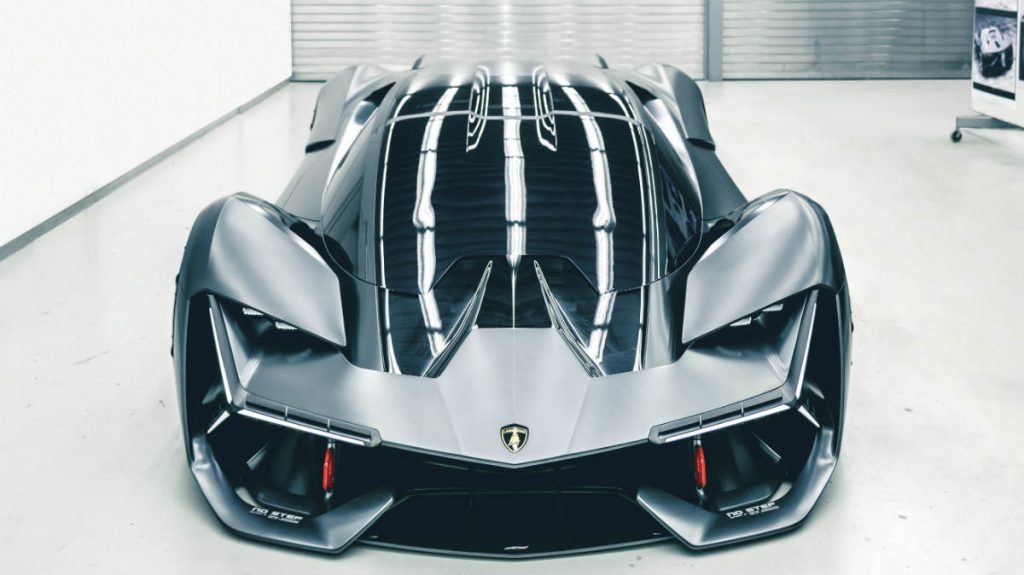
Eliminating a bulky mid-mounted internal combustion engine and mechanical driveline gave the stylists at Lamborghini Centro Stile unprecedented freedom. Under the direction of design chief Mitja Borkert, the Terzo Millennio explores an extreme silhouette shaped primarily by aerodynamic efficiency and aggressive angular surfaces. Rather than fighting airflow around large mechanical components, the body channels air straight through the car’s core architecture.
The front fascia introduces an exaggerated evolution of Lamborghini’s hallmark Y-shaped lighting signature, which stretches across the front fenders and flanks. Deep airflow tunnels pass completely through the nose, underneath the cockpit, and emerge out through a massive rear diffuser assembly, generating immense downforce without requiring cumbersome fixed wings. The central monocoque tub, molded in Forged Composite, houses only the two deeply recessed race-inspired bucket seats and primary structural connections, keeping the overall center of gravity extraordinarily low.

Emotion and the Virtual Track Coach
Lamborghini executives have long stressed that sheer numbers on a spec sheet mean little if the driver is disconnected from the machine. In an electrified landscape where silent linear acceleration can quickly feel sterile, the Terzo Millennio prioritizes visceral immersion. Sound design, aerodynamic feedback, and dynamic body control systems work together to deliver real sensory feedback rather than artificial synthetic engine noises piped through interior speakers.
The concept also introduces the visionary “Piloted Driving” track simulation program. Conceived for circuits like Imola or the Nürburgring, the virtual cockpit allows an autonomous digital expert to demonstrate the ideal racing line, braking markers, and apex speeds at full pace. Once the demonstration is complete, the human driver takes manual control of the helm to chase a projected holographic ghost car, perfecting their lap times and cornering technique in real time. It is an approach that treats automated driving not as an excuse to disengage, but as an interactive coaching tool to elevate human driving skill.
Vehicle data
| Field | Value |
|---|---|
| Make | Lamborghini |
| Model | Terzo Millennio |
| Generation / chassis code | Concept study |
| Model year(s) covered | 2017–2018 |
| Body style | 2-door hypercar coupe concept |
| Powertrain / engine | All-electric with 4 integrated in-wheel electric motors and supercapacitor energy storage |
| Power / torque | Not stated in sources |
| Transmission | Direct drive via in-wheel motors |
| Drivetrain | All-wheel drive (torque-by-wire) |
| Key performance figures | Not stated in sources |
| Price (as stated) | Not stated in sources (concept vehicle) |
| On-sale / announcement period | Announced November 2017 (MIT EmTech conference) |
| Market | Global design and technology concept study |