
A highly sought-after young classic: the Mercedes-Benz 500 E
Anyone in the know will already be slavering at this model designation: launched in 1990, the Mercedes-Benz 500 E with its naturally aspirated V8 engine and subtly muscular body is the top-of-the-range model in the 124 model series—and has long been one of the brand’s most desirable modern classic saloons. Conceived during an era when German engineering ambition knew few financial restraints, the car occupies a rare intersection of boardroom discretion and genuine sports car pace.
The 500 E came into being because Mercedes-Benz wanted to plant its formidable M119 five-litre V8 into the mid-size W 124 saloon body, effectively creating an autobahn express capable of hunting down dedicated grand tourers while carrying four adults in absolute serenity. What seemed like a straightforward engineering exercise on paper quickly presented profound packaging challenges, ultimately forging one of the most celebrated industrial collaborations in German automotive history between Untertürkheim and Porsche’s skunkworks at Zuffenhausen.

A Wolf in Sheep’s Clothing: Understated Exterior and Muscular Stance
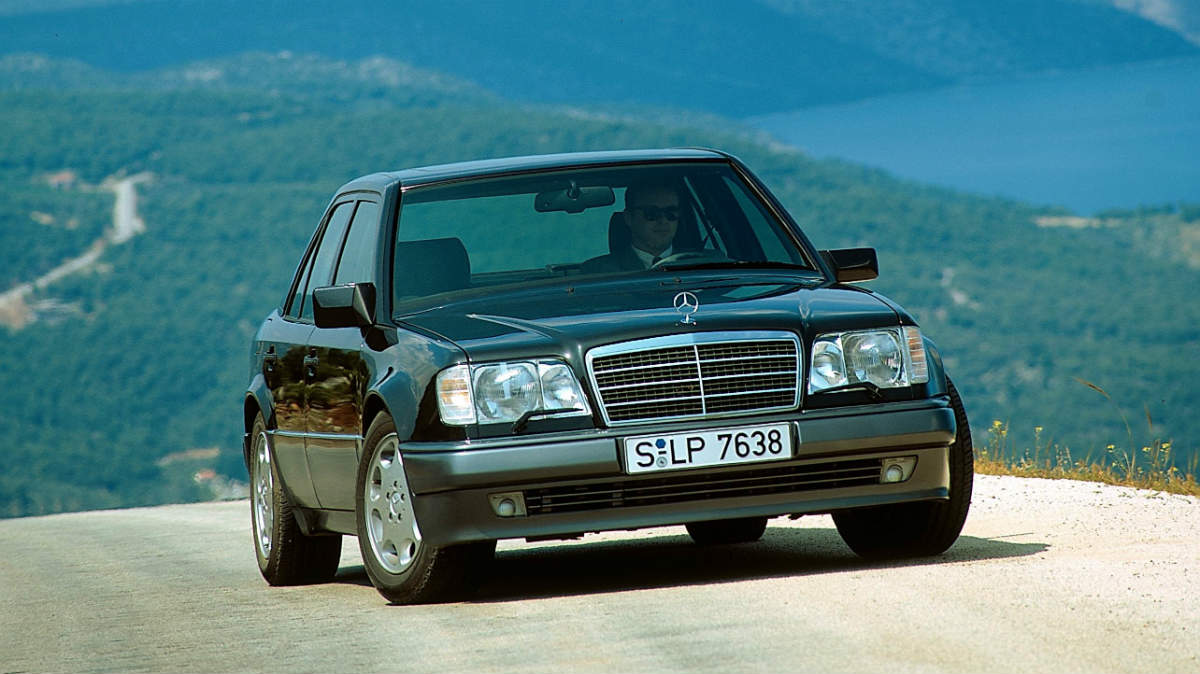
A modest appearance, at first glance—this is one side of the Mercedes-Benz 500 E. Only the somewhat more voluminous wheel arches, the slightly lower body and a modified front apron with inset fog lamps differentiate it from the standard six-cylinder models in the 124 series. To the untrained eye passing on the autobahn, it could easily be mistaken for a standard 200 E or 300 E taxi or rep-mobile. Yet those gently blistered wings were not an aesthetic indulgence; they were dictated entirely by necessity, carved out to accommodate the wider track, beefier suspension components, and substantial rolling stock required to keep 326 horsepower tethered to the tarmac.
The stance sits 23 millimetres lower than a standard W 124, giving the car a planted, purposeful poise without compromising the dignity expected of a three-pointed star. The side protective cladding, integrated rocker skirts, and bespoke front spoiler with integrated driving lights lent just enough athletic intent to signal to connoisseurs that something unusual lurked within. Inside, the cabin retained the dignified, block-hewn ergonomic perfection that defined Bruno Sacco’s golden era of Mercedes design. High-bolstered Recaro sport seats, finished in leather or subtle ribbed fabric, cradled the front occupants, while the rear bench was divided by an integrated wood storage console into two individual bucket seats, firmly establishing the 500 E as an exclusive four-seater touring machine.
Genesis of an Autobahn Express: The M119 V8 Engine
The combination of all these ingredients and characteristics creates the allure that the Mercedes-Benz 500 E has exuded since the moment of its first appearance at the Paris Motor Show in October 1990. The heart of the machine is the legendary M119 5.0-litre four-cam, 32-valve V8, borrowed from the flagship 500 SL roadster (R 129). Yet shoehorning this burly eight-cylinder powerplant into the engine bay of a saloon originally configured around inline-fours and inline-sixes required substantial re-engineering.
The engine and four-speed automatic transmission were taken from the 500 SL, but the 500 E did incorporate several crucial new engineering features. It was the first car to feature what was known as the “standard deck” engine—utilising one and the same crankcase casting height for both the 4.2-litre and 5.0-litre units. Because of this rationalised block architecture, the 5.0-litre engine stood 16.5 millimetres lower in the engine compartment than when it made its initial debut in the 500 SL roadster a year and a half earlier. Shorter connecting rods were developed to ensure that the original bore-stroke ratio remained unaltered within the more compact block envelope.
Fuel metering and induction also received major upgrades. In the 500 E, Bosch LH-Jetronic fully electronic fuel injection, complete with electronic engine management and an accurate hot-wire air-mass sensor, replaced the mechanical-electronic Bosch KE-Jetronic system found in earlier applications. This digital fuel metering ensured razor-sharp throttle response across the entire rev band. From launch, the 32-valve V8 developed 326 hp (240 kW) at 5,700 rpm and a crushing 480 Nm (354 lb-ft) of torque at 3,900 rpm. From October 1992, engine output was lowered slightly to 320 hp (235 kW) and 470 Nm to comply with tightening exhaust emission standards and improve real-world fuel economy. Compared with the tall gearing of the 500 SL, the Mercedes-Benz 500 E received a shorter final drive axle ratio (1:2.82), which paid handsome dividends in standing-start acceleration and mid-range overtaking punch. The sprint from zero to 100 km/h took just 6.1 seconds, while top speed was electronically limited to 250 km/h (155 mph).
Small-Series Craftsmanship at Porsche: The Zuffenhausen Connection
The Mercedes-Benz 500 E, incidentally, was created in close cooperation with Porsche: also based in Stuttgart, the sports car manufacturer was brought on board by Mercedes-Benz at a very early stage in order to boost the company’s own somewhat stretched development capacity. The engineering division in Untertürkheim was busy readying the vast W 140 S-Class, leaving insufficient in-house bandwidth to tackle the bespoke packaging challenges of fitting a wide V8 into the W 124 bulkhead. Porsche’s development engineers took on the task of adapting the chassis, widening the transmission tunnel, modifying the bulkhead, and recalibrating the suspension geometry.

Once development was complete, production logistics proved even more extraordinary. The widened bodyshell of the 500 E was 56 millimetres wider than a standard saloon, meaning it could not pass through the standard assembly line fixtures at Mercedes-Benz’s Sindelfingen plant. Mercedes therefore contracted Porsche to handle the assembly. The manufacturing process was subsequently split across Stuttgart in a meticulous, multi-stage relay: the bare bodyshell was stamped at Sindelfingen, trucked across Stuttgart to Porsche’s historic Rössle-Bau plant in Zuffenhausen (which had recently fallen quiet following the end of the 959 supercar run), where Porsche technicians assembled the chassis and mechanical sub-assemblies. The car was then loaded back onto transport lorries and returned to Sindelfingen for cathodic dip priming and high-grade multi-stage painting. Once painted, the shell returned to Zuffenhausen for final assembly, interior trimming, and powertrain installation, before making one last journey back to Sindelfingen for final pre-delivery inspection and sign-off.
Each 500 E required an astonishing 18 days of transit and hand assembly to complete. There were two primary reasons for this elaborate arrangement. First of all, the production order came as a timely stroke of good fortune during what was a somewhat difficult financial period for the sports car manufacturer in the early 1990s, keeping skilled Porsche line workers gainfully employed. And secondly, the relatively small volume was an ideal match for the bespoke, hand-built manufacturing processes at Porsche, meaning that production of the 500 E could not have been in better hands.

Chassis Dynamics, Braking Power, and Safety Systems
Harnessing the immense torque of the M119 V8 required heavy-duty underpinnings far removed from an ordinary executive saloon. Porsche and Mercedes engineers looked directly to the R 129 500 SL parts bin, borrowing its robust front suspension components, steering knuckles, and reinforced multi-link rear axle setup. The track width grew significantly over the standard saloon—widened by 38 millimetres at the front and 37 millimetres at the rear—delivering the high-speed directional stability needed for continuous cruising at 150 mph on derestricted autobahn stretches.
Braking capability received equal attention. The front brakes utilised substantial ventilated discs grabbed by four-piston aluminium callipers sourced from the 500 SL, ensuring fade-free deceleration from high velocities. The rear braking system was similarly beefed up. To cope with the car’s tremendous torque output on wet or icy roads, Acceleration Skid Control (ASR) was fitted as mandatory standard equipment. While driving purists occasionally debated the intervention thresholds of early traction systems, in a rear-wheel-drive saloon carrying 354 lb-ft of torque, ASR was a necessity rather than mere technical gimmickry, preventing the rear tyres from lighting up uncontrollably under sudden full throttle.

Evolution to E 500 and the 1993 Model Facelift
The powerful saloon benefited from the last comprehensive facelift of the W 124 model series in June 1993. The first change related to the official nomenclature: the mid-series was formally christened the E-Class. As with the other model series across the Mercedes portfolio, the class letter now preceded the numerical displacement figures, and the historic “E” suffix denoting fuel injection (“Einspritzer” in German) was dropped entirely, transitioning the model name from 500 E to E 500.
The design idiom of the exterior was subtly modernised under the guidance of Bruno Sacco. The most apparent revision was the front radiator grille, which abandoned the traditional chrome surround perched ahead of the sheet metal in favor of a sleek, modern grille unit framed by and integrated cleanly into the bonnet contour. The three-pointed star stood directly upon the bonnet pressing. The headlight lenses were updated with smooth, flush-fitting glass and clear lower indicator bands. In the case of the saloon models, there was also a redesign of the rear end: the boot lid and the surrounding rear wing sheet metal were softened with wider radii, while the recessed area around the rear number plate was modified to give a broader, cleaner horizontal appearance. Smoked tail light lenses rounded off the aesthetic enhancements.

The Sibling: 400 E and E 420 Executive Cruiser
We should at this point also mention the 400 E, later designated the E 420, launched two years after the 500 E in October 1992. This car, too, packed a formidable 32-valve M119 V8 under its 124-series body, in this instance displacing 4.2 litres and producing 279 hp (205 kW). Mercedes-Benz built the 400 E entirely on its own standard assembly lines in Sindelfingen, aiming it primarily at markets like North America and Germany where buyers wanted effortless, quiet long-distance touring power without sports car stiffness.
The 400 E did not feature the flared wheel arches, lowered suspension tune, or aggressive track extensions of the 500 E. It rode on narrower tyres and standard 15-inch wheels, blending invisibly into the corporate car park alongside entry-level diesels. In terms of absolute stealth, the 400 E outrivalled the Mercedes-Benz 500 E because it bore no outward telltales whatsoever of its eight-cylinder muscle, offering an ultra-refined, velvet-glove alternative for high-speed cruising.

Rarity, Pricing, and the Modern Classic Legacy
Production of the Mercedes-Benz 500 E / E 500 was discontinued in April 1995. The W 210 model series was already waiting in the wings to succeed the legendary 124 platform and was launched in June 1995. Just 10,479 units of the 500 E and E 500 were built across its entire production run between late 1990 and early 1995. That total includes a tiny, ultra-exclusive batch of E 60 AMG models equipped with an enlarged 6.0-litre V8 producing 381 hp, which were counted alongside the standard cars in official factory production statistics.
Exclusivity was reflected in the price from day one. When launched in late 1990, the first 500 E carried a base price of 134,520 Deutschmarks—more than twice as much as a well-equipped six-cylinder 300 E saloon, a car which itself could not exactly be called unspectacular. By the end of production in 1995, inflation and additional equipment raised the sticker price to 145,590 Deutschmarks for an E 500. For context, this pricing placed the saloon in the same financial territory as high-end sports coupés and luxury convertibles, restricting ownership when new to captains of industry, racing drivers, and affluent enthusiasts who appreciated stealth speed over ostentatious badges.
The equipment and appointments of the 500 E lived up to its flagship positioning. Cabin appointments included supple leather upholstery, burr walnut wood trim across the dashboard and center consoles, electric memory front seating, automatic climate control, cruise control, and premium audio systems. Because many of these cars were driven hard across European motorways as intended high-mileage executive transports, finding well-preserved, unmolested examples with documented service records is a challenging pursuit for collectors.
There were quite a few customers who regretted not having bought an E 500 before the Zuffenhausen production lines fell silent. Demand for a bespoke sports saloon of this calibre remained strong, ensuring that a high-output flagship became a permanent fixture in subsequent Mercedes-Benz model lines. Following the end of 500 E production, Mercedes turned increasingly to its motorsport and tuning partner AMG, which officially became the integrated subsidiary Mercedes-AMG GmbH in early 1999. At the Frankfurt Motor Show (IAA) in September 1995, Mercedes unveiled the V8-powered E 50 AMG as the spiritual successor to the 500 E, charting a new path for high-performance German saloons. Yet for purists, the hand-built character, Porsche provenance, and Bruno Sacco elegance of the 500 E ensure it stands apart as the definitive Q-car of the 1990s.

Vehicle data
| Field | Value |
|---|---|
| Make | Mercedes-Benz |
| Model | 500 E / E 500 (W 124) |
| Generation / chassis code | W 124 |
| Model year(s) covered | 1990–1995 |
| Body style | Four-door saloon / sedan (four-seater) |
| Powertrain / engine | 5.0-litre naturally aspirated 32-valve V8 (M119) |
| Power / torque | 326 hp (240 kW) at 5,700 rpm / 480 Nm (354 lb-ft) at 3,900 rpm (1990–1992); 320 hp (235 kW) / 470 Nm (1992–1995) |
| Transmission | 4-speed automatic |
| Drivetrain | Rear-wheel drive |
| Key performance figures | 0–100 km/h in 6.1 s; top speed electronically limited to 250 km/h (155 mph) |
| Price (as stated) | 134,520 DM (1990) to 145,590 DM (1993–1995) |
| On-sale / announcement period | October 1990 (Paris Motor Show) to April 1995 |
| Market | Europe / Global (including North America) |