

Alpine Premiere Run to Geneva
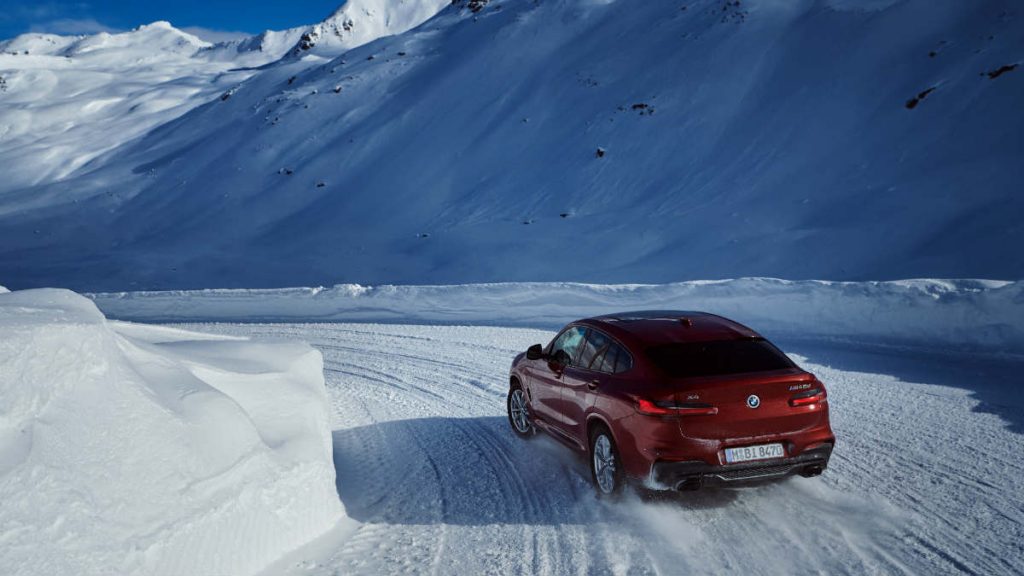
Before pulling into the carpeted halls of Geneva’s Palexpo for the 88th Geneva International Motor Show, BMW decided to give the second-generation BMW X4 an entirely unvarnished road debut. Rather than hauling the freshly unveiled Sports Activity Coupé inside a climate-controlled trailer directly from Munich to Lake Geneva, the Bavarian development team steered a pre-production model—specifically the performance-oriented BMW X4 M40d—straight across the high-altitude passes of the Swiss Alps.
The route led out of Munich, cut south into the mountain valleys around Davos, and climbed directly into the Flüela Pass at an altitude of 2,383 meters. Late-winter storms had just blanketed the high Alpine passes under a deep front, leaving banks of snow more than a meter deep alongside the roadway. Tossing a brand-new vehicle into sub-zero mountain weather right before its official public unveiling was a deliberate statement. It put the mechanical upgrades of the all-new G02 chassis into clear relief, proving that the coupe-styled crossover carries genuine all-weather traction and sharp driving manners rather than merely trading on cosmetic flair.
Conquering the Snows of Flüela Pass
Ascending the Flüela Pass presents a demanding challenge for any vehicle, let alone an all-wheel-drive crossover measuring over 4.7 meters in length. The asphalt snakes through tight hairpin turns, steep inclines, and variable patches of sheet ice hidden beneath fresh powder. Under these conditions, the fundamental chassis architecture of the second-generation BMW X4 comes into sharp focus. Transitioning from the previous F26 architecture to BMW’s lightweight CLAR (Cluster Architecture) foundation yielded significant engineering benefits, including a total weight reduction of up to 50 kilograms depending on specification, along with a measurably lower center of gravity.
These diet measures fundamentally alter how the vehicle rotates through quick direction changes. Through the narrow hairpins above Davos, the reduced mass means less inertia pushing the nose outward toward snow banks. The front suspension responds eagerly to steering inputs, aided by a wider front track that plants the tires firmly into slippery surfaces. Even in freezing conditions, the chassis communicates grip limits cleanly through the wheel, allowing confident placement along sheer Alpine drop-offs.

Standard xDrive All-Wheel Drive and Chassis Dynamics
Central to this winter shakedown is BMW’s intelligent xDrive all-wheel-drive system, fitted as standard equipment across the entire model line. For the G02 generation, the transfer case and electronic distribution software received thorough mechanical revisions aimed at both efficiency and sporting character. The updated transfer case reduces internal parasitic drag while shedding kilograms from the driveline. More importantly for driving enthusiasts, the multi-plate wet clutch system retains a distinctly rear-biased baseline calibration under normal driving conditions.
When powering out of tight, snow-laden switchbacks, the rear-biased torque split allows the chassis to pivot gracefully without washing out the front tires in heavy understeer. Millisecond-quick electronic controllers continuously monitor wheel rotation, steering angle, and yaw rates, routing torque forward only when slip is detected. In the M Performance models like the M40d and M40i, this system works in harmony with an electronically controlled M Sport differential on the rear axle. By actively managing torque distribution across the left and right rear wheels, the differential generates stabilizing yaw moments, driving the car forward out of corners with resolute mechanical bite rather than relying solely on engine-throttling stability intervention.
Working alongside the all-wheel-drive hardware is a bespoke suspension arrangement featuring standard variable sport steering and an optional Adaptive M suspension with electronically controlled dampers. Drivers can toggle through Driving Experience Control modes, sharpening throttle response, gearbox shift strategies, and damping stiffness according to changing road textures. On icy mountain tarmac, selecting an appropriate balance between compliance and roll stiffness ensures consistent tire contact patches without upsetting the vehicle balance over frost heaves.

Athletic Proportions and Exterior Styling
Descending from the Alpine peaks into the lower valleys toward Lake Geneva brings the visual transformation of the BMW X4 into natural sunlight. Against the dramatic backdrop of Europe’s largest inland lake and the snow-capped peak of Mont Blanc, the revised styling displays significantly more athletic maturity than the outgoing generation. The original F26 X4 often drew criticism for awkward rear-quarter proportions that looked somewhat compressed on its underpinnings. Munich addressed those criticisms directly with revised dimensions that give the crossover a more planted, swept-back profile.
The overall vehicle length stretches by approximately 81 millimeters (about 8 centimeters) to reach 4,752 millimeters, while the wheelbase grows by 54 millimeters to 2,864 millimeters. The overall width expands by 37 millimeters, paired with a visibly wider track at both axles (up by over 30 millimeters in the rear). Concurrently, the roofline sits roughly 3 millimeters lower than before. These adjusted dimensional ratios combine to lower the visual center of gravity and impart an assertive road presence.
Up front, a prominent, sculpted kidney grille stands upright between sleek twin full-LED headlights fitted as standard. Horizontal LED fog lamps integrate smoothly into the aggressive outer air intakes of the front bumper. Along the vehicle’s flanks, crisp shoulder lines stretch backward past flush door handles toward pronounced muscular rear haunches. The roofline slopes toward the rear deck in an elegant, unbroken arc that terminates in an integrated lip spoiler. At the tail, slender horizontal three-dimensional LED light strips span wide across the tailgate, emphasizing vehicle width while giving the rear styling a thoroughly modern signature reminiscent of high-end coupes.
Cabin Craftsmanship and Interior Packaging
The dimensional growth of the second-generation crossover pays tangible dividends inside the passenger compartment. Where the original model felt somewhat snug in the rear passenger quarters, the lengthened wheelbase opens up an additional 27 millimeters of rear legroom. Passengers in the outboard rear seating positions enjoy greater knee clearance and improved lateral elbow room, making long-distance continental journeys genuinely comfortable for four adults.
The cockpit layout retains BMW’s driver-centric ergonomics. The instrument cluster and center stack angle slightly toward the pilot, topped by a freestanding high-resolution touchscreen display powered by the latest iDrive infotainment generation. Beneath the screen, physical shortcut buttons and climate dials maintain intuitive, tactile control that requires minimal eyes-off-the-road time in adverse weather. Premium materials define the cabin appointments, featuring stitched Sensatec or Vernasca leather upholstery options, galvanized electroplated switchgear, and ambient lighting strips embedded within the door trims and center console.
Luggage capacity improves as well, expanding by 25 liters over the predecessor to offer 525 liters of cargo room with the rear seats in place. The rear backrest incorporates a 40:20:40 split-folding layout with adjustable tilt angles. Folding all three sections flat increases utility volume to 1,430 liters, capable of swallowing winter sports gear, luggage cases, or outdoor equipment without hassle.
Powertrains: Gasoline and Efficient Diesel Options
Beneath the sculpted aluminum hood, the launch roster encompasses a diverse range of turbocharged four-cylinder and smooth six-cylinder engines from the modular BMW EfficientDynamics family, all paired with an eight-speed Steptronic automatic transmission. The gasoline lineup begins with the 2.0-liter TwinPower Turbo four-cylinder in the xDrive20i, producing 184 horsepower (135 kW) and 290 Nm of torque, followed by the xDrive30i delivering a robust 252 horsepower (185 kW) and 350 Nm of torque.
Diesel buyers can choose between the frugal 2.0-liter four-cylinder xDrive20d developing 190 horsepower (140 kW) and 400 Nm of torque, and the smooth 3.0-liter inline-six xDrive30d generating 265 horsepower (195 kW) and 620 Nm of pulling power. Across the entire engine range, fuel consumption combined spans between 5.4 and 9.0 liters per 100 kilometers (31.4 to 52.3 mpg imperial), with CO2 emissions rated from 142 to 209 grams per kilometer under prevailing European test procedures.
Sitting at the pinnacle of the lineup are two BMW M Performance models: the gasoline M40i and the diesel M40d that completed the Alpine run. The M40i utilizes a 3.0-liter turbocharged inline-six that pumps out 360 horsepower (265 kW) and 500 Nm of torque, propelling the crossover from standstill to 100 km/h in just 4.8 seconds. Meanwhile, the M40d employs a sequential twin-turbocharged 3.0-liter inline-six diesel generating 326 horsepower (240 kW) and a monumental 680 Nm of torque from 1,750 rpm, launching to 100 km/h in 4.9 seconds while maintaining muscular mid-range overtaking muscle through mountain passes.

Replacing a Sales Success Story
When BMW first introduced the concept of the Sports Activity Coupé in the compact-executive tier back in 2013, industry skeptics questioned whether a niche vehicle blending an SUV stance with a coupe roofline would find an enduring audience. The sales numbers answered that question emphatically. In less than five full years of production, the first-generation F26 X4 surpassed 200,000 units sold worldwide. It demonstrated that a sizable segment of luxury crossover buyers actively prioritizes personal design expression and agile road manners over boxy cargo volume.
The second-generation G02 model arrives ready to expand that momentum across global markets. As the doors open at the 2018 Geneva International Motor Show on March 8, the BMW X4 takes its place under the exhibition spotlights wearing the road-proven pedigree of an Alpine winter crossing. It stands as a more mature, dynamically focused machine that refines the coupe-SUV formula without compromising the athletic driving identity expected of the Munich roundel.
Vehicle data
| Field | Value |
|---|---|
| Make | BMW |
| Model | X4 (G02) |
| Generation / chassis code | Second generation (G02) |
| Model year(s) covered | 2018–2019 |
| Body style | 5-door Sports Activity Coupé (SUV / Crossover) |
| Powertrain / engine | 2.0L turbocharged inline-4 (gasoline/diesel), 3.0L turbocharged inline-6 (gasoline/diesel) |
| Power / torque | 184 hp to 360 hp / 290 Nm to 680 Nm |
| Transmission | 8-speed Steptronic automatic |
| Drivetrain | xDrive intelligent all-wheel drive |
| Key performance figures | 0–100 km/h: 4.8 s (M40i), 4.9 s (M40d); Fuel consumption: 5.4–9.0 l/100 km |
| Price (as stated) | Not stated in sources |
| On-sale / announcement period | World premiere March 2018 (Geneva Motor Show) |
| Market | Global / European |