

On June 8, 1948, an unassuming open-top two-seater bearing chassis number 356-001 was granted its official general operating permit in Carinthia, Austria. That single regulatory stamp certified Ferdinand “Ferry” Porsche’s vision of a nimble, lightweight, rear-mid-engine sports car and established Porsche as an independent automotive manufacturer. Seven decades later, the Stuttgart automaker marked that defining milestone by gathering the technical and cultural turning points of its history under the exhibition lights of Berlin, opening the special exhibition “70 Years of the Porsche Sports Car” at the DRIVE Volkswagen Group Forum on Unter den Linden.
Curated across ten themed zones, the Berlin retrospective presents the evolution of Porsche sports cars from that hand-hammered aluminum prototype to modern plug-in performance machines and electric concept vehicles. Open free of charge through May 31, 2018, the exhibition examines how a boutique engineering bureau weathered economic upheavals, pioneered motorsport technologies, and transformed idiosyncratic mechanical layouts into some of the most recognized performance machinery on earth.
The Genesis of a Philosophy: Chassis 356-001
The story began in Gmünd, Austria, where Ferry Porsche and a tight-knit cadre of engineers sought an agile vehicle built on principles of efficiency rather than brute displacement. Ferry famously remarked that because he could not find the lightweight sports car he dreamed of driving, he decided to build it himself. Chassis 356-001 reflected that clarity of purpose. Using a tubular steel spaceframe cloaked in aluminum body panels, the roadster placed an air-cooled 1,131 cc flat-four engine ahead of the rear axle.
Producing a modest 35 metric horsepower (26 kW), the featherweight prototype relied on balance, immediate steering response, and low aerodynamic drag to deliver genuine sports performance. Although production 356 models soon adopted a rear-engine layout behind the axle to simplify manufacturing and free up interior cockpit space, the mid-engine blueprint established Porsche’s fundamental design philosophy: mass centralization, purposeful lightweight construction, and mechanical engagement. At the entrance to the Berlin exhibition, visitors are greeted by a recreated 356 “No. 1” Roadster Show Car, anchoring the ten-part retrospective in that formative post-war moment.
Ten Chapters Across Berlin’s Unter den Linden
The exhibition layout within the DRIVE Volkswagen Group Forum organizes seven decades into ten specific thematic chapters, highlighting technical breakthroughs, design philosophies, and the people behind the steering wheel and drafting table. Long-time factory ambassador and two-time World Rally Champion Walter Röhrl attended the opening alongside German actor Richy Müller, illustrating the bond between competitive motorsport and cultural appreciation that surrounds the brand.
According to Achim Stejskal, Director of the Porsche Museum, the retrospective aims to demonstrate how technical risk-taking turned Porsche into one of the world’s most profitable car manufacturers while preserving an unmistakable driver-focused identity. Each exhibition area pairs iconic hardware with historical archives, technical drawings, and contemporary advertisements from bygone eras.

The 911: An Enduring Icon and the One-Millionth Benchmark
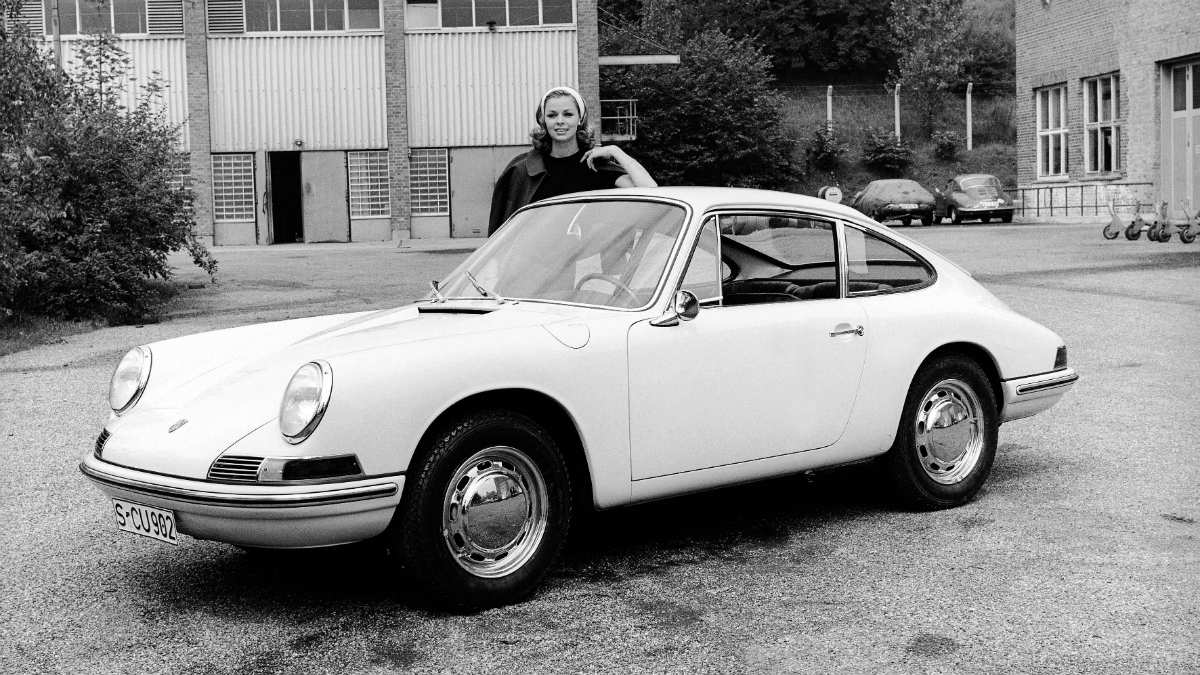
No retrospective of Porsche sports cars can overlook the 911. When Ferdinand Alexander “Butzi” Porsche styled the Typ 901 in the early 1960s as the successor to the 356, few could have predicted that its fastback silhouette, upright glasshouse, and rear-slung flat-six engine would persist for more than fifty years across seven distinct generations. Through every transition—from air cooling to water cooling, mechanical carburetors to electronic fuel injection, and natural aspiration to ubiquitous turbocharging—the 911 retained its core mechanical architecture.
In Berlin, the 911 display centers around a monumental production milestone: the one-millionth Porsche 911. Rolled off the Zuffenhausen assembly line in May 2017, this unique Carrera S is painted in Irish Green, reminiscent of Ferry Porsche’s own company car, and finished with houndstooth cloth seat centers and mahogany trim. The car represents decades of continuous refinement, proving that an idiosyncratic platform could be honed into an everyday sports car capable of turning quick laps at any circuit in Europe.

Motorsport as the Proving Ground: The Legend of the “Pink Pig”
Porsche’s road cars have always been tied directly to its motorsport department. At Le Mans, the Nürburgring, the Targa Florio, and the Carrera Panamericana, the company used high-stress endurance racing to test cooling methods, materials, and aerodynamics before transferring those lessons to serial production. The exhibition dedicates substantial floor space to racing engineering, headlined by one of the most eccentric racing machines in endurance history: the Porsche 917/20.
Built for the 1971 24 Hours of Le Mans, the 917/20 was an experimental aerodynamic collaboration between Porsche and French aerodynamicist Robert Choulet of SERA. Combining the low straight-line drag of the long-tail 917LH with the cornering stability of the short-tail 917K, the car featured wide, bulbous flanks and recessed wheel arches. Its peculiar proportions prompted Porsche designer Anatole Lapine to paint the exterior in butcher-style pink, complete with red dotted lines delineating cuts of pork like Ham, Snout, and Rump. Dubbed “The Pink Pig” (and known colloquially in Germany as “Der Trüffeljäger” or “The Truffle Hunter”), the 600-hp monster set the fastest lap during the official pre-race test session, underscoring that behind the cheeky livery lay serious aerodynamic innovation.

Reinvention and Survival: From the Boxster to Modern GTs
The “Sports cars, reinvented” section of the exhibition covers the pivotal, challenging era of the early 1990s. Facing sharp currency fluctuations and inefficient manufacturing lines, Porsche AG found itself in serious financial jeopardy. Survival demanded a sweeping industrial overhaul and a bold product gamble. The answer was the original 986-generation Boxster, introduced alongside the water-cooled 996-generation 911.
By implementing a shared-parts strategy across both models—sharing front structures, headlamps, suspension arms, and cabin components—Porsche reduced assembly costs drastically while introducing a roadster with true mid-engine poise. The commercial triumph of the Boxster revitalized company finances and financed the engineering breakthroughs that followed, proving that expanding the model range could safeguard Porsche’s performance credentials rather than dilute them.

Modern Hybrid Performance and the Mission E Vision
Modern sports car performance at Porsche has embraced high-voltage electrification without abandoning motorsport pedigree. That dual strategy is displayed in the “Sports cars today” installation, where a Panamera Turbo S E-Hybrid Sport Turismo anchors a virtual reality showcase. Pairing a 4.0-liter twin-turbocharged V8 with an electric motor to generate a massive 680 metric horsepower, the shooting brake demonstrates how plug-in hybrid technology derived directly from the three-time Le Mans-winning 919 Hybrid LMP1 race car elevates road performance.
Looking ahead, the exhibition highlights the Mission E concept study, heralding the production sports sedan scheduled to debut on the global market in 2019 as Porsche’s first fully electric road car. Featuring an 800-volt architecture designed for rapid DC charging and consistent track-worthy thermal endurance, the Mission E promises over 600 horsepower and sprint times under 3.5 seconds. For Porsche, electrification is not a retreat from sports car dynamics; it represents the next chapter in lightweight electric motors, low center of gravity packaging, and instant power delivery.

A Global Calendar of Anniversary Celebrations
The Berlin exhibition at DRIVE is only the opening salvo of a global anniversary campaign running throughout 2018. On June 9, the Porsche Museum in Stuttgart-Zuffenhausen opens its own comprehensive special exhibition, concurrently staging the worldwide “Sports Car Together Day” across dealerships and Porsche Experience Centers.
Over the weekend of June 16–17, 2018, Porsche is inviting factory staff, Stuttgart residents, and global enthusiasts to open-house festivities at the Zuffenhausen production facility. International motorsport fixtures follow: Porsche takes center stage as the featured marque at the Goodwood Festival of Speed in the UK from July 12–15, gathers historic racing cars at the Porsche Rennsport Reunion VI at WeatherTech Raceway Laguna Seca in California from September 27–30, and finishes the year with the “Sound Night” celebration inside the Porsche Arena in Stuttgart on October 13.
Vehicle data
| Field | Value |
|---|---|
| Make | Porsche |
| Model | 356 “No. 1” Roadster (Prototype / Exhibition Show Car) |
| Generation / chassis code | Chassis 356-001 |
| Model year(s) covered | 1948 |
| Body style | Mid-engine open-top two-seater roadster |
| Powertrain / engine | 1,131 cc air-cooled naturally aspirated flat-four |
| Power / torque | 35 PS (26 kW / 35 hp) at 4,000 rpm / 67 Nm (49 lb-ft) at 2,600 rpm |
| Transmission | 4-speed manual gearbox |
| Drivetrain | Mid-engine, rear-wheel drive |
| Key performance figures | Top speed: 135 km/h (84 mph); curb weight: approx. 585 kg |
| Price (as stated) | Not stated in sources |
| On-sale / announcement period | General operating permit granted June 8, 1948 |
| Market | Austria / Germany (Global Heritage) |