

The million-stitch Rolls-Royce Phantom Bespoke
Rolls-Royce occupies a rarefied position among luxury car manufacturers — a marque so deeply associated with handcrafted exclusivity that even its standard production models feel like commissions. Yet for some patrons, standard exclusivity is merely the starting point. The Rose Phantom, a one-off bespoke creation built on the eighth-generation Rolls-Royce Phantom, began with a commission from a Swedish entrepreneur whose family life revolves around flowers. His wife and two of his four children carry flower-inspired names, and the brief he handed to the Rolls-Royce Bespoke Collective was precise: build a car that immerses its occupants in a rich floral scene.
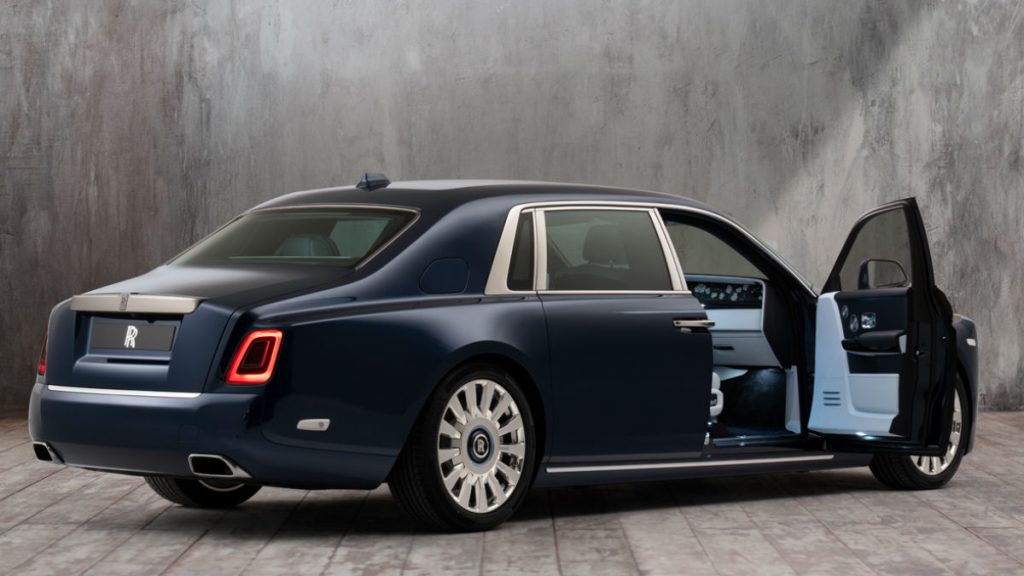
The result is a sanctuary of true luxury, realised through more than one million embroidered satin stitches that transform the Phantom’s interior into an immersive rose garden. Torsten Müller-Ötvös, Chief Executive of Rolls-Royce Motor Cars, described it as one of the greatest Phantoms of its generation, singling out the Bespoke Collective’s craftsmanship as something that could not be replicated anywhere else in the world. That is not idle corporate flattery — the scope of embroidery alone, spanning every surface of the rear cabin, represents a technical challenge that few ateliers would attempt, let alone execute.

The Phantom as a canvas
The eighth-generation Phantom arrived in 2017 as a ground-up redesign, the first Rolls-Royce built on the marque’s proprietary aluminium spaceframe architecture, a platform dubbed the “Architecture of Luxury.” Unlike earlier generations that shared underpinnings with BMW Group models, this Phantom was engineered from the outset as a dedicated Rolls-Royce structure. The spaceframe delivers the rigidity required for the car’s celebrated magic-carpet ride while giving the Bespoke programme a far more accommodating foundation for ambitious one-off projects. When a patron requests a million stitches distributed across leather, fabric and fascia surfaces, the car’s structure must support that creative ambition without compromise.
The Gallery — the Phantom’s signature interior innovation — sits at the heart of this bespoke philosophy. A full-width, uninterrupted pane of glass spans the dashboard fascia, behind which a recessed, up-lit stage allows patrons to display commissioned works of art. The concept reframes the car’s instrument panel as a curated exhibition space rather than a collection of vents and screens. The Rose Phantom would ultimately become one of the most elaborate expressions of this idea.

A rose bred exclusively for Rolls-Royce
The rose at the centre of this commission is no ordinary garden variety. Rolls-Royce commissioned British rose breeder Philip Harkness, of Harkness Roses, to develop a flower that would exist nowhere else on earth except the grounds of the marque’s Goodwood headquarters. The Harkness family has bred roses since 1879, accumulating more than twenty-five gold medals at the RHS Chelsea Flower Show over the past half century. The Phantom Rose, as it was named, took eight years to develop — a labour of love, in Harkness’s own words.
The result is a blousy, creamy-white bloom offering fifty petals and a rich perfume. Bespoke Designer Sina-Maria Eggl, who oversaw the rose commission, noted that the flower had to embody Rolls-Royce’s poise, elegance and allure: pure and delicate in appearance, yet strong in presence with an alluring aroma and extra winter durability. The Phantom Rose grows in a specially designed bed, fringed with lavender, alongside the reflection pools adjacent to the marque’s Sir Nicholas Grimshaw-designed factory in West Sussex. Through the plant’s floor-to-ceiling glass walls, the Bespoke Collective’s designers and craftspeople can observe the blooms as they work.

From porcelain to embroidery
The Phantom Rose first appeared in a Phantom’s Gallery in 2017, rendered not in thread but in porcelain. Stems of the actual rose were flown to master artisans at Nymphenburg, the renowned Bavarian porcelain manufacturer founded in 1747. There, the flower was studied in every stage of maturity — from tight bud to full bloom — before being painstakingly hand-crafted in the finest black and white porcelain the company had ever produced. The development process alone lasted three months to achieve the same level of delicacy as the living Phantom Rose.
That initial Gallery piece established the rose as a recurring Bespoke motif. When Bespoke Designer Ieuan Hatherall later took the concept further for the Swedish entrepreneur’s commission, the rose was translated from porcelain sculpture into satin-stitch embroidery, scaled up enormously in ambition. Over one million stitches, distributed across an asymmetrical design covering the Phantom’s interior surfaces, transformed the flower from a dashboard ornament into a fully immersive environment.

The exterior: colour and coachline
The Peacock Blue exterior of the Rose Phantom is punctuated with a Charles Blue twinned-coachline that intertwines organically, mimicking the sinuous curve of a rose stem. The coachline introduces the rose motif and hints at the colours and treatment awaiting inside. The wheels are embellished with a twinned pinstripe, also in Charles Blue, reinforcing the visual connection between exterior restraint and interior exuberance.
The patron’s daughter, Magnolia, defined the exterior hue — a detail that underscores how deeply personal this commission became. The family’s involvement extended well beyond approving swatches; each member contributed creatively to the final specification.

Inside the rose garden
Opening the Phantom’s rear-hinged coach doors reveals the embroidery on the inner surfaces of the rear doors first — a preview of what lies beyond. But the full impact of the million-stitch interior only registers once you step into the rear cabin and take in the entire composition at once.
The Phantom Rose is illustrated in varying stages of maturity, from tight bud to full bloom, rendered in satin stitch across an asymmetrical design that appears to grow across the roof lining from the rear of the car forward. The composition does not simply repeat a single motif — it unfolds, with stems and blossoms placed at different scales and angles, creating a sense of organic growth rather than mechanical repetition.
The marque’s starlight headliner illuminates the scene, with individually placed fibre-optic lights interspersed among the embroidered roses. The combined effect suggests a garden at dusk, softly lit and quietly alive.

In the rear compartment, Serenity Seating with a soft calf rest cushion adopts the inverted colour-way of the exterior: sumptuous Charles Blue leather accented with Peacock Blue piping. From here, occupants can admire the Phantom’s Gallery, where stems of embroidered roses climb through the glass-fronted fascia, providing a spectacle that changes character depending on the angle and the light.
At the patron’s specific request, Peacock and Adonis Blue butterflies are woven into the floral embroidery, introducing movement and a touch of life to the motif. The patron’s wife designed the car’s umbrellas, and his daughter Magnolia defined the exterior hue. The patron himself summed up the result simply: “I wanted to have flowers and roses everywhere. It became an amazing piece of art.”

What the Rose Phantom represents
Bespoke commissions at this level transcend the usual special-order options that luxury car buyers encounter. The Rose Phantom represents the outermost reach of the Rolls-Royce Bespoke programme, where a single thematic idea — the beauty of a particular flower — is translated across multiple media and surfaces to create an environment that no other car replicates. Porcelain from Bavaria, embroidery requiring over a million individual stitches, a rose that took eight years to breed, and a family’s personal story woven into every specification decision.
The Phantom VIII’s architecture was designed to accommodate exactly this kind of creative freedom. Its aluminium spaceframe, developed in-house by Rolls-Royce rather than adapted from a shared platform, provides the structural and packaging latitude that the Bespoke Collective requires when a patron’s vision pushes beyond conventional trim options. The Gallery, conceived as a stage for individual works of art, reframes the dashboard as a curated space rather than a utilitarian panel — and the Rose Phantom’s embroidered Gallery piece is among the most ambitious works it has hosted.
Few cars anywhere near this price bracket invite their owners to collaborate so deeply in the creative process. The Rose Phantom stands as evidence that Rolls-Royce’s Bespoke Collective operates closer to a collaborative art studio than a factory options desk, translating a patron’s personal vision into a cohesive, multi-disciplinary design executed across every surface of the motor car.

Vehicle data
| Make | Rolls-Royce |
| Model | Phantom (Bespoke “Rose Phantom” commission) |
| Generation / chassis code | Eighth generation (Phantom VIII) |
| Body style | Four-door saloon |
| Powertrain / engine | 6.75-litre twin-turbocharged V12 |
| Drivetrain | Rear-wheel drive |
| On-sale / announcement period | Phantom VIII launched 2017; Rose Phantom commission revealed 2019 |
| Market | Global (one-off bespoke commission for a Swedish patron) |