
A Century of Luxury and Space
The word “Pullman” did not begin with automobiles. It began on American railroads in the 1860s, when an entrepreneur named George Mortimer Pullman decided that long-distance train travel deserved better than a hard wooden bench. His Pioneer sleeping car, patented in 1868, fitted railroad carriages with proper blankets, padded cushions, and enough room for passengers to lie flat. Travellers paid a steep premium for the privilege, and the Pullman Palace Car Company quickly earned the nickname “the world’s greatest hotel on wheels.”
That reputation for spacious, first-class transport did not stay confined to the rails. Coachbuilders across Europe adopted “Pullman” as shorthand for any vehicle body built on an extended wheelbase with a generously proportioned passenger compartment. In automotive use, a Pullman body typically meant two or more rows of seats, four to six side windows, and enough interior length to separate the chauffeured driver from the owners in the rear. Mercedes-Benz embraced the concept early and has kept it alive, in various forms, for the better part of a century.

From Rails to Roads: Jellinek and the Pre-Pullman Tradition
The Mercedes-Benz Pullman tradition is nearly as old as the brand itself. Emil Jellinek, the Austrian businessman and racing enthusiast who effectively christened the Mercedes marque, understood the value of travelling in spacious comfort. In 1907 he had his 1904 Mercedes-Simplex 60 PS — the top model in the Daimler range at the time — rebuilt as a luxurious touring saloon with an enclosed, multi-seat body. That car survives today in the Mercedes-Benz Museum, displayed in the “Legend 2: Mercedes – Birth of the Brand, 1900 to 1914” gallery. It never wore the Pullman badge, but in spirit it already fulfilled the brief: a large, comfortable cabin, a powerful engine, and room enough for long journeys without fatigue.

The Nürburg, the 770 and the Interwar Pullman Era
The Pullman name became formally attached to Mercedes-Benz passenger cars in the late 1920s. The Mercedes-Benz “Nürburg” 460 Pullman Saloon (W 08), introduced in 1928, paired the brand’s large eight-cylinder chassis with a long-wheelbase Pullman body offering two rows of seats and generous headroom. It was also the vehicle that established a less glamorous but equally important Mercedes-Benz tradition: armoured transport. Pope Pius XI took delivery of a Nürburg 460 Pullman Saloon in 1930, making it one of the first specially protected vehicles commissioned from Daimler-Benz.
That lineage reached its prewar apex with the Mercedes-Benz 770 “Grand Mercedes” (W 07), launched in 1930. Fitted with a 7.7-litre supercharged straight-eight, the 770 was the largest and most opulent car Stuttgart had ever built. The Pullman Saloon variant stretched the wheelbase further still, adding a glass division between driver and passengers and providing enough rear space for formal state occasions. Emperor Hirohito of Japan received an armoured 770 Pullman in 1935. Other heads of state, industrialists and royalty followed. By the outbreak of war, the Grand Mercedes Pullman had established itself as the default transport for those who required the most imposing car money could buy.
The Diesel Pullman and the 260 D
Pullman was not reserved exclusively for supercharged flagships. In 1936, Mercedes-Benz introduced the 260 D (W 138), the world’s first series-production diesel passenger car. A Pullman Saloon variant was offered alongside the standard body, giving fleet operators and taxi services a long-wheelbase, six-passenger vehicle with the fuel economy of a compression-ignition engine. An example survives in the Mercedes-Benz Museum’s “Legend 3: Upheavals – Diesel and Compressor” exhibition, and the car’s dimensions illustrate just how generous a Pullman treatment could make even a mid-size chassis.

Postwar Revival: The 300 and Commercial Pullmans
After the war, Mercedes-Benz rebuilt its luxury lineup slowly. The Type 300 (W 189), introduced in 1951, carried forward the Pullman tradition with extended-wheelbase limousine versions. Survivors from this era are vanishingly rare — of the 1960 examples, just three are known to remain. Pullman also crossed into the commercial vehicle range during the 1950s: the letter “P” in the LP 315 truck’s type designation stood for Pullman, denoting a cab engineered for long-haul driver comfort. The twin-front-axle LP 333 “Millipede” from that period can be seen in the museum’s “Collection 2: Gallery of Carriers.”
The Definitive Grand Mercedes: 600 Pullman (W 100)
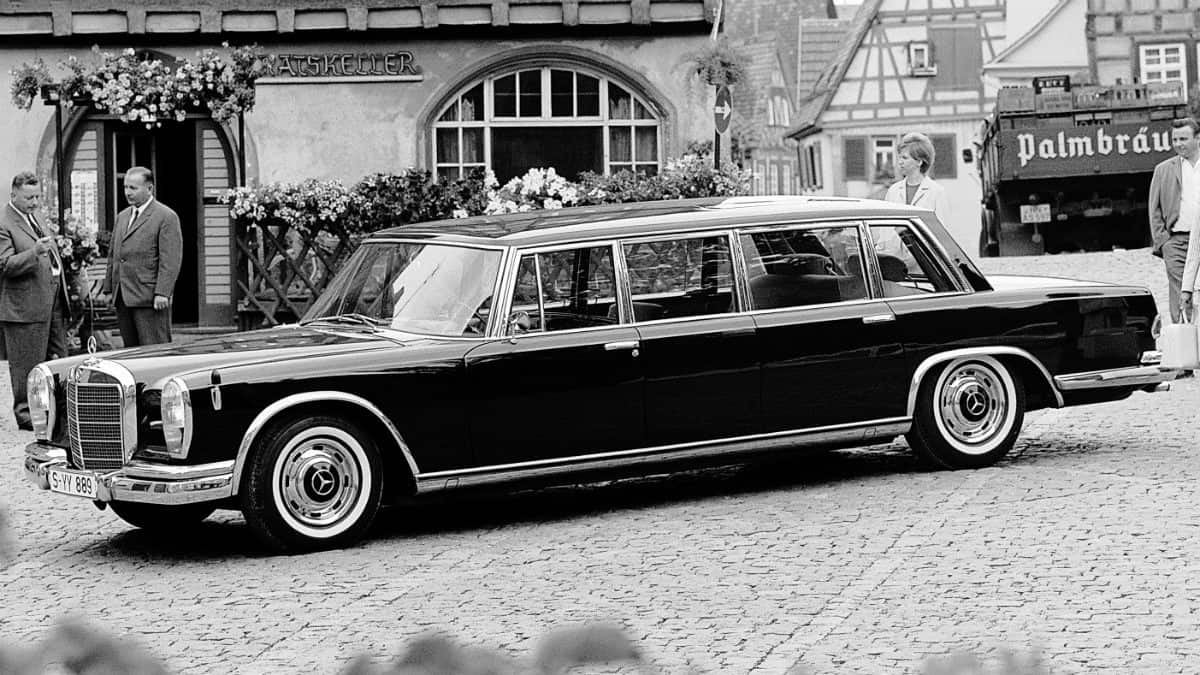
When the Mercedes-Benz 600 (W 100) arrived in 1963, it reset the benchmark for what a state limousine could be. Under the bonnet sat a 6.3-litre V8 — the first V8 engine in a Mercedes-Benz passenger car — paired with an automatic transmission designed to handle its substantial torque. But the real engineering story was the “Komfort-Hydraulik”: a 150-bar hydraulic system that operated the windows, seat adjustment, sunroof, boot lid and even the self-levelling suspension. Nearly every comfort function in the car ran on hydraulic pressure rather than electric motors, giving the 600 an almost eerie smoothness in operation.
The Pullman variants of the W 100 extended the wheelbase substantially and offered both four-door and six-door configurations, as well as a landaulet body style with an opening rear roof section. Serial production began in September 1964 and continued through 1981 — an unusually long run that reflected the car’s unique position in the market. The first postwar bulletproof version from Daimler-Benz was completed in June 1965, responding to persistent demand from governments and diplomatic services.
Individual specification was central to the W 100 Pullman experience. When John Lennon took delivery of a 600 Pullman Saloon in 1970, Mercedes-Benz fitted the rear seats longitudinally rather than in the standard arrangement and installed one of the finest in-car hi-fi systems available at the time. Other owners specified cocktail cabinets, television sets, intercom systems and armoured bodywork. The W 100 remained in production for nearly two decades not because it was fashionable, but because nothing else matched its combination of hydraulic sophistication, cabin space and quiet authority.

The S-Class Pullman: 140 Series and Beyond
After the W 100 ended production in 1981, the Pullman name went dormant in the Mercedes-Benz passenger car range for over a decade. It returned with the 140-series S-Class, which spawned the S 600 Pullman Saloon in 1996. Powered by a twelve-cylinder engine producing 290 kW (394 hp), the 140-series Pullman offered the divided cabin, extended wheelbase and hand-finished interior that the badge demanded. Much of the assembly was carried out by hand, continuing a tradition of low-volume, high-precision manufacturing that had always accompanied the Pullman designation.
Mercedes-Maybach S 650 Pullman: The Modern Standard
The current chapter in the Pullman story opened at the Geneva Motor Show in March 2018, when Mercedes-Benz presented the Mercedes-Maybach S 650 Pullman. Built on the extended-wheelbase platform of the modern Mercedes-Benz S-Class, the S 650 Pullman adds a further 200 mm of body length and houses a 6.0-litre V12 biturbo engine developing 463 kW (630 hp) and 1,000 Nm of torque. The interior follows the traditional vis-à-vis seating layout with a folding division, and the specification list includes the full range of Maybach trim, leather and technology options. It is, in every measurable sense, the most advanced Pullman saloon Stuttgart has ever built.
A Continuous Thread
From the Nürburg 460 of 1928 to the Maybach S 650 of 2018, the Mercedes-Benz Pullman has served a single, consistent purpose: to give rear-seat passengers the most spacious, comfortable and well-appointed environment that Mercedes-Benz engineering can deliver. Popes, emperors, musicians and heads of state have all specified Pullman bodies at various points over the past nine decades, but the engineering response has remained remarkably consistent. Extend the wheelbase. Enrich the cabin. Provide an engine worthy of the weight. The Pullman tradition is one of the longest-running nameplates in automotive luxury, and it shows no sign of ending.
Vehicle data
Mercedes-Benz Nürburg 460 Pullman Saloon
| Make | Mercedes-Benz |
| Model | Nürburg 460 Pullman Saloon |
| Generation / chassis code | W 08 |
| Model year(s) covered | 1928 onwards |
| Body style | Pullman Saloon |
| Powertrain / engine | Inline-eight petrol |
| Power / torque | Not stated in sources |
| Transmission | Not stated in sources |
| Drivetrain | Rear-wheel drive |
| Key performance figures | Not stated in sources |
| Price (as stated) | Not stated in sources |
| On-sale / announcement period | 1928 |
| Market | Europe / global |
Mercedes-Benz 770 Grand Mercedes Pullman Saloon
| Make | Mercedes-Benz |
| Model | 770 “Grand Mercedes” Pullman Saloon |
| Generation / chassis code | W 07 |
| Model year(s) covered | 1930–1938 (pre-war series) |
| Body style | Pullman Saloon (also available as armoured variant) |
| Powertrain / engine | 7.7-litre supercharged inline-eight petrol |
| Power / torque | Not stated in sources |
| Transmission | Not stated in sources |
| Drivetrain | Rear-wheel drive |
| Key performance figures | Not stated in sources |
| Price (as stated) | Not stated in sources |
| On-sale / announcement period | 1930 |
| Market | Europe / global |
Mercedes-Benz 260 D Pullman Saloon
| Make | Mercedes-Benz |
| Model | 260 D Pullman Saloon |
| Generation / chassis code | W 138 |
| Model year(s) covered | 1936 onwards |
| Body style | Pullman Saloon |
| Powertrain / engine | Diesel (world’s first series-production diesel passenger car) |
| Power / torque | Not stated in sources |
| Transmission | Not stated in sources |
| Drivetrain | Rear-wheel drive |
| Key performance figures | Not stated in sources |
| Price (as stated) | Not stated in sources |
| On-sale / announcement period | 1936 |
| Market | Europe |
Mercedes-Benz 600 Pullman
| Make | Mercedes-Benz |
| Model | 600 Pullman (Saloon and Landaulet) |
| Generation / chassis code | W 100 |
| Model year(s) covered | 1963–1981 |
| Body style | Pullman Saloon, Pullman Landaulet (4- and 6-door) |
| Powertrain / engine | 6.3-litre V8 petrol |
| Power / torque | Not stated in sources |
| Transmission | Automatic |
| Drivetrain | Rear-wheel drive |
| Key performance figures | 150-bar Komfort-Hydraulik system for windows, seats, suspension, boot and sunroof |
| Price (as stated) | Not stated in sources |
| On-sale / announcement period | Serial production from September 1964; first bulletproof version June 1965 |
| Market | Global |
Mercedes-Benz S 600 Pullman Saloon (140 series)
| Make | Mercedes-Benz |
| Model | S 600 Pullman Saloon |
| Generation / chassis code | 140 series |
| Model year(s) covered | 1996 onwards |
| Body style | Pullman Saloon |
| Powertrain / engine | Twelve-cylinder petrol |
| Power / torque | 290 kW (394 hp) |
| Transmission | Not stated in sources |
| Drivetrain | Not stated in sources |
| Key performance figures | Not stated in sources |
| Price (as stated) | Not stated in sources |
| On-sale / announcement period | 1996 |
| Market | Global |
Mercedes-Maybach S 650 Pullman
| Make | Mercedes-Maybach |
| Model | S 650 Pullman |
| Generation / chassis code | VV222 (based on modern S-Class platform) |
| Model year(s) covered | 2018 onwards |
| Body style | Pullman Saloon |
| Powertrain / engine | 6.0-litre V12 biturbo petrol |
| Power / torque | 463 kW (630 hp) / 1,000 Nm |
| Transmission | Not stated in sources |
| Drivetrain | Not stated in sources |
| Key performance figures | Body length extended by 200 mm over long-wheelbase S-Class |
| Price (as stated) | Not stated in sources |
| On-sale / announcement period | Unveiled March 2018, Geneva Motor Show |
| Market | Global |