
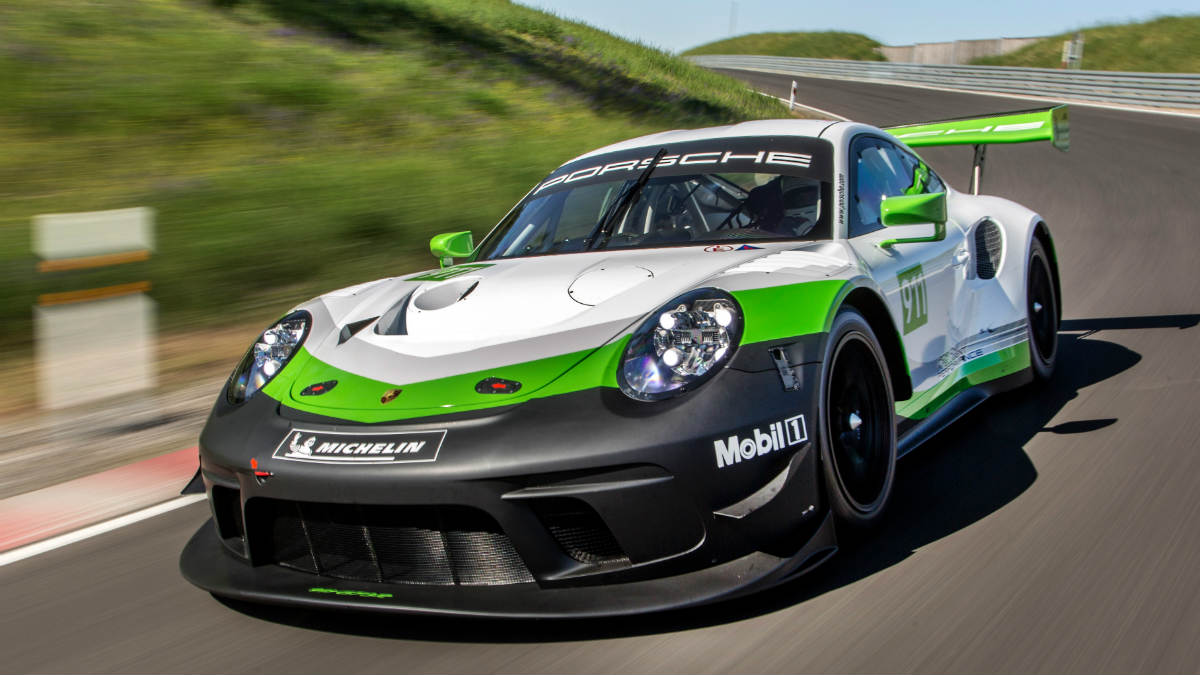
Porsche Motorsport has pulled the covers off its latest customer racing weapon built for international GT3 competition: the new Porsche 911 GT3 R. Developed in Weissach on the structural foundation of the road-going 911 GT3 RS, this thoroughbred track machine brings a potent combination of razor-sharp aerodynamics, enhanced driver safety, and substantially reduced operating and maintenance costs for independent racing outfits around the world.
In global endurance sports car racing, the GT3 category demands a careful balancing act. Privateer teams operate under punishing operational schedules across series such as the Blancpain GT Series, ADAC GT Masters, and the IMSA WeatherTech SportsCar Championship. For these squads, raw single-lap pace means nothing if a car proves fragile, financially ruinous to maintain, or overly punishing on tire wear during double stints. In designing the 991.2 generation 911 GT3 R, Porsche engineers focused squarely on operational stamina, accessible chassis limits, and dependable component longevity under grueling 24-hour competition conditions.

Lightweight Composite Architecture and Bodyshell Design
The core structure of the 911 GT3 R stems directly from the production 911 GT3 RS street car, capitalizing on Stuttgart’s intelligent aluminum-steel composite architecture. This production foundation delivers outstanding torsional rigidity while keeping structural weight to an absolute minimum. From that bare shell, Weissach technicians replace virtually every exterior panel with specialized lightweight racing components.
Extensive use of carbon-fiber reinforced plastic (CFRP) defines the exterior cladding. The roof panel, front hood, fairings, extended wheel arches, doors, side sections, rear decklid, and rear apron are all fabricated from autoclave-cured carbon composite. Even internal cabin surfaces and trim pieces feature bare carbon-fiber weave to shed superfluous grams. Every window is formed from optical-grade polycarbonate, with the side door windows engineered for rapid tool-less removal during paddock servicing or emergency driver extraction. Integrated recovery tow points and an FIA-homologated roof escape hatch ensure total alignment with the latest international safety regulations.

Naturally Aspirated Four-Liter Flat-Six Powerhouse
Nestled low behind the rear axle sits the mechanical centerpiece of the 911 GT3 R: a water-cooled 4.0-liter boxer engine closely related to the high-revving flat-six found in the road-going GT3 RS. Displacing 3,996 cc with a square 102 mm bore and 81.5 mm stroke, this naturally aspirated mill breathes through six independent, electronically operated throttle butterflies. The multi-throttle intake arrangement sharpens throttle response to telepathic precision, handing racing drivers granular control when metering out torque on corner exit.
High-pressure direct fuel injection atomizes unleaded racing gasoline at pressures reaching 200 bar directly into the combustion chambers. Combined with variable valve timing on both the intake and exhaust camshafts, the combustion cycle extracts maximum thermal efficiency across an exceptionally broad usable powerband. Without restrictive Balance of Performance intake air restrictors, the four-valve boxer produces over 404 kW (550 hp). Final competition output varies according to specific series BoP classifications, but the engine’s flat torque curve and wide rev envelope significantly enhance overall drivability compared to the previous-generation customer racer.
Endurance reliability is secured through a motorsport dry-sump lubrication circuit that guarantees uncompromised oil flow even through sustained multi-G cornering complexes like the Nürburgring Nordschleife’s Karussell. Electronic engine management is handled by a sophisticated Bosch MS 6.4 unit with onboard high-speed data acquisition. Exhaust gasses exit through an unrestrictive race-spec exhaust system, with modular motorsport catalytic converters and country-specific sound pre-silencers available to comply with strict track noise ordinances.

Sequential Drivetrain and Cockpit Controls
Torque flows to the massive 310-mm rear competition tires through a Porsche sequential six-speed constant-mesh dog-ring gearbox. Shifting duties are managed via steering-wheel-mounted paddle shifters coupled to an electronic shift drum actuator. This setup executes seamless, split-second upshifts and rev-matched downshifts without requiring physical gear lever linkages or manual rev-blipping.
The driveline incorporates an electrohydraulically operated racing clutch, which entirely removes the clutch pedal from the driver footwell. The automated clutch engagement smooths out launches from the pit box and virtually eliminates stall hazards during high-pressure pit stop turnarounds. Power distribution across the rear axle is governed by a mechanical limited-slip differential featuring external pre-load adjustment, enabling race engineers to dial in specific locking percentages for tight sprint courses or high-speed flowing circuits.

Chassis Kinematics, Brakes, and Aerodynamic Evolution
Underneath the carbon bodywork, the suspension architecture has taken a substantial leap forward. While the rear setup retains an aluminum multi-link geometry suspended by high-performance spherical bearings and four-way adjustable motorsport dampers, the front axle now features an advanced double wishbone suspension with forged aluminum control arms. This double wishbone arrangement maintains optimal tire contact patches across severe suspension compression, dramatically improving front-end bite, turn-in precision, and braking stability.
Suspension alignment adjustments no longer require tedious trackside rod end changes. Porsche Motorsport integrated an adjustable shim system into the suspension mounts, enabling mechanics to make camber, caster, and track geometry changes quickly without requiring an entirely new string alignment. Front tire rolling circumference has expanded from 650 mm to 680 mm, mounted on one-piece center-lock BBS alloy wheels measuring 12.5 J x 18 inches at the front and 13 J x 18 inches at the rear.
Deceleration duties are handled by dual independent hydraulic brake circuits modulated by an adjustable balance bar inside the cockpit. Front stopping power comes courtesy of monobloc six-piston aluminum racing calipers clamping 390 mm ventilated, grooved steel discs. The rear axle utilizes four-piston aluminum monobloc calipers with 370 mm grooved discs. Dedicated twin-flow cooling ducts funnel fresh ambient air directly into the rotor cores and caliper bodies to prevent fluid boil. System management is overseen by a Generation 5 Bosch racing ABS, finely calibrated to prevent tire flat-spotting without causing premature pedal intrusion.
Aerodynamic efficiency was refined using computational fluid dynamics and scale wind tunnel testing. The front bumper fairing incorporates sculpted air curtains and prominent wheel arch louvers cut directly above the front fenders to evacuate turbulent high-pressure air from the wheel wells, pinning the nose to the tarmac. At the rear, an imposing carbon-fiber wing measuring 1,900 mm in span and 400 mm in chord provides adjustable balance, allowing teams to trim drag for high-speed venues like Monza or stack downforce for technical layouts like the Nürburgring.

Cockpit Ergonomics, Safety Engineering, and Driver Endurance
Endurance racing requires keeping drivers alert and physically capable across grueling two-hour stints in blistering ambient heat. Recognizing this, Porsche introduced factory-integrated air conditioning to the 911 GT3 R cockpit for the first time. The climate system features dedicated ducting linked straight to the driver seat and helmet ventilation port, channeling chilled air where it creates the greatest physiological benefit while consuming minimal parasitic engine power.
The cockpit layout centers around an ergonomic console angled toward the driver, accompanied by a digital multi-touch switch panel. The multi-function racing steering wheel incorporates a quick-release coupling, gearshift paddles, and essential controls for pit speed limiters, radio communication, and the multi-stage Porsche Motorsport traction control (PMTC). Instrumentation is displayed through a vivid Cosworth CDU full-color digital display, supported by a Cosworth CLU data logger boasting 6 GB of solid-state storage and an IPS48 MK2 solid-state power management module.
Driver passive safety adheres strictly to FIA standard 8862/2009. The deep racing bucket seat is securely anchored directly to the vehicle chassis at six rigid bolting points. Rather than sliding the heavy seat frame along rails, longitudinal adjustment is achieved via an adjustable pedal box, maintaining an optimal center of gravity within the welded-in roll cage. The driver door features an integrated side-impact intrusion element composed of carbon fiber, Kevlar, aluminum honeycomb, and energy-absorbing structural foam. Pit stop flexibility is further boosted by a 120-liter FT3 safety fuel cell equipped with a cut-off safety valve, configured for quick conversion between left-hand and right-hand circuit fueling rigs.
Factory Technical Specifications and Optional Packages
Porsche provides a wide array of factory-installed endurance options to customize each chassis for specific championship requirements. Squads targeting North American sports car competition can equip the car with a dedicated IMSA package. For grueling overnight endurance classics, Porsche offers dual auxiliary LED endurance headlights integrated into the front fairing, illuminated door numbers, and cockpit ambient lighting. Teams can also option a heated front windshield, windshield and rear window structural braces, advanced tire pressure monitoring systems (TPMS), high-speed 1,000 Hz channel telemetry extensions, and a Bosch collision avoidance radar system (CAS).
With an entry price of 459,000 Euros plus country-specific taxes, the 911 GT3 R represents Weissach’s definitive answer to global GT3 racing. Delivery commences in December 2018 ahead of the 2019 motorsport calendar, giving privateer squads a complete, turn-key customer racer primed for podium battles on the international stage.


Vehicle data
| Field | Value |
|---|---|
| Make | Porsche |
| Model | 911 GT3 R |
| Generation / chassis code | 991.2 generation (based on 911 GT3 RS) |
| Model year(s) covered | 2019 (revealed May 2018) |
| Body style | Race car / coupe |
| Powertrain / engine | 4.0-liter water-cooled naturally aspirated boxer 6-cylinder (rear-mounted, 3,996 cc, 4 valves per cylinder, direct injection) |
| Power / torque | Over 404 kW (550 hp) without restrictors (subject to FIA BoP) | Torque not stated in sources |
| Transmission | Sequential 6-speed constant-mesh gearbox with paddle-shift electronic actuator and electrohydraulic clutch |
| Drivetrain | Rear-wheel drive with mechanical limited-slip differential |
| Key performance figures | Not stated in sources (pure competition vehicle; governed by FIA BoP) |
| Price (as stated) | 459,000 Euros (plus country-specific VAT) |
| On-sale / announcement period | Announced May 2018; deliveries starting December 2018 for the 2019 racing season |
| Market | Global (customer motorsport, FIA GT3 regulations) |