

The legendary Porsche sports car aces a test program on gravel, sand, and snow
Porsche is preparing to unveil a remarkably bold evolution of its most iconic icon: the new 911 Dakar. Slated to step out of the shadows of traditional GT variants, this dedicated model represents the absolute outer limits of what Porsche believes a street-legal 911 can achieve when taken far beyond the boundaries of tarmac. For the first time, this two-door sports car offers genuine, sustained off-road capability without sacrificing the fundamental corner-carving dynamics that have defined the 911 lineage since the 1960s.
The decision to badge a 911 with “Dakar” carries immense prestige—and massive expectations. The name pays direct homage to Porsche’s defining moment in motorsport history: a triumphant first overall victory at the grueling Paris-Dakar Rally in 1984. That historic win came courtesy of a modified Porsche 911 (internally designated the Type 953), famously outfitted with a bespoke all-wheel-drive system specifically designed to conquer unforgiving Saharan terrain. Fast forward nearly four decades, and Stuttgart is channeling that same conquering spirit into a modern marvel powered by cutting-edge thermal management, advanced aerodynamics, and next-generation chassis tuning.
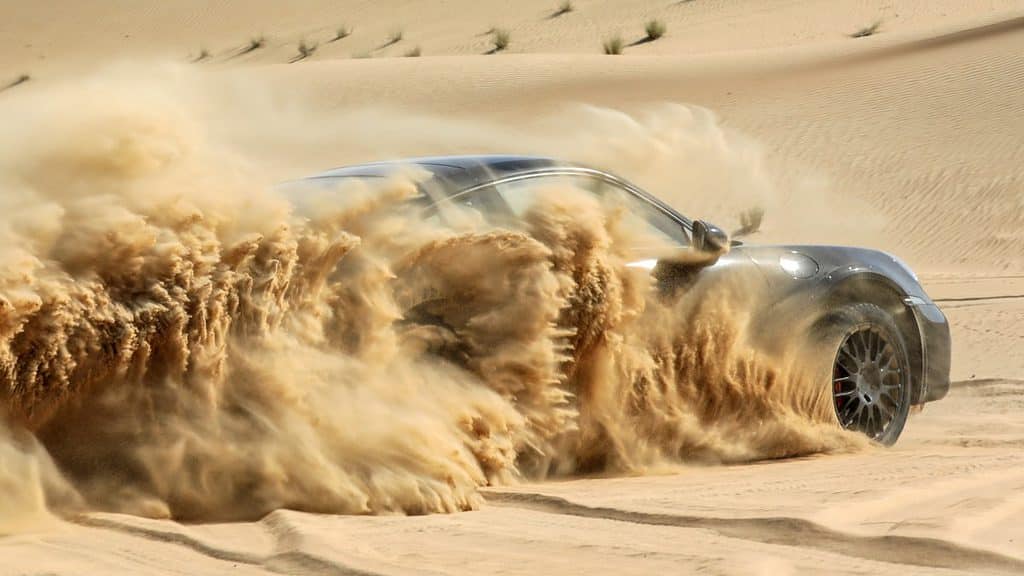
But before this unconventional coupe could reach showroom floors, the 911 Dakar had to prove itself across thousands of miles of the world’s most punishing landscapes. Over more than half a million kilometers of rigorous real-world testing—including roughly 10,000 kilometers dedicated entirely to rough, unpaved environments—the development team pushed this machine to its absolute operational limits. Every bolt, every sensor, and every line of software underwent relentless scrutiny. When the dust settles, what emerges is a vehicle purpose-built to thrive where traditional supercars fear to tread.
One critical proving ground was the Château de Lastours test track nestled deep in southern France. Designed to replicate authentic cross-country rally stages, its tightly packed dirt loops, steep banked turns, and abrupt elevation changes provided the ideal framework for engineers tuning the Dakar’s unique suspension architecture. Development drivers spent countless hours hitting ruts, rolling bumps, and high-speed chicanes, gathering terabytes of telemetry data. Engineers focused heavily on damping characteristics, optimizing both rebound and compression cycles to ensure that sudden impacts wouldn’t upset the car’s stability or compromise driver feedback through the steering column.
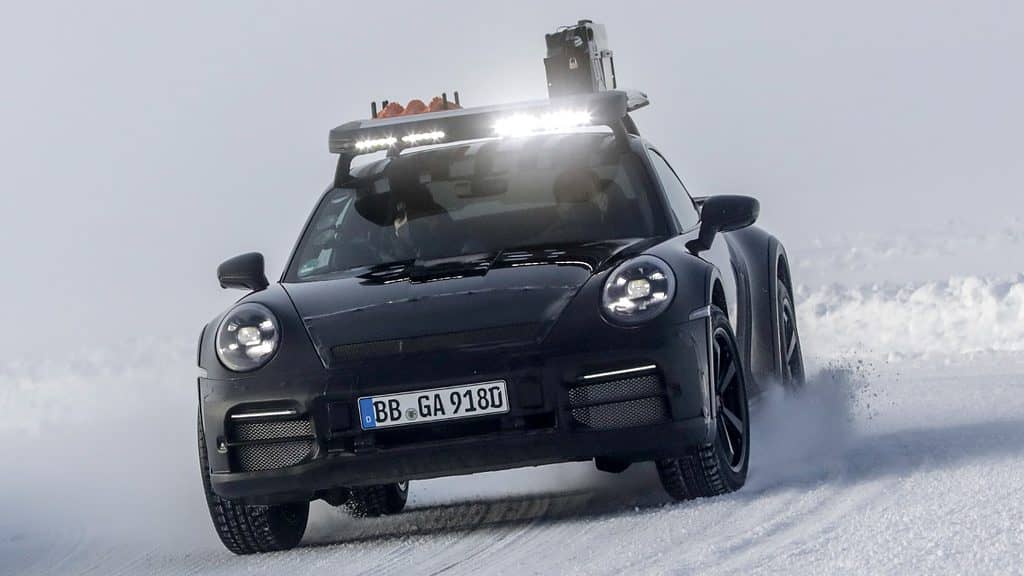
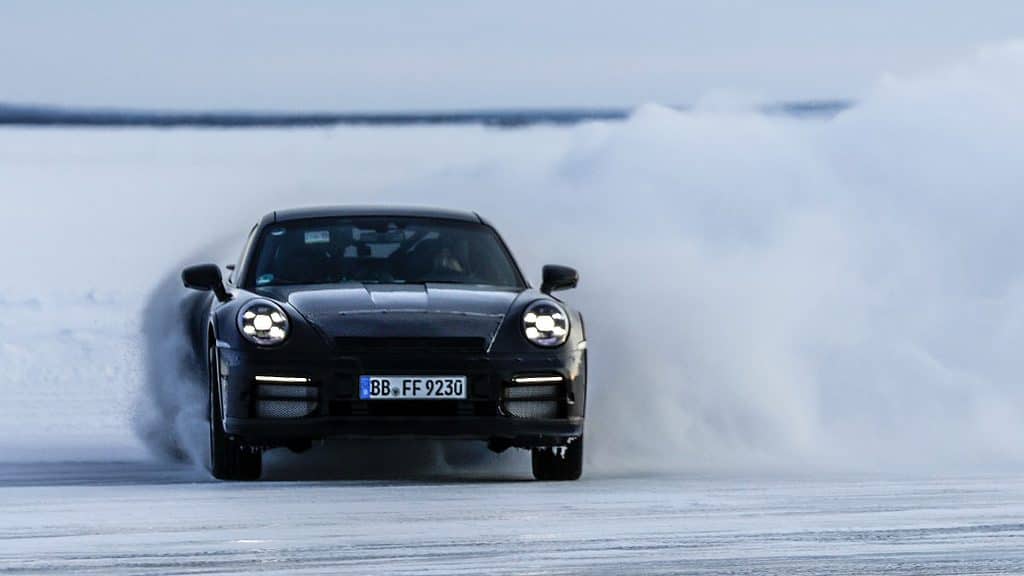
When conditions grew too hot elsewhere, the test fleet headed north. At Arjeplog, Sweden—one of Scandinavia’s premier winter testing hubs—two-time World Rally Champion Walter Röhrl tested his hand at piloting the new machine across frozen lakes and compacted snow fields. Röhrl, whose name is synonymous with rallying excellence, didn’t simply drive the prototype; he scrutinized every nuance of chassis feedback, weight transfer, and throttle modulation. In those slippery conditions, traction control systems, electronic stability aids, and differential programming had to be carefully calibrated so that power delivery never became sudden or unpredictable. Even when venturing off the beaten path, a Porsche must communicate directly through the steering wheel—it cannot hide behind layers of artificial assistance.
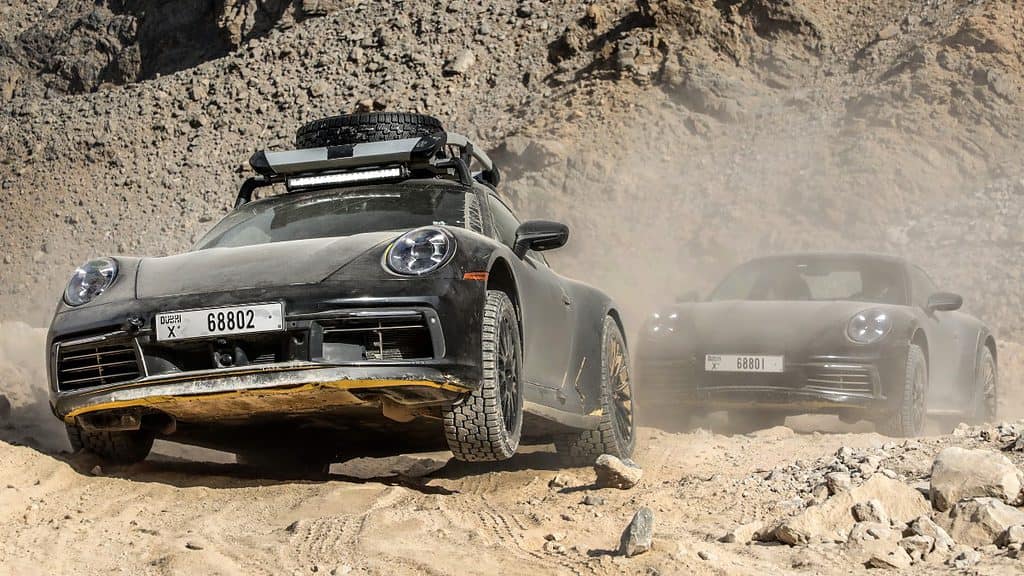
Then came the desert crucible. In the sprawling ergs of Dubai and the rugged washes of Morocco, development drivers repeatedly hammered the 911 Dakar straight up 50-meter (roughly 164-foot) sandy inclines under blistering ambient heat reaching 45 °C (113 °F). Sand doesn’t forgive hesitation, overheating, or sluggish throttle response, and the Dakar proved remarkably resilient both mechanically and thermally. Cooling ducts, oil radiators, and intercooler pathways were constantly evaluated under load to ensure the engine remained comfortably within safe operating temperatures even during slow-speed, max-throttle climbs.
“The 911 Dakar delivered a commanding performance even in the desert,” says Frank Moser, Vice President of Model Line 911/718. “Especially here, the 911 Dakar can make the most of its conceptual advantages – the combination of low weight, higher ground clearance, a powerful rear-mounted engine, and the short wheelbase make for an exhilarating driving experience. I was able to experience it myself on test drives in the Sahara.” That rear-engine layout, traditionally associated with razor-sharp rear-weight bias, works surprisingly well in loose conditions when paired with intelligent torque vectoring and robust underbody protection.
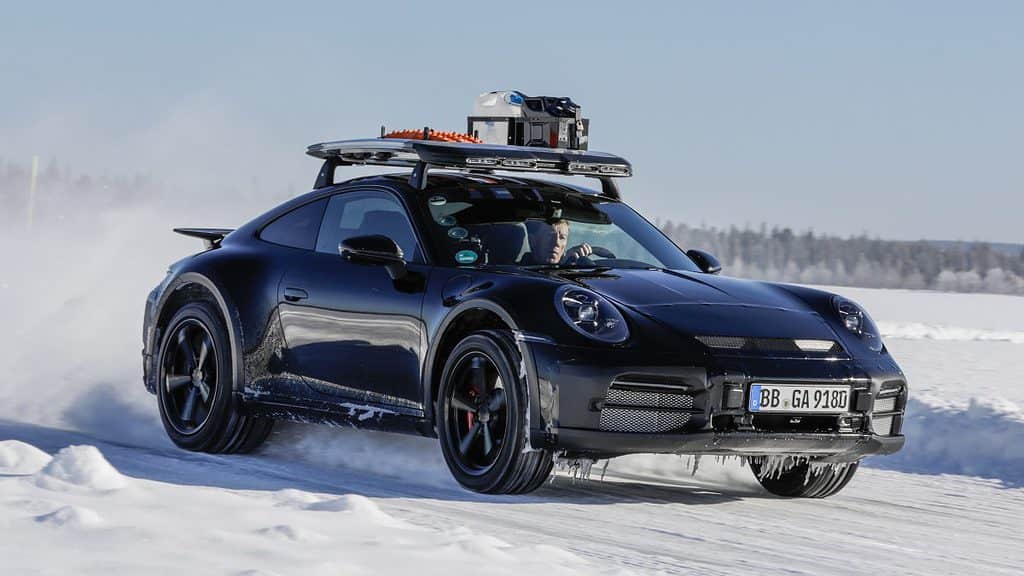
Beneath the Dakar’s aggressive, adventure-ready silhouette lies a deeply reworked version of the 992-generation 911 architecture. Ground clearance has been increased substantially compared to standard models, giving the Dakar the physical confidence to glide over rocks and whoops that would severely damage a conventional coupe. To protect vital mechanical components underneath, Porsche fitted reinforced aluminum scuff plates along the entire front section, extending deep beneath the turbocharged flat-six powerplant and front differential.
Visually, the Dakar announces its intentions instantly. A redesigned, highly angular front bumper integrates a massive aluminum underbody shield while allowing cool air to flow unhindered toward the intercoolers and radiators—essential for sustaining performance during extended desert runs. Wheel arches stretch noticeably wider to accommodate specialized Pirelli Scorpion All-Terrain 4S tires mounted on unique forged alloy wheels: 21-inch units up front gripping 255/45 ZR rubber, and staggerated 22-inch wheels at the rear shod in 315/35 ZR compounds. Those tires are specifically chosen to balance puncture resistance, long-distance durability, and sufficient lateral bite on dry earth or washed-out trails.
Power comes from the familiar yet highly evolved 3.0-liter twin-turbocharged horizontally opposed six-cylinder engine. Delivering 473 horsepower and 443 pound-feet of torque, the flat-six retains the sharp throttle response and immediate acceleration Porsche enthusiasts expect. However, unlike traditional rear-drive 911 platforms, the Dakar pairs this potent powertrain with a newly developed, permanently engaged all-wheel-drive system. This drivetrain features electronically controlled multi-plate clutches allowing seamless distribution of torque between the front and rear axles depending entirely on surface grip levels. On smooth tarmac, the system prefers sending most power rearward to maintain playful, drift-capable behavior characteristic of standard 911 models. When loose surfaces demand attention, power shifts forward instantly to prevent wheelspin and optimize directional stability.
Suspension duties fall to adaptive dampers featuring continuous variable control, offering both comfort-oriented compliance for everyday roads and stiffer settings for tackling rough dunes or washboard tracks. Ride height adjusts dynamically depending on driving mode—adding vital extra clearance automatically when switched away from standard road presets. Inside, cabin updates subtly reflect the Dakar’s dual nature: bold red safety belts contrast against dark leather upholstery, echoing race-car heritage while maintaining luxury standards. Brushed-aluminum door sill panels proudly feature “911 Dakar” lettering. Yet beyond those small aesthetic cues, the cockpit largely mirrors the standard 911 layout, ensuring familiarity remains intact.
Porsche brand ambassador Jörg Bergmeister participated actively during various stages of development testing and emerged genuinely impressed with the vehicle’s agility despite its elevated stance:
“I wouldn’t have thought that a vehicle with such ground clearance and all-terrain tires would still feel like a Porsche 911 on asphalt,” he admitted, noting how natural steering weighting and balanced weight transfer defied expectations typically built around SUVs or heavy crossover vehicles.
Development driver Lars Kern echoed similar sentiments regarding loose-surface manners during final fine-tuning sessions:
“At first I didn’t have the nerve to push the car to its limits. But I am very satisfied with the handling on loose surfaces. Even the ABS is optimized for braking on gravel. It’s amazing how much traction the off-road tires deliver. The car is a blast to drive.”
Anticipated pricing places the 911 Dakar firmly within hyper-premium territory, with estimates suggesting a starting point near $243,750 USD before destination charges. Given exclusivity constraints inherent to initial production batches and growing global demand for adventurous grand touring machines capable of venturing beyond paved highways, allocating resources accordingly makes financial sense—not just for buyers seeking something extraordinary, but also reinforcing Porsche’s legacy bridging classic rally heritage with tomorrow’s performance aspirations.
As deliveries ramp up heading toward spring of 2023, automotive collectors worldwide await their chance behind the wheel of what promises to become one of the most memorable iterations ever penned by Stuttgart’s master craftsmen—a true celebration of human ingenuity meeting unrelenting passion for speed across any surface imaginable.
Vehicle data
| Make | Porsche |
| Model | 911 Dakar |
| Generation / chassis code | 992 |
| Model year(s) covered | 2023 |
| Body style | Two-door coupé |
| Powertrain / enginecoupé>3.0L twin-turbocharged flat-six | |
| Power / torque | 473 hp / 443 lb-ft |
| Transmission | 8-speed PDK dual-clutch automatic |
| Drivetrain | All-wheel drive (AWD) |
| Key performance figures | Tested across 500,000+ km globally, 10,000+ km off-road; climbs 50m dunes at 45°C |
| Price (as stated) | Approximately $243,750 USD |
| On-sale / announcement period | Announced December 2022; deliveries expected Spring 2023 |
| Market | Global |