

The spirit of the original Type 2 Microbus is officially returning to the road, this time propelled entirely by electricity. In August 2017, against the manicured backdrop of the Pebble Beach Concours d’Elegance in Monterey, California, Volkswagen executives confirmed what enthusiasts and show-goers had been pleading for since the start of the year: the Volkswagen I.D. BUZZ concept is heading into series production, targeted to reach dealer showrooms by 2022.
Standing on the California lawn alongside classic Type 1 Beetles and vintage split-window T1 Transporters, Dr Herbert Diess, Chairman of the Board of Management for the Volkswagen brand, and Dr Eckhard Scholz, Chairman of Volkswagen Commercial Vehicles, gave the official green light to the project. The decision follows an overwhelmingly enthusiastic public reception at the 2017 North American International Auto Show in Detroit—where the vehicle was voted Show Car of the Year—and subsequent global acclaim at the Geneva Motor Show.
“After the presentations at the global motor shows in Detroit and Geneva, we received a massive number of letters and emails from customers saying, ‘please build this car,'” Diess reported in Pebble Beach. “The Microbus, which is what the Bulli is called in America, has always been part of the California lifestyle. Now we’re bringing it back by developing Volkswagen’s next generation and reinventing the Bulli as an electric vehicle.”

From Detroit Concept to Monterey Production Green Light
When Volkswagen pulled the satin cover off the yellow-and-silver concept at Cobo Center in Detroit in January 2017, the car seemed to strike an instant chord. For decades, Volkswagen designers had teased enthusiasts with nostalgic bus prototypes, from the clean Microbus concept of 2001 to the compact Bulli concept in Geneva in 2011 and the boxy BUDD-e shown at CES in 2016. None of those prior experiments made the leap from turntable to assembly line. Each stalled over packaging hurdles, production costs, or internal powertrain priorities.
The I.D. BUZZ represents a decisive break from those earlier hesitations. Built from the outset around the Volkswagen Group’s dedicated Modular Electric Drive Matrix—universally known inside Wolfsburg as the MEB architecture—the packaging advantages of flat-floor electrification solved the dimensional puzzles that hobbled previous front-engine or internal combustion concepts. Here, the layout mimics the mechanical packaging freedom of the original air-cooled rear-engine rear-wheel-drive T1, while upgrading propulsion into a zero-tailpipe-emission future.
The Monterey Peninsula provided symbolic ground for the production declaration. California was the cultural crucible where the air-cooled Microbus morphed from humble commercial workhorse into an emblem of freedom, surf culture, and counterculture adventure in the 1960s and 1970s. Diess noted that uniting Pebble Beach and Silicon Valley in one vehicle concept was deliberate: the design tips its hat to the classic Bulli heritage, while underneath sits pure Silicon Valley software integration, high-voltage battery modules, and Level 3 autonomous driving hardware.
The MEB Platform and Electric Packaging Ingenuity
The engineering premise of the I.D. BUZZ hinges entirely on the structural possibilities offered by the MEB platform. By packaging a massive 111-kilowatt-hour lithium-ion battery pack completely flat within the vehicle floor between the axles, Volkswagen engineers have decoupled cabin space from traditional powertrain constraints. There is no tall transmission tunnel dividing the cockpit, no radiator intrusion deep into the nose, and no bulky internal combustion engine demanding long front crash zones.
As showcased on the concept car, propulsion comes from a dual-motor electric all-wheel-drive setup. An electric motor mounted directly on the front axle and another on the rear axle work together to produce a combined system output of 275 kW, equivalent to roughly 369 horsepower. Volkswagen quotes an acceleration time from rest to 60 miles per hour in roughly five seconds, with top speed electronically restricted to 99 mph to conserve battery reserves during sustained high-speed touring.
Driving range is estimated at up to 270 miles under the United States EPA test cycle, or up to 600 kilometers under the European New European Driving Cycle (NEDC). Charging capability is equally ambitious: the concept’s high-voltage charging system is designed to take advantage of Combined Charging System (CCS) direct-current fast chargers operating at up to 150 kW, enabling an 80 percent battery replenish in approximately 30 minutes. An inductive wireless charging plate positioned in the floor of the vehicle also offers hands-free charging over compatible garage induction pads.
Exterior Dimensions and Modern Heritage Styling
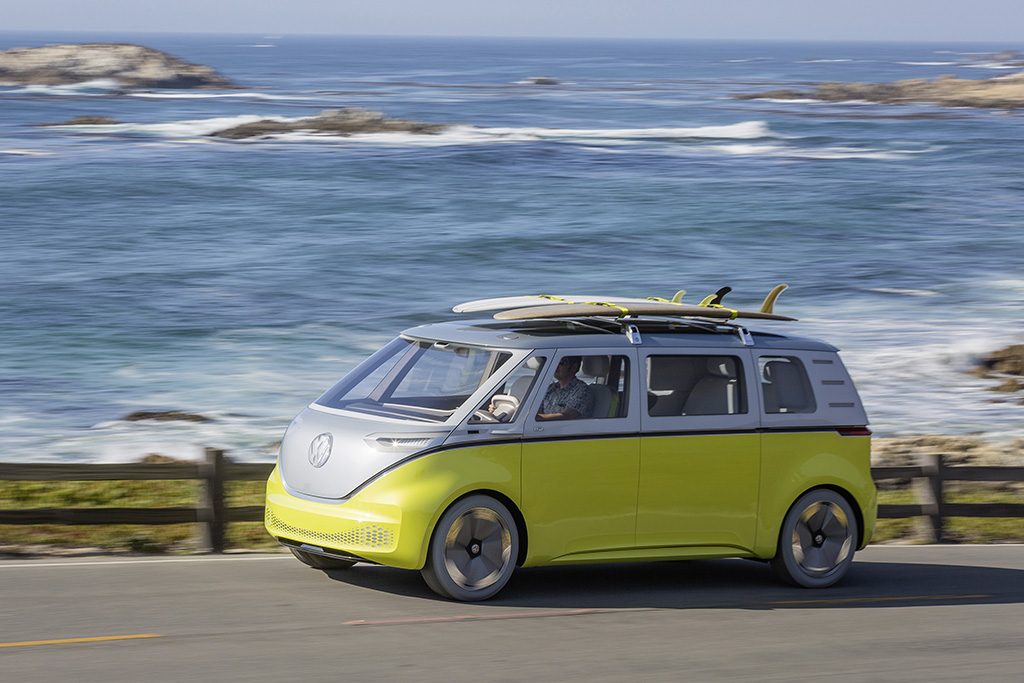
To the naked eye, the I.D. BUZZ looks remarkably compact, yet its dimensional measurements place it firmly in the practical sweet spot of modern vans. The concept stretches 4,942 mm in total length (about 194.6 inches), measures 1,976 mm in width (77.8 inches), and stands 1,963 mm tall (77.3 inches). The standout mechanical metric, however, is its wheelbase: a cavernous 3,300 mm (129.9 inches). This puts both front and rear axles right at the outer perimeter of the bodywork, creating ultra-short front and rear overhangs.
“The vehicle looks like a compact van on the outside, even as it offers the generous interior space of a large van,” explained Diess. That stance allows the vehicle to park easily on crowded metropolitan streets or navigate tight European parking garages, while simultaneously yielding three cavernous rows of passenger accommodation inside.
Visually, the concept avoids heavy-handed retro pastiche while paying homage to the original 1950 T1 Transporter. The traditional two-tone paint split—Cyber Yellow Pearl paired with Nevada White Pearl—follows a crisp horizontal character line that rings the entire waistline of the van. Up front, the smiling face features a large, backlit illuminated VW roundel flanked by narrow, communicative full-LED headlights. These lighting clusters use interactive LED light elements that simulate human eye movements, subtly greeting the driver upon approach or communicating vehicle operational status to pedestrians.

The Lounge Cabin and I.D. Pilot Automation
Step inside through the electrically operated sliding doors, and the I.D. BUZZ reveals an interior conceived more like a mobile Scandinavian living room than a conventional automotive cabin. The floor is lined with warm, light-colored birch wood slats fitted with integrated aluminum rails. These floor tracks allow the multi-position seats to slide forward, slide backward, fold flat into beds, or rotate completely. The front bucket seats can pivot 180 degrees backwards to face rear passengers, creating an intimate conversation lounge when the vehicle is stationary or operating in self-driving mode.
A modular center console, termed the “I.D. Box,” slides smoothly along the central track between the front and rear passenger compartments. It houses a removable tablet interface that controls infotainment, ambient cabin lighting, and climate zoning, while doubling as an adjustable tabletop complete with integrated cup holders.
Technological interaction is centered on an intuitive, haptic-touch steering wheel devoid of traditional spokes, instrument cluster dials, or physical stalks. In place of a conventional dashboard binnacle, driving information and turn-by-turn navigation arrows are projected directly onto the road ahead via a large augmented reality (AR) head-up display. In the center of the wheel rim sits a touchpad allowing drivers to select drive modes, switch signals, and manage media with gentle thumb inputs.
The concept is designed around Volkswagen’s automated driving vision, dubbed I.D. Pilot. Touching the center of the steering wheel for several seconds causes the wheel assembly to decouple mechanically and gently retract flush into the soft dashboard fascia. Ultrasonic sensors, radar sensors, front cameras, side surround cameras, and four roof-mounted laser lidar scanners extend outward to read the surrounding traffic environment, enabling Level 3 and automated cruising capability.

Commercial Fleets: The I.D. BUZZ Cargo Variant
While the passenger version targets families, outdoor sports enthusiasts, and lifestyle drivers, Volkswagen Commercial Vehicles is preparing a companion vehicle dedicated to commercial duties: the I.D. BUZZ Cargo. Dr Eckhard Scholz emphasized the vital role commercial haulage plays in Volkswagen’s ongoing electrification roadmap.
“Along with a minibus version, we’ll also be offering an I.D. BUZZ Cargo variant for zero-emission delivery operations in a Level 3 vehicle that boasts a high degree of automated driving capability,” said Scholz in California. “It’s an ideal electric van concept, particularly for inner cities.”
The Cargo version will forgo rear passenger glazing in favor of solid side panels, maximizing secure load volume and providing extensive flat surface area for corporate branding. With zero local emissions, the I.D. BUZZ Cargo is tailored directly for European and Asian urban centers that are preparing low-emission and zero-emission environmental zones, where internal combustion commercial delivery vans face escalating taxes or outright operational bans. The flat floor, generous payload capability, and wide rear door openings make it a direct modern counterpart to the venerable T1 panel vans that delivered parts and goods across post-war Europe.
A 70-Year Lineage: From Ben Pon’s Notebook to Strategy 2025
The historical significance of the Pebble Beach announcement was underscored by the presence of Dutch automotive royalty. Ben Pon, whose family built one of the earliest and most successful Volkswagen import networks through Pon Holdings in the Netherlands, traveled to California to inspect the vehicle in person. Exactly 70 years prior, in April 1947, Ben Pon’s father, Bernardus “Ben” Pon Sr., visited the Volkswagen factory in Wolfsburg to purchase Beetles. While touring the plant, he spotted an improvised parts-hauler known as the Plattenwagen, built by workers on a Beetle chassis.
Pon Sr. pulled out his notebook and sketched a rough box-on-wheels van with the driver seated way out over the front wheels and the engine tucked under the rear deck. That humble pencil sketch served as the direct conceptual spark for the Volkswagen Type 2 Transporter, which entered production in 1950 and went on to spawn more than six generations of vans, campers, and pickups worldwide.
When the production version of the I.D. BUZZ arrives at retail dealerships in 2022, seven decades will separate it from that first Wolfsburg T1. Yet the core design formula remains intact: maximizing usable interior volume within a tidy exterior footprint, wrapping utility in a friendly, approachable aesthetic, and democratizing personal mobility.
The I.D. BUZZ is also a cornerstone in Volkswagen’s overarching “Together – Strategy 2025” corporate initiative. Following the launch of the compact four-door MEB hatchback (previewed by the original I.D. concept at the 2016 Paris Motor Show), the electric Microbus will serve as the emotional flagship of the electric vehicle portfolio. Volkswagen aims to introduce more than 30 all-electric battery-powered models across its group brands by 2025, targeting key consumer markets across North America, Europe, and China.
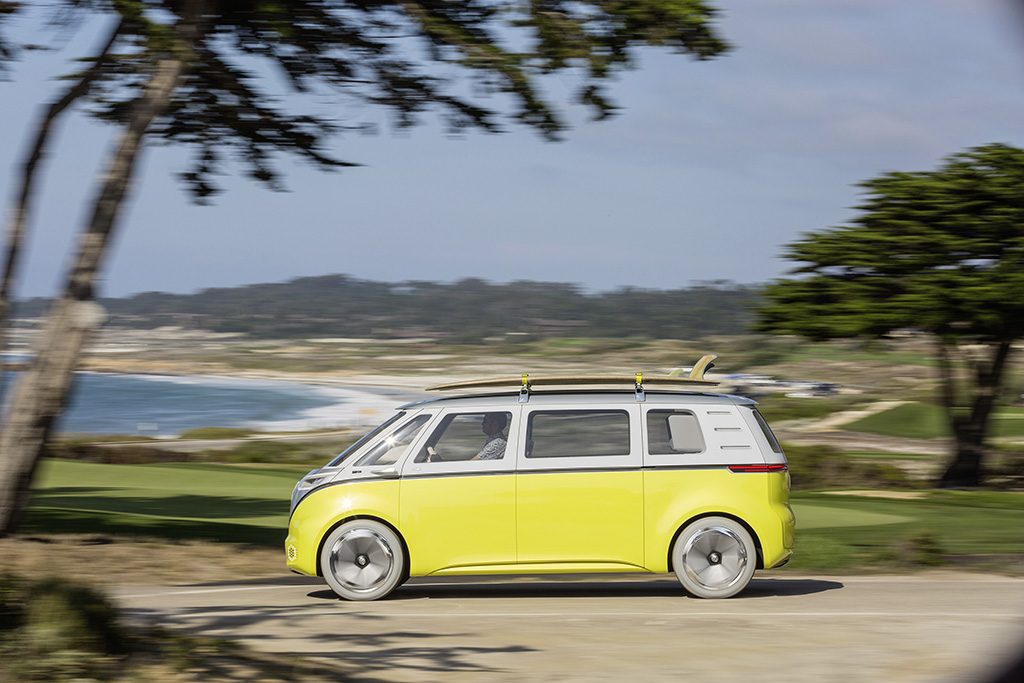
Vehicle data
| Field | Value |
|---|---|
| Make | Volkswagen |
| Model | I.D. BUZZ Concept (Production Confirmed) |
| Generation / chassis code | MEB Architecture (Modular Electric Drive Matrix) |
| Model year(s) covered | 2017 Concept / 2022 Target Production Launch |
| Body style | Electric Minibus / MPV (Passenger and Cargo variants) |
| Powertrain / engine | Dual electric motors (front and rear axle) with 111 kWh floor-mounted lithium-ion battery |
| Power / torque | 275 kW (369 hp) system total; torque not stated in sources |
| Transmission | Single-speed automatic electric drive |
| Drivetrain | All-wheel drive (electric AWD) |
| Key performance figures | 0–60 mph in approx. 5.0 seconds; top speed 99 mph (electronically limited); range up to 270 miles (EPA) / 600 km (NEDC); 80% charge in ~30 min at 150 kW DC |
| Price (as stated) | Not stated in sources |
| On-sale / announcement period | Announced August 2017 at Pebble Beach; series production launch targeted for 2022 |
| Market | North America, Europe, and China |