

A Legend Returns: The Fifth-Generation Toyota GR Supra Debuts in Detroit
In July 2018, at the Goodwood Festival of Speed, a low-slung prototype wrapped in dizzying black, red, and white geometric camouflage surged up the Duke of Richmond’s hill climb. Stenciled boldly across its flank was a single code that set enthusiast forums ablaze: “A90.” For Toyota loyalists, that alphanumeric sequence was an unmistakable declaration of intent. The A40, A60, A70, and the legendary A80 had each carried the Supra nameplate across three decades of high-speed grand touring. In January 2019 at the North American International Auto Show in Detroit, the disguise has finally come off. The 2020 Toyota GR Supra marks its undisguised world premiere, emerging as the premier global sports car engineered under the Toyota GAZOO Racing banner and ending a 21-year showroom absence in North America.
Behind the rebirth of the Supra stands more than a half-century of sports car engineering heritage. Scheduled to arrive at dealerships in the summer of 2019, the fifth-generation coupe will launch in two well-appointed grades—the 3.0 and 3.0 Premium—alongside an exclusive Launch Edition limited to 1,500 units for the U.S. market, priced from $49,990 for the 3.0 and $55,250 for the Launch Edition. For driving purists who spent two decades pining for an authentic successor to the twin-turbo A80, the A90 GR Supra preserves the sacred mechanical blueprint that made its ancestors legendary: a front-mounted, turbocharged inline six-cylinder engine, rear-wheel drive, a 50:50 front-to-rear weight balance, and a remarkably low center of gravity.
Yet the 2020 GR Supra is far from an exercise in sheer nostalgia. It represents a thoroughly modern, razor-sharp interpretation of the classic grand tourer, bristling with advanced chassis architecture, active powertrain electronics, and rigid structural tuning. Under the sculpted composite clamshell hood sits a 3.0-liter twin-scroll turbocharged inline-six developed in close technical collaboration with BMW, generating 335 horsepower and 365 lb-ft of torque. Channeled through a quick-shifting eight-speed automatic transmission, Toyota projects this rear-drive coupe will sprint from zero to 60 mph in just 4.1 seconds—instantly earning it the title of the fastest-accelerating Toyota-branded production car ever made.

GAZOO Racing Engineering and Akio Toyoda’s Track Development
From the earliest stages of development, Toyota GAZOO Racing established rigorous benchmarks to ensure the fifth-generation Supra possessed distinct, razor-sharp dynamics. Rather than assembling a generic grand tourer, engineers in Japan collaborated closely with teams from Toyota Motor North America and Toyota Motor Europe. Their mission was clear: craft a driver-focused two-seater that would communicate chassis feedback with surgical precision while remaining civil enough for cross-country highway jaunts.
The car’s dynamics received direct scrutiny from the very top of the company. Toyota President Akio Toyoda, driving under his seasoned Nürburgring alter ego “Master Driver,” took prototypes out on the Nordschleife, sweeping European mountain passes, and private proving grounds. His insistence on immediate front-end turn-in, predictable breakaway characteristics, and progressive throttle steering shaped the calibration of every electronic and mechanical system. The resulting setup guarantees that whether a driver is attacking apexes at a weekend track day or negotiating an undulating back road, the Supra delivers immediate feedback through the steering rack and chassis.
Condensed Extreme: Exterior Styling and the FT-1 Concept Legacy
Visually, the 2020 GR Supra embraces its heritage without resorting to caricature. The exterior design draws inspiration from the FT-1 concept car, originally penned by Toyota’s Calty Design Research facility in Newport Beach, California, and revealed in 2014. To transition the sweeping, exotic forms of the FT-1 into a functional, ultra-stiff production sports car, designers condensed the proportions, pulled the wheels to the absolute corners, and eliminated all extraneous surface bulk. Toyota refers to this design philosophy as “Condensed Extreme.”
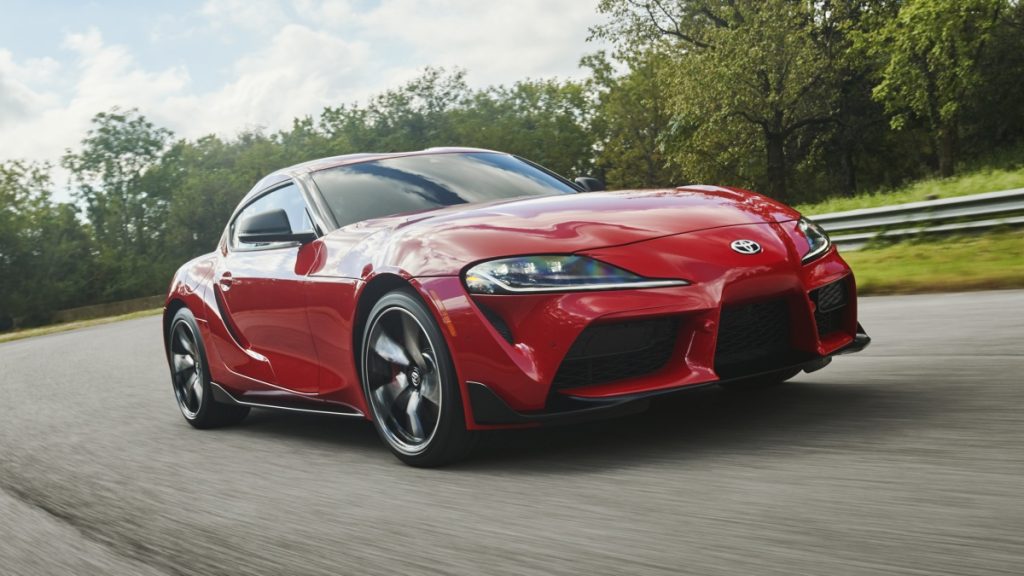
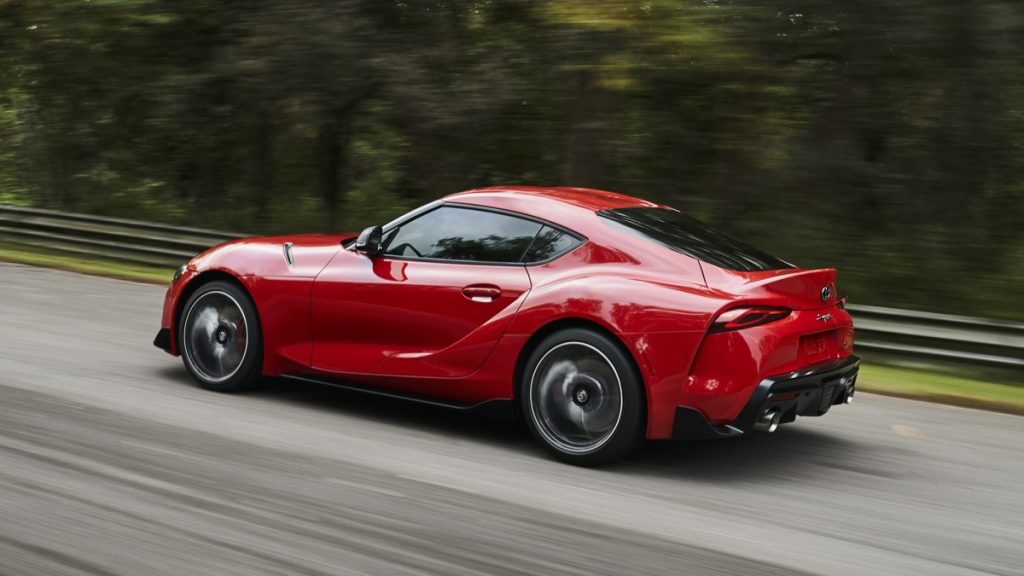
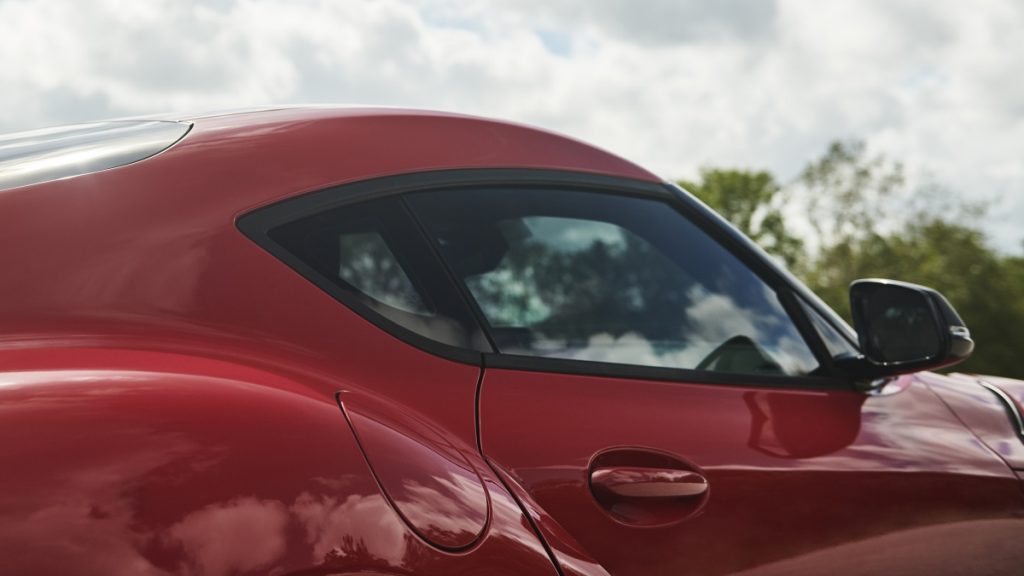
The packaging emphasizes core performance virtues: an elongated hood that highlights the longitudinal inline-six, an ultra-wide track, and a compact, two-seat cabin anchored between broad rear fenders. Aerodynamic efficiency played an equally decisive role in sculpting the sheet metal. The distinctive double-bubble roofline serves a double purpose: it pays direct visual homage to the 1967 Toyota 2000 GT while lowering aerodynamic frontal area without cutting into driver headroom when wearing a helmet.
Up front, the fascia evokes the broad, muscular face of the Mk. IV Supra, dominated by a prominent center section flanked by cavernous lower intake grilles that feed fresh air to the cooling modules and oil cooler. Six-lens LED headlamps bundle low and high beams with integral daytime running lamps and directional indicators into a sinister lighting signature. Around back, an integrated ducktail rear spoiler pays tribute to the towering wing of the 1990s Supra Turbo, effectively quelling aerodynamic lift at triple-digit speeds. A sculpted lower diffuser houses central F1-style LED reverse lights and dual circular exhaust exits. Even the script badging features thoughtful detail: the flowing “S” in the Supra emblem was redesigned to trace the arc of a classic racetrack chicane.
Toyota selected a rich exterior paint palette to accentuate the body’s sculpted surfaces. Standard and premium colors include Renaissance Red 2.0, Nitro Yellow, Downshift Blue, Absolute Zero White, Tungsten Silver, Turbulence Gray, and Nocturnal Black. Drivers seeking maximum visual drama can specify Phantom Matte Gray, an advanced matte finish infused with blue undertones that captures light across the muscular rear wheel arches like raw billet metal.
Cockpit Architecture and Interior Ergonomics
Step across the low sill into the Supra’s cockpit, and the cabin layout immediately reveals its single-minded focus on the driver. The horizontal dashboard is slender and low, opening an exceptionally broad forward sightline that allows the driver to spot corner apexes and clipping points with total confidence. Facing the pilot is a compact, thick-rimmed, leather-wrapped three-spoke steering wheel featuring integrated paddle shifters and audio controls.
Directly behind the wheel sits a high-definition digital instrument cluster dominated by a large central three-dimensional tachometer dial with a digital speed readout and shift-timing indicator. Driving telematics and audio readouts occupy the display periphery, ensuring that critical performance metrics remain directly in the driver’s line of sight. An available full-color Head-Up Display projects vehicle velocity, navigation turns, and active safety alerts directly onto the windshield glass.
The center console features an intentional asymmetrical design that wraps around the pilot like a racing tub. A prominent padded console spine serves as a right knee bolster during aggressive lateral cornering, while the passenger side is scooped out for extra shoulder space and fitted with dedicated knee bracing. Climate functions are housed on an intuitive push-button switchbank below the central air vents, enabling quick adjustments on the move without pulling attention away from the tarmac ahead.
High-bolstered sports seats with integrated head restraints provide lateral support without sacrificing long-distance comfort. The base 3.0 model features power-adjustable sport seats wrapped in grippy black Alcantara with memory functions, while the 3.0 Premium grade steps up to heated, full leather-trimmed upholstery. Practicality has not been abandoned: lifting the composite rear hatch reveals a wide, cleanly carpeted cargo hold tailored to swallow luggage for two or track-day essentials like tool rolls and racing helmets.
Twin-Scroll Turbocharged Inline-Six Powertrain
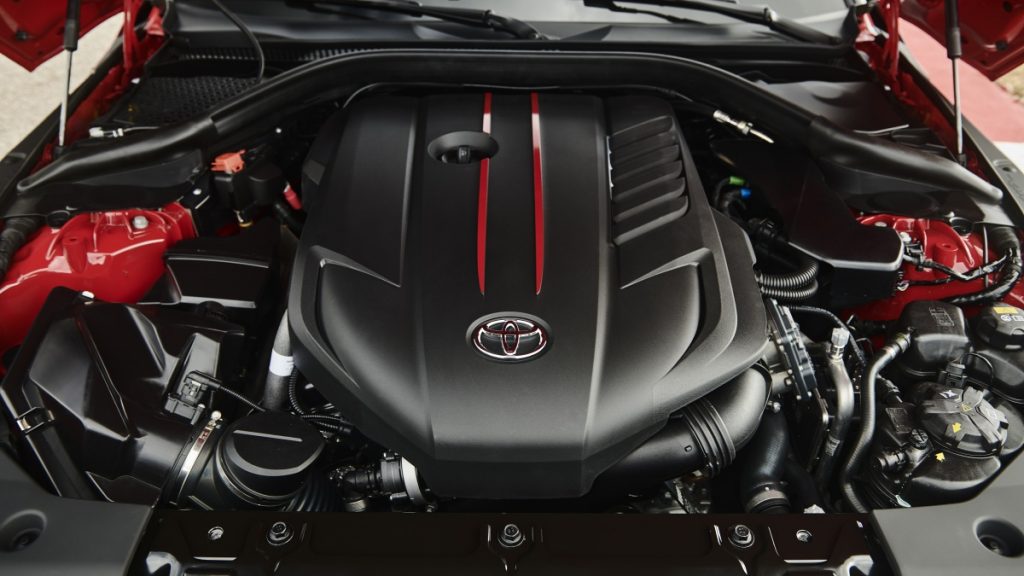
An inline six-cylinder engine is non-negotiable for any vehicle bearing the Supra badge. The 2020 GR Supra stays true to that legacy with a modern 3.0-liter longitudinal DOHC 24-valve inline-six. Built around a robust aluminum block and cylinder head, the engine features direct fuel injection, variable intake and exhaust camshaft timing, and variable intake valve lift. Feeding the combustion chambers is a twin-scroll turbocharger that divides exhaust pulses through split scroll passages, virtually eliminating turbo lag and providing instantaneous throttle response.
Output is rated at a stout 335 horsepower from 5,000 to 6,500 rpm, backed by a broad 365 lb-ft plateau of torque that hits as low as 1,600 rpm and pulls cleanly through 4,500 rpm. This flat torque curve delivers explosive mid-range punch, giving the Supra immense pulling power out of tight second-gear bends and rapid highway overtaking authority.
Backing the turbo inline-six is a quick-shifting eight-speed sport automatic transmission with steering-column paddle shifters. Engineers tuned the transmission software for lightning-fast gear changes during enthusiastic driving and relaxed cruising on the highway. Aggressive launch control software and short ratios in the lower gears allow the Supra to launch cleanly from a standstill, rocket from 0 to 60 mph in 4.1 seconds, and pull relentlessly until reaching an electronically limited top speed of 155 mph.
Chassis Dynamics, Active Differential, and Suspension
Pure straight-line speed is only one facet of the Supra’s personality. Toyota GAZOO Racing benchmarked torsional stiffness rigorously, achieving structural rigidity that surpasses even the carbon-fiber tub of the Lexus LFA supercar. To attain this level of stiffness without excessive weight penalties, engineers reinforced nine distinct structural zones around the rear frame and passenger compartment.

Underpinning the car is a double-joint spring strut front suspension and a five-arm multi-link rear axle. Lightweight forged aluminum control arms reduce unsprung weight, while rigid steel subframes and reinforced mounting points ensure that suspension geometry remains rock-solid under high lateral cornering loads. Variable-assist, variable-ratio electric power steering delivers direct, tactile feedback from the front contact patches.
Standard on every 2020 Supra is an Adaptive Variable Suspension (AVS) system with active damping that continuously adjusts damping force based on road imperfections and driver steering inputs. Drivers can toggle between Normal mode, tuned for compliant daily commutes, and Sport mode, which stiffens the dampers, sharpens steering weight, crisps up gear shifts, and opens an active exhaust valve for an exhilarating acoustic bark.
A central mechanical highlight of the driveline is the electronically controlled active differential. Utilizing an electric actuator and a multi-plate clutch pack, the differential manages torque distribution between the rear wheels with stepless variable locking ranging from zero to 100 percent. Under aggressive acceleration, trail braking, or hard mid-corner throttle application, the differential automatically stabilizes the rear axle, preventing unwanted inside-wheel spin and eliminating snappy oversteer or understeer.
Rolling stock consists of staggered 19-inch forged aluminum alloy wheels wrapped in ultra-high-performance Michelin Pilot Super Sport tires (255/35R19 front and 275/35R19 rear). Braking performance is anchored by four-piston Brembo front calipers clamping down on ventilated 13.7-inch iron rotors, offering fade-free stopping power and firm pedal modulation lap after lap.
Global Testing, Magna Steyr Production, and Technology
The development of the A90 Supra was an international endeavor. Prototypes endured tortuous durability cycles on the Nürburgring Nordschleife, winding Alpine passes through Austria and Italy, sub-zero ice tracks in northern Sweden, rugged proving grounds in Japan and Australia, and varied American highway routes. Final assembly takes place in Graz, Austria, at the Magna Steyr manufacturing plant alongside its platform sibling, the BMW Z4.
Despite its focused track credentials, the 2020 GR Supra comes generously equipped with premium grand touring amenities. Standard conveniences across the range include Keyless Smart Entry, dual-zone automatic climate control, rain-sensing wipers, auto-dimming mirrors, a rearview camera, and power-folding heated side mirrors.
Active safety is comprehensive. Every Supra features forward collision warning, automatic emergency braking with pedestrian detection, lane departure warning with steering assist, automatic high beams, and road sign assist. An optional Driver Assist Package adds full-speed adaptive cruise control, blind spot monitoring, rear cross-traffic alert, and rear-end collision warning.
Infotainment hardware varies cleanly by trim grade. The standard 3.0 model features a 6.5-inch center display controlled via a rotary dial on the center tunnel, complete with Bluetooth pairing and USB inputs. The 3.0 Premium grade steps up to a vibrant 8.8-inch touchscreen display with navigation, a touchpad rotary controller, Supra Connect telematics, wireless Apple CarPlay, wireless Qi smartphone charging, and a thunderous 500-watt, 12-speaker JBL premium audio setup (which is also offered as an option on the base grade).
Tracing the Lineage: Fifty Years of Toyota Sports Cars
To fully understand the fifth-generation Supra, one must look back half a century through Toyota’s sports car bloodline. The foundation began with the tiny 1965 Sports 800. Measuring barely 140 inches in length and tipping the scales at just 1,300 pounds, the featherweight coupe extracted 40 horsepower from an air-cooled two-cylinder boxer engine. It earned a reputation for reliability in endurance racing and holds the historic distinction of being the first production sports car to feature a lift-off aluminum roof panel.
In 1967, Toyota took the global automotive world by surprise with the hand-crafted, limited-production 2000 GT. Powered by a Yamaha-engineered dual-overhead-cam 2.0-liter inline-six, this svelte grand tourer captured three world speed records, set 13 international endurance records, and famously starred as an open-top roadster in the James Bond classic You Only Live Twice. With just 351 units ever crafted, the 2000 GT established Toyota’s credentials as a builder of world-class thoroughbred machinery.
The Supra nameplate itself was born in 1978 with the Celica Supra (A40), conceived as an elongated, upscale version of the Celica powered by a smooth inline-six. In 1982, the second-generation A60 Celica Supra arrived with pop-up headlights, pronounced wheel arches, and independent rear suspension. The decisive split occurred in 1986 with the standalone A70 generation, which introduced the first factory turbocharged Supra Turbo in 1987 with 230 horsepower and an optional sport roof.
The pinnacle arrived in 1993 with the fourth-generation A80 Supra. Armed with the legendary 2JZ-GTE sequential twin-turbocharged inline-six pushing 320 horsepower, the Mk. IV was an engineering triumph. It humiliated far pricier European exotics, vaulted from 0 to 60 mph in under five seconds, and achieved immortal status in modern car culture and tuner folklore. Although U.S. sales ceased in 1998 and Japanese assembly ended in 2002, the Mk. IV created a passionate global following. The arrival of the 2020 GR Supra closes that two-decade hiatus, resurrecting Toyota’s most revered badge with uncompromised focus on pure driving engagement.
Vehicle data
| Field | Value |
|---|---|
| Make | Toyota |
| Model | GR Supra (A90) |
| Generation / chassis code | Fifth generation (A90 / J29/DB) |
| Model year(s) covered | 2020 |
| Body style | 2-door, 2-seat fastback coupe |
| Powertrain / engine | 3.0-liter turbocharged DOHC 24-valve inline 6-cylinder (twin-scroll turbocharger, direct injection, variable valve timing and lift) |
| Power / torque | 335 hp @ 5,000–6,500 rpm / 365 lb-ft @ 1,600–4,500 rpm |
| Transmission | 8-speed automatic with paddle shifters and launch control |
| Drivetrain | Rear-wheel drive with active electronic differential (0–100% variable lock) |
| Key performance figures | 0–60 mph in 4.1 seconds; top speed 155 mph (electronically limited) |
| Price (as stated) | $49,990 (3.0 base), $53,990 (3.0 Premium), $55,250 (Launch Edition) |
| On-sale / announcement period | Unveiled January 2019 (Detroit Auto Show); U.S. on-sale Summer 2019 |
| Market | North America / Global |