

Open-Air V12 Grandeur: The Lamborghini Aventador S Roadster
When Sant’Agata Bolognese unveiled the Lamborghini Aventador S Roadster at the Frankfurt motor show, the world took notice—not merely because another open-top supercar had arrived, but because Lamborghini was refusing to compromise the soul of its flagship. While the broader industry was chasing forced induction and electrification, Sant’Agata dug deeper into its natural-aspiration playbook. The Aventador S Roadster is proof that even at its peak development stage, the company could extract new dimensions of excitement from a platform many assumed had already reached its limits.
The “S” badge signals more than aesthetic revision; it marks a full-throttle evolution of every mechanical subsystem. Where the original Aventador Roadster opened the door to roofless V12 motoring, the S version sharpens agility, increases grip, and redefines exactly what this class of automobile should deliver. As former Chairman and Chief Executive Officer Stefano Domenicali stated during its launch phase, the Aventador S Roadster sets fresh benchmarks in both technology and outright performance, adding an unmatched layer of sensory immersion to the existing lineup.

At the heart sits Lamborghini’s legendary 6.5-liter Naturally Aspirated V12 (codename L539), a masterwork of high-strung Italian engineering that continues to defy the industry’s drift toward smaller, boosted units. Redlining at 8,500 rpm, the flat-plane-crank V12 delivers 740 hp and an even more critical 690 Nm (509 lb-ft) of torque right at 5,500 rpm. The block features a 60-degree bank angle, aluminum construction, dry-sump lubrication for optimal oil control during hard cornering, and titanium connecting rods to keep rotating mass frantically light. Ignition uses piezo-electric injectors fed through a direct-plenum induction system engineered specifically for maximum volumetric efficiency at altitude and extreme rev ranges.
Transmission duties fall to Lamborghini’s seven-speed Independent Shifting Rods (ISR) automated manual, chosen deliberately over dual-clutch rivals to maintain a lighter overall package. Despite being a single-clutch unit, ISR manages lightning-fast shifts: up to 50 milliseconds when launched in Corsa mode, close to 300 milliseconds in STRADA for buttery smoothness. Power routes through a permanent all-wheel-drive train governed by an electronically actuated multi-plate Haldex clutch, which dynamically apportions torque front-to-back. Under heavy acceleration the rear axle can receive up to 80 percent of available driveline thrust, lending the roadster playful oversteer tendencies that seasoned enthusiasts will appreciate.

Saving weight while eliminating a fixed roof has always been a challenge for convertibles, yet Lamborghini approached the problem with characteristic material science ambition. The two-piece hardtop panels are molded from high-strength carbon fiber, tipping the scales at fewer than six kilograms total. Their convex architectural contour preserves generous head clearance above occupants and integrates seamlessly into the body lines when fitted. Removal requires no tools: simple latches allow panel extraction and placement in the front trunk storage compartment, where dedicated supports keep them safely stacked against airflow drag during transport.
Should drivers wish to trade full canopy exposure for moderate wind deflection, Lamborghini integrated an electrically operable rear screen behind the occupant compartment. Raised at the push of a button, the window channels turbulent air away from shoulders and neck while leaving the sky overhead completely accessible—a compromise solution that retains much of the open-air experience without subjecting passengers to deafening turbulence.

Aerodynamic refinement separates the S Roadster definitively from its predecessor. The rear bodywork adopts entirely new sculpting that differentiates the roadster visually from the coupe, channeling airflow around a distinctive engine bridge spanning the rear glass to the taildeck. Available in matte black painted carbon blade inserts or transparent variants showing the raw V12 beneath, the bridge houses ducting that accelerates boundary-layer separation and reduces lift at velocity. The adjustable rear spoiler operates among three defined positions, coordinated directly by LDVA—the Lamborghini Dinamica Veicolo Attiva—based on real-time speed, yaw rate, lateral acceleration, and the driver-selected operating mode.
Combined with a sharpened front splitter geometry and enlarged underfloor vortex generators, the aerodynamic suite pushes front-end downforce upward by more than 130 percent versus the outgoing Aventador. High-downforce configuration yields over fifty percent net aero efficiency; in minimum-drag posture, the figure climbs past forty percent. These numbers translate practically into press-button stability at triple-digit cruising speeds and planted traction during hard trail-braking entries into blind corners.

Beneath the carbon monocoque, the S designation unlocks one of the most sophisticated electronic control architectures ever assembled in a road-going supercar. LDVA serves as the central nervous system, continuously sampling telemetry from dozens of sensors—including wheel slip, brake pressure, steering angle, lateral G-force, ride height, and throttle position—at frequencies exceeding one thousand times per second. All data feeds govern active interventions before human reaction time could intervene.
The crown jewel is Lamborghini Rear-wheel Steering (LRS), implemented via two dedicated electromechanical actuators linked to the rear uprights. Below roughly thirty kilometers per hour, the system cranks the rear tires counter-phase to the front wheels, effectively shortening the wheelbase by centimeters and transforming what feels like a long-haul grand tourer into something nimble enough for narrow urban streets. Above that threshold, rear and front wheels turn in lockstep, increasing high-speed composure and reducing the steering effort needed for stable lane transitions. Paired with Lamborghini Dynamic Steering (LDS)—a speed-sensitive variable-ratio rack that tightens its ratio as velocity climbs—the roadster communicates road surface texture through the steering wheel with remarkable clarity.
Vertical compliance receives equal treatment. Pushrod-mounted shock absorbers equipped with Lamborghini Magneto-rheological Suspension (LMS) fluid adapt their damping force within single-digit millisecond intervals. Revised rear spring rates accommodate the altered weight distribution once the roof is stripped away, while updated kinematic linkages minimize squat during aggressive throttle application. Four selectable driving modes—STRADA, SPORT, CORSA, and the novel EGO program—govern everything from shift scheduling and traction calibration to steering feel and damper hardness, letting owners tailor behavior precisely to each outing.

Cabin design reflects an obsession with exclusivity rather than utilitarian practicality. Five factory interior themes provide foundational palettes of premium leather, Alcantara suede, contrast stitching patterns, and decorative inserts ranging from polished aluminum to exposed carbon weave. Yet few buyers settle for catalogue selections. Lamborghini’s Ad Personam bespoke division transforms the cockpit into a personal gallery. Launch-day highlight spec featured the striking Blu Aegir exterior paint—a deep aquamarine shade evoking coastal Mediterranean waters masking volcanic intensity—and matched internally with Blu Delphinus leather juxtaposed against Bianco Polar highlights. Accents include S-striped seat bolsters, color-matched dashboard fascia, and custom-tinted floor mats completing the statement.
The optional Carbon Skin textile upgrade replaces standard Alcantara headliners with a proprietary ultra-lightweight woven fabric, extending also to portions surrounding the passenger cell. Wing mirror cowlings, windshield surrounds, and lower body cladding—including front and rear fascias, side rocker elements, and functional vent apertures—finish in exposed carbon fiber throughout, establishing the visual language of raw technical competence.
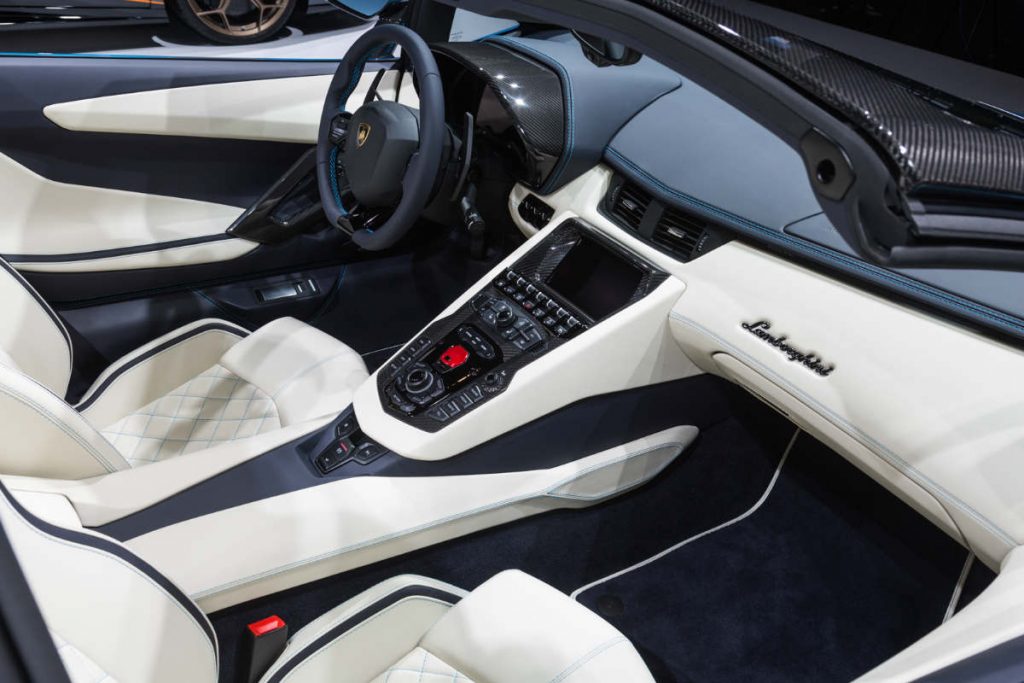
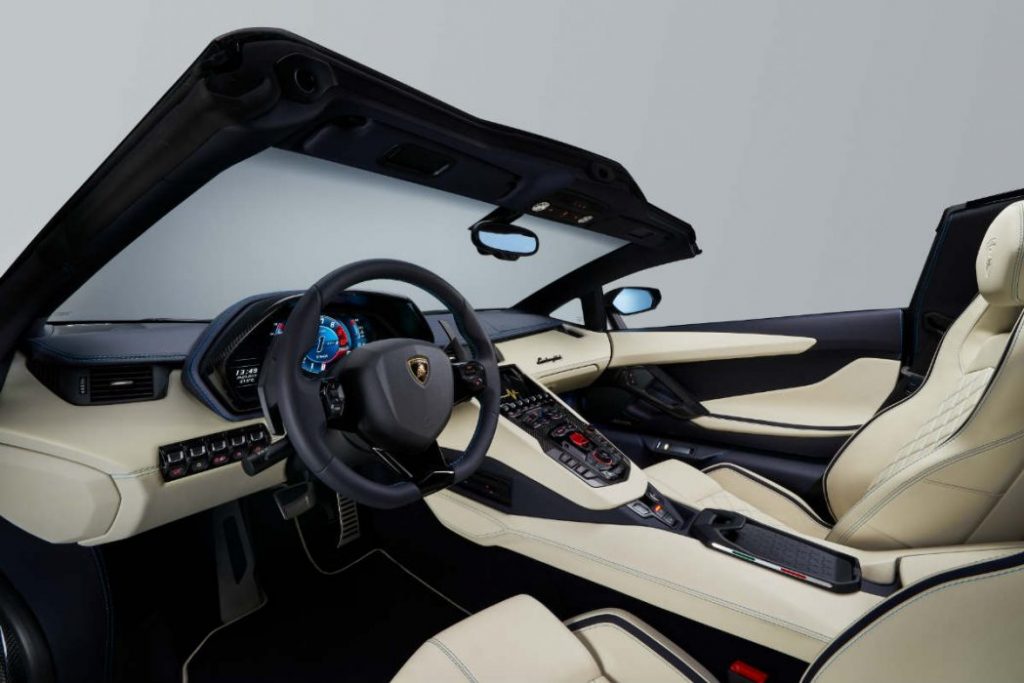
The driving experience merges theatrical flair with genuine everyday usability—remarkable for any car commanding this class of price. The instrument panel centers on a configurable TFT digital display projecting vital metrics, navigation prompts, and media information into the driver sight line. Apple CarPlay integration satisfies practical demands for smartphone pairing without compromising the driver-centric environment. Behind the squared-off multifunction wheel, paddle-shifters mounted on the column trigger ISR gear changes, delivering satisfaction comparable to flicking a proper toggle gate despite being automated commands.
Measured performance confirms every specification claim: zero to one hundred kilometers per hour arrives in exactly three seconds flat, the electronically limited top speed matching the coupé sibling at three hundredcoupéy kilometers per hour (two hundred seventeen miles per hour). Weight penalty versus the fixed-roof model measures just fifty kilograms—impressive considering the reinforcement work required to restore torsional stiffness. Standard footwear comes as staggered Dione-pattern forged alloy wheels, twenty inches diameter forward and twenty-one inches aft, shod exclusively in Pirelli P Zero rubber formulated specifically for this chassis.
Braking authority derives from standard-issue carbon-ceramic rotors—four hundred millimeters at the front hub, three hundred eighty millimeters at the rear—clamped by fixed aluminum calipers. Threshold braking reveals linear pedal progression rarely seen below million-dollar hypercars, inspiring confidence during repeated track deployments without fade-induced degradation.
The Lamborghini Aventador S Roadler arrives positioned squarely at the intersection of heritage and progress. Hand-assembled individually at Sant’Agata’s manufacturing facilities, each example carries the DNA of Giovanni Lamborghini’s founding philosophy: uncompromising performance fused with unmistakable Italian character. Against contemporaries including Mercedes-AMG’s SL range, Ferrari’s 488 Spider, and Porsche’s evolving Boxster lineage, the Aventador S Roadster occupies territory none others can replicate—the unfiltered intimacy of a screaming naturally aspirated twelve-cylinder engine vibrating through carbon fiber seats with nothing between driver and horizon except thin leather-wrapped steering column.

Vehicle data
| Make | Lamborghini |
| Model | Aventador S Roadster |
| Generation / chassis code | Not stated in sources |
| Model year(s) covered | 2018 |
| Body style | 2-door convertible / roadster |
| Powertrain / engine | 6.5-liter naturally aspirated V12 (L539) |
| Power / torque | 740 hp / 690 Nm (507 lb-ft) at 5,500 rpm |
| Transmission | 7-speed Independent Shifting Rods (ISR) automated manual |
| Drivetrain | Permanent all-wheel drive with Haldex clutch |
| Key performance figures | 0-100 km/h in 3.0 seconds; top speed 350 km/h (217 mph) |
| Price (as stated) | Not stated in sources |
| On-sale / announcement period | September 2017 (Frankfurt Motor Show debut) |
| Market | Global |