
Toyota Petrol-Electric Hybrid Momentum
Petrol-electric hybrid technology has firmly established itself at the centre of the British crossover and SUV market, driven by record half-year demand for Toyota’s electrified line-up. For the opening six months of 2017, the newly introduced C-HR and the established RAV4 Hybrid posted remarkable momentum, confirming that buyers are increasingly turning away from traditional diesel alternatives in favour of petrol-electric drive. The C-HR, introduced late in 2016, made an immediate impact with its sharp angles, distinctive roofline, and contemporary interior architecture. Instead of settling into a cautious supporting role, the petrol-electric variant quickly captured the lion’s share of interest, with hybrid drivetrains accounting for more than two out of every three C-HRs delivered during its first half-year in dealer showrooms.
Private motorists and commercial fleet operators alike have gravitated toward the petrol-electric configuration. Toyota’s latest fourth-generation hybrid architecture delivers seamless low-speed response and hushed urban running, qualities that traditional high-compression diesels struggle to match in urban traffic. Combined with low carbon emissions and reduced tax liabilities, the system offers substantial fiscal benefits for corporate drivers alongside genuine running-cost relief for family budgets. What is most popular is the highly efficient 1.8-litre Toyota hybrid petrol engine at the heart of the C-HR’s powertrain. It is a winner where the cost of ownership is concerned — efficiency designed in from the start, fuel economy optimised and emissions kept as low as any car in its class.
The C-HR’s own hybrid story
It is worth remembering how quickly the C-HR established itself. When it arrived in showrooms, it was not the obvious way into Toyota’s hybrid range. Crossovers were supposed to be practical, upright and a little predictable; the C-HR was none of those things. Yet the hybrid variant quickly became the one most people chose, and by the middle of 2017 more than two-thirds of all C-HR sales were petrol-electric. That is not a niche within a niche. It is the reverse: the hybrid became the mainstream, and the conventionally powered versions became the alternative.
Part of the appeal is that Toyota did not treat the hybrid as a compromise. There is no sense, sitting in a C-HR Hybrid, that you have bought the sensible version and given something up. The car drives with the smooth, unhurried responses that Toyota’s full-hybrid system is known for, gliding away from junctions on electric power alone, then bringing the petrol engine in almost imperceptibly as speed builds. For buyers stepping out of a diesel crossover, that calm, quiet progress is the surprise, and it is the thing they tend to mention first.
Under the skin of the C-HR Hybrid
The C-HR borrows its hybrid hardware from the Prius, which by 2017 was about the best possible provenance a petrol-electric system could have. A 1.8-litre petrol engine is paired with an electric motor and Toyota’s planetary-gear transmission, and the two work together to deliver a combined output quoted at around 120bhp. On paper that is modest for a car with this much visual drama, but the way the electric motor fills in the low-speed gaps means the C-HR never feels as slow as the number suggests. Toyota quoted a top speed of 105mph, and the torque figure, around 142Nm, tells you the system is tuned for easy, efficient cruising rather than for headline acceleration.
The real payoff is at the pump. Toyota’s official economy figure for the C-HR Hybrid was 72mpg, and even allowing for the usual gap between laboratory numbers and real roads, owners were reporting figures hovering around 60mpg in everyday motoring. For a family crossover doing the school run, the commute and the occasional long trip, that is a meaningful saving over the course of a year, and it explains why fleet managers, who count every penny, were just as taken with the car as private buyers. The design deserves a mention too, because it is inseparable from the C-HR’s success. The chiselled body, the coupe-like roofline and the high-mounted rear door handles were a deliberate break from crossover convention, and they gave Toyota something the segment badly needed: a car people wanted to be seen in.
The hybrid badge stopped being a signal of worthiness and started being a signal of taste. That shift in perception mattered far beyond one model.
Why a self-charging hybrid made sense in 2017
It is worth being precise about what these cars are, because the word hybrid covers a lot of ground. The C-HR and the RAV4 are full hybrids in Toyota’s sense: they never need plugging in. The electric motor draws its energy from a battery that the car keeps topped up by itself, recovering energy that would otherwise be lost as heat every time you slow down or brake. Around town, that means the petrol engine can shut off entirely at low speed and the car creeps along on electricity, which is exactly where a conventional petrol crossover is at its thirstiest. The clever part is that none of this asks anything of the driver.
There is no cable, no charging routine, no change to how you use the car. You fill it with petrol as you always did and the car quietly does the rest, deciding for itself when to run on electricity, when to run on the engine and when to blend the two. For a customer who liked the idea of lower fuel bills but had no way of charging at home, that was the whole point, and in 2017 it was a far easier sell than a plug-in alternative that needed a driveway and a routine. There were trade-offs, of course. A steady motorway cruise is not where a hybrid shines brightest, and a conventional diesel of the day could still match it on a long, constant-speed run.
But the hybrid clawed the advantage back everywhere else, in the stop-start traffic, the short trips, the cold mornings, and it did so without the clatter and the particulates that had started to turn buyers against diesel. Add Toyota’s long-standing reputation for reliability and the sums became easy to do, which is precisely why so many of these cars ended up on company fleets as well as driveways.
RAV4 Hybrid: the original recreational SUV turns electric
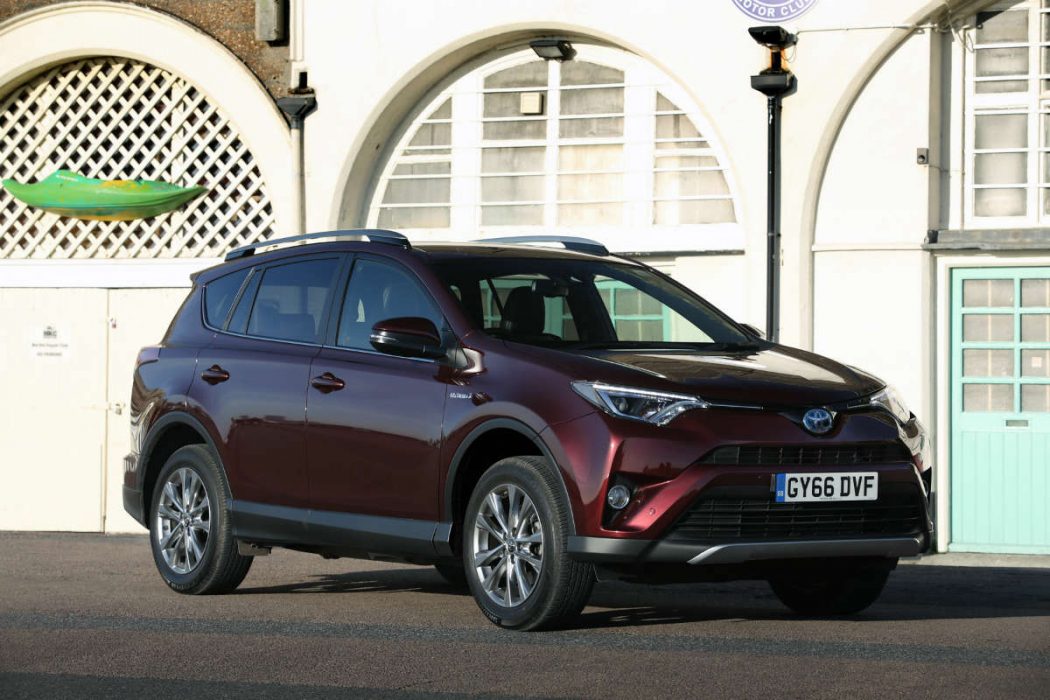
The other half of the first-half story is the RAV4, a nameplate with a longer history than almost anything else in the segment. Introduced at the start of the previous year, the RAV4 Hybrid opened a significant new chapter in the history of the world’s original recreational SUV, and in the evolution of Toyota’s hybrid technology. Where the C-HR uses a compact 1.8-litre system, the RAV4 packs something with more muscle. Its hybrid setup combines a 2.5-litre petrol engine with electric assistance to produce a full system output of 195bhp, which is the kind of power family buyers expect when they move up to a larger, more capable SUV.
Just as importantly, the RAV4 Hybrid offered the option of all-wheel drive, which is not something every hybrid of the era could claim. Toyota’s answer is called E-Four, and it is a clever piece of engineering that avoids the usual mechanical clutter. Rather than running a propshaft to the rear wheels, E-Four mounts a separate electric motor on the rear axle. When the car senses that the front wheels are losing grip, that motor quietly adds drive to the back, giving the traction of a four-wheel-drive SUV without the weight and efficiency penalty of a conventional system. In practice it means a RAV4 Hybrid can pull away cleanly from a damp junction, hold its line on a greasy country road and still return the fuel economy that made the hybrid badge worth having in the first place.
Toyota described it as delivering extra traction automatically when needed in slippery conditions, and that is exactly how it behaves: invisible when you do not need it, dependable when you do. For a car that has to work as a family workhorse through a British winter, that quiet reassurance is worth a great deal. In this market, the RAV4 Hybrid achieved excellent sales momentum, again with a good balance between private customers and business users. That balance is harder to achieve than it sounds.
Private buyers are drawn to style, space and low running costs; fleet buyers care about residuals, whole-life cost and reliability above almost everything else. A car that satisfies both is doing something right, and the RAV4 Hybrid’s split between retail and fleet tells you it is not an enthusiasts’ curiosity but a genuinely rounded proposition.

The numbers behind the first half
Step back and the scale of what happened in the first half of 2017 becomes clear. Toyota (GB) sold 22,616 hybrids between January and June, a rise of 30.6 per cent over the same period a year earlier. That is a remarkable rate of growth in a market that was, overall, far from buoyant. Hybrids were not simply keeping pace with the rest of the range; they were pulling ahead of it, and the C-HR and RAV4 together accounted for a large part of that lift. What makes the figure more striking is that it was not driven by a single hit model.
The C-HR brought in a wave of new, younger buyers who might never otherwise have considered a hybrid, while the RAV4 converted existing SUV owners who wanted the space and capability of a large family car without the fuel bills. Two different customers, two different cars, one shared powertrain philosophy. That is the strength-in-depth that Toyota’s marketing people were so keen to talk about, and the numbers backed it up neatly.
Ten million hybrids and counting
The first-half sales surge did not happen in a vacuum. Toyota has been building petrol-electric cars since the late 1990s, when the original Prius arrived and the rest of the industry treated hybrid power as an intriguing dead end. It was not. In February 2017, Toyota announced that worldwide sales of its hybrids had passed the ten million mark, a milestone reached just nine months after the previous nine-million milestone. The company pointed out that it now offered 34 different hybrid models across its range.
That long history matters when you look at the C-HR and RAV4. Toyota did not bolt a hybrid system onto these cars as an afterthought. The technology had been refined through more than a decade and millions of owners, and the reliability record built along the way is a big part of why fleet buyers trust it. When a company like Toyota has spent close to twenty years making hybrid systems better, the maturity shows up in the small things: the smoothness of the handover between electric and petrol power, the durability of the batteries, the way the whole car feels designed around the powertrain rather than adapted to carry it.
What Andrew Cullis had to say
Andrew Cullis, Toyota GB Marketing Director, summed up the mood. He said the fantastic performance of the C-HR and RAV4 demonstrated the increasing strength-in-depth of the company’s hybrid range, a line-up that offered more choice than any other manufacturer. Toyota had successfully tailored its technology to suit the demands of different vehicle segments, he added, so that its crossover and SUV models were a strong and attractive alternative to their conventionally powered rivals.
It is easy to read a quote like that as corporate optimism, but in this case the sentiment was backed by five-figure sales. The point Cullis was making is the one that ultimately defined Toyota’s position in the hybrid market: the company was not selling a single hybrid car, it was selling a hybrid choice in almost every size and shape a family might want. A C-HR for the couple who want something stylish and cheap to run; a RAV4 for the family that needs space and all-wheel drive. Same underlying idea, tailored to fit.
Where the technology goes from here
The first half of 2017 showed that hybrid power had moved from the edge of the showroom to the centre of it. The C-HR and RAV4 did not sell in spite of their hybrid systems; they sold because of them. Buyers who once worried about the complexity of a petrol-electric car, or the cost of replacing a battery, had clearly stopped worrying. What they saw instead was a straightforward bargain: less fuel, fewer emissions, and no compromise on the way the car drove.
For Toyota, that is the vindication of a very long bet. For the crossover and SUV segments, it is a sign of where things are heading. The petrol engine is not going anywhere in a hurry, but in more and more of these cars, it is being asked to work alongside an electric motor, and the models that make that partnership feel natural are the ones winning the sales. On the evidence of the first six months of 2017, the C-HR and the RAV4 Hybrid are doing exactly that.
Vehicle data
| Field | Value |
|---|---|
| Toyota C-HR Hybrid | |
| Make | Toyota |
| Model | C-HR Hybrid |
| Generation / chassis code | First generation (AW10) |
| Model year(s) covered | 2017 |
| Body style | Subcompact crossover SUV (coupe-like) |
| Powertrain / engine | 1.8-litre petrol + electric motor (full hybrid, self-charging) |
| Power / torque | Approximately 120bhp combined / 142Nm |
| Transmission | E-CVT (planetary-gear eCVT) |
| Drivetrain | Front-wheel drive |
| Key performance figures | Top speed 105mph / Official economy 72mpg / Real-world ~60mpg |
| Price (as stated) | Not stated in sources |
| On-sale / announcement period | Launched late 2016; H1 2017 review period |
| Market | United Kingdom / Global |
Toyota RAV4 Hybrid
| Field | Value |
|---|---|
| Make | Toyota |
| Model | RAV4 Hybrid |
| Generation / chassis code | Fourth generation (XA40) |
| Model year(s) covered | 2017 |
| Body style | Compact SUV / Recreational utility vehicle |
| Powertrain / engine | 2.5-litre petrol + dual electric motors (full hybrid, self-charging) |
| Power / torque | 195bhp system output |
| Transmission | E-CVT |
| Drivetrain | E-Four electric all-wheel drive (rear electric motor) |
| Key performance figures | Not stated in sources |
| Price (as stated) | Not stated in sources |
| On-sale / announcement period | Available from mid-2016; reviewed for H1 2017 |
| Market | United Kingdom / Global |