

World premiere of the Porsche Taycan: The sports car for a sustainable future
Porsche did something today that the brand has been teasing for years: it finally pulled back the curtain on the production version of what was once called the Mission E concept. The Porsche Taycan—the name borrowed from a rearing Mustang in the wilds of New Mexico—arrived simultaneously on three continents, because Stuttgart clearly wanted everyone in on the news at once. This is not a half-measure. It is the automaker’s boldest bet yet, a fully-electric four-door sports sedan that aims to prove EV performance need not sacrifice soul.
The timing is no accident. As Tesla’s Model S continues to siphon off affluent eco-conscious buyers and legacy rivals scramble to launch their own electric propositions, Porsche is entering the arena with weapons-grade hardware wrapped in unmistakable Porsche styling. And unlike some competitors’ electric efforts—which feel like afterthoughts grafted onto conventional designs—the Taycan was conceived from the ground up as an EV. Every component, from chassis layout to interior architecture, starts with the battery pack at floor level and builds outward.
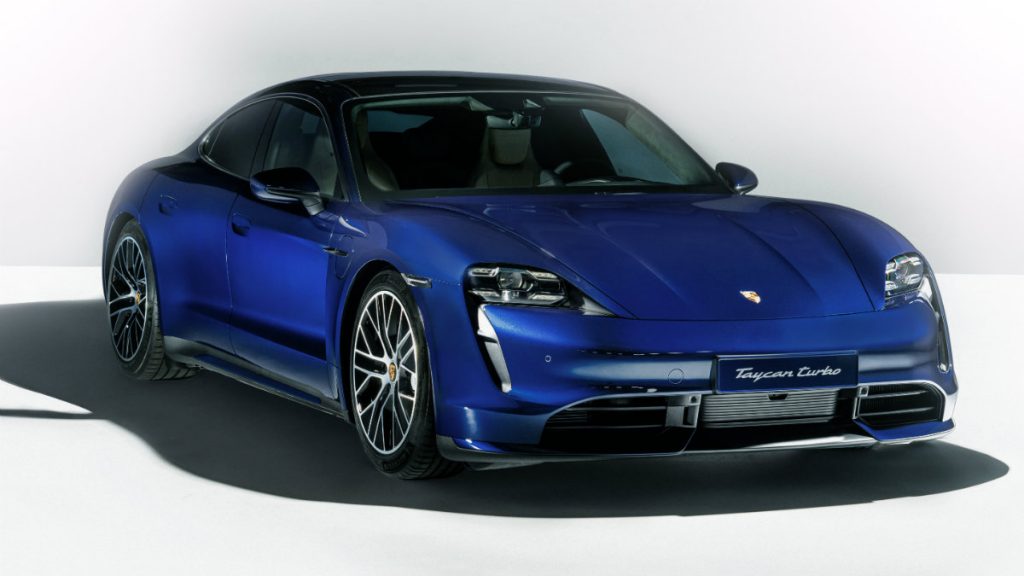
Two flavors of power: Turbo S and Turbo
At launch, Porsche is offering two all-wheel-drive variants, each armed with a pair of electric motors—one on each axle. The numbers are staggering even by Porsche standards. The top-of-the-line Taycan Turbo S cranks out up to 750 horsepower (560 kW) with Launch Control engaged, equivalent to roughly 560 kilowatts through overboost. The regular Taycan Turbo sits slightly lower at 670 horsepower (500 kW), though both figures require you to fire up the overboost function to access maximum output.
In concrete terms, those power figures translate to 0-60 mph sprints of 2.6 seconds for the Turbo S and 3.0 seconds for the Turbo. Both claim a top track speed of 161 mph. These aren’t just quick-off-the-line numbers either; Porsche engineers have focused heavily on sustained high-speed capability, which matters when you’re dealing with a heavy battery pack pushing several hundred horsepower to all four wheels. The torque delivery is immediate and linear, fundamentally changing how this four-door sports sedan accelerates compared to a traditional turbocharged engine.
The 800-volt advantage
Perhaps the most technically significant feature of the Taycan is its electrical architecture. While nearly every other electric car on the market runs on a 400-volt system, the Taycan operates at 800 volts—or close enough, depending on your charging setup. The practical payoff is dramatic: under ideal DC fast-charging conditions, Porsche claims the vehicle can recharge from 5 percent to 80 percent State of Charge in just 22.5 minutes, provided your charger can deliver the peak charging power of up to 270 kW. That puts the Taycan ahead of the competition in refuel time, a critical factor for daily usability that many early EVs neglected entirely.
Beneath the rear seats lies the main battery, a water-cooled unit with a total capacity of 93.4 kWh gross (approximately 79.5 kWh usable, though Porsche doesn’t emphasize that figure publicly). For home charging, owners can draw up to 9.6 kW AC through a standard SAE J1772 connector, which allows overnight replenishment in most scenarios. The 800-volt design also enables recuperation rates of up to 265 kW, meaning the electric motors act as generators during deceleration and feed substantial energy back into the battery—a process that Porsche says accounts for approximately 90 percent of everyday braking in typical driving.
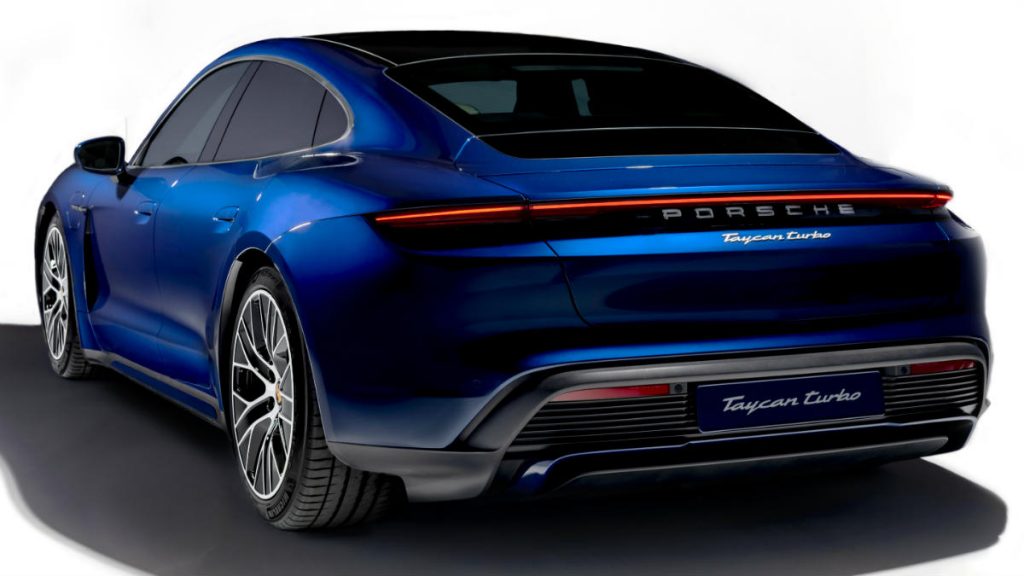
Design language: Pure Porsche, but different
Styling the Taycan required walking a tightrope between familiarity and innovation. Porsche could not afford to make a car that felt alien to existing customers, yet it had to signal clearly that this was something new. The result is an unmistakably proportioned four-door coupe silhouette with the brand’s signature teardrop roofline running smoothly from A-pillar to tail. Up front, wide haunches house slim LED headlights with the optional Matrix-beam Light Matrix technology, and the absence of a conventional grille—an unavoidable consequence of having no engine needing air—has been handled with active grille shutters and aerodynamic ducting that keep the nose looking purposeful rather than hollow.
Rear lighting gets special attention too. Porsche integrated its logo into the light bar using glass elements, a clever trick that maintains brand recognition while keeping lines clean. The overall drag coefficient of 0.22 is remarkably low for a vehicle of this shape and size, directly translating to better range without compromising interior space. That balance between aesthetics and efficiency is exactly where Porsche wants to position the Taycan against rivals whose designs prioritize packaging over visual appeal.

A cockpit built for a new era
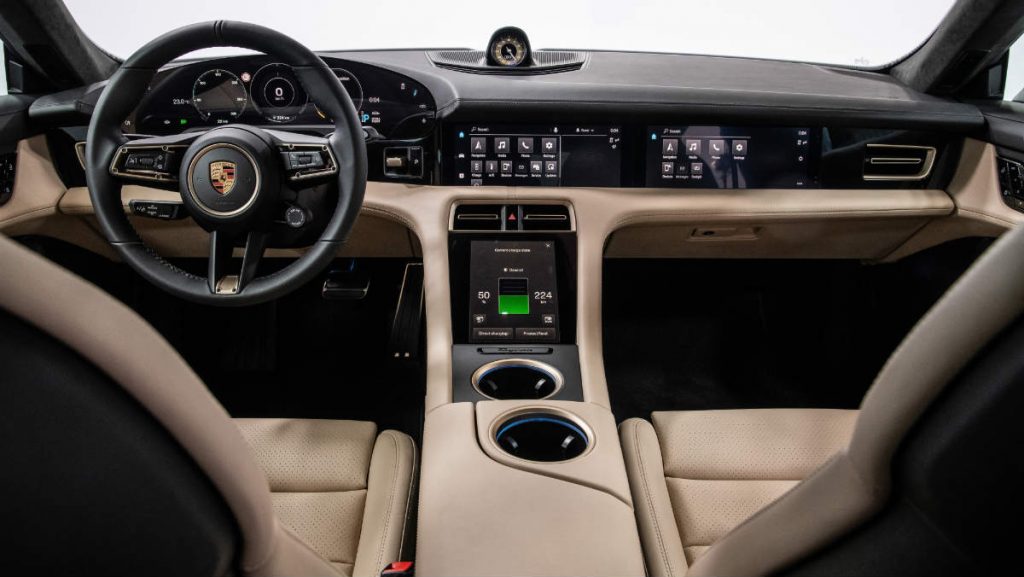
Sit inside and you immediately notice the absence of the instrument cluster you’d expect behind the steering wheel. Instead, Porsche mounted a free-standing, curved digital display slightly above the dash—a departure from nearly every other car in the brand’s history. A central 10.9-inch touchscreen handles infotainment, navigation, climate controls, and vehicle settings, while an optional 10.9-inch passenger display adds entertainment for the front seat rider without distracting the driver. All user interfaces were designed specifically for the Taycan and respond to touch or voice command via “Hey Porsche” activation.
Physical buttons have been drastically reduced but not eliminated. Climate dials remain tactile, a sensible choice Porsche deserves credit for, while most other functions live within menus. Interior materials span everything from leather to innovative alternatives made from recycled plastics, reinforcing the sustainability narrative. Rear passengers benefit from recessed footwells carved into the transmission tunnel—a classic sports car packaging trick—and separate luggage compartments: 2.8 cubic feet in the frunk (front trunk) and 12.9 cubic feet in the rear, enough for weekend baggage despite the battery intrusion.
Chassis engineering and drive modes
Underneath lies what Porsche calls 4D Chassis Control, an integrated approach that coordinates suspension, damping, steering, and drivetrain behavior simultaneously. Standard equipment includes adaptive air suspension with Porsche Active Suspension Management (PASM), which adjusts ride height and damping based on conditions. Optional upgrades add the PDCC Sport electromechanical roll stabilization system and PTV Plus torque vectoring across the rear axle.
One mechanical innovation specific to the Taycan is the two-speed transmission on the rear axle. First gear optimizes acceleration from rest—critical for an EV with instant torque—while second gear kicks in at higher speeds to improve efficiency and sustain top-end performance. It’s an elegant solution that avoids the compromise many single-gear EVs face between sprint performance and highway cruising economy.
Four driving modes frame the experience: Normal, Sport, Sport Plus, and Range, plus an Individual setting where drivers mix and match parameters freely. Each mode alters throttle response, shift character, steering weight, and recuperation intensity. Range mode deliberately softens everything to maximize efficiency, while Sport Plus sharpens responses and holds gears longer in simulated auto-mode. Even in Normal, the Taycan feels agile and responsive, though never anxious unless you ask it to perform.

A triple-world premiere, a bold statement
What made this launch event particularly unusual was its geographic scope. Rather than hosting a single reveal in Europe and asking journalists elsewhere to tune in via livestream, Porsche staged simultaneous unveilings in North America, China, and Europe. Niagara Falls served as the American backdrop, harnessing hydroelectric power. Neuhardenberg near Berlin showcased a solar installation. Pingtan Island off the coast of Fuzhou featured wind turbines. It was theatrical, yes, but deliberate: Porsche wanted to communicate that its vision for sustainable performance draws from renewable sources worldwide.
The broadcast reached audiences globally through NewsTV.porsche.com, a direct-to-consumer channel that sidestepped traditional automotive press events. Whether this signals a broader shift in how premium brands engage buyers remains to be seen, but the gesture underscored the significance Porsche places on the Taycan. This isn’t merely a compliance car designed to meet zero-emission mandates. It is positioned as a halo product that will define the brand’s electrified identity for years to come.
Market positioning and what follows
The initial Taycan lineup covers the Turbo S and Turbo variants, both positioned firmly in the upper echelon of the luxury EV market. Less powerful derivatives are confirmed for development, with Porsche explicitly naming the Cross Turismo variant—a raised, wagon-style body—as the next addition to the range. Beyond that, industry observers speculate about a more affordable entry-level model bearing simply “Taycan” badging, potentially arriving later in the decade, but these remain unconfirmed at present.
Porsche has committed over 6.6 billion euros toward electric mobility investments through 2022, a sum that extends well beyond the Taycan platform. But in automotive marketing terms, the Taycan is the spearhead. If Porsche can replicate even a fraction of the emotional connection enthusiasts feel toward the 911 in this four-door package, it will have accomplished something remarkable: making sustainability desirable rather than obligatory.
The road test awaits. Production deliveries haven’t begun yet, and the final driving impressions will come later this year when reviewers take the wheel. Until then, the Taycan stands as both a proof of concept and a promise—a glimpse of where Porsche intends to go, and a challenge thrown down to every other manufacturer still contemplating what electric performance really means.
Vehicle data
| Make | Porsche |
| Model | Taycan Turbo S / Taycan Turbo |
| Generation / chassis code | J1 (first generation) |
| Model year(s) covered | 2020 |
| Body style | Four-door sports sedan (fastback coupe) |
| Powertrain / engine | Dual electric motors (front + rear), 800V architecture |
| Power / torque | Turbo S: 750 hp (overboost w/Launch Control) | Turbo: 670 hp (overboost) |
| Transmission | 2-speed automatic (rear axle) |
| Drivetrain | All-wheel drive (AWD) |
| Key performance figures | Turbo S: 0-60 mph in 2.6s | Turbo: 0-60 mph in 3.0s | Top speed: 161 mph both |
| Price (as stated) | Not stated in sources (US MSRP estimated ~$150k-$185k for Turbo S) |
| On-sale / announcement period | Announced October 2019 |
| Market | Global (North America, Europe, China) |