

The eighth-generation Porsche 911 arrives with wider arches, digital cockpits, and 450 horsepower
Few car designs carry the sheer historical gravity of the Porsche 911. When Zuffenhausen pulls the wraps off an entirely new generation, the sports car landscape pauses to take notes. Unveiled on the eve of the Los Angeles Auto Show in late 2018, the eighth-generation 911—codenamed the Type 992—steps forward into a radically shifting market. Porsche’s engineers faced a delicate brief: elevate raw cross-country pace and cornering precision while satisfying an escalating appetite for digital cockpits, high-bandwidth driver assistance, and daily refinement. Rather than tearing up the blueprint, Porsche has doubled down on its rear-engine silhouette, broadening the stance and modernizing the mechanical foundation.
At launch, the spotlight falls squarely on the Carrera S and its all-wheel-drive sibling, the Carrera 4S. Both iterations receive a heavily reworked 3.0-litre twin-turbocharged flat-six that now delivers 450 PS (331 kW; 443 hp). That represents a clean 30 PS lift over the outgoing 991.2 generation. Backing that powerplant is an all-new eight-speed dual-clutch transmission (PDK) engineered specifically to manage heavier torque loads and accommodate future hybrid integration. Paired with wide-track bodywork standard across both rear-wheel-drive and all-wheel-drive derivatives, the 992 blends traditional sports car tactile balance with thoroughly contemporary technical architecture.

Twin-turbo flat-six engineering and the new eight-speed PDK
Under the rear decklid sits an extensively revised version of Porsche’s 2,981 cc boxer unit. While the engine displacement matches the outgoing Carrera S, almost every critical ancillary has been repositioned or redesigned. The twin turbochargers are larger, mirror-symmetrical units with electronically controlled wastegate valves, spinning in opposite directions to optimize exhaust gas flow and sharpen transient throttle response. Porsche has also relocated the charge air coolers. Previously tucked into the lower corners behind the rear wheels, the intercoolers now sit directly above the engine beneath the rear decklid grille, significantly shortening the intake tract and lowering charge-air temperatures under hard sustained acceleration.
Piezo injectors replace solenoid valves in the direct fuel injection system, spraying fuel with surgical accuracy at pressures up to 200 bar. This refined combustion process not only cleans up tailpipe emissions to satisfy strict European particulate standards, but it also releases peak torque of 530 Nm (391 lb-ft) across a remarkably wide rev band from 2,300 to 5,000 rpm. Whether pulling out of a hairpin in second gear or building speed along an unrestricted Autobahn stretch, the flat-six delivers linear, relentless drive that belies its forced-induction plumbing.
Channelling that muscle is a brand-new eight-speed dual-clutch transmission developed alongside ZF. Replacing the former seven-speed PDK unit, this gearbox features a gear spread that broadens both end of the driving envelope. First gear is slightly shorter for sharper off-the-line getaways, while the eighth ratio serves as a tall overdrive gear, allowing quiet, relaxed, high-speed motorway cruising at minimal engine revs. Top speed in both Carrera S models is actually achieved in sixth gear, leaving seventh and eighth dedicated to touring efficiency. The gearbox housing has also been cast with a deliberate internal cavity designed to host an electric motor, quietly preparing the 992 platform for hybridisation later in its life cycle without eating into passenger luggage space.

Benchmark acceleration and all-weather traction
Against the stopwatch, the Carrera S and Carrera 4S demonstrate tangible gains. The rear-wheel-drive 911 Carrera S sprints from zero to 100 km/h (62 mph) in just 3.7 seconds, shaving 0.4 seconds off its predecessor’s time. The all-wheel-drive Carrera 4S exploits its extra front-axle traction off the mark to hit the same benchmark in 3.6 seconds. Specify the optional Sport Chrono Package—which adds dynamic engine mounts, the steering-wheel mode dial, and launch control—and both times fall by another 0.2 seconds, recording 3.5 seconds and 3.4 seconds respectively. These figures place an entry-level S-model on par with the naturally aspirated track specials of just one generation prior.
Top speed numbers confirm that high-speed stability was a major priority for Weissach’s aerodynamicists. The Carrera S tops out at 308 km/h (191 mph), while the extra driveline drag of the Carrera 4S trims top velocity to 306 km/h (190 mph). In the 4S, power distribution between front and rear axles is managed by an enhanced Porsche Traction Management (PTM) system featuring water cooling for the clutch pack and reinforced drive shafts, ensuring the all-wheel-drive mechanics withstand hard, repetitive launches without thermal degradation.

Muscular proportions and an all-aluminium outer skin
Visually, the Type 992 looks hunkered down, purposeful, and noticeably broader than the car it replaces. The most significant architectural change is the elimination of the narrow-body shell. In previous 911 generations, all-wheel-drive and GTS variants enjoyed widened rear arches, while standard two-wheel-drive Carreras made do with a slimmer waist. With the 992, Porsche standardizes the wide body across the entire lineup. The rear track measures an identical 1,852 mm across all Carrera models, emphasizing the pinched cockpit greenhouse and athletic rear haunches.
At the front, the track has widened by 45 mm, matching the front apron width of the outgoing 911 GT3. This wider front footprint provides greater turn-in stability, reduces body roll, and works in concert with staggered wheel diameters: 20-inch alloys at the front wrapped in 245/35 ZR20 rubber, and 21-inch wheels at the rear wearing meaty 305/30 ZR21 tires. The larger rear wheel diameter increases tire contact patch and longitudinal grip, transforming how the car puts down power out of second-gear corners.
Underneath the paintwork, Porsche’s body engineers have completely re-engineered the monocoque structure. The outer skin is now stamped entirely from lightweight aluminium, saving weight and increasing torsional rigidity by five percent over the 991. The only exterior panels not pressed in aluminium are the front and rear bumper aprons. Flush, electrically deploying door handles pop out smoothly when approaching with the key fob and retract flush into the coachwork when driving, smoothing airflow along the body sides.

Heritage styling cues and advanced active aerodynamics
Look closely at the forward silhouette, and the historical design dialogue becomes evident. Between the modern four-point LED headlights sits a front luggage lid featuring a pronounced central depression. This subtle dip is a direct visual nod to the early air-cooled 911s from the 1960s and 1970s, which featured a recessed bonnet to clear the front luggage compartment latches. It is a clean piece of heritage detailing that breaks up the expanse of modern surfacing.
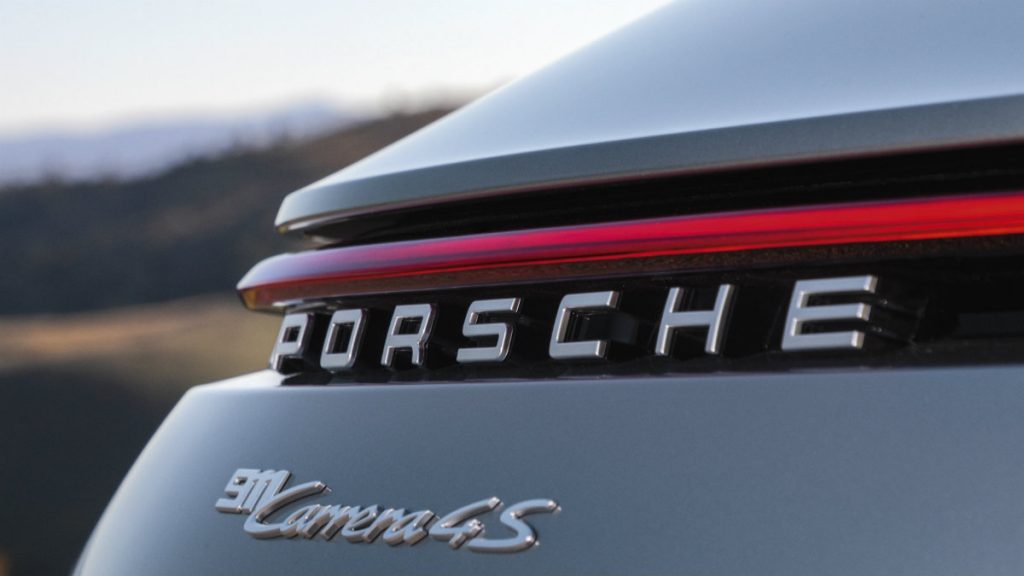
Around back, the rear apron is dominated by a variable-position active rear spoiler that spans almost the full width of the car. The spoiler deploys at three distinct angles depending on road speed, driving mode, and whether the optional sliding sunroof is open. In its most aggressive stance, it supplies authentic rear downforce during fast circuit driving. Directly beneath the spoiler lip runs a razor-thin, seamless LED light strip that unifies the tail. Vertical slats above the rear decklid incorporate third brake lights styled to look like twin exhaust pipes when viewed from behind, demonstrating Porsche’s obsessive attention to sculptural detail.

A digital cockpit inspired by classic 1970s architecture
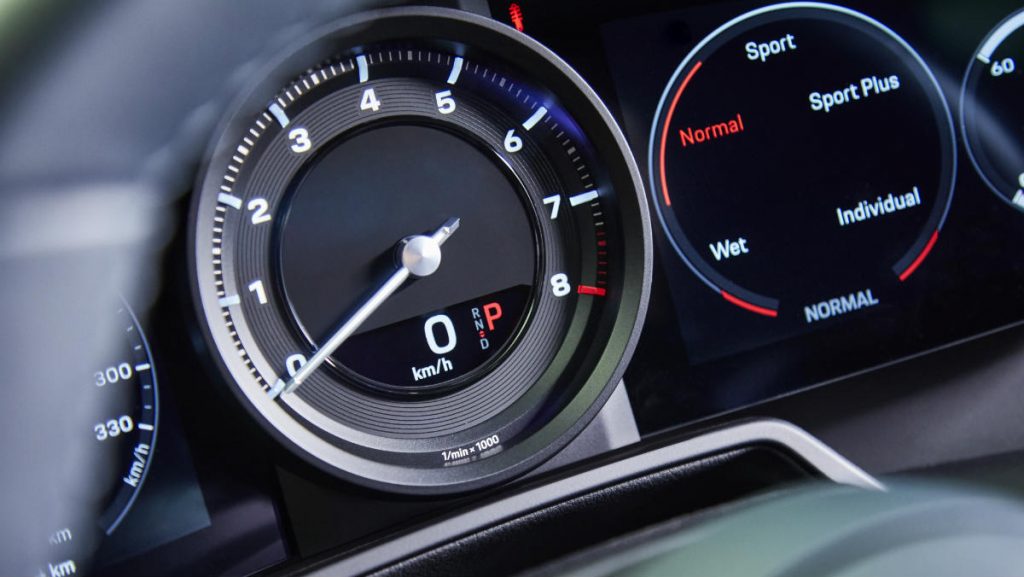
Step inside, and the cabin transformation is immediate. The rising center console seen on the Carrera GT, Panamera, and 991 has been replaced with a crisp, horizontal dashboard architecture reminiscent of the classic G-series 911 of the 1970s. The dashboard extends straight across the cabin between the front pillars, featuring clean recessed switchgear and sharp horizontal planes. At its center stands an analog tachometer, preserving the purist focal point Porsche drivers expect. It is flanked by two high-resolution seven-inch frameless freeform digital displays that can project virtual dials, trip computer telemetry, g-force readouts, or full navigation mapping.
Dominating the center stack is a 10.9-inch touchscreen housing the latest Porsche Communication Management (PCM). The interface is fast, capacitive, and designed for intuitive navigation, featuring customizable tile menus and haptic touch feedback. Beneath the main screen sits a compact bank of five tactile toggle switches that grant direct, physical access to critical dynamic functions: damper stiffness, stability control defeat, hazard lights, and drive mode selection. Drivers do not need to hunt through digital sub-menus to stiffen the suspension or disengage traction systems.

Pioneering chassis technology: Porsche Wet Mode
Among the technical debuts introduced on the Type 992, Porsche Wet mode stands out as a genuine world first. Rather than waiting for driven wheels to lose grip and register wheel slip—the traditional trigger for stability control intervention—Wet mode detects water before traction is severed. Acoustic acoustic sensors installed inside the front wheel arches listen for the physical splashing noise of spray kicked up from standing water. When sufficient surface moisture is detected, the dashboard flashes an alert advising the driver to engage Wet mode via the toggle switch or steering-wheel rotary dial.
Once engaged, Wet mode alters multiple onboard systems simultaneously. The throttle mapping softens, engine torque delivery becomes gradual, and the electronic rear differential lock adjusts to prevent sudden yaw. The variable rear spoiler automatically deploys to its maximum angle to plant the rear axle, active cooling flaps in the front bumper open to modify front aero balance, and the Porsche Stability Management (PSM) sensitivity threshold tightens significantly. On standing water or drenched motorway lanes, this preventive system transforms a high-powered rear-engine sports car into a remarkably predictable and reassuring machine.
Driver assistance systems and connected telemetry
In addition to Wet mode, Porsche has expanded the 911’s active safety suite. Forward Collision Warning and Brake Assist come standard, scanning the road ahead with radar and cameras to identify cyclists, pedestrians, or slowing traffic, initiating emergency braking automatically if the driver fails to respond. For the first time on a 911, buyers can specify Night Vision Assist, which employs an intelligent thermal imaging camera mounted in the front grille. The system detects people and large animals at distances well beyond headlamp range, highlighting them in warm yellow on the digital cockpit display and flashing warning beams at them if they step onto the road corridor.
Adaptive Cruise Control now includes stop-and-go functionality, automatic following distance regulation, and an innovative Emergency Assist protocol that safely halts the car within its lane if the driver becomes unresponsive. The PCM platform integrates permanently connected SIM cards, utilizing swarm intelligence from connected vehicle fleets to provide live crowd-sourced traffic data, hazard warnings, and parking space availability. In select markets such as the UK and Germany, Porsche is introducing two companion digital services: the Porsche Road Trip app, curating bespoke driving itineraries with tailored navigation and hotel reservations, and Porsche Impact, a carbon-offset calculator allowing owners to neutralize their specific driving footprint.

Balancing analogue emotion with digital precision
The Type 992 generation arrives during a period of deep automotive evolution. As regulations tighten and performance cars increasingly adopt electrification, Porsche has demonstrated how an iconic sports car can evolve without losing its soul. By stiffening the chassis, broadening the front footprint, refining the twin-turbo boxer unit, and incorporating intuitive digital architecture, the 911 Carrera S and Carrera 4S offer an exceptionally wide operating bandwidth. It remains an everyday commuter, a long-distance continental cruiser, and a formidable circuit car wrapped in an unmistakable silhouette.
Vehicle data
| Field | Value |
|---|---|
| Make | Porsche |
| Model | 911 Carrera S / 911 Carrera 4S (Type 992) |
| Generation / chassis code | Eighth generation / Type 992 |
| Model year(s) covered | 2019–2020 |
| Body style | 2+2 Coupé |
| PoCoupéain / engine | 3.0-litre (2,981 cc) twin-turbocharged flat-six |
| Power / torque | 450 PS (331 kW; 443 hp) @ 6,500 rpm / 530 Nm (391 lb-ft) @ 2,300–5,000 rpm |
| Transmission | 8-speed dual-clutch transmission (PDK) |
| Drivetrain | Rear-wheel drive (Carrera S) / All-wheel drive (Carrera 4S) |
| Key performance figures | 0–62 mph in 3.7 s (Carrera S) / 3.6 s (Carrera 4S); Sport Chrono reduces by 0.2 s (3.5 s / 3.4 s); Top speed 191 mph (308 km/h Carrera S) / 190 mph (306 km/h Carrera 4S) |
| Price (as stated) | Not stated in sources |
| On-sale / announcement period | Revealed late 2018 (Los Angeles Auto Show debut); on-sale 2019 |
| Market | Global (Europe, UK, North America) |