
Open-Top Purism and Motorsport DNA
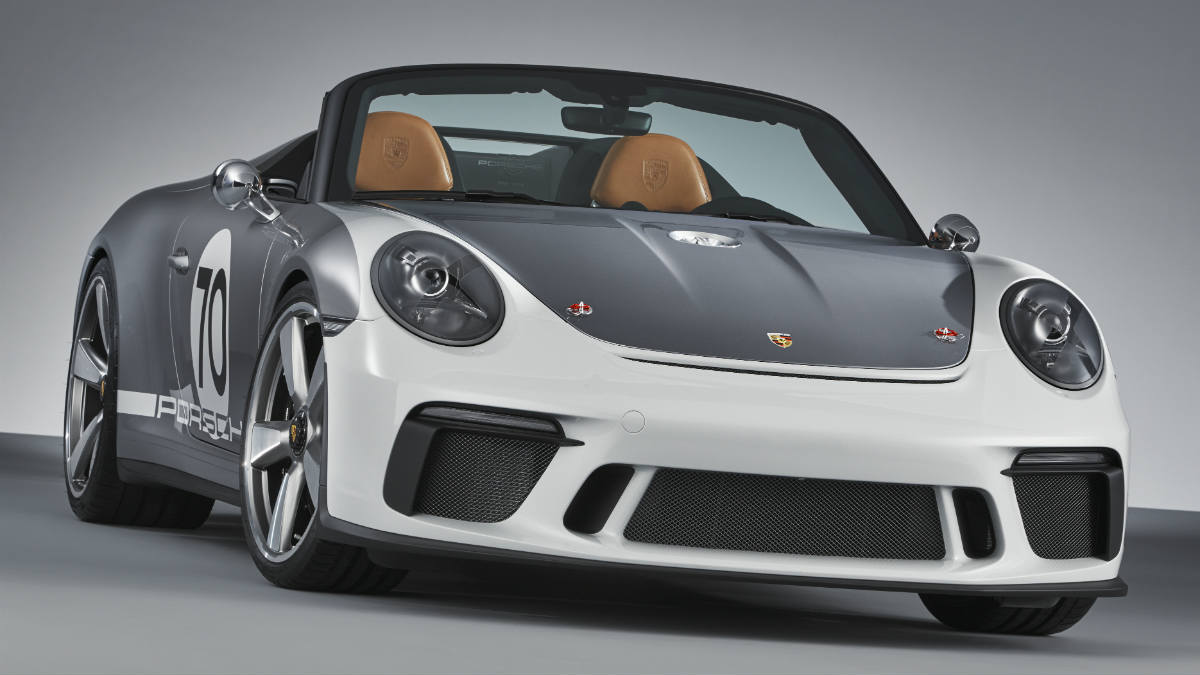
To celebrate seven decades of sports car manufacturing, Porsche delivered an uncompromising birthday gift to itself: the Porsche 911 Speedster Concept. Unveiled on June 8, 2018, during the official anniversary gathering in Zuffenhausen, the drivable design study deliberately links the very dawn of the marque—the 356 ‘No. 1’ Roadster that gained its general operating permit on June 8, 1948—to contemporary engineering from the motorsport department in Weissach. While series production remains unconfirmed, the concept offers a tantalising glimpse of what could follow for enthusiasts who crave open-cockpit visceral engagement over digital insulation.
The Speedster nameplate has always occupied a distinct corner of Zuffenhausen lore. Where standard convertibles lean toward comfort and year-round usability, a genuine Speedster strips away convenience in pursuit of an unfiltered connection between driver, machine, and asphalt. In the case of this concept study, Porsche did not merely fit a chopped windscreen to a standard Carrera. Instead, the engineering team turned to the Porsche Motorsport Centre in Flacht—the very facility responsible for the 911 GT3, GT3 RS, and GT2 RS—borrowing a competition-bred running gear and combining it with bespoke, hand-crafted styling cues that celebrate seventy years of sports car history.
Bespoke Speedster Proportions and Carbon Construction
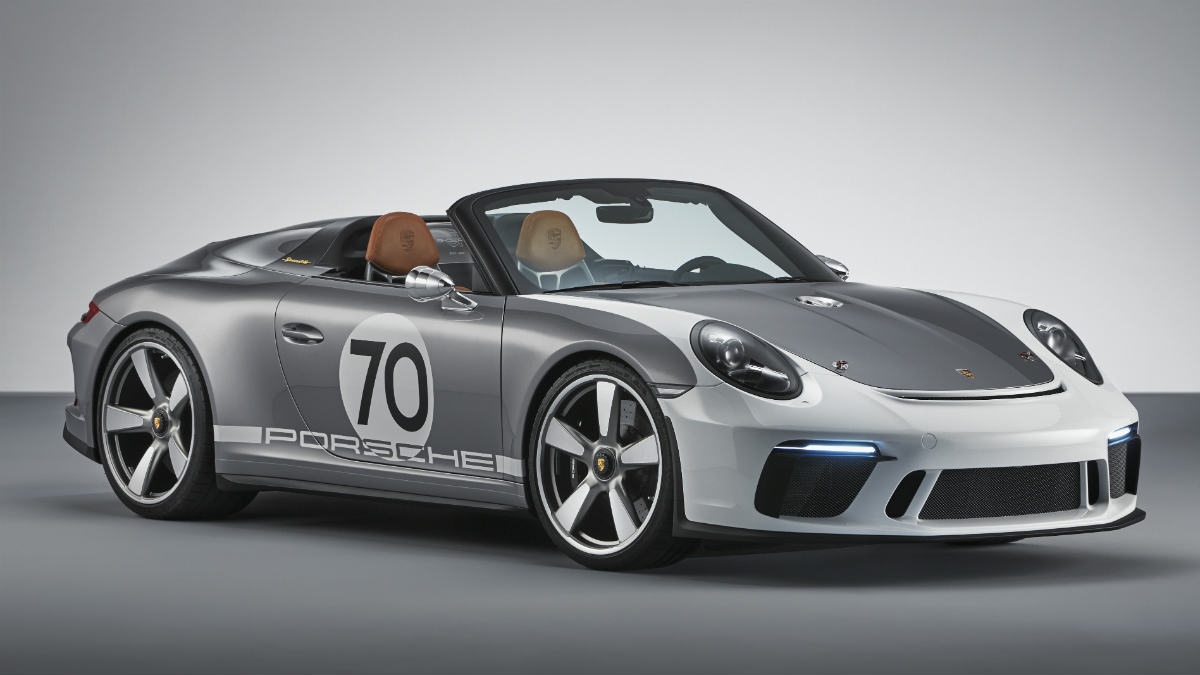
Visually, the Porsche 911 Speedster Concept establishes its character through dramatic, rakish proportions. The windscreen frame has been significantly shortened and raked further back, accompanied by correspondingly lower side glass. This dramatic chop lowers the roof flyline significantly, creating a planted, muscular stance reminiscent of historical forebears such as the 356 1500 Speedster. The broad body shell itself is sourced from the all-wheel-drive 911 Carrera 4 Cabriolet, giving the car substantial rear track width and pronounced rear haunches, yet the drivetrain underneath remains strictly rear-wheel drive.
Lightweight materials dominate the exterior execution. To shave mass and maintain exceptional structural rigidity, the front wings, the front bonnet, and the substantial rear deck cover are all fabricated from lightweight carbon-fibre composite material. The rear cover connects directly behind the two front bucket seats, concealing an integrated roll-over protection structure beneath a signature ‘double bubble’ rear deck. That distinctive dual-hump contour has served as a hallmark of 911 Speedster design ever since the 1989 G-Series model. On the concept study, two contrasting black aerodynamic slats bridge the space between the humps, guiding airflow across the rear deck, while a transparent Plexiglas wind deflector sits between the seats, subtly engraved with an anniversary logo honouring seventy years of Porsche sports cars.

Heritage Detailing: From Le Mans Tape to Fuchs Center Locks
Every surface of the 911 Speedster Concept reflects meticulous historical cross-referencing. The exterior paintwork pairs GT Silver Metallic with contrasting White front bonnet accents and fender darts, directly recalling the livery of early Porsche factory racers. That vintage racing dialogue continues with the central fuel filler cap, mounted in 1950s competition fashion right in the middle of the front luggage lid, featuring a milled fuel cap finished with vintage craftsmanship.
The side mirrors adopt a classic torpedo Talbot design, aerodynamically streamlined and mounted directly to the doors. Up front, the headlight assemblies incorporate a subtle design homage to vintage endurance racing: clear and frosted cross-shaped surface treatments on the headlight lenses replicate the crossed masking tape applied to glass headlights in period to prevent track debris from shattering the lenses. Along the sides, the wide B-pillars and the engine deck lid carry milled, gold-plated Speedster script, completing an aesthetic package that bridges mid-century competition paddock details with contemporary carbon-fibre engineering.

Interior Stripped for Purpose
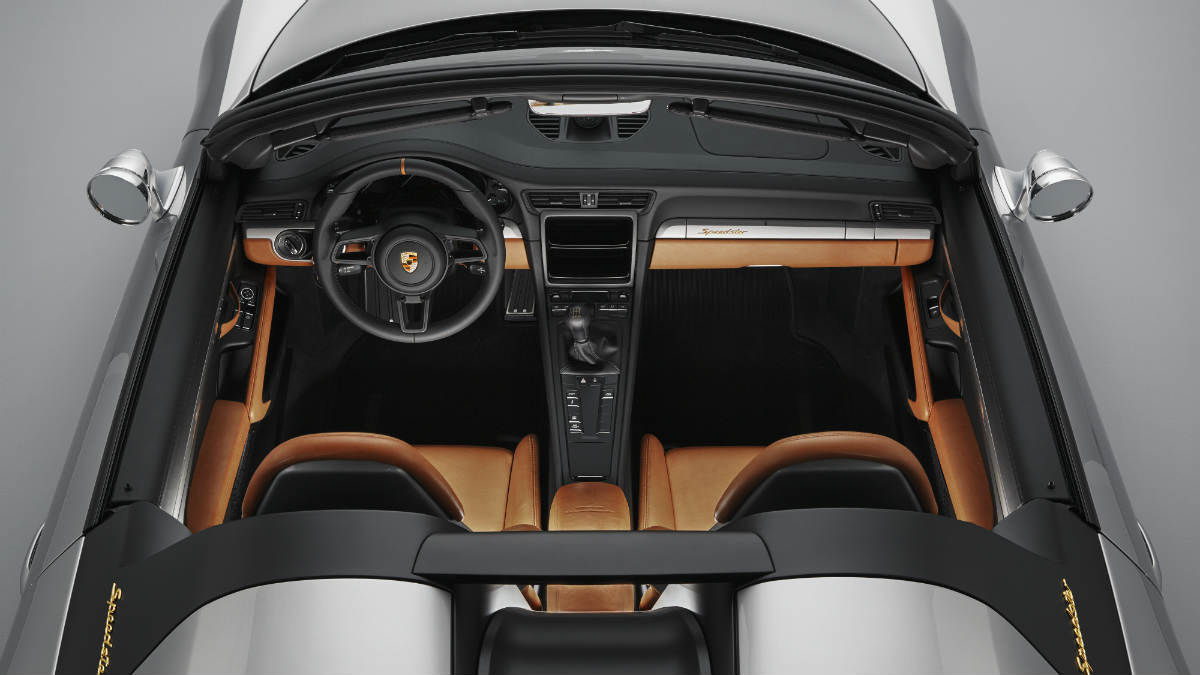
In keeping with classic Speedster philosophy, the interior dispenses entirely with luxury distractions. There is no folding convertible fabric roof mechanism. In its place, the car relies on a simple, lightweight tonneau cover designed purely to protect the cabin from rain when parked, fastening securely to the bodywork via eight traditional Tenax fasteners. This minimalist open-top ethos eliminates substantial overhead weight, ensuring the centre of gravity remains as close to the tarmac as possible.
Step across the carbon sill into the cabin, and the purist intent is unmistakable. Air conditioning has been eliminated. The radio and satellite navigation systems have been deleted, leaving clean, uncluttered dash surfaces in place of digital touchscreens. Driver and passenger sit in deep, fixed-back full bucket seats constructed from carbon-fibre reinforced plastic (CFRP). The seats are upholstered in exquisite light brown Aniline leather in a Cognac 356 shade, offering a warm, tactile nod to early 356 cabins while gripping occupants securely during high-g cornering. The three-spoke steering wheel retains a bare, unfussy rim, devoid of multi-function switches, focusing the driver’s attention solely on throttle inputs, steering angle, and manual gear selection.

Naturally Aspirated GT3 Firepower Under the Skin
Beneath the retro-infused carbon-fibre body panels, the Porsche 911 Speedster Concept relies on uncompromising modern motorsport hardware. The rolling chassis and suspension architecture are taken directly from the 911 GT3, featuring adaptive GT dampers and rigid ball-joint mountings engineered for laser-sharp steering response. The concept rides on imposing 21-inch wheels featuring a modern interpretation of the classic Fuchs cloverleaf pattern. High-gloss polished petals contrast sharply against dark wheel barrels, and for the first time on this design, the wheels are secured via motorsport-derived central locking nuts rather than traditional five-bolt hubs.
The mechanical heart of the machine is a naturally aspirated 4.0-litre flat-six engine developed by Porsche Motorsport. Delivering over 500 horsepower and screaming all the way to a dizzying 9,000 rpm redline, this atmospheric powerplant eschews turbochargers in favour of instantaneous throttle response, linear power delivery, and an acoustic crescendo that only high-revving boxer engines can deliver. Flacht engineers paired the engine with a lightweight titanium sports exhaust system terminating in central dual tailpipes, guaranteeing an unfiltered mechanical howl with the top off. Crucially for driving purists, power travels to the rear wheels via a six-speed manual gearbox, refusing the automated dual-clutch PDK alternative in favour of driver involvement and tactile three-pedal shifting.

Seven Decades of the Porsche Speedster Heritage
The Speedster lineage traces its roots back to 1952 in the United States. Influential American importer Max Hoffman convinced Ferry Porsche that US sports car enthusiasts wanted an affordable, stripped-down roadster suited for weekend road racing in the SCCA. The resulting pioneer was the Porsche 356 1500 America Roadster. Featuring a lightweight aluminium body beaten entirely by hand over wooden bucks, it weighed 60 kilograms less than a standard 356 Coupé. Powered by a 70-horsepower flat-four engine, it reached a top speed of 175 km/h—an extraordinary performance benchmark for an entry-level roadster in the early post-war era. Built just sixteen times due to intensive hand-crafting costs, the America Roadster nevertheless established the fundamental blueprint: cut-down windscreen, slot-in side curtains, minimal rain roof, and lightweight bucket seats.
Recognising the appetite for an accessible open racer, Porsche introduced the production 356 Speedster in 1954, quickly becoming a motorsport darling across sunny California circuits. By 1957, the legendary 356 A 1500 GS Carrera GT Speedster arrived, pairing the stripped body with Ernst Fuhrmann’s complex four-cam racing powerplant. In total, eight distinct production and special models have carried the revered Speedster designation across subsequent generations.
The 911 family officially adopted the Speedster badge in 1988 with the run-out of the G-Series platform, introducing the iconic twin-hump ‘double bubble’ rear deck lid that concealed the manual roof canopy. That formula carried forward into the 964 generation in 1992, offering both narrow-body road configurations and rare Turbo-look widebody iterations. Later, ultra-exclusive one-off or small-batch examples emerged in the 993 generation, before the 997-generation 911 Speedster was unveiled in 2010. Restricted to just 356 units worldwide to honour the original roadster, the 997 Speedster represented the most recent chapter before the concept study appeared in Zuffenhausen.

Zuffenhausen Anniversary and the Road Ahead
The debut of the 911 Speedster Concept formed the centrepiece of the official ‘70 years of Porsche sports cars’ celebrations at the Porsche Museum in Zuffenhausen. The special exhibition gathers historic milestones from throughout seven decades, tracing the continuous engineering thread that runs from Ferdinand Porsche’s Gmünd roadster through air-cooled racing legends to today’s high-downforce GT machines.
Whether this road-ready study transitions into a limited production run remains an open question for Porsche leadership. The company has stated that a formal production decision will be taken in the coming months, with any potential customer deliveries unlikely to commence before 2019. Yet with a fully sorted GT3 chassis, functional 500-horsepower powertrain, and street-legal lighting gear, the concept is far more than a static show sculpture. For Porsche collectors and driving purists, it stands as the ultimate synthesis of heritage styling and modern motorsport engineering.

Vehicle data
| Field | Value |
|---|---|
| Make | Porsche |
| Model | 911 Speedster Concept |
| Generation / chassis code | 991 generation (991.2) |
| Model year(s) covered | 2018 |
| Body style | Two-seat open-top roadster / Speedster |
| Powertrain / engine | 4.0-litre naturally aspirated flat-six (boxer) |
| Power / torque | Over 500 hp / Not stated in sources |
| Transmission | 6-speed manual |
| Drivetrain | Rear-wheel drive |
| Key performance figures | Engine redline 9,000 rpm / Other figures not stated in sources |
| Price (as stated) | Not stated in sources |
| On-sale / announcement period | Unveiled June 8, 2018; series production decision pending for 2019 |
| Market | Global / Germany (concept premiere) |