

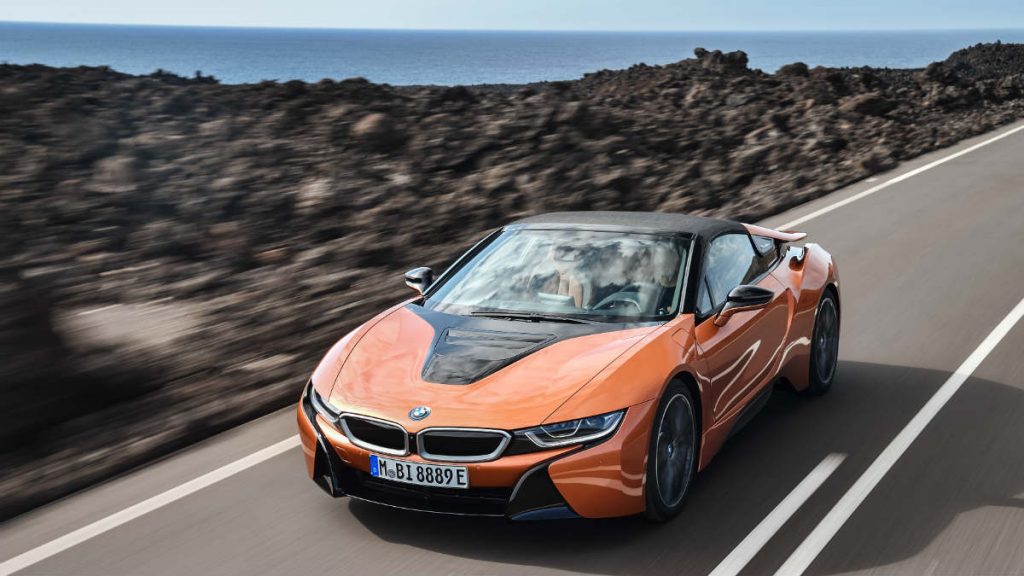
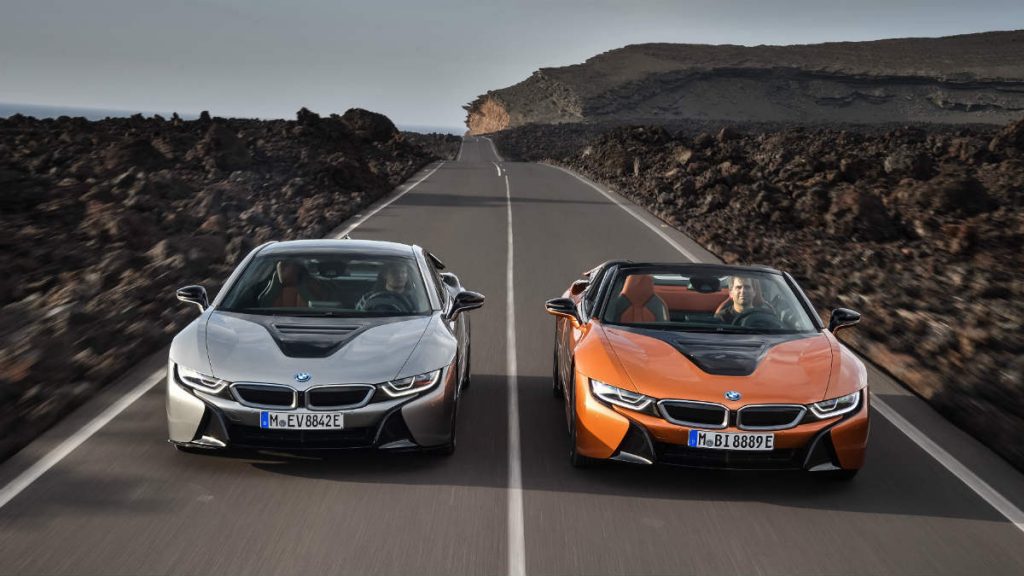
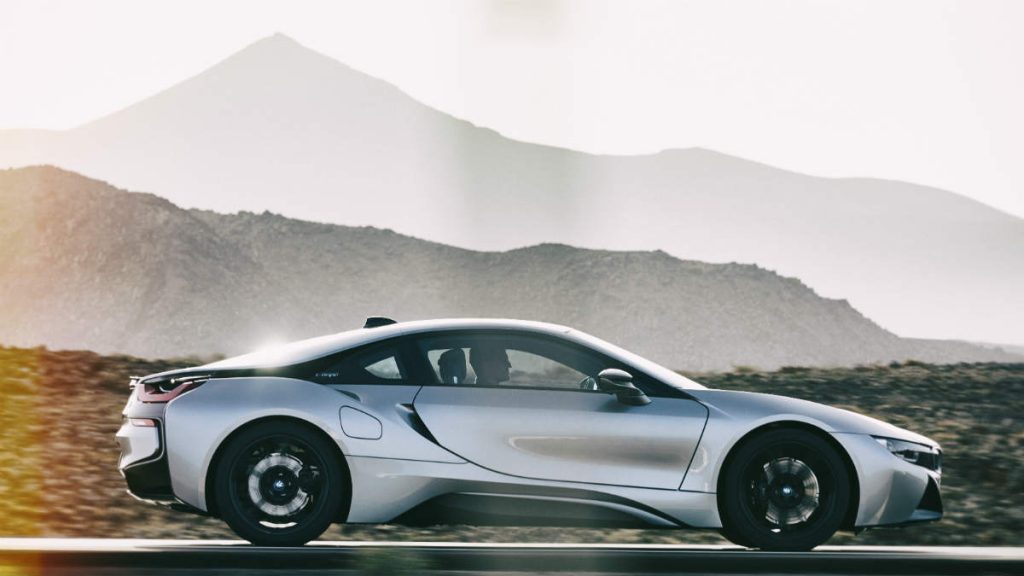
When BMW introduced the production i8 in 2014, it looked less like an assembly-line sports car and more like a concept vehicle that had escaped directly into dealer showrooms. With its dihedral doors, layered carbon-fiber bodywork, and a plug-in hybrid architecture pairing a mid-mounted three-cylinder engine with a front electric motor, it immediately carved out its own territory in the performance world. Four years later, BMW is broadening the appeal of its halo hybrid with the arrival of the open-top BMW i8 Roadster alongside an updated, more capable BMW i8 Coupe.
The addition of an open-air variant marks a natural evolution for BMW i. Where the Coupe continues as a compact 2+2 grand tourer, the Roadster transforms the platform into a pure two-seater, sacrificing the token rear jump seats in exchange for an ingenious roof mechanism and an intimate, skyward cabin experience. Both models benefit from a shared wave of mid-cycle engineering updates, bringing an expanded battery pack, higher electric output, extended zero-emissions range, and subtle chassis refinements that preserve the car’s distinctive dynamic balance.

LifeDrive Architecture and Roadster Engineering
Underpinning both variants is BMW’s specialized LifeDrive vehicle architecture, a modular design philosophy engineered from inception specifically for electrified vehicles. The structure divides the car into two core components: the aluminum Drive module, which houses the suspension, high-voltage battery, structural subframes, combustion engine, and front electric drive unit; and the Life module, an ultra-stiff passenger cell constructed from carbon-fiber-reinforced plastic (CFRP).
Adapting an ultra-rigid closed coupe into an open-top roadster usually exacts a steep weight penalty, but the inherent strength of the carbon passenger cell minimized structural compromises from the outset. Rather than welding in massive steel gussets, BMW engineers reinforced key focal areas with bespoke carbon components. The windscreen frame is molded entirely from CFRP, creating a robust protective rollover halo without adding unwanted bulk over the front axle. Carbon fiber is also utilized for the side skirts, which feature a broadened cross-section to resist torsional flex across the open cabin perimeter.
Additional chassis struts and bracing panels tie the front and rear aluminum subframes together, ensuring rigidity remains razor sharp under hard cornering. The unladen weight of the BMW i8 Roadster checks in at 1,595 kilograms (DIN), adding merely 60 kilograms compared to the updated Coupe. In an era where convertible conversions frequently burden sports cars with an extra 100 to 150 kilograms, maintaining a 60-kilogram differential is a testament to the strengths of high-tech composite engineering.

A Bespoke Soft-Top Mechanism
The defining visual and functional triumph of the i8 Roadster is its all-electric fabric roof. While a retractable hardtop might have seemed an obvious choice, BMW opted for an insulated soft-top to keep the vehicle’s center of gravity as low as possible. When closed, the fabric panel mimics the flowing roofline of the Coupe, tapering cleanly toward the sweeping rear buttresses and preserving the sculpted aerodynamic channel along the rear quarter panels.
Operating the roof reveals a choreography of precision linkages. Touch the console switch, and the mechanism opens or closes in 15 seconds flat, operable on the move at speeds up to 50 km/h (31 mph). Rather than folding flat across the engine bay, the roof panel folds into an intricate Z-shape and stows in a vertical orientation immediately behind the passenger compartment. This vertical packaging trick allows BMW to carve out roughly 100 liters of enclosed cargo space directly behind the seats, offering practical room for weekend bags or coats that makes up for the lack of traditional rear jump seats.
Aerodynamic management with the top lowered was equally scrutinized in the wind tunnel. When the roof retracts, the rear glass window automatically elevates by approximately 30 millimeters, serving as an integrated draught stop to curb unwanted cabin turbulence at highway speeds. Drivers can also adjust this rear glass panel independently, cracking it open on warm days with the roof up to let the turbocharged exhaust note filter directly into the cabin.
Ingress and egress maintain all the showcar theater expected of the platform. The Roadster adopts frameless gullwing doors crafted with a CFRP inner structure and an aluminum outer skin. Pivoting upward and forward smoothly, they allow entry over the sculpted carbon sills, putting the exposed weave of the inner passenger tub on clear display.

Upgraded eDrive Battery and Electric Motor Output
At the mechanical heart of this mid-cycle update is an upgraded lithium-ion high-voltage battery pack. Situated centrally along the vehicle’s spine within the aluminum tunnel between driver and passenger, the battery retains its compact footprint while delivering a dramatic bump in cell chemistry. Individual cell capacity jumps from 20 to 34 ampere-hours (Ah), pushing gross battery capacity from the original 7.1 kilowatt-hours to 11.6 kWh, with a usable net energy rating of 9.4 kWh.
This increased energy reserve directly enhances performance. With higher current flow available, BMW engineers unlocked more power from the hybrid synchronous electric motor driving the front axle. Peak output climbs by 9 kW (12 hp) to reach 105 kW (143 hp), backed by an instantaneous 250 Nm (184 lb-ft) of torque delivered from zero rpm. The front motor channels drive exclusively through an integrated two-speed automatic transmission, allowing strong off-the-line thrust and sustained high-speed electric efficiency.
On the road, the added electrical muscle is immediately perceptible. In normal driving modes, both the i8 Coupe and i8 Roadster can cruise on electric power alone at speeds up to 105 km/h (65 mph)—a marked step up from the 70 km/h (43 mph) electric ceiling of the original 2014 car. Press the dedicated eDrive button on the center console, and pure-electric operation stretches up to 120 km/h (75 mph). Pure electric range expands accordingly under the European NEDC cycle to 55 kilometers (34 miles) for the Coupe and 53 kilometers (33 miles) for the Roadster, making typical daily commutes achievable with zero exhaust emissions.
Three-Cylinder Turbocharged Combustion Engine
Mounted transversely behind the passenger cell is BMW’s familiar 1.5-liter TwinPower Turbo three-cylinder petrol engine. Displacing 1,499 cc, this compact all-aluminum powerplant remains an engineering marvel of specific power output, extracting an impressive 170 kW (231 hp) and 320 Nm (236 lb-ft) of torque. Those numbers equate to more than 154 hp per liter, rivaling top-tier motorsport power units.
Power from the combustion unit routes through a six-speed Steptronic automatic gearbox directly to the rear wheels. For this update, BMW engineers retuned the acoustic tuning of the exhaust system, lending the three-cylinder engine a huskier, more resonant tone under acceleration. To meet tightening environmental standards without choking engine breathing, a gasoline particulate filter is integrated into the exhaust tract, capturing fine soot particles produced during high-load combustion cycles.
Combined, the front electric drive motor and the rear turbo engine generate a total system output of 275 kW (374 hp). With both powertrains working in unison, the updated BMW i8 Coupe sprints from 0 to 100 km/h in 4.4 seconds, while the marginally heavier Roadster completes the benchmark run in 4.6 seconds. Top speed for both models remains electronically limited to 250 km/h (155 mph). In everyday operation, intelligent all-wheel drive governs traction seamlessly: the front wheels pull via electricity while the rear wheels push via petrol, linked purely by high-speed electronic control algorithms rather than a heavy physical driveshaft.
Chassis Dynamics and Intelligent Energy Management
Managing power delivery across two separate axles requires exceptional processing speed. The i8’s hybrid energy management system coordinates both powertrains with continuous precision. Under hard acceleration, the front motor serves up an electric boost effect to eliminate any momentary turbocharger lag from the petrol engine. During deceleration or braking, the motor switches roles instantly to become a generator, capturing kinetic energy and feeding electricity back into the central battery pack.
Additionally, a high-voltage starter-generator connected directly to the combustion engine acts as a secondary power generator, ensuring the high-voltage battery always retains sufficient reserve power to supply full-throttle overtaking bursts. When destination guidance is programmed into the onboard navigation system, the car’s predictive energy management maps out the entire route ahead. It assesses topography, vehicle speed, and traffic conditions, strategically reserving pure electric drive for stop-and-go urban stretches while charging the pack efficiently during steady highway cruising.
To preserve the car’s athletic handling with the open top, BMW gave the Roadster model-specific suspension and damping calibrations. Dynamic Damper Control comes fitted as standard across both variants, continuously adjusting shock absorber valving to adapt to road surface changes in milliseconds. The Roadster features firmer roll stabilization hardware, recalibrated anti-roll bars, and altered Dynamic Stability Control (DSC) parameters to balance body motion through aggressive transitions. Standard equipment includes newly styled 20-inch light-alloy wheels whose lightweight architecture shaves roughly one kilogram per corner compared to the lightest wheels previously offered on the i8.
Cabin Appointments, Tech and Charging Ecosystem
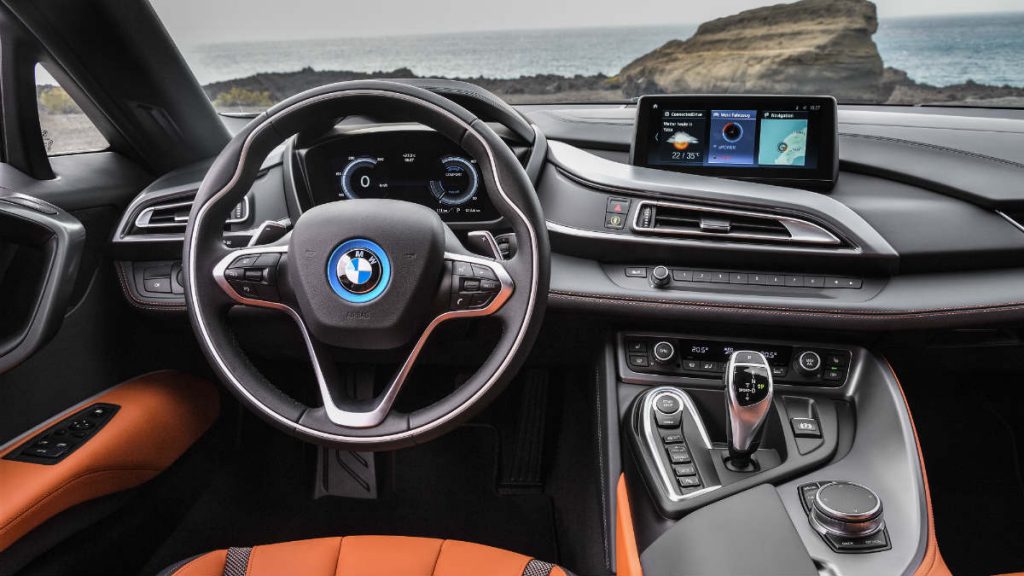
Step over the wide carbon-fiber door sill into the cockpit, and the driver-focused layout remains distinctive. The updated lineup brings refreshed interior trim configurations. Carpo trim comes standard, outfitting the Coupe in Ivory White full leather and the Roadster in a striking two-tone Ivory White and Black leather arrangement. Drivers seeking an alternative ambiance can opt for Halo interior appointments or a newly introduced Accaro trim scheme featuring rich Amido leather contrasted with E-Copper textile accents that match the newly added exterior paint shades.
A thick-rimmed leather sports steering wheel incorporates multifunction thumb controls and steering wheel gearshift paddles. Directly ahead of the driver sits a fully digital multifunctional instrument display whose graphic presentation changes themes based on the selected drive mode. The center console houses the updated Navigation system Professional, featuring an 8.8-inch freestanding Control Display whose main user menu is redesigned into horizontally arranged live tiles, providing immediate glances at media, navigation, and power flow.
Standard safety and convenience equipment includes BMW’s Driving Assistant package complete with Surround View cameras, the futuristic BMW Display Key with integrated remote touch display, and heated power sports seats. High-tech options include BMW Laserlight headlights featuring non-dazzling Selective Beam technology, a full-color Head-Up Display tailored with model-specific rev indicators, and an external acoustic pedestrian sound generator that emits an artificial tone during low-speed electric driving.
Replenishing the onboard energy store is designed around BMW’s 360° ELECTRIC ecosystem. Both models include a standard Mode 2 charging cable, allowing the battery to recharge from a standard domestic socket in less than four and a half hours. For faster home turnaround, installing a 3.6 kW BMW i Wallbox reduces the complete charge cycle to under three hours. Owners opting for the BMW i Wallbox Connect can tap into the BMW Digital Charging Service, an intelligent charging system that can automatically manage recharge schedules to capture off-peak grid electricity rates or maximize the direct use of self-generated home solar energy.
In terms of laboratory efficiency figures, the updated powertrain posts remarkable official numbers. Under the EU test cycle for plug-in hybrid vehicles, the BMW i8 Coupe achieves a combined fuel consumption of 1.9 liters per 100 kilometers (148.7 mpg imp) and an electric power consumption of 14.0 kWh per 100 km, with CO2 emissions rated at 42 grams per kilometer. The BMW i8 Roadster is rated at 2.1 liters per 100 kilometers (134.5 mpg imp) and 14.5 kWh per 100 km, alongside 46 grams per kilometer of CO2 emissions. While real-world spirited driving will naturally yield different returns, the technological statement remains clear: genuine sports car drama and electrified efficiency can share the same chassis.
Vehicle data
| Field | Value |
|---|---|
| Make | BMW |
| Model | i8 Coupe & i8 Roadster |
| Generation / chassis code | I12 (Coupe) / I15 (Roadster) |
| Model year(s) covered | 2019 |
| Body style | 2+2 Coupe / 2-seater Roadster |
| Powertrain / engine | Plug-in hybrid; 1.5-liter turbocharged inline-3 petrol engine plus front electric motor |
| Power / torque | Total system: 275 kW / 374 hp; Engine: 170 kW / 231 hp, 320 Nm (236 lb-ft); Electric motor: 105 kW / 143 hp, 250 Nm (184 lb-ft) |
| Transmission | 6-speed Steptronic automatic (engine/rear wheels) + 2-speed automatic (electric motor/front wheels) |
| Drivetrain | All-wheel drive (hybrid-specific all-wheel drive) |
| Key performance figures | 0–100 km/h: 4.4 s (Coupe), 4.6 s (Roadster); Top speed: 250 km/h (155 mph); Electric range: up to 55 km (Coupe) / 53 km (Roadster) NEDC |
| Price (as stated) | Not stated in sources |
| On-sale / announcement period | Announced late 2017 / early 2018; market launch spring 2018 |
| Market | Global (European specifications detailed) |