
Kia’s European Performance Hatchback Unveiled
Kia has pulled the wraps off the all-new Kia Ceed GT ahead of its official public debut at the 2018 Paris Motor Show, where it stands shoulder to shoulder with the new ProCeed GT shooting brake. Engineered, developed, and produced entirely in Europe, the latest hot hatch represents a deliberate step forward from the original 2013 cee’d GT and pro_cee’d GT—the two models that initially demonstrated a Korean automaker could deliver credible, driver-focused dynamics to European enthusiasts.
While the previous generation laid the structural and philosophical groundwork, the new Ceed GT arrives with a broader mechanical scope. Under the bonnet sits an updated version of Kia’s 1.6-litre T-GDi (Turbocharged Gasoline Direct injection) four-cylinder engine, producing 204 ps (201 bhp) at 6,000 rpm and 265 Nm (195 lb-ft) of torque across a broad operating band between 1,500 and 4,500 rpm. For the first time in Kia performance hatchback history, European buyers can choose between the standard six-speed manual gearbox and an optional in-house developed seven-speed dual-clutch transmission (7DCT).

According to Emilio Herrera, Chief Operating Officer for Kia Motors Europe, the original GT nameplates established vital credibility within the brand’s wider portfolio. The original cee’d GT proved there was an authentic appetite for engaging, responsive road cars from Kia, creating the mechanical momentum that eventually led to rear-drive performance models like the Stinger and spurred the widespread popularity of GT Line trim packages across the model line-up. Rather than chasing headline top speeds or extreme Nürburgring lap times, the engineering mandate for the Ceed GT focuses on real-world European road composure: swift pace, predictable chassis feedback, and daily gran turismo practicality.
Albert Biermann’s Chassis Tuning and Dynamic Development
To ensure the new Ceed GT delivers genuine dynamic capability, the chassis underwent six months of dedicated fine-tuning under the direction of Albert Biermann, Head of Vehicle Test and High-Performance Development for Hyundai Motor Group. This extensive test program took place beyond the normal validation cycle of the standard five-door hatchback, taking in congested European city centers, German autobahns, high-altitude alpine passes, and tight British B-roads.
The core structural hardware remains an independent suspension design with MacPherson struts at the front and a multi-link arrangement at the rear. However, Biermann’s engineering team revised the spring rates and anti-roll bars to dramatically alter how the car manages weight transfer. The GT rides 5 mm lower than the standard Ceed and Ceed Sportswagon, lowering its center of gravity to reduce body movement through rapid directional changes. Stiffer springs front and rear limit lateral pitch and roll without compromising everyday compliance over broken tarmac.
Intriguingly, the engineers opted for softer front and rear anti-roll bars compared to standard hot hatch tuning recipes. By allowing slightly more independent wheel articulation, the softer bars ensure the inside tire maintains optimal contact with the road surface under heavy lateral loading, dramatically improving front-end grip and traction out of tight bends. The suspension changes give the Ceed GT cornering speeds and front-axle bite that rival more aggressively tuned front-wheel-drive hot hatches, yet the car preserves the supple motorway composure necessary for long-distance cruising.
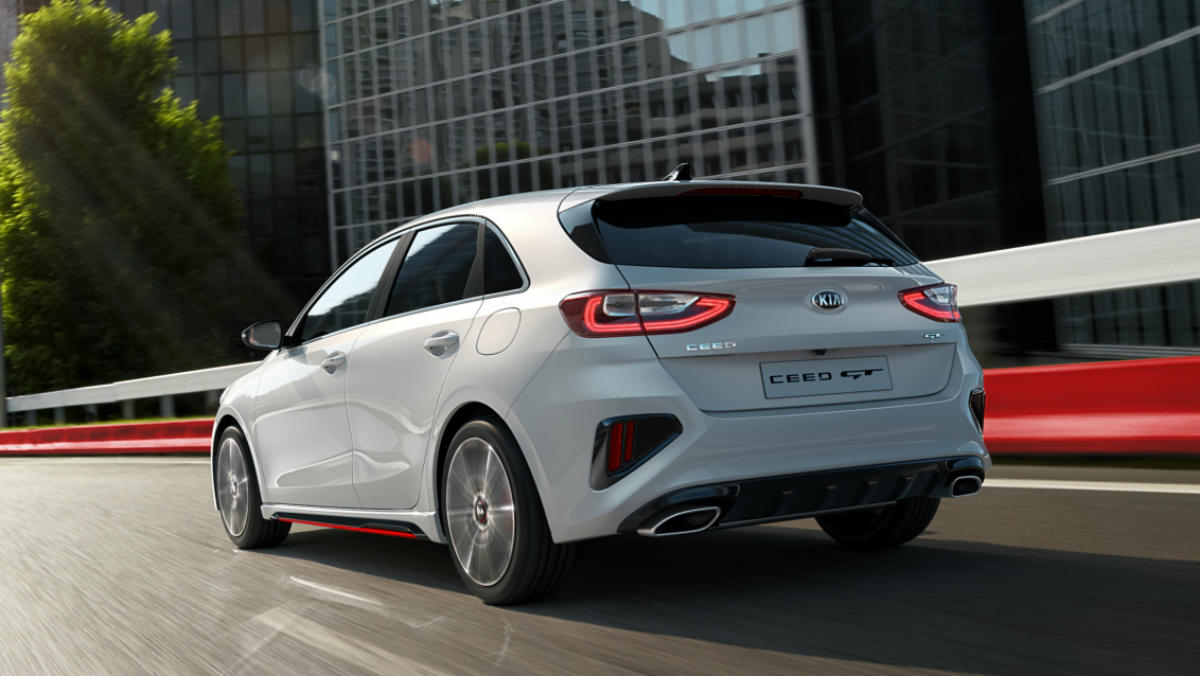
Braking performance has been stepped up accordingly. Standard Ceed models utilize 288 mm front brake discs, but the Ceed GT upgrades to 320 mm ventilated front discs. The new rotors are also 3 mm thicker (28 mm compared to 25 mm), significantly increasing thermal capacity and resisting brake fade under repeated hard stops down mountain passes. Standard Michelin Pilot Sport 4 tires (225/40 R18) provide high mechanical adhesion, working in harmony with a quick electric power steering rack geared at 12.7:1 and requiring just 2.44 turns lock-to-lock—a 17 percent increase in response over the first-generation cee’d GT.
Electronic driver assistance systems have also been calibrated exclusively for GT duty. The standard Electronic Stability Control (ESC) and Vehicle Stability Management (VSM) feature relaxed intervention thresholds, allowing enthusiastic drivers to manipulate the car’s yaw attitude on turn-in. An integrated Torque Vectoring by Braking system gently nibbles at the inside wheels when accelerating through corners, mitigating understeer and pulling the nose neatly toward the apex without clumsy power cuts.
1.6-Litre T-GDi Powertrain and New 7DCT Transmission
At the mechanical core of the Ceed GT is Kia’s responsive 1.6-litre T-GDi petrol engine. The direct-injected turbocharged four-cylinder delivers 204 ps at 6,000 rpm, paired with 265 Nm of torque available across an exceptionally wide plateau from 1,500 to 4,500 rpm. This broad torque spread ensures effortless progress in mixed traffic, allowing rapid mid-gear overtakes without needing to constantly drop ratios.
The headline technical upgrade for this generation is the introduction of an optional seven-speed dual-clutch transmission alongside the slick six-speed manual gearbox. Developed completely in-house, the 7DCT responds to strong customer demand across Europe for automated convenience without sacrificing performance. Drivers can allow the gearbox to change gears automatically or take full manual control via tactile metal alloy paddle shifters mounted neatly behind the steering wheel.
Dual-clutch models come equipped with Kia’s Drive Mode Select system, letting the driver toggle between Normal and Sport modes. Normal mode prioritizes fuel economy and relaxed cruising, feathering throttle mapping and lightening the steering effort. Selecting Sport mode sharpens throttle pedal response, increases steering weight for enhanced feedback, and alters transmission shift points to hold intermediate gears right up to the 6,000 rpm power peak.
To complement the car’s athletic character, Kia engineers fitted an electronic sound generator alongside active exhaust flaps. In everyday cruising, the exhaust flaps stay closed, ensuring quiet, unstrained motorway refinement. Under spirited acceleration or in Sport mode, the flaps open to produce an engaging exhaust bark that adds mechanical drama without droning on long journeys.
Performance Styling and Driver-Focused Cabin
Visual distinction separates the Ceed GT clearly from non-GT models in the lineup. Up front, a bespoke bumper incorporates aggressive lower air intakes framed in gloss black trim, flanked by Kia’s signature four-lamp ‘ice-cube’ LED daytime running lights integrated cleanly into the main headlamp clusters. The tiger-nose front grille features a dark chrome surround, delicate red accents within its honeycomb mesh, and a discreet ‘GT’ emblem.
Along the flanks, gloss black side sills with vibrant red inserts underscore the car’s lowered 135 mm ride height. The Ceed GT rides on distinctive 18-inch aluminum-alloy wheels with red castellated center caps, framing high-contrast red brake calipers. At the rear, an aerodynamic roof spoiler sits above a remodeled rear bumper containing a gloss black diffuser and twin exhaust exits. Across Europe, buyers can select from eight distinct exterior paint finishes.

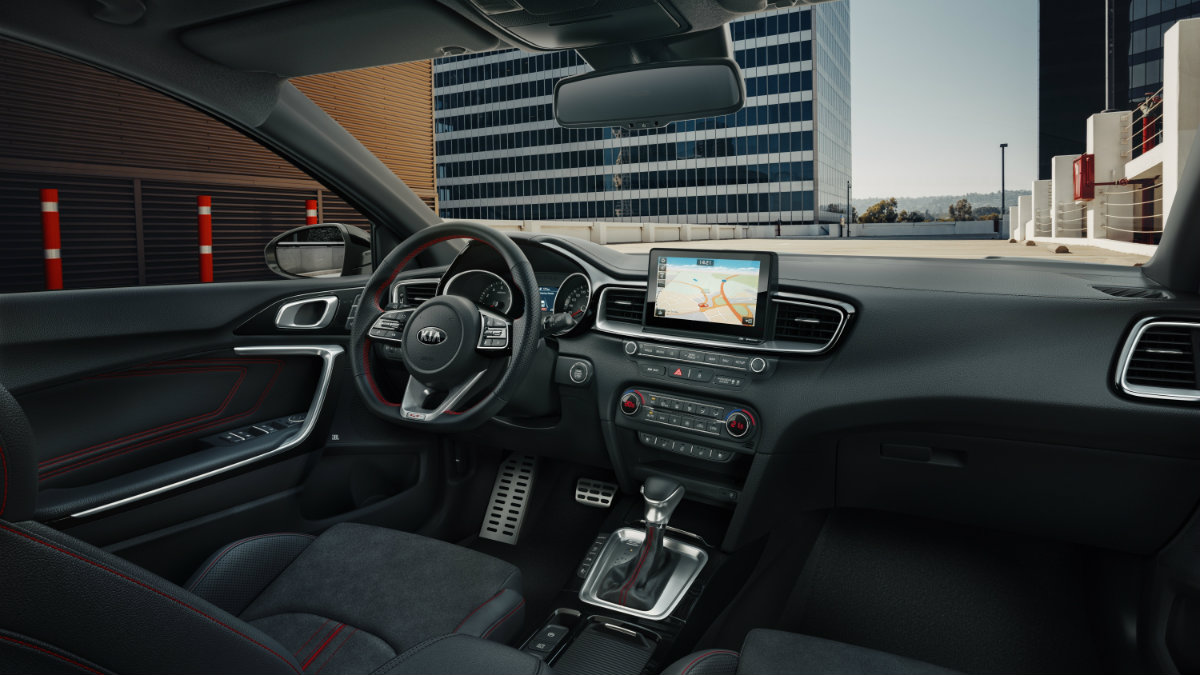
Step inside, and the cabin adopts a purposeful, driver-centric architecture. A black roofliner replaces the grey cloth of standard models, immediately lending the interior a snug, cockpit feel. The driver holds a flat-bottomed, D-shaped leather steering wheel embossed with the GT badge, complemented by brushed aluminum sports pedals. Front occupants sit in newly sculpted sports seats designed exclusively for the Ceed GT. Providing substantial lateral and thigh bolstering, they are upholstered in tactile black leather and suede, highlighted by contrast red stitching and embroidered GT logos.
Everyday Usability and Advanced Safety Equipment
Crucially for European buyers who rely on a single car for work, family duties, and weekend trips, the Ceed GT sacrifices none of the core hatchback’s practicality. Luggage capacity matches standard versions with a roomy 395-liter boot. The load lip is 87 mm lower than that of the preceding model, making it straightforward to hoist heavy luggage or sports gear aboard. A flexible split-level boot floor allows drivers to lower the load deck for bulky cargo or create a covered compartment underneath to stow valuables out of sight. Standard 60:40 split rear seats drop easily via quick-release levers located right inside the tailgate.
Cockpit infotainment centers on Kia’s floating touchscreen display, available in 7.0-inch or 8.0-inch formats with satellite navigation and TomTom-powered Kia Connected Services. Both setups provide full Apple CarPlay and Android Auto smartphone integration, paired optionally with an eight-speaker JBL premium audio system featuring Clari-Fi sound restoration technology. Modern conveniences include keyless entry, push-button start, wireless smartphone charging, and heated front and rear seats.

For chilly winter mornings, a heated windscreen uses almost invisible micro-wires embedded in the glass to clear frost, ice, and mist in seconds at the press of a console button. Safety systems are equally comprehensive, featuring six standard airbags alongside active driver assists such as High Beam Assist, Driver Attention Warning, and Lane Keeping Assist with Forward Collision-Avoidance Assist. Dual-clutch variants can be optioned with Lane Following Assist—a Level 2 autonomous driving aid operating between 0 and 180 km/h (112 mph) that tracks road markings to steer, accelerate, and brake relative to preceding vehicles.
Additional driver aids include Smart Cruise Control with Stop & Go, Blind Spot Collision Warning, Rear Cross-Traffic Collision Warning, Smart Parking Assist, and pedestrian detection. Backed by Kia’s signature 7-year, 100,000-mile warranty, the European-built Ceed GT enters production at the Žilina plant in Slovakia late in 2018, with customer deliveries across Europe starting in the first quarter of 2019.
Vehicle data
| Field | Value |
|---|---|
| Make | Kia |
| Model | Ceed GT |
| Generation / chassis code | Third generation (CD) |
| Model year(s) covered | 2019 |
| Body style | Five-door hatchback |
| Powertrain / engine | 1.6-litre T-GDi four-cylinder turbocharged petrol |
| Power / torque | 204 ps (201 bhp) @ 6,000 rpm / 265 Nm @ 1,500–4,500 rpm |
| Transmission | Six-speed manual or seven-speed dual-clutch transmission (7DCT) |
| Drivetrain | Front-wheel drive (FWD) |
| Key performance figures | Not stated in sources |
| Price (as stated) | Not stated in sources |
| On-sale / announcement period | Debut: October 2018 (Paris Motor Show); On-sale: Q1 2019 |
| Market | Europe |