
More character, more space, more safety.
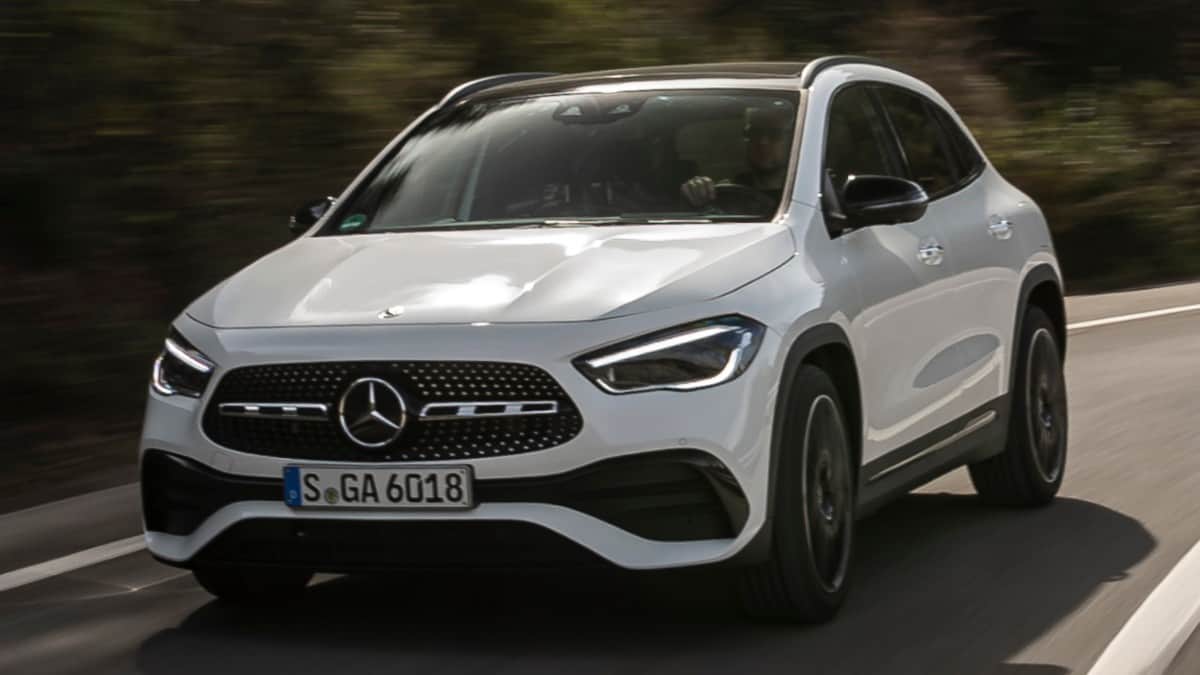
The second-generation Mercedes-Benz GLA arrives as a fundamentally reworked compact SUV – an eighth model overall to join the brand’s global lineup, and now the entry point into Mercedes’ increasingly popular SUV family. At 1,611 millimeters tall (1,616 mm with roof rails), this new GLA stands more than ten centimeters higher than its predecessor, a number that translates directly into a commanding driving position and a cabin that finally feels at home among proper sport utilities rather than lifted hatchbacks.
The dimensional shift tells only part of the story. Even though the wheelbase has grown by 25 millimeters compared to the outgoing X156 generation while overall length has shrunk by 15 millimeters, the packaging wins are substantial. Rear legroom gains a generous allocation thanks to the longer floorpan, while the cargo bay swells to 435 liters with rear seats upright – up roughly 65 liters over the old car. The rear bench itself slides fore and aft by 14 centimeters on rails, and buyers can order the backrest to recline, turning weekend shopping trips into something almost civilized.

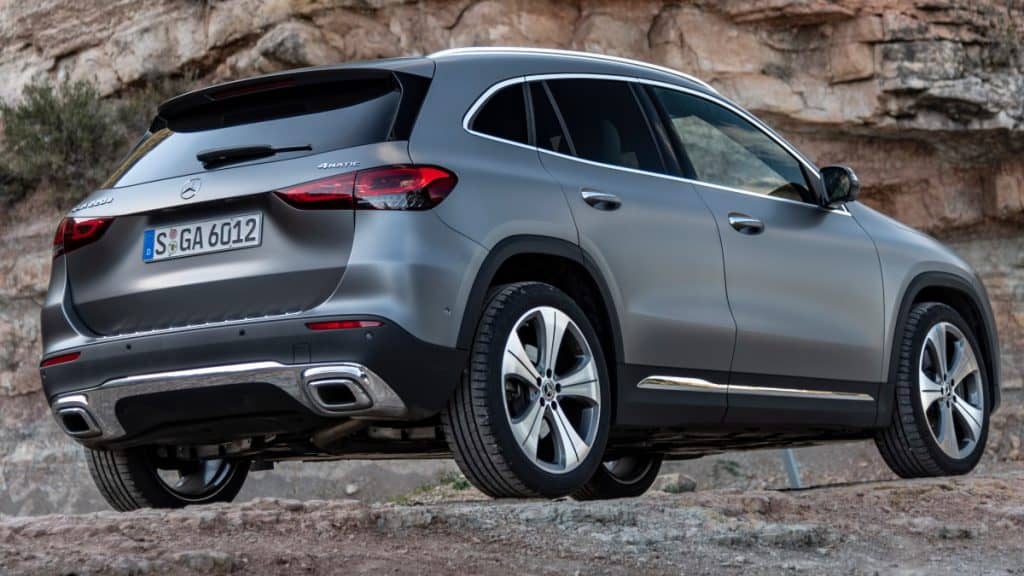
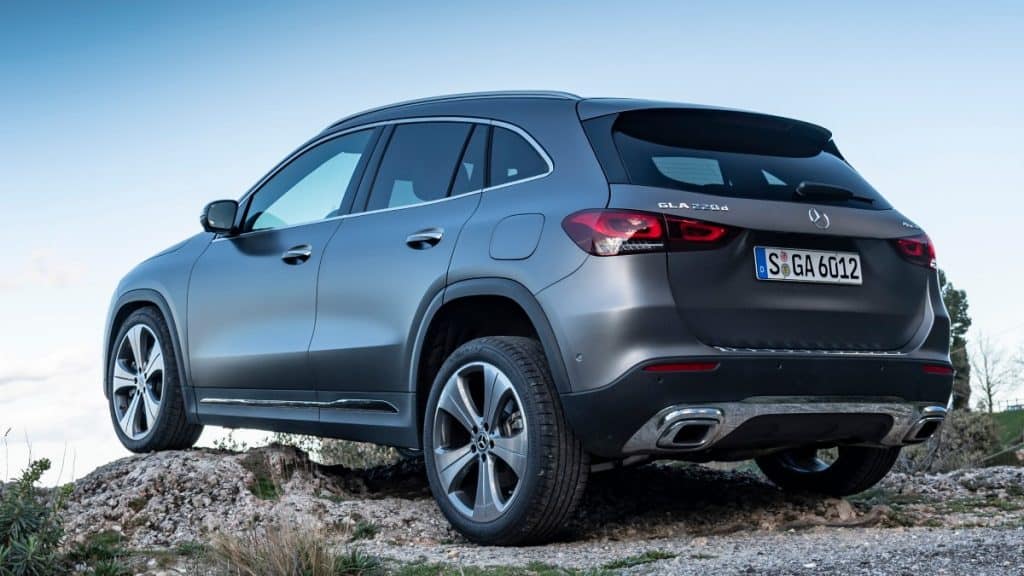
Mercedes describes the exterior design language here as “sensual clarity” – whatever you call it, the W256 GLA carries unmistakable DNA from the larger GLE while carving out its own territory. The front end sits more upright than before, with shorter overhangs accentuating an approach angle that suggests genuine off-road capability even if most owners will never take their GLA beyond a gravel driveway. Protective cladding runs around the entire lower body like a defensive perimeter, and the four-MATIC models come standard with an Off-Road Engineering Package that adds a dedicated terrain mode, downhill-assist control, and a novel off-road animation on the media display.
The side profile deserves particular praise. Powerful shoulder lines sweep from the wheel arches toward the C-pillar, while the window beltline tapers sharply at the rear, giving the two-box shape a coupé-coupéurgency that defies its practical purpose. Flush-mounted wheels up to 20 inches fill those arches generously, and the hood’s subtle powerdomes echo the aggressive stance. Every contour serves a purpose, every plane creates a shadow line meant to catch light at certain angles. It’s styling with restraint rather than excess – precisely the kind of design communication that tends to age gracefully.
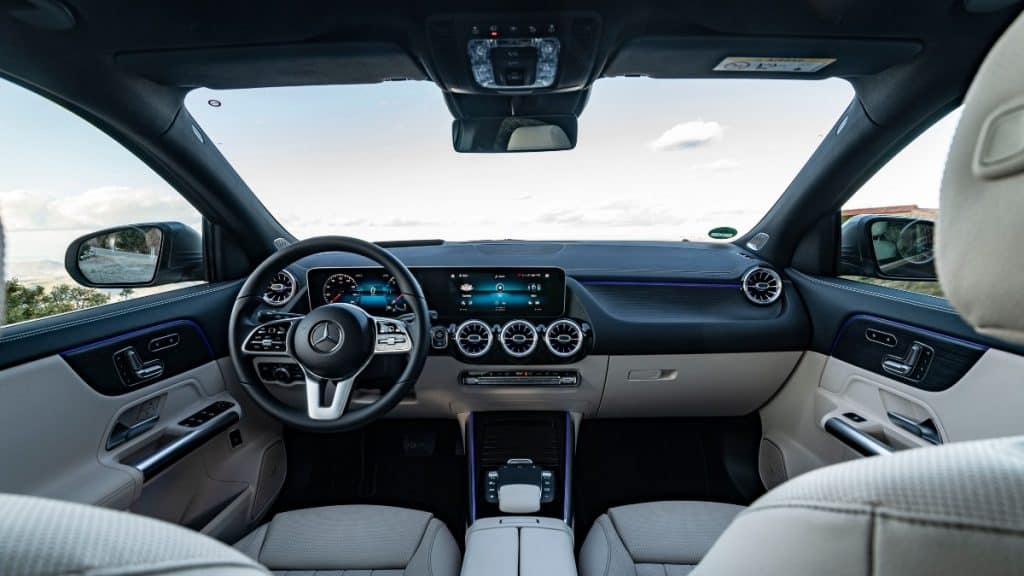
Inside, the cabin architecture borrows liberally from the wider A-Class and CLA family built on the same MGA (Modular Architecture) platform. That’s not criticism – it’s a compliment to Mercedes’ ability to scale premium environments across different segments. The digital instrument cluster and MBUX infotainment screen create a seamless horizontal display that feels genuinely modern without being gimmicky. Physical controls remain where your hands expect them: climate settings, drive mode selector, and volume knob retain tactile presence alongside the touch-capacitive surfaces that dominate the center console.
Seating position sits 97 millimeters higher than the previous GLA – that’s a meaningful difference, not just a marketing figure. Compared to the A-Class sedan, the driver sits nearly 140 millimeters above; versus the B-Class estate, still 52 millimeters higher. Roof pillar cross-sections have been optimized to reduce blind spots, and the greenhouse area feels more open despite the slightly shorter exterior footprint. Materials quality matches the premium positioning: soft-touch plastics on upper surfaces, properly weighted switches, and enough aluminum trim options to suit most tastes.

Safety equipment comes well equipped as standard because the competition won’t accept anything less. The Driving Assistance Package adds active brake assist with pedestrian detection, lane-keeping assist, and the attention alert system that monitors steering inputs for signs of drowsy driving. Available upgrades build further: adaptive cruise control with route-based speed adaptation learns from navigation data and slows for bends ahead, while the emergency corridor function detects stationary vehicles and widens brake pressure distribution across all four wheels if a collision looks imminent. Exit warning monitors traffic behind the vehicle when doors unlock – practical thinking that matters more than enthusiasts might assume.
The powertrain lineup opens with conventional four-cylinder engines ranging from entry-level to performance variants. The GLA 200 carries a 1.332-liter turbocharged inline-four producing 120 kW (163 PS) and 250 Nm of torque, mated to Mercedes’ seven-speed dual-clutch automatic transmission (7G-DCT). Power delivery is smooth and adequately brisk for daily use, with overtaking requiring little more than a firm press of the accelerator and confidence that the gearbox will find the right ratio quickly. Fuel consumption targets sit around 5.8 liters per 100 kilometers for this variant – respectable for a vehicle weighing north of 1,500 kilograms.
Diesel buyers receive the GLA 220 d, equipped with a 2.0-liter CRB engine delivering 140 kW (190 PS) and 380 Nm – more than adequate for moving this compact SUV with authority. The diesel variant benefits from Mercedes’ latest emissions technology including selective catalytic reduction and sophisticated exhaust management to meet Euro 6d-TEMP standards. Four-MATIC permanent all-wheel drive is optional on both petrol and diesel derivatives, though the front-wheel-drive configuration handles everyday duties competently. When conditions deteriorate or loads increase, the 4MATIC system shifts torque rearward automatically, providing traction reserve without the weight penalty of keeping it engaged continuously.
Enthusiasts looking for additional flavor should note the AMG Line packages available at launch. These aren’t full AMG models – don’t mistake the badge placement for genuine Performance division engineering – but they add sporting suspension tuning (reduced ride height by 15 millimeters), larger alloy wheels, specific exterior styling elements including side skirts and rear diffuser, and the AMG steering wheel with flattened bottom section. Inside, sports seats with enhanced lateral support make cornering feel more assured even if the GLA isn’t designed for track days. The suspension retuning stiffens things appreciably while still absorbing road imperfections with the composure expected from Stuttgart.
Electric aspirations lurk beneath the combustion-powered present. Mercedes confirms that an EQ-Power plug-in hybrid variant will arrive in the first half of 2020, combining one of the established internal combustion engines with an electric motor integrated into the transmission housing. Official figures haven’t all been published yet, but expectations center on approximately 200 kilometers of total range combining electric and fuel portions, with pure-electric city commuting feasible for maybe 45 to 50 kilometers depending on variant. Charging happens via standard household connection or wallbox within a few hours. This bridges the gap until the fully electric EQA arrives later in 2020, sharing the same platform architecture and targeting the growing zero-emission urban mobility segment.

Pricing, when officially confirmed at dealerships, positions the GLA above the A-Class Hatchback but below the GLC in Mercedes’ SUV hierarchy. Entry-level variants start roughly around €35,000 in Germany, scaling upward through trim levels and options packages. Full specification lists include everything from ambient lighting packages with adjustable color themes to advanced driver assistance bundles that bring semi-autonomous highway driving closer to reality. Those who value convenience technologies find themselves seduced quickly – the combination of camera systems, parking sensors, and active steer assist makes tight urban maneuvers almost effortless.
Competition arrives from familiar rivals: BMW’s X1, Audi’s Q3, and Volvo’s XC40 all occupy adjacent showroom spaces with compelling arguments. The GLA counters with superior interior technology integration, best-in-class safety systems availability, and the prestige factor inherent in three-pointed star ownership. Whether it outsells the Bavarian alternatives remains an open question answered by market forces rather than engineering brochures. What seems certain is that Mercedes has built a compact SUV worthy of its nameplate – one that balances accessibility with refinement in ways that appeal far beyond traditional luxury buyers. The W256 GLA doesn’t shout about its ambitions; it demonstrates them through execution, and that quiet competence may prove its greatest strength.
Vehicle data
| Make | Mercedes-Benz |
| Model | GLA |
| Generation / chassis code | W256 (second generation) |
| Model year(s) covered | 2020 |
| Body style | Compact SUV / crossover |
| Powertrain / engine | 1.3L turbo I-4 (petrol), 2.0L turbo I-4 (diesel) |
| Power / torque | 120 kW (163 PS) / 250 Nm (GLA 200); 140 kW (190 PS) / 380 Nm (GLA 220d) |
| Transmission | 7G-DCT seven-speed dual-clutch automatic |
| Drivetrain | FWD (standard), 4MATIC AWD (optional) |
| Key performance figures | Curb weight approx. 1,500–1,600 kg; top speed approx. 210 km/h (GLA 200) |
| Price (as stated) | Approximately €35,000+ starting price in Europe |
| On-sale / announcement period | Announced early 2020; on sale from mid-2020 |
| Market | Global (Europe, Americas, Asia-Pacific) |