
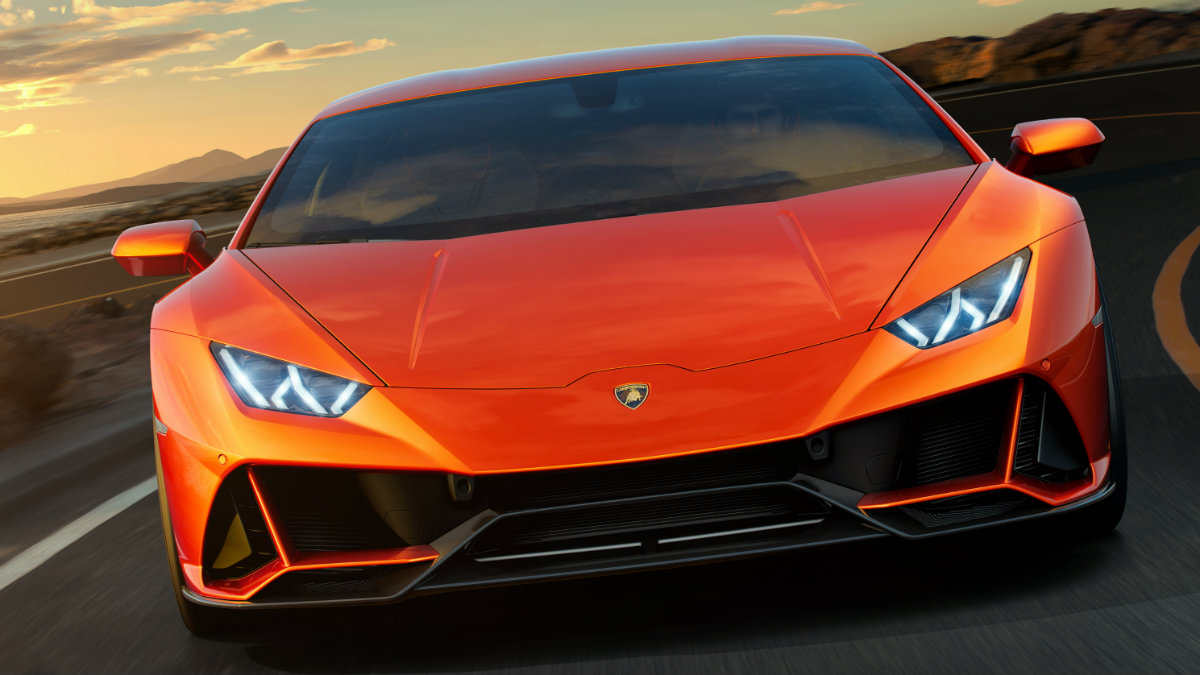
Next-Generation Dynamics and Aerodynamic Evolution
Automobili Lamborghini has pulled the cover off the Lamborghini Huracán EVO, marking the next evolution of its naturally aspirated V10 super sports car. Drawing directly on the track-proven engineering of the Huracán Performante, the EVO elevates Sant’Agata Bolognese’s core sports car platform with integrated vehicle dynamics and an extensive redesign of its aerodynamic surfaces. Rather than treating electronic driver aids and aerodynamic hardware as separate elements, the Huracán EVO unifies chassis electronics, all-wheel drive, four-wheel steering, and cabin technology into a singular predictive control architecture.
Behind the cockpit sits the familiar 5.2-liter naturally aspirated V10 engine, tuned here to match the output of the hardcore Performante. The revised powerplant incorporates titanium intake valves and a lightweight sports exhaust system routed higher in the rear fascia. Calibrated to rev cleanly to an 8,500 rpm redline, the powerplant generates 640 hp (470 kW) at 8,000 rpm alongside 600 Nm (443 lb-ft) of torque arriving at 6,500 rpm. With a dry weight registered at 1,422 kg (3,135 lbs), the coupe achieves an exceptional weight-to-power ratio of 2.22 kg per horsepower.
Straight-line acceleration reflects those figures. The Huracán EVO charges from zero to 100 km/h (62 mph) in 2.9 seconds, passing 200 km/h (124 mph) in 9.0 seconds flat. Anchored by standard carbon-ceramic brakes, the car halts from 100 km/h to zero across 31.9 meters, continuing on to a stated top speed beyond 325 km/h (202 mph). Yet raw speed tells only half the story; the real leap lies in how the chassis translates driver inputs into cornering agility.
Predictive Vehicle Dynamics: Inside LDVI and LPI 2.0
At the mechanical core of this handling evolution sits the Lamborghini Dinamica Veicolo Integrata, commonly designated as LDVI. Serving as the car’s central processing brain, the LDVI system coordinates every individual mechanical and electronic chassis subsystem. While earlier stability systems reacted to loss of traction or yaw deviations after tire slip occurred, LDVI introduces predictive feedforward logic. By processing vehicle data in real time, the unit anticipates driver intentions and dynamically preconditions the suspension, steering, and differentials before the car settles into a turn.
Feeding real-time acceleration data to the LDVI is the upgraded Lamborghini Piattaforma Inerziale version 2.0. Nestled directly at the vehicle’s center of gravity, this cluster of precision gyroscopes and multi-axis accelerometers continuously measures longitudinal, lateral, and vertical forces, tracking vehicle roll, pitch, and yaw rates with heightened accuracy. Instantaneous data streams flow to the magnetorheological suspension system, which has been redeveloped to version 2.0 calibration. Damper damping fluid viscosity changes instantaneously under magnetic fields, continuously countering body roll and maintaining optimal tire contact patches across undulating road surfaces.
Traction management receives a parallel overhaul. The permanent all-wheel-drive system works in tandem with full torque vectoring across both axles, capable of sending full driving torque to an individual wheel when slip or sudden lateral loading requires stabilization. Furthermore, the variable-ratio Lamborghini Dynamic Steering is integrated with an active rear-wheel steering setup. At lower parking and city speeds, the rear wheels turn in counter-phase to virtually shorten the wheelbase for immediate turn-in response. At high road speeds and heavy track braking, the rear wheels steer in phase with the front wheels, delivering rock-solid high-speed cornering stability.

Tailored Calibration via the ANIMA Drive Selector
The operational demeanor of LDVI shifts fundamentally based on the ANIMA drive mode selector located at the base of the steering wheel. Drivers can switch between Strada, Sport, and Corsa calibrations depending on road conditions and driving goals. In Strada mode, LDVI is calibrated for smooth road feedback, stability, and everyday composure. The chassis remains compliant over road imperfections, with all-wheel traction biased toward predictable understeer mitigation and effortless steering responses.
Selecting Sport mode unlocks an entirely different dynamic attitude. Here, the LDVI system recalibrates the torque vectoring and rear-wheel steering to allow controlled power oversteer while retaining safety intervention thresholds. Rear-biased torque delivery gives drivers the playful freedom to drift progressively on corner exit without sacrificing precision. Steering effort firms up, and the exhaust valves open to provide immediate acoustic feedback from the high-revving 5.2-liter V10.
For closed-circuit lapping, Corsa mode transforms the Huracán EVO into a razor-sharp track instrument. Calibrated directly from Lamborghini Squadra Corse motorsport data, Corsa optimizes LDVI parameters for maximum lap times and pure mechanical grip. Lateral stability, magnetorheological damping rates, and torque transfer are held at their tightest settings, ensuring that transient weight transfers result in instantaneous direction changes. The seven-speed dual-clutch transmission delivers lightning-quick gearshifts with maximum mechanical engagement.
Aerodynamic Architecture and Sculpted Exterior Design
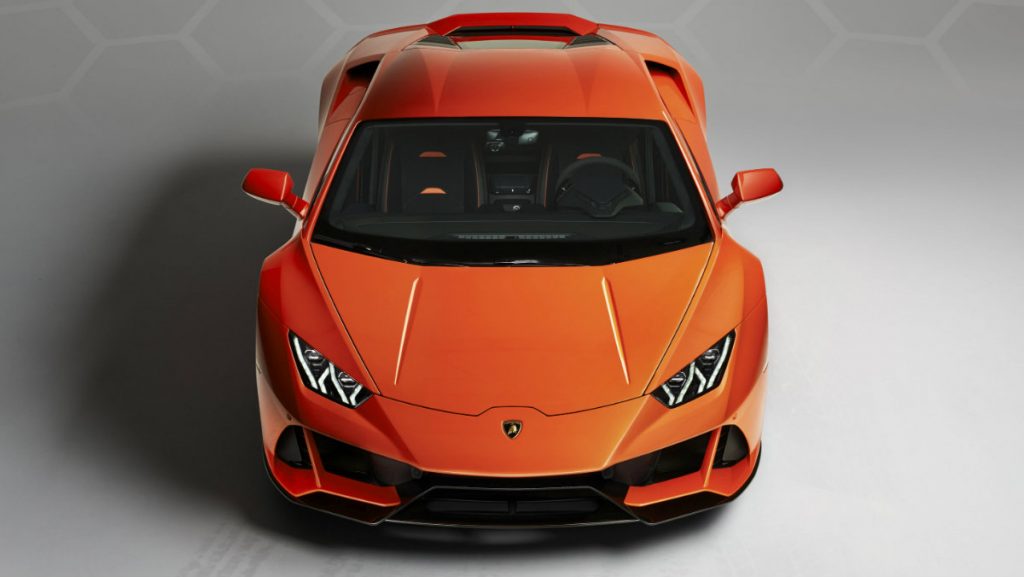
Visual changes across the Huracán EVO are inextricably tied to aerodynamic efficiency. Sant’Agata engineers reworked the entire aero package, yielding a downforce and overall aerodynamic efficiency improvement of more than five times compared to the original Huracán LP 610-4. Up front, a redesigned front bumper features enlarged air intakes shaped with Lamborghini’s signature Ypsilon motif. An integrated front splitter complete with dedicated wing elements channels turbulent air under the vehicle and feeds vital cooling radiators.
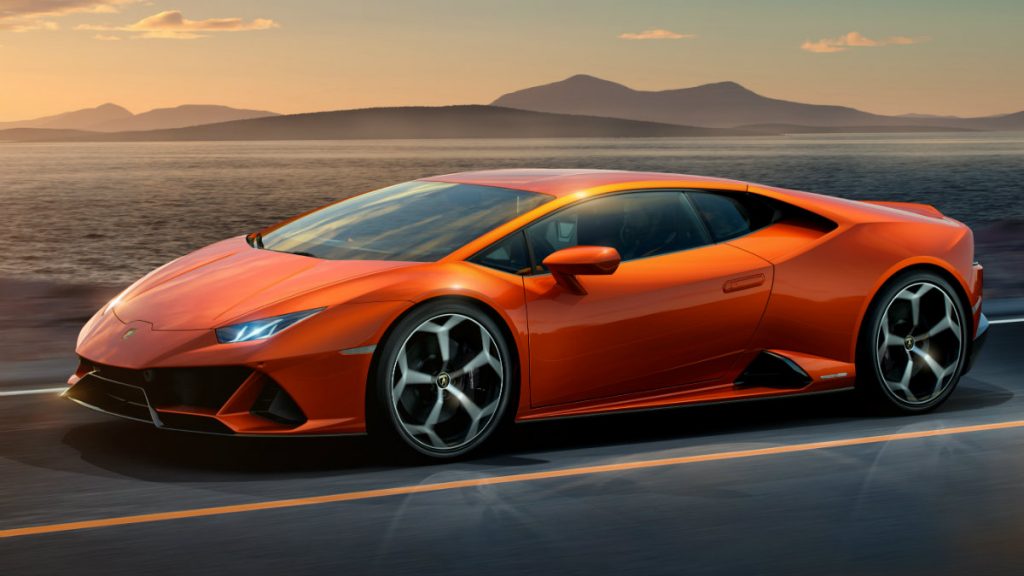
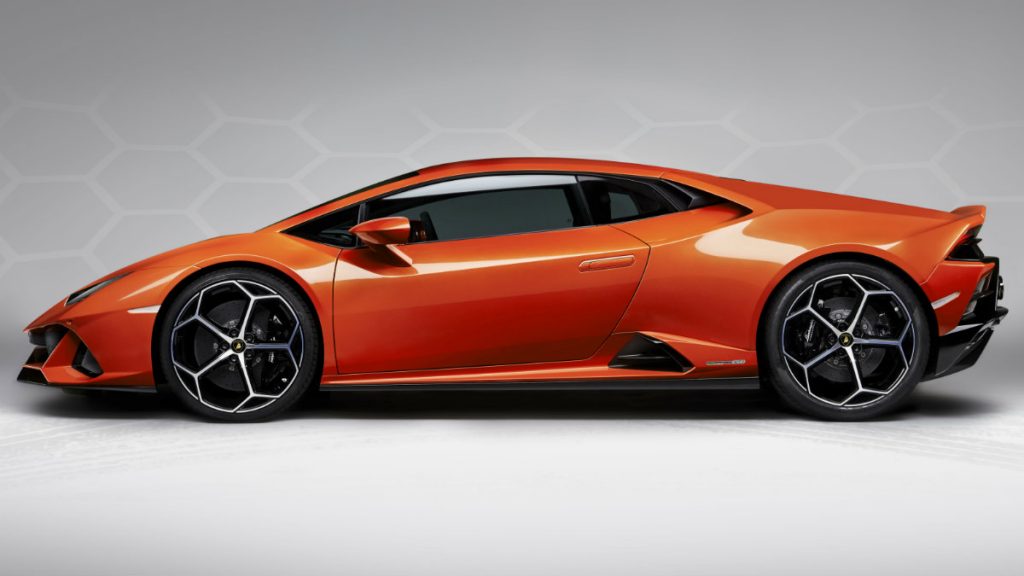
Along the profile, clean lines highlight iconic hexagon design elements within the side glazing and wheel spokes. Freshly sculpted side air scoops pull massive volumes of cooling air into the mid-mounted engine bay and auxiliary oil coolers. Staggered 20-inch Aesir alloy wheels were developed specifically for the EVO, shod with bespoke Pirelli P Zero compounds engineered to sustain extreme lateral cornering loads.
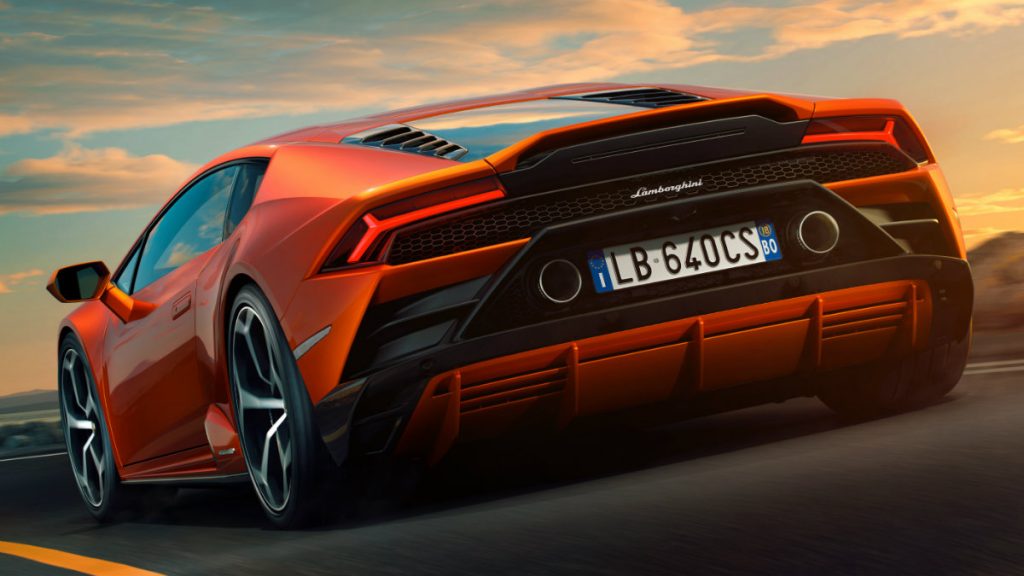
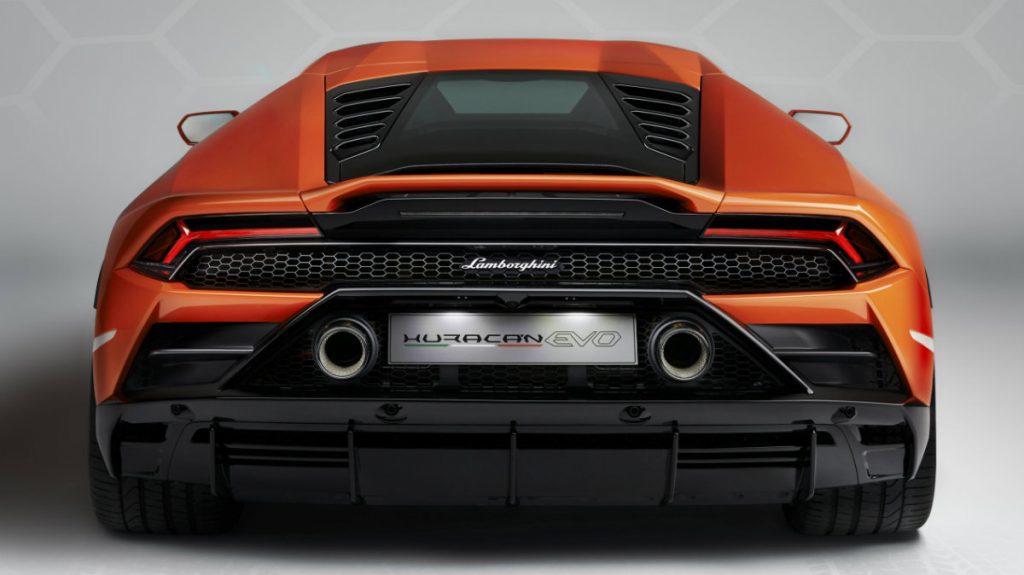
At the rear, the EVO adopts the purposeful stance of its GT3 and Super Trofeo racing siblings. The dual sports exhaust tailpipes exit high up within the center of the rear fascia rather than down near the diffuser floor. This high-mounted layout clears room for an expansive underbody diffuser that extracts low-pressure air with incredible speed. Above the tailpipes, an integrated slotted rear spoiler directs airflow across the rear deck, creating functional downforce without resorting to the drag penalty of a fixed tall racing wing.
Cockpit Technology and Connected Infotainment
Inside the cabin, the Huracán EVO introduces a major technological advancement for Lamborghini sports cars: a vertically oriented 8.4-inch capacitive HMI touchscreen positioned directly in the center console just ahead of the fighter-jet-style missile-switch starter cover. Replacing the cluster of physical buttons found in earlier models, the high-resolution display supports multi-finger gesture recognition for swift control over cabin temperature, seat adjustments, and audio playback.
Beyond entertainment, the central screen acts as a dynamic monitor for the driver. It delivers real-time graphic readouts of the LDVI system, showing torque distribution across all four wheels, steering angles, and suspension damping behavior. Full smartphone connectivity includes Apple CarPlay integration with voice control via Siri. Connected satellite navigation provides live routing, while an integrated multimedia interface includes digital web radio and video playback functions supported by a high-capacity internal hard drive.
For enthusiasts keen on tracking circuit performance, Lamborghini offers an optional dual-camera telemetry setup integrated into the touchscreen. The system syncs onboard video with comprehensive telemetry data, logging lap times, steering angles, braking points, and longitudinal acceleration. Drivers can review cornering lines and sector splits directly on the console or export data logs for detailed external driver analysis.
Bespoke Craftsmanship and Ad Personam Customization
Lamborghini debuted the Huracán EVO in an arresting four-layer paint finish dubbed Arancio Xanto, an iridescent orange that shifts intensity under direct sunlight. Inside the cockpit, a dedicated EVO upholstery scheme blends high-grade black leather and lightweight Alcantara with matching Arancio Dryope stitching and contrast leather accents. The cabin atmosphere is further heightened by customizable ambient lighting that illuminates the footwells and door cards.
Weight reduction and technical artistry continue through lightweight material options. Owners can specify forged composite carbon fiber elements across interior trim pieces, alongside Lamborghini’s patented Carbon Skin fabric, an ultra-lightweight woven composite that provides a textured, competition-grade interior surface. A variety of exterior Style Packs add gloss black or body-colored finishes to front splitters, mirror caps, side skirts, and the rear diffuser.
For clients desiring one-off exclusivity, Lamborghini’s Ad Personam personalization program unlocks limitless customization pathways. From bespoke paint-to-sample exterior shades to hand-stitched personalized interior monograms and custom brake caliper lacquers, every Huracán EVO can be configured to the exact aesthetic preference of its owner. Through this combination of bespoke Italian craftsmanship, blistering naturally aspirated performance, and predictive LDVI dynamics, the Lamborghini Huracán EVO solidifies its place as an engineering benchmark among modern V10 supercars.


Vehicle data
| Make | Lamborghini |
| Model | Huracán EVO |
| Generation / chassis code | First generation facelift |
| Model year(s) covered | 2020 |
| Body style | Two-door coupe |
| Powertrain / engine | 5.2-liter naturally aspirated V10 with titanium intake valves |
| Power / torque | 640 hp (470 kW) @ 8,000 rpm / 600 Nm @ 6,500 rpm |
| Transmission | 7-speed dual-clutch transmission |
| Drivetrain | All-wheel drive with torque vectoring and rear-wheel steering |
| Key performance figures | 0-100 km/h: 2.9 s, 0-200 km/h: 9.0 s, 100-0 km/h: 31.9 m, Top speed: >325 km/h |
| Price (as stated) | Not stated in sources |
| On-sale / announcement period | January 2019 |
| Market | Global |