

Formula 1 Hybrid Engineering Built for the Road
Marking the 50th anniversary of Mercedes-AMG, the Mercedes-AMG Project ONE show car transfers modern, championship-winning Formula 1 powertrain hardware into a two-seat, road-legal hypercar. Developed in close technical cooperation with Mercedes-AMG High Performance Powertrains in Brixworth and the Mercedes-AMG Petronas Motorsport team in Brackley, the concept delivers over 1,000 hp (more than 735 kW) and eclipses 350 km/h (217 mph). It demonstrates how race-bred thermal efficiency and advanced electrification can unite in a machine destined for everyday roads.

Drawing on consecutive Formula 1 world championship titles, the engineering team set out to construct a fully functioning road-going vehicle centered around an authentic grand prix engine. Dr. Dieter Zetsche, Chairman of the Board of Management of Daimler AG and Head of Mercedes-Benz Cars, noted that motorsport serves as an active testbed where intense competition breeds advancements directly applicable to production cars. With three constructors’ and drivers’ world championships already under their belt in the turbo-hybrid era, Mercedes-AMG used Project ONE to turn that track record into tangible machinery. Ola Källenius, Daimler AG Board Member for Group Research and Mercedes-Benz Cars Development, pointed out that the show car represents the first Formula 1-derived package configured to pass road certification standards, matching an electrically driven front axle to extreme power density. Tobias Moers, Head of Management at Mercedes-AMG GmbH, framed the hypercar as the absolute pinnacle of AMG’s strategic expansion into standalone sports car design, providing a tangible preview of how the brand plans to interpret driving performance as electrification takes hold.

Championship Powertrain Architecture: 1.6-Litre V6 and Quad Electric Motors
The beating heart of the Mercedes-AMG Project ONE is an EQ Power+ high-performance plug-in hybrid drive system taken straight from Brixworth’s racing benches. The mid-engine layout, installed forward of the rear axle, relies on an integrated network linking a turbocharged 1.6-litre V6 petrol combustion engine with four specialized electric motors. The internal combustion engine features direct fuel injection, four overhead camshafts turned by spur gears, and pneumatic valve springs in place of traditional mechanical springs to handle extreme rev ceilings.
Where road-going sports cars historically rely on engine speeds below 8,500 rpm, this 1.6-litre unit revs freely to 11,000 rpm. While lower than the unrestricted grand prix limit to safeguard component longevity and allow standard commercial Super Plus unleaded fuel instead of specialized racing mixtures, it remains unmatched by any contemporary road car. The electrification setup is equally radical: one motor assists the turbocharger, a second mounts to the crankcase, and two independent units govern the front wheels. The front-axle electric motors spin up to an astonishing 50,000 rpm, far surpassing the typical 20,000 rpm limit of conventional EV drives.

Eliminating Lag: Split Turbocharger, MGU-H, and MGU-K Recovery
Forced induction in high-output engines usually comes at the price of delayed boost response, but the Project ONE bypasses turbo lag through an electrically energized split-turbo configuration. The exhaust gas turbine and compressor turbine sit apart from each other, matched cleanly to the exhaust and intake tracts of the V6 bank. Connecting the two turbine wheels is a rigid shaft housing an integrated 90 kW electric motor, known in Formula 1 nomenclature as the MGU-H (Motor Generator Unit-Heat).
Under transient conditions, off-idle maneuvers, or immediate gear shifts, this 90 kW motor accelerates the compressor wheel up to 100,000 rpm before exhaust gases fully build up. Throttle response is instantaneous, outpacing even a high-displacement naturally aspirated V8. When the driver lifts off or exhaust pressures surge beyond boost requirements, the MGU-H works as a generator, harvesting residual energy from the exhaust gas stream. It diverts that power directly into the high-voltage battery or channels it to the MGU-K (Motor Generator Unit-Kinetic)—a 120 kW electric motor coupled to the engine crankshaft via spur gears. Together, these systems push thermal efficiency past 40 percent, an unprecedented milestone against the 33 to 38 percent typical of modern series production engines.

Front-Axle Torque Vectoring and 800-Volt Electrical Systems
Electrification at the front wheels gives the Project ONE variable all-wheel drive with comprehensive torque vectoring. Two 120 kW electric motors mount directly on the front axle, each linked to a wheel through a dedicated reduction gearbox. Because each wheel receives positive drive or deceleration commands independently, the chassis can distribute yaw moments across cornering transitions with millisecond precision. Under braking in everyday traffic, the front-axle system recovers up to 80 percent of kinetic deceleration energy, funneling it straight back into the battery cells.
Each electric motor links to its own power electronics tucked close to the chassis floor. The high-voltage lithium-ion pack and DC/DC converter sit low behind the front axle. Benefiting from Brixworth’s grand prix battery design, the cells and their direct fluid cooling mirror Formula 1 hardware, though configured with increased cell capacity to support practical highway range. Operating at an 800-volt standard instead of the typical 400-volt threshold, the electrical architecture significantly lowers conductor cable diameters, shaving valuable kilograms and freeing tight packaging volume inside the carbon tub.
Operating Strategies and Transmission Engineering
The EQ Power+ powertrain incorporates multiple driving profiles spanning quiet urban commuting to aggressive racetrack setups akin to Formula 1 qualifying modes. In all-electric mode, the Project ONE sets off using front-wheel traction alone, supported briefly by the crank-mounted MGU-K during rapid throttle tip-in. As the throttle demands increase, the 1.6-litre V6 fires cleanly into life, combining all power sources into an all-wheel sprint. Utilizing Race Start mode, the hypercar blasts from rest to 200 km/h (124 mph) in less than six seconds.
Transferring rear-axle power is a bespoke 8-speed manual transmission designed entirely from clean-sheet blueprints by Mercedes-AMG. The gearbox employs hydraulic activation and gives drivers the option of fully automated shifting or manual gear changes via steering-wheel-mounted shift paddles. Both the mid-mounted engine and the transmission casing serve as fully stressed structural members, bolting into the monocoque and carrying the entire rear suspension linkage.
Chassis Dynamics, Push-Rod Suspension, and Carbon Aero Wheels
Underneath the carbon body panels lies a lightweight, high-rigidity carbon-fibre monocoque. The suspension layout relies on multi-link geometries at both axles paired with adjustable coil-over damper assemblies. In a direct motorsport nod, both push-rod spring struts are oriented horizontally across the direction of travel. This transverse arrangement eliminates the need for traditional tubular stabilizer bars, preventing lateral body roll during abrupt transitions without creating excessive vertical ride harshness over surface imperfections.
Chassis balance is backed by an advanced multi-stage safety net. AMG’s three-stage ESP system gives drivers total control over dynamic intervention: ESP ON maintains maximum electronic oversight, ESP Sport Handling Mode allows wider slip angles before correcting yaw, and ESP OFF leaves handling strictly in the driver’s hands for enclosed circuits. Road contact comes courtesy of bespoke 10-spoke forged aluminum wheels featuring center-lock hubs. Each wheel integrates a radial carbon-fibre aero ring with three ventilation slots per spoke section, reducing aerodynamic drag while actively extracting turbulent heat from the brakes. Up front, 10.0 J x 19 wheels are wrapped in 285/35 ZR 19 Michelin Pilot Sport Cup 2 tires, balanced at the rear by 12.0 J x 20 rims shod in massive 335/30 ZR 20 rubber. Stopping duties fall on an AMG Carbon Ceramic high-performance braking system, shaving unsprung mass while offering remarkable fade resistance under heavy track use.
Sensual Purity and Aerodynamic Sculpture
Design leadership under Daimler AG Chief Design Officer Gorden Wagener balanced the brand’s “Sensual Purity” philosophy with functional motorsport necessity. The exterior shape prioritizes downforce, cooling balance, and slipstream management without relying on disconnected ornamental styling. The cab-forward silhouette, flared arches, tightened wasp waist, and stretched tail echo prototype endurance racers while maintaining distinctive road car proportions.
The front apron is spanned by functional cooling intakes, centered around a wide trapezoidal air inlet with a painted AMG insignia, topped by the Mercedes star on the bonnet edge. Below, the hallmark silver AMG A-wing feeds cool air toward side ducts framed by active aero flaps. Twin bonnet extractors channel spent radiator heat away from the cockpit, directing undisturbed laminar air toward the high-mounted roof intake. Front-axle downforce is actively balanced by an automatically extending front splitter and motorized louvres over the front wheel arches.
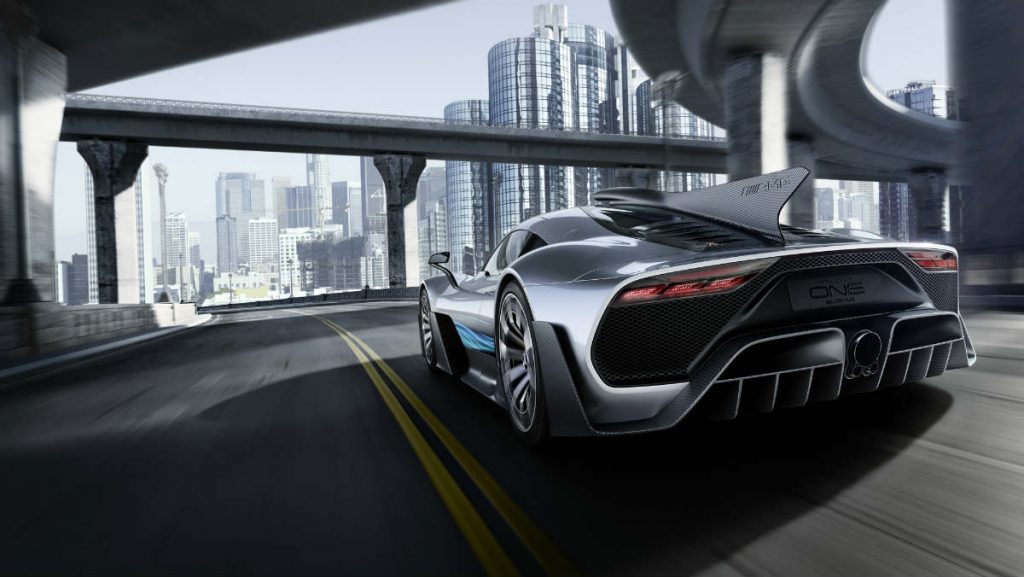
Along the profile, deep side scallops expose dark carbon-fibre ducting accented with Petronas green graphics. The roof intake feeds engine induction air directly into the V6 plenum, flowing backward into a prominent vertical shark fin that enhances high-speed directional stability during fast sweeping turns. Beneath the rear glazing, which reveals the power unit, twin NACA ducts route fresh air to rear-mounted engine and transmission oil coolers. The rear fascia terminates in a prominent vertical spoiler lip, a two-stage extendible aerofoil, and an enormous two-tier carbon-fibre diffuser anchored by a distinctive central round exhaust flanked by dual wastegate exits.
Minimalist Cockpit Architecture: Track Purpose Meets Everyday Function
Inside the carbon tub, the cockpit layout strips away superfluous ornamentation in favor of purist racing ergonomics. Monocoque bucket seats with adjustable backrests are bonded directly into the structural floor, with driving position adjustments handled through a movable pedal assembly and telescoping steering column. A flowing center spine divides driver and passenger, while a floating, structural wing dashboard spans the forward cowl to increase torsional rigidity.
Two free-standing 10-inch high-resolution displays provide critical instrumentation and infotainment readouts, mounted via solid metal brackets. The rectangular screen styling carries over into suspended aluminum air vents, console switchgear, and the push-button ignition cluster. The Formula 1-inspired rectangular steering wheel features flattened upper and lower rims, an integrated airbag, LED rev indicator lights, and rotary toggles for drive modes and suspension stiffness. Practical cabin amenities remain intact, including standard air conditioning, power windows, dual storage cubbies behind the seats, and a rear-facing mirror cam that projects crisp exterior video onto a high-mounted roof screen. Racing seats finished in non-slip black microfibre with magma grey nappa leather inserts and yellow contrast stitching complete an interior engineered for authentic motorsport immersion.
Vehicle data
| Field | Value |
|---|---|
| Make | Mercedes-AMG |
| Model | Project ONE |
| Generation / chassis code | Show car / concept prototype |
| Model year(s) covered | 2017 (IAA Frankfurt premiere) |
| Body style | Two-seat mid-engine hypercar coupe with dihedral doors |
| Powertrain / engine | EQ Power+ plug-in hybrid: 1.6-litre turbocharged V6 (petrol direct injection, pneumatic valve springs, electrically driven turbocharger MGU-H) + 1 crank motor (MGU-K) + 2 front-axle electric motors |
| Power / torque | Over 1,000 hp (>735 kW) system output (V6 combustion + 4 electric motors) |
| Transmission | 8-speed manual transmission with hydraulic actuation and paddle-shift control |
| Drivetrain | AMG Performance 4MATIC+ all-wheel drive with electrically driven front axle and torque vectoring |
| Key performance figures | Top speed >350 km/h (>217 mph); 0–200 km/h in <6.0 seconds |
| Price (as stated) | Not stated in sources |
| On-sale / announcement period | World premiere September 2017 (IAA Frankfurt) |
| Market | Global showcase |