

35 Years of Munich’s Fastest Sedan
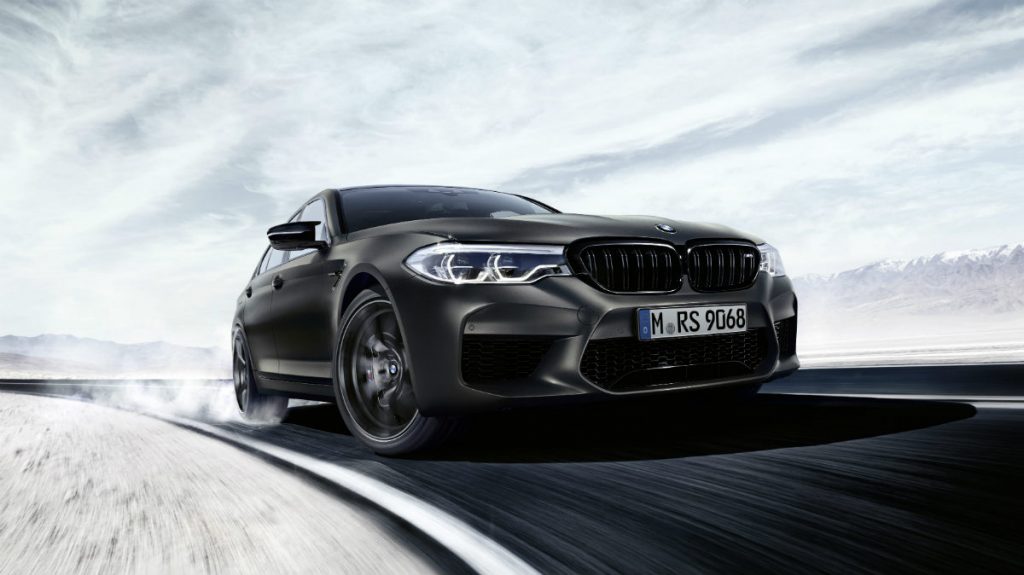
Three and a half decades. Six generations. One stubbornly consistent idea: take a discreet executive sedan and stuff it with an engine that belongs in a sports car. That is the BMW M5 in a sentence, and BMW M GmbH marked the anniversary with a limited-run special that carries the most powerful engine in the model’s history: the BMW M5 Edition 35 Years, capped at 350 units worldwide and available from July 2019.
The story stretches back to the mid-1980s, when BMW Motorsport GmbH decided that the 5 Series saloon deserved the full competition treatment. The first-generation M5 borrowed its inline six-cylinder engine directly from the mid-engine M1 supercar, wrapped it in bodywork that looked almost indistinguishable from a regular 5 Series, and quietly created a new vehicle category: the high-performance sports sedan. Nobody saw it coming. That combination of sleeper styling and genuine sports-car pace became the M5’s calling card, and every generation since has turned the dial a little further.
Across six iterations, the driving dynamics potential of the M5 has climbed steadily, but the underlying character has held firm. As an independent model based on the 5 Series, it has always offered that crucial extra in performance — the kind that expresses a genuine passion for motorsport rather than mere straight-line speed. High-revving engines, suspension technology tuned to match, and M-specific design touches for cooling and aerodynamics have guaranteed handling defined by precision and agility. That is the M5 formula, and the Edition 35 Years sits right at its apex.

The Edition 35 Years: Built on the M5 Competition
The starting point for the Edition model is the BMW M5 Competition — already the sharpest tool in Munich’s performance-saloon arsenal. Where the standard M5 is a serious machine, the Competition variant dials up the racing inspiration further: stiffer engine mounts, a track-focused suspension calibration, and an output bump that separates it from the base car.
Under the bonnet sits the familiar 4.4-litre V8 with M TwinPower Turbo technology, here producing 460 kW (625 hp) and 750 Nm of torque. That twist routes through an eight-speed M Steptronic automatic transmission, the M xDrive all-wheel-drive system, and an Active M Differential at the rear axle. The result is a sedan that hits 100 km/h from standstill in 3.3 seconds and passes 200 km/h after just 10.8 seconds. Traction is relentless, ride stability outstanding, and the steering carries the kind of precision that makes serious speed feel manageable rather than terrifying.

Exclusive Exterior and Interior Details
The exterior treatment begins with BMW Individual’s Frozen Dark Grey II metallic — a special paint with unique pigmentation that produces a satin-matt surface. It is the kind of finish that absorbs light rather than reflecting it, giving the bodywork an almost liquid appearance. New 20-inch M light alloy wheels in a Y-spoke design, finished in Graphite Grey, were created exclusively for the Edition.
Brake hardware is visible behind those spokes: the standard M compound brake system wears calipers in high-gloss black, while the optional M carbon ceramic brake system swaps them for gold — a visual signal that the car carries serious stopping hardware.

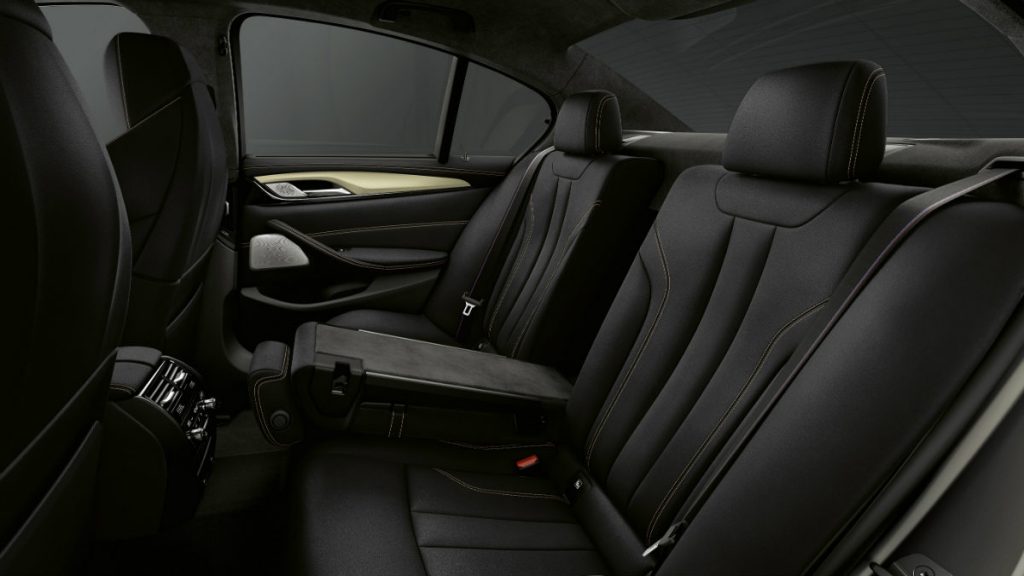
Inside, M multifunction seats sit within BMW Individual Merino full leather trim in black, picked out with beige contrast stitching. The most striking addition is a new trim material debuting here: aluminium carbon structure in gold anodized. These finely structured, shimmering surfaces cover the instrument panel, door trim sections, and centre console, catching the light differently depending on the viewing angle. It is the sort of detail that separates a collector’s piece from a regular production car.
Door sill finishers carry the inscription “M5 Edition 35 Jahre,” and a laser engraving on the cupholder cover in the centre console reads “M5 Edition 35 Jahre 1/350” — a quiet reminder that you are sitting in one of exactly three hundred and fifty.

Six Generations of the BMW M5
To appreciate what the Edition 35 Years represents, it helps to trace the thread back to the beginning. The M5 formula has always been the same: a restrained 5 Series bodyshell, an engine from the motorsport parts bin, and suspension tuned to keep up. What has changed across six generations is the scale of the ambition.
E28 (1984–1988): The Original Sleeper
The first M5 was remarkably inconspicuous. Visually, it was nearly identical to a standard E28 5 Series — no widened arches, no aggressive body kit, nothing to alert the neighbours. That made the engine all the more startling. BMW Motorsport lifted the 3.5-litre inline six-cylinder from the M1 mid-engine supercar, gave it optimised digital engine electronics, and extracted 210 kW (286 hp) — nine horsepower more than the M1 itself. In a production sedan, in the mid-1980s, that was genuinely startling.
“The suspension must always be faster than the engine” — this was the guiding principle at BMW M at the time, which meant the E28 M5 received a tightened sports suspension, a high-performance brake system, a reinforced five-speed manual transmission, and a differential lock in the rear axle with a 25 per cent locking factor. The first M5 was hand-built at the Garching facility, keeping volumes low and exclusivity high.
E34 (1988–1995): Refinement and More Power
The second generation kept the same basic recipe but executed it with greater polish. The inline six grew to 3.6 litres, initially producing 232 kW (315 hp). From 1992, capacity increased further to 3.8 litres and output rose to 250 kW (340 hp). A six-speed manual gearbox replaced the earlier five-speed unit, giving the E34 M5 a more relaxed cruising character without sacrificing engagement at higher speeds.
Notably, the E34 introduced self-levelling suspension on the rear axle as standard equipment — a feature that underscored the M5’s dual nature between track capability and everyday comfort. The car could carry four adults and their luggage across a continent, then tackle a circuit without embarrassing itself. It was also the last M5 assembled largely by hand, closing out a chapter in Munich’s production philosophy.

E39 (1998–2003): The V8 Arrives
The third-generation M5 broke with tradition in the most welcome way possible: it gained a V8. The 5.0-litre naturally aspirated unit produced 294 kW (400 hp) and 500 Nm of torque, requiring considerably enlarged cooling air inlets at the front and announcing its presence through the now-iconic twin rear exhaust pipes — a discreet visual cue that distinguished the M5 from lesser 5 Series models.
The E39 M5 is widely regarded as one of the finest sports saloons ever built. Its combination of a free-revving atmospheric V8, a precise six-speed manual, and a chassis with beautifully judged damping delivered a driving experience that felt both fast and intimate. The brakes, suspension, and rear-axle differential were all uprated to handle the step up in output, and the car’s 0–100 km/h time of approximately 4.8 seconds placed it firmly in serious performance territory.

E60 (2005–2010): The Formula 1 V10
If the E39 was a masterclass in refinement, the E60 M5 was an act of sheer mechanical audacity. BMW M fitted a 5.0-litre V10 engine derived from the company’s Formula 1 programme, producing 373 kW (507 hp) and revving past 8,000 rpm. The sound it made at full throttle was closer to a racing prototype than a production saloon — a howling, metallic bark that no turbocharger could ever replicate.
The V10 took the high-revving philosophy of M engines to a new extreme. A seven-speed SMG III sequential manual transmission handled gear changes, and the chassis was stiffened to cope with the additional output. The E60 M5 was a demanding car to drive quickly — it did not flatter the driver so much as reward skill — and that rawness made it divisive. Some called it the greatest M5; others found it too raw for daily use. Either way, it was unforgettable.

F10 (2011–2016): Turbo Technology Returns
The fifth generation marked a fundamental shift: the high-revving naturally aspirated V10 was replaced by a 4.4-litre twin-turbo V8 with M TwinPower Turbo technology. Output climbed to 412 kW (560 hp), and — critically — torque swelled dramatically, arriving lower in the rev range and pulling harder for longer. Two turbochargers mounted in the V between the cylinder banks and a cross-bank exhaust manifold defined the technical character of the new engine.
A seven-speed M double-clutch transmission managed the power, while an Active M Differential Lock at the rear axle kept traction in check. The F10 M5 was a fundamentally different animal from the V10 car: less manic at the top end, but massively more usable in real-world driving. It was quicker point-to-point for most drivers, even if the high-rpm drama had been traded for a broader, more accessible wave of thrust.
F90 (2017–present): All-Wheel Drive and 625 hp
The sixth-generation M5 introduced the most significant change in the car’s drivetrain history: M xDrive all-wheel drive. For the first time, an M5 sent power to all four wheels, though the system could be switched to a rear-drive-only mode for drivers who preferred the traditional M-car power-oversteer experience. This flexibility gave the F90 a dual character that previous generations could only hint at.
The 4.4-litre twin-turbo V8 returned, now producing 441 kW (600 hp) in standard form and 460 kW (625 hp) in the Competition variant. Combined with the grip of M xDrive and the traction benefits of the Active M Differential, the F90 M5 Competition delivered the kind of performance figures — 3.3 seconds to 100 km/h — that would have seemed absurd in a four-door sedan even a decade earlier. The car was faster, more stable, and more controllable than any M5 before it.
The Edition 35 Years sits at the very top of this lineage. With 625 hp, M xDrive, exclusive Frozen Dark Grey II paint, gold-anodised interior trim, and a production run of just 350 units, it represents the most dynamically capable and visually distinctive M5 that BMW M GmbH has built to date. Three and a half decades of continuous evolution, all funnelled into one limited-run sedan.

Vehicle data
| Field | Value |
|---|---|
| Make | BMW |
| Model | M5 Edition 35 Years |
| Generation / chassis code | F90 (based on M5 Competition) |
| Body style | 4-door saloon |
| Powertrain / engine | 4.4-litre twin-turbo V8, M TwinPower Turbo |
| Power / torque | 460 kW (625 hp) / 750 Nm |
| Transmission | 8-speed M Steptronic automatic |
| Drivetrain | M xDrive all-wheel drive with Active M Differential |
| Key performance figures | 0–100 km/h: 3.3 s; 0–200 km/h: 10.8 s |
| Price (as stated) | From $128,995 (US MSRP incl. destination) |
| On-sale / announcement period | Announced May 2019; deliveries from July 2019 |
| Market | Global (limited to 350 units) |