
BMW Concept Z4: Bavarian Roadster Design Reimagined
When the BMW Concept Z4 rolled onto the manicured turf of the Concours d’Elegance at Pebble Beach in August 2017, it arrived carrying serious expectations. The two-seater roadster has long formed an emotional pillar for BMW, yet the outgoing E89-generation Z4 had drifted into cruiser territory with its heavy folding metal hardtop and soft-edged grand touring demeanor. With this concept study, the BMW Group delivers a blunt, purposeful preview of the next series-production model scheduled to break cover in 2018. It is a dramatic return to traditional roadster values, executed through an assertive, angular visual language.
Adrian van Hooydonk, Senior Vice President of BMW Group Design, did not mince words when presenting the open-top study. “The BMW Concept Z4 is an all-out driving machine,” van Hooydonk stated. “Stripping the car back to the bare essentials allows the driver to experience all the ingredients of motoring pleasure with supreme directness. This is total freedom on four wheels.” Rather than merely refining familiar styling cues, the design team in Munich re-examined what makes a classical roadster compelling: compact agility, minimal weight, and an unvarnished connection between the driver’s hands, the asphalt, and the sky above.
The roadster lineage runs deep at BMW, tracing a path through icons like the pre-war 328, the sculpted 507 of the late 1950s, the quirky Z1 with its drop-down doors, and the Henrik Fisker-penned Z8. Each of those cars celebrated athletic minimalism and open cockpit motoring. The Concept Z4 honors that heritage not by copying retro silhouettes, but by distilling their underlying spirit into modern surfacing. Van Hooydonk noted that the show car expresses BMW’s emerging design philosophy from every perspective: a handful of precise character lines paired with intricate surface tension create an unmistakable sense of athletic poise.

Proportions Shift Inward: A Compact, Driver-Centric Stance
Traditional proportions for modern BMW roadsters historically leaned on an exceptionally long nose, a low seating hip-point pushed back almost atop the rear axle, and minimal boot overhang. The BMW Concept Z4 alters that geometry deliberately. While the overall silhouette remains low-slung and stretched across a generous wheelbase, the bonnet is noticeably shorter than before and both front and rear overhangs are trimmed down tight. This structural packaging shifts the cockpit forward, seating the driver noticeably closer to the physical center of the chassis.
The practical result is a tighter, far more agile stance. Instead of watching the nose pivot through a corner from far behind, the driver feels positioned right where rotational inertia gathers. The outline follows a crisp wedge profile that sweeps upward from the low front apron through the sills and into high, muscular rear quarters. Dynamic tension builds before the vehicle turns a wheel. Behind each bucket seat, prominent aero domes flow rearward over the rear deck, elegantly integrating structural rollover protection while sculpting a taut, athletic finish behind the open cabin.
Shark Nose and Heritage Grille: Sculpting the Flanks
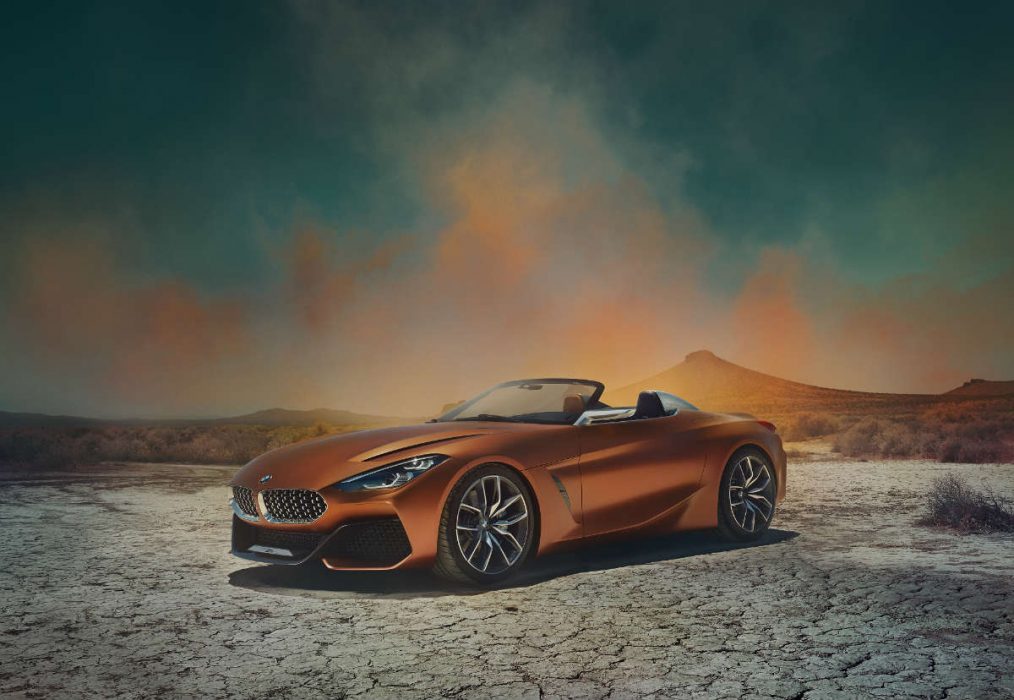
At the front end, a sharp, forward-jutting shark nose establishes the primary trajectory for the entire exterior. BMW designers abandoned fussy creases in favor of cleanly sculpted sheet metal that guides incoming air across the body. Behind the front wheel arches, massive Air Breathers cut deep into the flanks. Rather than looking like tacked-on plastic garnishes, these vents act as the visual source for the body sides: the surfacing appears shaped and hollowed out by turbulent air streaming outward as the car accelerates.
Light and shadow play across these scooped door sections in an upward movement toward the rear, resolving into bulging haunches that sit over the driven rear axle. Every line directs the eye toward the rear wheels, making no secret of the roadster’s front-engine, rear-wheel-drive architecture. Crisp door sills with an acute horizontal crease bring the visual mass closer to the ground, reinforcing the low-slung impression from the profile view.

Energetic Orange and Expressive Front Detailing
To showcase these complex geometric transitions under the California sun, BMW finished the show car in Energetic Orange frozen paint. The matte-satin sheen deepens the contrast between highlights along the body creases and shadows within the side scoops. Large 20-inch light-alloy wheels in a two-tone double-spoke layout fill the flared arches, giving the roadster a grounded, muscular footprint.
The front apron departs dramatically from current BMW production models. The kidney grille sits extraordinarily wide and low to the asphalt, creating immediate visual kinship with the celebrated BMW Z8. Inside the grille surround, traditional vertical chrome bars make way for an intricate wire-mesh structure. Its vertical geometric alignment pays subtle tribute to historic pre-war sports cars, specifically the legendary BMW 328 Mille Miglia roadster. Above the grille, the headlights discard the side-by-side twin circular corona rings that defined BMW fascias for decades. Instead, the Concept Z4 arranges four lighting tubes vertically in stacked pairs, flanking sharp diagonal turn signals that point down toward the kidneys like predatory eyebrows.
A broad clamshell bonnet curves seamlessly down over the front fenders, eliminating ugly panel gaps across the wheel arches. Integrated gill vents relieve air pressure from the engine bay. Down below, three huge air intakes puncture the front bumper, promising substantial airflow for cooling a high-output powertrain. The central intake features an exposed carbon-fiber splitter pulled straight from BMW Motorsport competition cars, firmly establishing the concept’s performance intentions.

Muscular Haunches and Aerodynamic Rear End
At the back, the BMW Concept Z4 resolves its high waistline with exceptional clarity. The upward wedge of the flanks wraps around broad, flared arches into an athletic tail end. Ultra-slim L-shaped taillights stretch horizontally across the rear, accentuating the car’s broad track and low center of gravity. Just above the lights, an integrated ducktail spoiler curves across the trailing edge of the boot lid, extending outward to meet the wide rear fenders.
Deep air extraction vents carved into the rear bumper flank a prominent carbon-fiber diffuser, which seals the car’s underbody at its lowest point to the tarmac. Angled exhaust outlets integrate cleanly into the aerodynamic elements. Every line at the back emphasizes mechanical width, ensuring that anyone following the roadster understands its rear-driven agility.
The Split Cockpit: Pure Driver Focus
Open-air roadsters demand complete harmony between exterior styling and interior layout, and the Concept Z4 takes that concept to a dramatic extreme. The interior mirrors the exterior’s three-dimensional surfaces, but introduces a striking asymmetrical color split designed around the driver’s role. Rather than trimming both seats uniformly, BMW finished the driver’s seat, door card, dashboard binnacle, and center console entirely in black leather and alcantara. The passenger seat, dashboard face, and door panel, by contrast, wear rich orange Nubuck leather matching the frozen body paint.

This deliberate color division creates a distinct visual capsule around the steering wheel—a true cockpit cone of vision. The driver sits enveloped in dark, anti-glare surfaces that draw focus forward onto the road ahead. Polished aluminum trim separates the two zones like a surgical seam, emphasizing that the passenger is along for the ride while the driver is in command of a precision tool.
Ergonomics take a major leap forward inside the show car. The digital instrument cluster and central infotainment screen sit directly adjacent at virtually identical eye heights, creating a unified glass display surface oriented toward the driver. Information presents hierarchically: vital telemetry appears directly ahead on the digital dials and through a color Head-Up Display projected onto the windscreen, while navigation, drive modes, and audio controls live within the touch display. By consolidating controls into neat function islands across the center console, BMW stripped away confusing button clutter.
Interior finishes reflect meticulous craftsmanship without excessive ornamentation. Hexagonal laser-cut perforations add depth to the seat upholstery, while genuine carbon-fiber sill plates greet passengers upon stepping inside. Embossed asymmetrical graphics on the seats and dashboard subtly reinforce the roadster’s performance bent.
Previewing the 2018 Production Roadster
While concept cars at Pebble Beach often indulge in fantasy elements that never survive the transition to the assembly line, the BMW Concept Z4 is clearly grounded in production reality. Beneath its razor-sharp surfacing lies the architecture BMW co-developed with Toyota for its upcoming sports car platform. Production roadsters, designated to carry the G29 chassis code, will share key proportions, suspension pick-up points, and packaging with this concept.
Most importantly for driving enthusiasts, the concept confirms that BMW is abandoning the folding hardtop of the previous generation. The low rear haunches and tight packaging shown here mandate a return to a lightweight fabric soft top, slashing center-of-gravity height and shedding crucial kilograms. When the production roadster makes its debut during 2018, it will be tasked with reclaiming BMW’s position against formidable roadster competition. If this Pebble Beach show car is any indication, BMW has rediscovered the sharp, agile edge that made its classic roadsters legendary.
Vehicle data
| Field | Value |
|---|---|
| Make | BMW |
| Model | Concept Z4 |
| Generation / chassis code | Concept study previewing G29 generation |
| Model year(s) covered | 2017 (Concept study) |
| Body style | Two-door, two-seat roadster concept |
| Powertrain / engine | Not stated in sources |
| Power / torque | Not stated in sources |
| Transmission | Automatic transmission (as indicated by cabin controls; specific unit not stated in sources) |
| Drivetrain | Rear-wheel drive |
| Key performance figures | Not stated in sources |
| Price (as stated) | Not stated in sources |
| On-sale / announcement period | Unveiled August 2017 at Pebble Beach Concours d’Elegance; production version previewed for 2018 |
| Market | Global / International show car debut |