

Design Icon Refined
Twenty years after the series premiere of the original TT, the third-generation Audi TT receives a focused mid-cycle update. Audi originally stunned the Frankfurt Motor Show in autumn 1995 with the clean, Bauhaus-influenced TT Coupé concept, following it up at the Tokyo Motor Show that same season with an open-top Roadster study. When series assembly commenced in autumn 1998, Peter Schreyer’s geometric, arc-driven shape disrupted a sports car landscape dominated by traditional long-bonnet wedge silhouettes. Two decades on, the 2018 refresh of the third-generation Typ FV/8S honors that heritage while sharpening its technical repertoire with upgraded direct-injection turbocharged petrol engines, a revised seven-speed S tronic dual-clutch transmission, and an enriched suite of standard equipment.
The core identity of the Audi TT has always rested on strict geometric cohesion, tactile cabin architecture, and compact agility. Rather than tearing up the blueprint, Ingolstadt’s styling department honed the details: sculpted aluminum trim, a taut greenhouse, dual exhaust outlets, and the iconic exposed capless alloy fuel filler flap. Available in both Coupé and Roadster configurations, the updated TT carries an athletic stance designed to deliver everyday usability alongside genuine backroad poise.

Design Heritage and Exterior Refresh
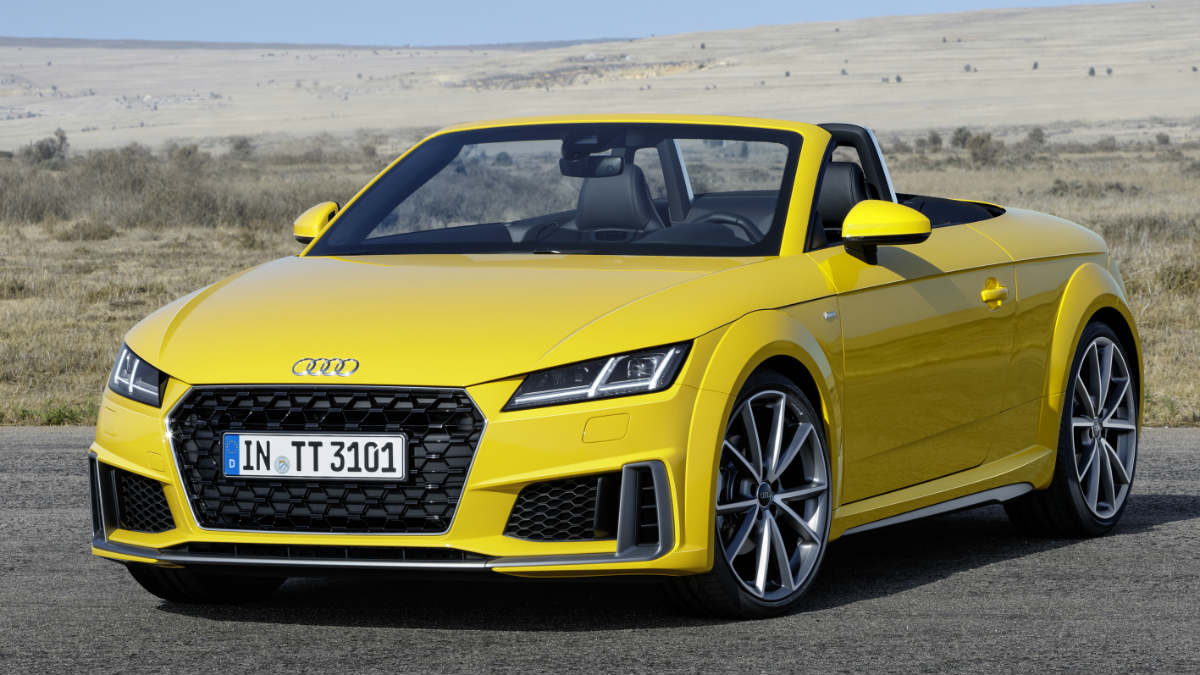
The styling of the third-generation TT has matured into a crisper, more assertive form. Up front, the Singleframe radiator grille gains a sculpted, three-dimensional honeycomb lattice that lends the nose greater visual depth. Flanking the grille, larger lower air intakes stretch outward toward the front wheel arches, visually widening the car’s footprint even on standard entry-level trim grades. Slender horizontal character lines across the tailgate and rear bumper mirror this effect, keeping the rear view grounded and purposeful.
Lighting technology remains a technical calling card for Audi. While xenon headlamps are eliminated, standard illumination relies on LED clusters, with advanced Matrix LED headlights available as an option. The Matrix units utilize miniature individual diodes that adapt their light beams in real time around oncoming traffic, paired with front and rear dynamic sweeping turn indicators. At the flanks, the muscular wheel arches intersect the straight tornado shoulder line that runs uninterrupted from headlamp edge to tail light. A hallmark feature remains intact: the brushed aluminum fuel filler flap in the right rear quarter panel requires no interior release catch and features no inner screw cap, letting the pump nozzle slip straight into the neck like a competition racer.

Dimensions, Body Options, and S line Styling
Both the TT Coupé and TT Roadster share identical exterior proportions, measuring 4.19 meters (165.0 inches) in total length on a compact 2.51-meter (98.8-inch) wheelbase. Width stands at 1.83 meters (72.1 inches), while overall height measures just 1.35 meters (53.1 inches). The short body overhangs emphasize the athletic stance, keeping inertia centralized within the axles. Rolling stock starts on standard 17-inch alloy wheels, while Audi and Audi Sport offer optional 18-inch, 19-inch, and 20-inch forged designs with performance rubber.
Drivers looking for extra visual aggression can specify the optional S line exterior package. This aero upgrade adds a full-width front splitter finished in matte twilight gray, vertical cooling slats within the bumper corners, and a titanium black grille insert. Matching rocker sills sculpt the lower flanks, leading to a redesigned rear apron with an enlarged aerodynamic diffuser and vertical air vents with three horizontal aero fins directly below the rear tail lamps. Three fresh paint shades join the color catalog for 2018: Cosmos Blue, Pulse Orange, and the S line exclusive Turbo Blue.

Cabin Architecture and Driver-Centric Tech
Step inside, and the Audi TT cabin stands as a masterclass in clean, functional design. Rather than cluttering the dashboard with a central infotainment screen, the dash panel arches smoothly across like an airplane wing. All primary data is funneled directly to the driver via the standard 12.3-inch Audi virtual cockpit. This high-resolution TFT cluster operates at 60 frames per second, driven by a dedicated Nvidia Tegra graphics processor. The driver can toggle between Classic view, featuring prominent circular dials for road speed and revs, and Infotainment mode, which minimizes the gauges to expand the full-color 3D navigation map and multimedia menus. A specialized Sport display option brings readouts for g-force loading, current boost levels, and power percentage.
Air conditioning and ventilation controls are integrated directly into the centers of the five round turbine-style air vents. Rotating the outer bezels adjusts airflow volume, while central push buttons and mini digital displays control temperature, seat heating, and distribution. This clever packaging frees up the center console for a clean MMI terminal featuring just six buttons, a tactile rotary dial with an MMI touch handwriting recognition pad, and an uncluttered transmission selector.
Sport seats with integrated head restraints come standard, holding driver and passenger securely during spirited cornering. Buyers choosing the S line package receive S sport seats upholstered in leather and Alcantara, equipped with pneumatic lumbar support and adjustable side bolsters that clamp snugly around the torso. Practicality remains a strong suit for a compact sports machine: the Coupé’s 2+2 layout offers rear seats suitable for children or luggage, with 305 liters (10.8 cubic feet) of cargo room beneath the liftback hatch, expanding to 712 liters (25.1 cubic feet) when the split rear seatbacks fold flat. The two-seat Roadster provides 280 liters (9.9 cubic feet) of dedicated trunk storage.

Powertrains, Transmissions, and Particulate Filters
Under the bonnet, the updated Audi TT rationalizes its engine lineup around modern 2.0-liter TFSI four-cylinder turbocharged petrol units, discontinuing earlier entry diesel and small-displacement options. The direct-injection powerplant features dual injection—combining direct chamber fueling with manifold port injection under partial loads—alongside variable valve timing and the Audi valvelift system (AVS). To meet stringent Euro 6d-TEMP emissions standards, every petrol engine in the updated TT range comes fitted with an integrated gasoline particulate filter (OPF) positioned directly in the exhaust flow.
The revised power output starts with the entry-level 40 TFSI, generating 197 hp (145 kW) and 320 Nm (236 lb-ft) of torque. For drivers demanding stronger acceleration, the 45 TFSI churns out 245 hp (180 kW) and 370 Nm (273 lb-ft) of torque across a broad rev band. Transmission choices include a precise six-speed manual gearbox or a newly recalibrated seven-speed S tronic dual-clutch transmission. The dual-clutch gearbox features close ratios through the lower gears to maximize off-the-line sprint responsiveness, while the tall seventh gear drops engine rpm on the highway to promote effortless cruising refinement and improved fuel efficiency.

Chassis Engineering, Suspension, and Quattro Traction
Underpinning the TT is the Audi Space Frame (ASF) hybrid construction, which blends ultra-high-strength hot-formed steel in the passenger cell with lightweight aluminum for the floorpan, sills, doors, bonnet, and roof structure. This composite architecture keeps curb weight around 1,265 kg (2,789 lb) in base Coupé trim, creating an exceptionally stiff torsional shell that gives the suspension a rock-solid platform to work from.
Up front, MacPherson struts with aluminum wishbones manage steering and wheel control, paired with an electromechanical progressive steering rack that quickens the ratio as the steering wheel turns farther off-center. Out back, a sophisticated four-link rear axle handles longitudinal and lateral forces independently. Electronic Stabilization Control (ESC) incorporates wheel-selective torque control, lightly dabbing the brakes on inside wheels when tracing tight bends to pivot the car crisply into corners without scrubbing front tire scrub.
Buyers seeking sharper reflexes can specify the S line sport suspension or Audi magnetic ride adaptive dampers, either of which lowers the ride height by 10 millimeters (0.4 inches). Magnetic ride employs a synthetic fluid filled with microscopic magnetic particles inside the damper pistons; adjusting electrical voltage through the coils alters damping firmness within milliseconds. Power delivery is routed to the front wheels as standard, while the 45 TFSI offers Audi’s quattro permanent all-wheel drive. Controlled via an electrohydraulic multi-plate wet clutch on the rear differential, the quattro system coordinates with Audi drive select to apportion drive rearward during aggressive cornering.

The TT Roadster: Open-Air Engineering
For purists who favor open-top motoring, the TT Roadster retains its signature classic fabric soft top rather than adopting a heavy folding metal roof. Offered in either black or titanium gray, the multi-layered hood incorporates an acoustic insulation fleece layer that cuts wind whistle and cabin road hiss down to near-coupe decibel levels. Tipping the scales at only 39 kilograms (86.0 pounds), the compact roof assembly minimizes weight at the vehicle’s highest point, preserving a low center of gravity.
The electrohydraulic folding mechanism operates in complete silence, tucking the roof away into an aluminum z-fold cassette behind the rollover safety hoops in roughly 10 seconds. The top can be raised or stowed on the move at vehicle speeds up to 50 km/h (31.1 mph), meaning unexpected rain showers require no sudden roadside stops. An optional electrically retractable mesh wind blocker raises between the fixed safety roll bars behind the head restraints, calming cabin buffeting during top-down highway runs.

Infotainment, Driver Assistance, and Daily Usability
Standard specification sees a meaningful lift across the entire TT family. Beyond the Audi virtual cockpit, every baseline TT now comes factory-equipped with Audi drive select—letting the driver toggle steering weighting, throttle response, and shift mapping across auto, comfort, dynamic, efficiency, and individual profiles. Rain and light sensors, heated door mirrors, illuminated USB ports, and Bluetooth smartphone pairing are all standard. The multifunction leather steering wheel plus adds integrated buttons and scroll rollers, allowing navigation, phone, and voice dialogue functions to be commanded without lifting hands from the rim.
Audi connect brings fast LTE cellular connectivity on board, supplying online traffic alerts, Google Earth satellite mapping, and an integrated Wi-Fi hotspot. Audi smartphone interface allows Apple CarPlay and Android Auto mirroring straight into the digital cluster via USB. Audiophiles can step up to the optional 680-watt Bang & Olufsen Sound System, which channels audio through 14 channels and twelve bespoke speakers—including dedicated door-mounted mid-woofers highlighted by subtle white LED light guides.
Driver assistance tech is tailored to keep long-distance cruising fatigue at bay. Audi side assist monitors blind spots using radar sensors behind the rear bumper, illuminating amber LEDs in the mirror housings when vehicles overtake. Audi active lane assist gently counter-steers if the car wanders across road lane markings without an indicator signal, while camera-based traffic sign recognition projects local speed limits onto the instrument binnacle. When parking in cramped European city bays, park assist actively guides the steering into parallel and perpendicular spaces, accompanied by visual parking sensors and a high-resolution rearview camera.

Market Rollout and Legacy
Orders for the refreshed Audi TT lineup commence in Europe in autumn 2018, with the first customer deliveries scheduled before the close of the calendar year. Marking two decades since the original 1998 production pioneer broke onto the sports car scene, the updated TT (Typ FV) demonstrates how a design icon can evolve gracefully without diluting its original mechanical DNA. With refined turbocharged engines, sharper S line aesthetics, and standard digital cockpit instrumentation, the Audi TT maintains its position as one of the most distinctive and complete compact sports cars on the road.
Vehicle data
| Field | Value |
|---|---|
| Make | Audi |
| Model | TT (Coupé / Roadster) |
| Generation / chassis code | Third generation (Typ FV / 8S) facelift |
| Model year(s) covered | 2018–2019 |
| Body style | 2+2 Coupé / 2-seat Roadster |
| Powertrain / engine | 2.0-liter turbocharged inline-4 direct-injection petrol (40 TFSI / 45 TFSI) with gasoline particulate filter |
| Power / torque | 40 TFSI: 197 hp (145 kW), 320 Nm (236 lb-ft) / 45 TFSI: 245 hp (180 kW), 370 Nm (273 lb-ft) |
| Transmission | 6-speed manual / 7-speed S tronic dual-clutch transmission |
| Drivetrain | Front-wheel drive (standard) / quattro permanent all-wheel drive (available on 45 TFSI) |
| Key performance figures | Top speed up to 250 km/h (155 mph); Roadster roof opens/closes in ~10 seconds up to 50 km/h (31.1 mph) |
| Price (as stated) | Not stated in sources |
| On-sale / announcement period | Announced July 2018; European orders autumn 2018; deliveries late 2018 |
| Market | Europe / Global |