

Engineering the Plug-In Hybrid SUV
Audi has opened a distinct technical chapter in its mid-size sport utility portfolio with the introduction of the Audi Q5 55 TFSI e quattro. Positioning an electrified powertrain squarely inside the popular second-generation Q5 footprint (Type FY), Ingolstadt is delivering its first model under a revised plug-in hybrid architecture engineered for everyday urban zero-emission motoring alongside uncompromised long-distance touring. Delivering a combined system output of 270 kW (367 hp) and a substantial 500 Nm (368.8 lb-ft) of torque, the electrified Q5 bridges the gap between everyday efficiency and athletic pace, completing the sprint from 0 to 100 km/h (62.1 mph) in just 5.3 seconds.
Under the bonnet sits a thoroughly proven 2.0-litre TFSI direct-injection four-cylinder petrol unit, turbocharged to develop 185 kW (252 hp) and 370 Nm (272.9 lb-ft) of torque across an accessible rev range. Nestled downstream within the housing of the seven-speed dual-clutch S tronic transmission is a permanently excited synchronous electric motor (PSM) capable of contributing up to 105 kW of peak power and 350 Nm (258.1 lb-ft) of instant torque. Together with an integrated separating clutch, this compact electric module works directly alongside the dual-clutch transmission gears, channeling motive force through an all-wheel-drive quattro system that has been tailored specifically for electrified operation.

What sets the Audi Q5 55 TFSI e quattro apart from earlier hybrid experiments in this segment is the seamless mechanical dialogue between combustion and electrification. The 2.0-litre turbo engine reaches its peak torque plateau early, and the electric motor fills in any off-boost moments with immediate shove. Power delivery is linear, muscular, and entirely free of hesitation. Top speed is governed at 239 km/h (148.5 mph), while purely on electrical power the SUV can cruise at speeds of up to 135 km/h (83.9 mph)—plenty for motorway commutes without waking the four-cylinder petrol engine.
Predictive Quattro All-Wheel Drive and Operating Modes
The Audi Q5 55 TFSI e quattro marks the debut deployment of Audi’s predictive quattro ultra technology operating in tandem with an electric motor. Rather than running permanent mechanical four-wheel drive at all times, the system works with constant foresight. Networked sensors continuously monitor ambient driving conditions, throttle inputs, lateral acceleration, and individual wheel speeds. Under light engine load and across dry, predictable tarmac, the rear axle drive is decoupled completely, letting the SUV run with the reduced mechanical drag of a front-wheel-drive vehicle. The efficiency benefits are immediate, reducing driveline losses across steady-state highway journeys.
Whenever conditions demand extra traction, engagement occurs in a fraction of a second. Audi relies on a disciplined three-stage strategy: proactive, predictive, and reactive. The proactive phase engages the rear axle before wheel slip can even materialize, drawing data from vehicle dynamics calculations. The predictive phase looks ahead based on driver behavior and steering wheel angle, anticipating tight corners or swift acceleration maneuvers. The reactive phase operates as an ultimate fail-safe, locking in all four wheels within milliseconds should an abrupt change in surface friction occur. Crucially, the rear axle remains poised on standby at all times, ready to hook up without the driver sensing any mechanical clunk or hesitation.
Driver control is balanced between three primary hybrid running modes: EV, Hybrid, and Battery Hold. When started, the vehicle defaults to EV mode, running purely on battery reserves until the driver pushes the accelerator past a distinct tactile pressure point or depletes the charge. In Battery Hold mode, the power electronics manage the combustion engine and energy recovery to freeze the high-voltage battery’s current state of charge, preserving electrical range for later urban travel or low-emission city centers. In Hybrid mode, the drivetrain operates autonomously to yield maximum efficiency across the entire trip.
Predictive Efficiency Assistant and Intelligent Energy Management
Crucial to extracting maximum real-world range from the Audi Q5 55 TFSI e quattro is the car‘s Predictive Efficiency Assistant (PEA). The system links the high-voltage powertrain directly to the route topography, onboard camera, radar sensors, and digital map data. Rather than treating battery energy as an isolated reservoir, the vehicle looks several miles down the road to anticipate traffic flow, elevation shifts, upcoming roundabouts, speed limit reductions, and sharp bends.
When the driver navigates without active adaptive cruise control, the PEA provides gentle haptic and visual cues. A subtle pulse through the accelerator pedal combined with clear optical alerts in the digital instrument cluster and optional head-up display advises the driver when to ease off the throttle. Rolling off early lets the SUV glide into deceleration zones while capitalizing on kinetic recuperation. When adaptive cruise control is engaged, the car handles these throttle transitions autonomously, adjusting coasting and regenerative phases smoothly without human intervention.

Braking Recuperation and Battery Packaging
Energy recuperation forms the operational backbone of the Q5 55 TFSI e quattro’s hybrid setup. When coasting with feet off the pedals, the electric motor acts as an alternator to regenerate up to 25 kW of kinetic energy back into the high-voltage pack. Touch the brake pedal, and the system coordinates an integrated electro-hydraulic braking concept capable of capturing up to 80 kW of electrical power under deceleration.
In everyday traffic, approximately 90 percent of all routine decelerations—anything under 0.1 g of braking force—rely exclusively on the electric motor rather than friction brakes. The conventional ventilated steel discs and hydraulic calipers sit quietly in reserve, engaging only during sudden panic stops or heavy high-speed descents. The transition between regenerative deceleration and mechanical friction braking remains undetectable at the pedal, ensuring predictable, confidence-inspiring pedal feel whether shedding a few km/h in city traffic or anchoring hard from autobahn cruising speeds.
Storing this reclaimed energy is a 14.1 kWh lithium-ion battery pack neatly tucked beneath the luggage compartment floor. Packaging the battery beneath the rear cargo area preserves cabin utility and leaves a flat loading floor, complete with Audi’s versatile sliding rear bench seat that moves fore and aft to adjust between passenger legroom and trunk capacity. The battery assembly consists of 104 prismatic pouch cells divided into eight compact modules, cooled by an advanced liquid thermal management loop. This dedicated cooling system is integrated into the vehicle’s primary coolant circuit and air-conditioning system, maintaining the battery cells within their optimal temperature window under both aggressive driving loads and blistering summer heat.

Charging Convenience and Infrastructure Integration
To ensure everyday usability for suburban commuters and city owners alike, the Audi Q5 55 TFSI e quattro arrives equipped with a comprehensive charging setup as standard. The included Compact charging system provides cables for both standard household domestic sockets and 400-volt three-phase industrial outlets, monitored by built-in safety diagnostics and status illumination. For home garages, Audi offers an optional wall-mounted lockable charging bracket that tidily holds the unit on display.
Using a 400 V / 16 A industrial power supply, the integrated 7.4 kW on-board charger restores the 14.1 kWh battery from completely empty to 100 percent in roughly two and a half hours. Plugged into a standard 220-volt domestic household outlet, full replenishment takes approximately six hours, making routine overnight charging convenient and fuss-free. When venturing beyond the home garage, European owners gain access to the extensive Audi e-tron Charging Service, which brings together more than 100,000 public charging points across multiple European charging network operators under a single RFID card and unified billing structure.

Cabin Appointments, myAudi Connectivity, and Preconditioning
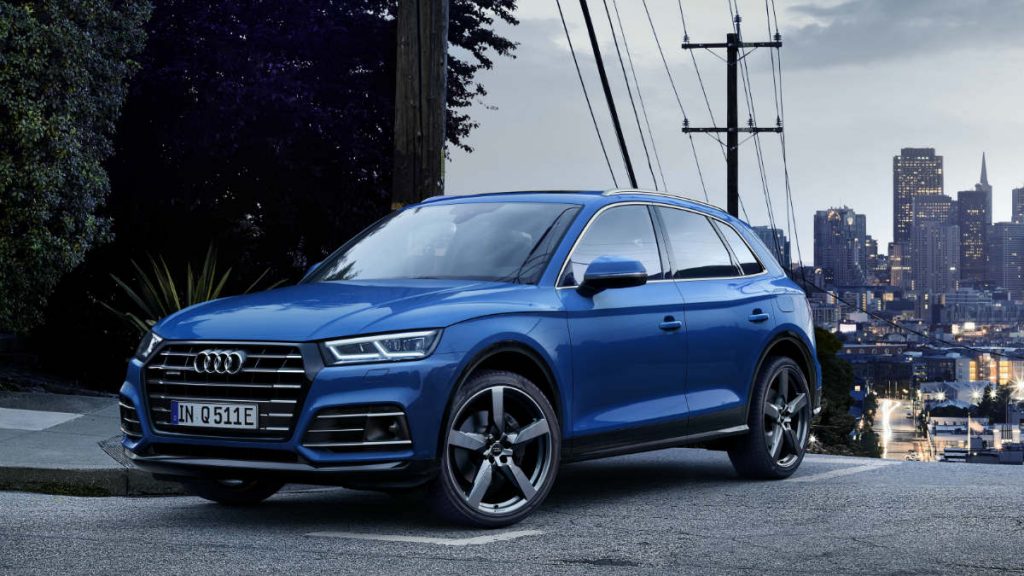
Inside the cabin, the Q5 55 TFSI e quattro matches its high-tech powertrain with an elevated level of standard equipment. Sport seats with sculpted bolsters, three-zone automatic climate control, a convenience key with hands-free access, and a driver information system (DIS) featuring color displays and dedicated PHEV telemetry come fitted straight from the assembly plant. External styling reflects the sport-oriented character of the model, incorporating S line exterior aero cues including aggressively contoured bumpers front and rear, an integrated rear diffuser with double clasp detailing, and 18-inch five-arm turbine-style alloy wheels.
Connected vehicle services anchored by the myAudi smartphone app bring smartphone control directly to the charging experience. Through the app, drivers can check live battery charge levels, verify remaining pure-electric range, schedule charging timers to take advantage of off-peak electric tariffs, and view historical efficiency logs. Route planners embedded in the myAudi app and the onboard MMI navigation automatically highlight compatible charging stations along intended destinations, recalculating stops based on live traffic congestion and current battery depletion.
Among the most appreciated daily luxuries of the electrified platform is auxiliary thermal preconditioning. Because the climate control compressor and supplementary cabin heater run directly off high-voltage battery power, the owner can preheat or precool the interior before stepping inside. When scheduled while plugged into the wall, this pre-climatization draws current from the electrical grid rather than draining battery capacity on initial startup, preserving the vehicle’s full electric driving range for the road ahead. Depending on selected interior options, auxiliary preconditioning can also warm or cool the front seats, warm the steering wheel rim, and activate defrosters on the windshield, rear window, and side mirrors.
By blending punchy 367 hp system performance with refined all-electric city silence and intelligent quattro traction, the Audi Q5 55 TFSI e quattro demonstrates how premium SUVs can adapt to stricter emissions standards without compromising luxury or open-road stamina.
Vehicle data
| Field | Value |
|---|---|
| Make | Audi |
| Model | Q5 55 TFSI e quattro |
| Generation / chassis code | Second generation (Type FY) |
| Model year(s) covered | 2019–2020 |
| Body style | 5-door mid-size SUV |
| Powertrain / engine | 2.0-litre TFSI turbocharged inline-4 petrol (185 kW / 252 hp) + permanently excited synchronous electric motor (105 kW) |
| Power / torque | Combined: 270 kW (367 hp) / 500 Nm (368.8 lb-ft) |
| Transmission | 7-speed dual-clutch S tronic |
| Drivetrain | All-wheel drive (quattro ultra with electric motor integration) |
| Key performance figures | 0–100 km/h in 5.3 seconds; Top speed: 239 km/h (148.5 mph); Electric top speed: 135 km/h (83.9 mph) |
| Price (as stated) | Not stated in sources |
| On-sale / announcement period | May 2019 |
| Market | Europe / Global |