
The luxury sports saloon – Jaguar XJ
- The Jaguar XJ remains the most dynamic and distinctive luxury saloon in the world, and the 2018 model year pushes the point harder
- A new performance flagship, the XJR575, brings 575PS and 700Nm from Jaguar’s supercharged 5.0-litre V8
- XJR575 lines up alongside XJ Luxury, Premium Luxury, Portfolio, R-Sport and the range-topping Autobiography
- Full LED headlights and the double ‘J-Blade signature’ daytime running lights define the face
- The 3.0-litre V6 diesel delivers 300PS and 700Nm, with CO2 emissions from 149g/km
- Touch Pro infotainment adds door-to-door navigation and straightforward iOS and Android connectivity
- A 10-inch central touchscreen works with a reconfigurable 12.3-inch Interactive Driver Display
- All-Surface Progress Control finds traction on snow and ice – the driver only has to steer
- Black Pack options quietly sharpen the exterior
- Driver assistance runs to Autonomous Emergency Braking, Adaptive Cruise Control with Queue Assist, Reverse Traffic Detection, Blind Spot Monitoring, a 360-degree Surround Camera and semi-automated bay and parallel parking
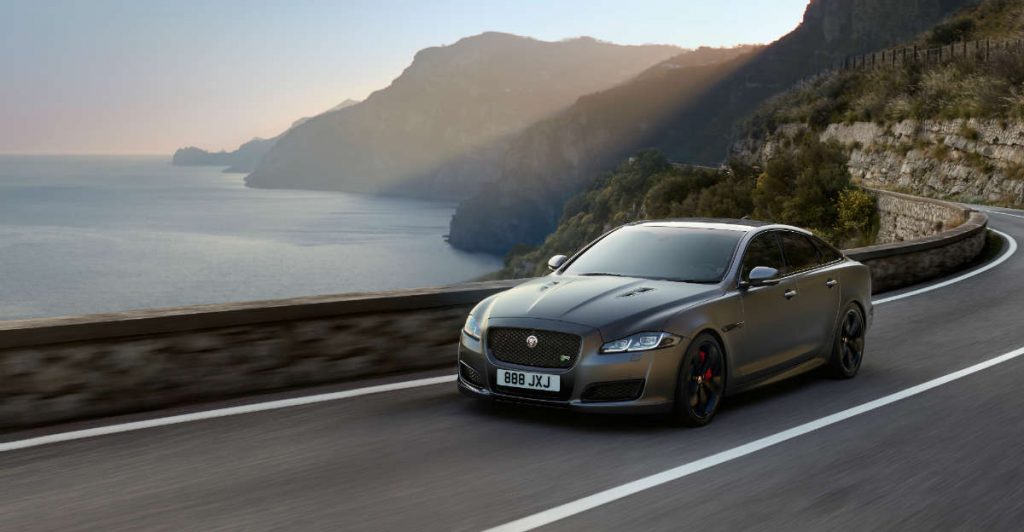
The XJ has sat at the top of Jaguar’s saloon range for years, and it has never been a car that hides what it is. The low, coupe-like stance, the long bonnet and the carefully judged proportions make it recognisable as a Jaguar from any angle, a trick the design team works hard to keep intact. The whole shape is formed around Jaguar’s aluminium-intensive architecture, the lightweight skeleton that does as much for the way the car drives as it does for economy.
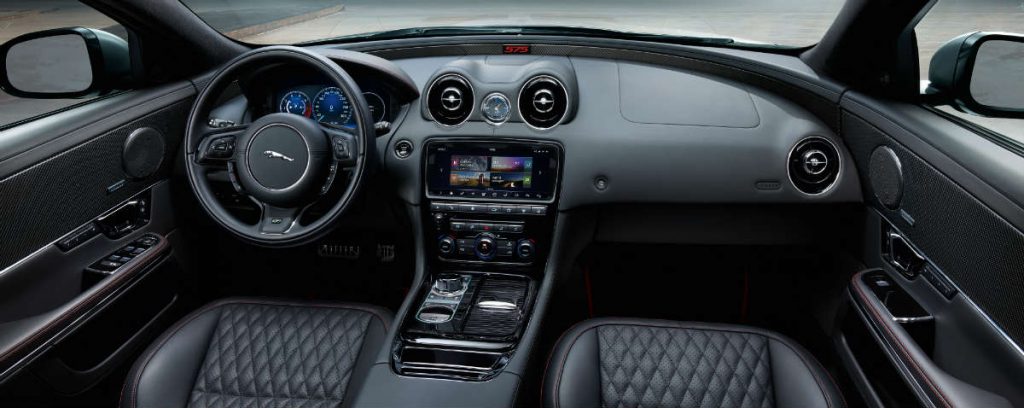
Inside, the mix is deliberate. Semi-aniline leather, inlay veneers and hand-finished detail sit alongside the technology a flagship buyer expects, and rear passengers in long-wheelbase cars get more than a metre of legroom. For 2018 the range gains its headline act in the XJR575, a performance flagship with its own exterior and interior touches: two paint colours mixed by Jaguar Land Rover’s Special Vehicle Operations, a 575 intaglio set into the dash, and diamond-quilted seats finished with additional 575 branding.
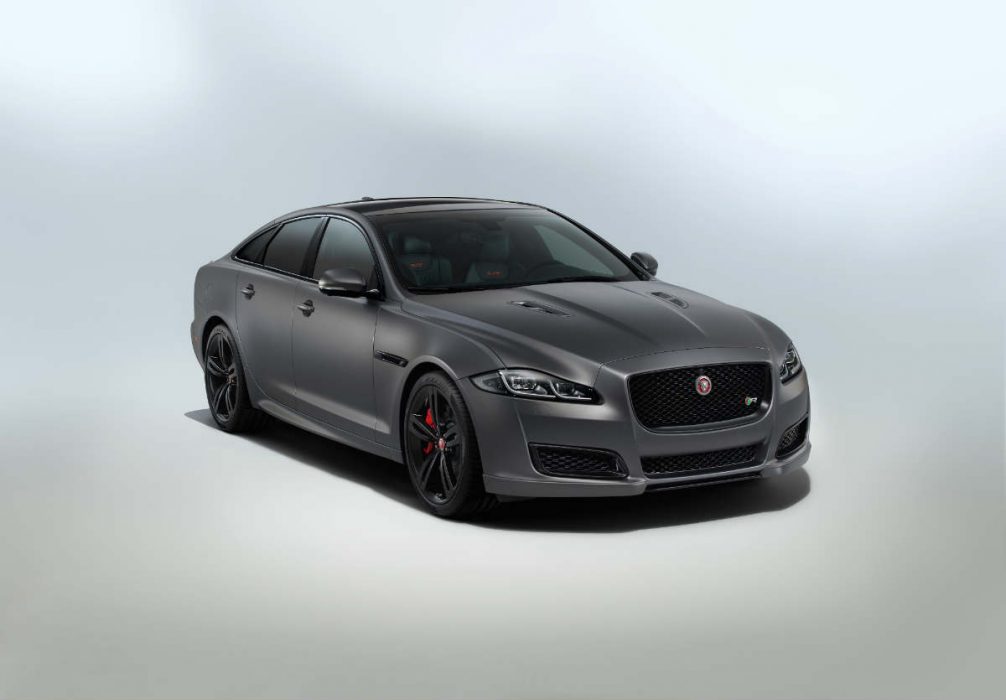
“The Jaguar XJ is the largest model in our saloon car line-up and retains the physical presence and graceful design customers expect from a Jaguar flagship. Anyone who sees this car immediately knows it is both great to drive and to sit in. The intricate details inside and out give owners and passengers the feeling that they are in the presence of something truly special.” – Ian Callum, Director of Design, Jaguar
Making a big saloon feel at once athletic and cosseting is the hard part, and Jaguar leans on its Adaptive Dynamics dampers to pull it off. The system reads the car up to 500 times a second, watching acceleration, cornering and what the driver is doing with the throttle and brakes, then works with the air suspension to hold body movement in check. Push on and it stays flat and composed; ease off and the ride settles back down.
The XJR575 takes the supercharged 5.0-litre V8 and adds 25PS through revised calibration, for 575PS and 700Nm of torque. That is enough for 0-100km/h in 4.4 seconds (0-60mph in 4.2) and a top speed of 186mph, or 300km/h. Electric power-assisted steering, used on the rear-wheel-drive cars, sharpens the response and also opens the door to the driver assistance kit: Lane Keep Assist, Driver Condition Monitor and park assist among it. When grip runs short, ASPC takes over at low speed, managing brakes and throttle between 1mph (3.6km/h) and 19mph (30km/h) so the car pulls away cleanly while the driver just steers.
“Our flagship saloon is more dynamic and distinctive than ever. We’ve engineered the XJ to deliver even greater levels of luxury and performance. Featuring our world-class Touch Pro infotainment system, luxurious interior materials and finishes which create an even more bespoke feel, and our powerful petrol and diesel engines, the XJ rewards drivers and passengers like no other luxury car.” – Erol Mustafa, Chief Product Engineer, Jaguar XJ
Technology in the XJ centres on Jaguar’s Touch Pro infotainment. It runs on a quad-core processor and an ultra-fast ethernet network, which together deliver the graphics and the quick responses you notice the moment you touch the screen. Door-to-door navigation, 4G Wi-Fi and the 1,300W Meridian Signature Sound System are all reachable through a 10-inch central touchscreen that behaves much like a smartphone. A stereo camera behind the rear-view mirror feeds a set of safety features including Autonomous Emergency Braking, Lane Departure Warning and Lane Keep Assist, while Adaptive Cruise Control with Queue Assist tracks the car ahead through stop-go traffic.

Traffic Sign Recognition teams up with the Adaptive Speed Limiter to keep the driver on the right side of changing limits. It reads the signs it passes, checks them against navigation data, and can lift the car to a higher limit or slow it for a lower one – the sort of help that earns its keep through roadworks and variable motorway limits.
The XJ range is made up of six trim levels: XJ Luxury, XJ Premium Luxury, XJ Portfolio, XJ R-Sport, XJR575 and XJ Autobiography.
Power comes from a choice of four engines. The diesel is a 300PS 3.0-litre V6 automatic with rear-wheel drive, priced from £59,995 on the road. The petrols begin with a 340PS 3.0-litre supercharged V6 automatic, rear-wheel drive, from £75,215; then the 510PS 5.0-litre supercharged V8 automatic, rear-wheel drive and long-wheelbase only, from £101,370; and finally the 575PS 5.0-litre supercharged V8 automatic, rear-wheel drive, from £93,710.
Every XJ is built at Jaguar Land Rover’s Castle Bromwich plant, alongside the F-TYPE sports car, the XF sports saloon, the XF Sportbrake and the XE sports saloon.
Sitting at the pinnacle of the saloon range, the XJ carries the most opulent luxury in the line-up along with genuine sporting intent. Ian Callum again: “The Jaguar XJ has a number of roles to fulfill. It must remain exciting to drive but also be incredibly compliant and comfortable. This all starts with the way the vehicle looks. Our advanced Lightweight Aluminium Architecture means we are able to create a vehicle that has an authoritative yet elegant stance. Inside, absolute precision is a prerequisite – exceptional craftsmanship ensures all occupants experience the feeling of ultimate luxury and refinement.”
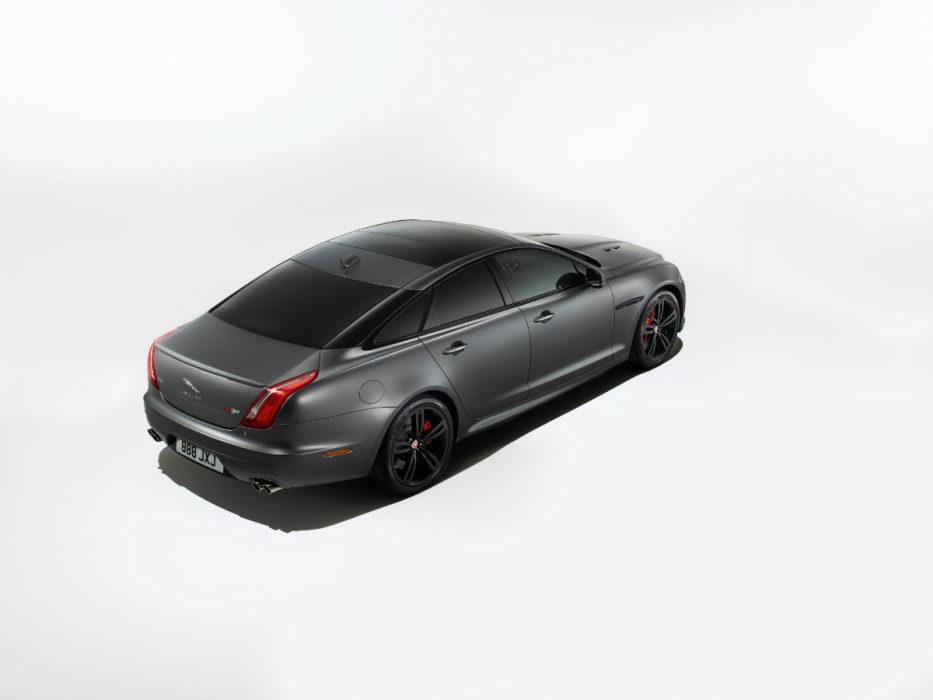
The XJ’s shape is the product of long computational modelling, with designers and engineers working side by side so that looks and aerodynamics pull in the same direction. At the front, the upright grille carries a mesh detail framed by the ‘J-Blade’ daytime running lights. Along the side, a chrome accent to the daylight opening plays up the car’s length, while the taut waistline keeps the stance low and planted. The rear finishes with elliptical tailpipes and LED tail lights that draw a crisp pinstripe ribbon of light. Fewer joints and welds than a conventional build help keep the aluminium body’s lines pure, and they are just as important to the car’s performance, economy and refinement.
The XJR575 separates itself with two exclusive paint colours, Satin Corris Grey and Velocity Blue, created by Special Vehicle Operations. A revised rear spoiler, side sills, front bumper, splitter and lower air intake with Gloss Black surrounds add intent, and the XJR575 badging is hard to miss. The final flourish is a set of 20-inch Farallon gloss-black wheels with red-painted brake calipers.
Adaptive LED headlights carry the ‘quad lamp’ look that Jaguar sporting saloons have made their own, helped by an Adaptive Front-lighting System, static bend lamps and auto high-beam assist. LED light is more natural than bi-xenon and easier on the eyes, and it uses less energy. Twin ‘J-Blade signature’ daytime running lights mark the car out as a Jaguar; the white light turns orange the moment the indicator goes on, and the LED tail lights repeat the J-signature in their tail and position graphics.
The cabin mixes contemporary design with the comfort and sporting style the badge promises. Standard and long-wheelbase models are both offered, and the LWB car gives rear passengers an even more generous experience. Handcrafted veneer runs right around the cabin, stressing the sense of space. The layered instrument panel, complete with the signature ‘Riva Hoop’, carries through into the door panel, and a leather-wrapped three-spoke steering wheel gives the driver the tactile point the marque is known for.
A full-width panoramic roof fills the cabin with light. The heat-reflective glass sweeps to the rear of the car and over the back seats, and the tinting keeps the interior private while cutting solar gain. On the XJR575, the sports seats use adjustable bolsters for lateral support in corners, and the diamond-quilted upholstery carries embroidered 575 branding, matched by the dashboard intaglio and unique front and rear treadplates.
Long-wheelbase cars give rear passengers two individual ‘airline-style’ reclining seats with cushion and squab adjustment, three massage programmes (wave/rolling, lumbar and shoulder), lumbar support and two memory settings. A button on the door panel returns each seat to its rest position, easing entry and exit.
The centre armrest, which can fold upright to free the middle seat, holds the seat controls and the Front Seat Activation button that hands rear passengers control of the front passenger seat. Through the central touchscreen any of the four electric seats can be selected and moved using the driver’s seat switches, and the rear seats can be programmed to slide home when a rear door opens.
Entertainment for the back seats comes through the Rear Seat Entertainment package: two 10.2-inch high-resolution screens mounted on the front seat headrests. They can take input from a DVD player, a digital TV tuner or an external device via the Rear Media Interface, which offers USB, HDMI and MHL connections. Wireless headphones let each passenger follow a different source, and everything, including climate zones and seat heating and cooling, is managed by a wireless controller in the centre console.
The LWB car also brings leather-surfaced business tables that fold out of the front seat backs, plus electric rear side window blinds worked by the window switches. Rear headroom is generous, giving limousine comfort. The material palette underlines the point: bond grain, soft grain and semi-aniline leathers, and veneers spanning Piano Black, Carbon Fibre, Gloss Burr Walnut, Gloss Rich Oak, Gloss Rich Oak with linear laser inlay and Gloss Figured Ebony.
The 3.0-litre V6 diesel is Euro 6 compliant, develops 700Nm and takes the XJ from 0-100km/h in 6.2 seconds (0-60mph in 5.9), with CO2 from 149g/km. Power and torque stand at 300PS and 700Nm, and Jaguar has smoothed and quietened the latest generation of the engine with common-rail injection and parallel-sequential turbocharging. Fuel consumption reaches 49.6mpg (5.7l/100km).
Eight-hole piezo injectors place fuel with precision, and peak injection pressure of 2,000bar helps the mixture form evenly. The parallel-sequential turbo set-up uses more efficient turbochargers, and the primary turbo runs ceramic ball bearings; the lower friction sharpens the launch and the way torque builds.
A switchable coolant pump and a dual-stage oil pump quicken warm-up and cut parasitic losses. The exhaust gas recirculation system uses a cooled low-pressure circuit as well as the high-pressure one, which holds nitrogen oxide emissions down while trimming pumping losses across more of the engine’s operating map. A selective catalytic reduction system injects a urea solution upstream of the SCR catalyst to turn NOx into nitrogen and water, keeping the XJ within Euro 6 limits.
The petrol side uses Jaguar’s all-aluminium V6 and V8 engines, all with direct injection, variable valve timing, forced induction and stop-start. The 3.0-litre supercharged V6 makes 340PS and 450Nm and comes with rear- or all-wheel drive; its linear delivery and free-revving character are matched to carefully tuned intake and exhaust systems.
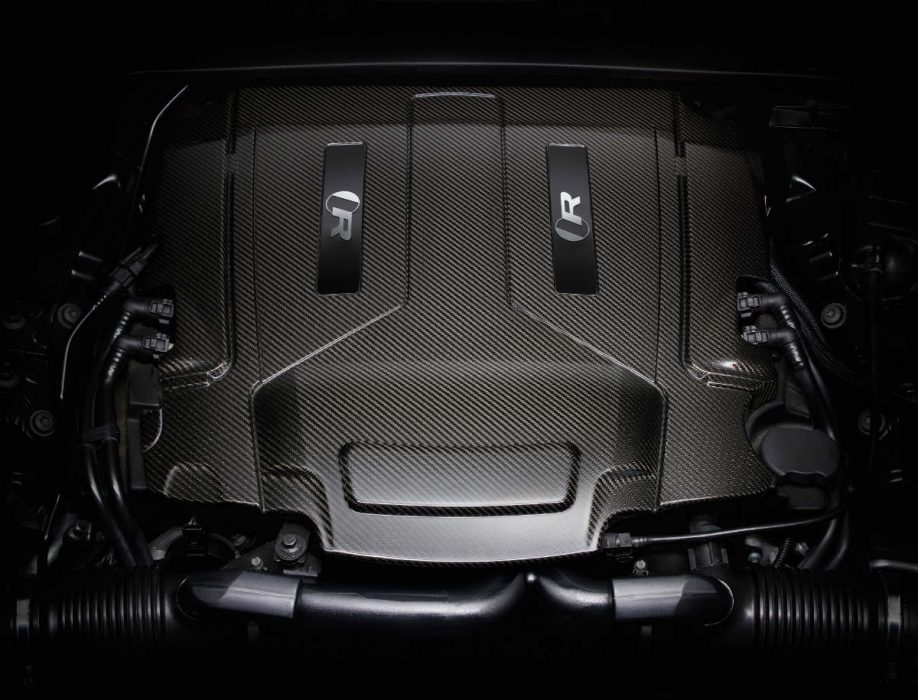
The 5.0-litre supercharged V8 remains the flagship. In the XJR575 it produces 575PS and 700Nm, good for 0-100km/h in 4.4 seconds (0-60mph in 4.2) and 186mph (300km/h). The same engine appears in 510PS and 625Nm form in the long-wheelbase Autobiography. All engines use a specific eight-speed automatic, either the 8HP70 or the lighter, more compact 8HP45, tuned for launch, shift comfort, dynamics and efficiency.
Electric power-assisted steering on the rear-wheel-drive cars improves response and feedback, enables the advanced driver assistance systems and helps efficiency. Jaguar has built a reputation for steering feel from the XE to the F-TYPE and F-PACE, and the XJ is no exception. Years of tuning mean the EPAS feels natural and consistent; it filters out disturbances from rough surfaces and compensates for road camber, and it only draws energy while the driver is turning the wheel.
Touch Pro’s navigation does door-to-door route planning, including public transport. A companion app lets you plan a route offline and load it when you get in. Commute Mode learns the daily drive and suggests alternatives to avoid congestion, and Approach Mode shows a 360-degree interactive view of the destination within 200m, even pointing out the nearest parking space. Dead reckoning keeps the position accurate where GPS drops out, and the whole navigation display can fill the 12.3-inch Interactive Driver Display. The home screen can be customised with wallpapers and widgets, extra pages can be added, and the touchscreen takes pinch-to-zoom and swipe gestures.
Four audio systems are offered, headed by a 26-speaker, 1,300W Reference set-up developed with Meridian. Its 17 channels of stereo and surround sound use Meridian’s Trifield technology to keep distortion low. For the rear cabin, the optional entertainment system’s two 10.2-inch screens fold away when not in use and offer a true 16:9 widescreen ratio; with the digital TV tuner, each screen can show a different channel, and passengers can connect devices through two USB 3.0 ports, one HDMI and one MHL port.
Staying connected is part of the brief. Using the car’s antenna for a stronger signal, the XJ can act as a Wi-Fi hotspot for up to eight devices. InControl Apps brings Apple and Android phones onto the infotainment screen over USB, so compatible apps can be used through the touchscreen.
Remote Essentials, through the Remote app, lets owners check fuel level, whether the doors are locked and whether any windows have been left open. Remote Premium goes further: lock or unlock the car remotely, get alerts if the alarm sounds, and find the car on a map. It can also start the engine remotely to bring the cabin to a pre-set temperature. Secure Tracker keeps watch and works with law enforcement if the car is stolen. Protect contacts the emergency services automatically, passing on the car’s GPS location, if a collision is heavy enough to fire the airbags, and occupants can also call for help with a button.
ASPC is the technology Jaguar proved on the XE and XF and now applies to the XJ. Where a conventional traction control reacts once the wheels have already slipped, ASPC works more like a low-speed cruise control, using the brakes as well as the throttle. Set between 1mph (3.6km/h) and 19mph (30km/h) with the steering wheel switches, it feeds only very low engine torque to the driven wheels from a standstill, so the car edges forward with little or no wheelspin. It works with rear- and all-wheel drive, and winter tyres make it better still.
The 2018 XJ also gains Jaguar Land Rover’s advanced stereo camera, packaged ahead of the rear-view mirror. It builds a real-time picture of the road and the objects on it, and image processing feeds a spread of assistance systems. Autonomous Emergency Braking primes the brakes and warns the driver if a collision looks likely; if the driver does nothing and a hit is imminent, it applies full braking to avoid it or soften the impact. The same camera enables Lane Departure Warning and Lane Keep Assist, which watch the car’s position between the markings. LDW warns with a light in the instrument panel and a nudge through the wheel, while LKA can apply a small corrective steer that the driver can easily override. The Driver Condition Monitor spots the steering patterns that go with fatigue and prompts a break.
Traffic Sign Recognition uses a forward camera to read speed limits, including temporary ones through roadworks and variable limits on motorways, and cross-checks them with GPS for accuracy. Because limits change fast in some places, the Adaptive Speed Limiter uses the TSR data to adjust its set point and can raise or lower the car’s speed, speeding up smoothly to a higher limit or easing off with engine braking for a lower one.
Queue Assist for the adaptive cruise control uses a long-range radar to hold a safe gap to the car in front, right down to a stop. Blind Spot Monitoring uses radar to flag fast-approaching traffic with a flashing icon in the door mirror. With electric power steering, the XJ can steer itself into both bay and parallel spaces, measuring the gap with ultrasonic sensors and leaving the driver to manage accelerator, brakes and transmission. A 360-degree Surround Camera combines four cameras to give a view all round the car, and radar sensors watch for crossing traffic when reversing, warning the driver of anything that might be a hazard.
Vehicle data
| Field | Value |
|---|---|
| Make | Jaguar |
| Model | XJ (including XJR575) |
| Generation / chassis code | Not stated in sources |
| Model year(s) covered | 2018 model year |
| Body style | Four-door luxury saloon, standard and long-wheelbase |
| Powertrain / engine | 3.0-litre V6 diesel; 3.0-litre V6 supercharged petrol; 5.0-litre V8 supercharged petrol |
| Power / torque | Diesel 300PS/700Nm; V6 petrol 340PS/450Nm; V8 510PS/625Nm and 575PS/700Nm |
| Transmission | Eight-speed automatic (ZF 8HP70 and 8HP45) |
| Drivetrain | Rear-wheel drive; all-wheel drive available with the 3.0-litre supercharged V6 |
| Key performance figures | XJR575 0-100km/h 4.4s, top speed 186mph (300km/h); diesel 0-100km/h 6.2s, CO2 from 149g/km, 49.6mpg |
| Price (as stated) | From £59,995 (diesel) to £101,370 (510PS V8 LWB) on the road |
| On-sale / announcement period | 2018 model year |
| Market | UK (OTR pricing); global |