

Ingolstadt’s First Premium Electric SUV
When Audi pulled the wraps off the production e-tron, the brand crossed a threshold it had circled for years. This was not a concept or a compliance vehicle—it was a full-size, five-seat, all-wheel-drive SUV carrying the four rings, a 95 kWh lithium-ion battery and a price tag that positioned it squarely against the Tesla Model X and the Jaguar I-PACE. Deliveries to early adopters were already rolling out in selected European markets in late 2018, and US buyers began taking keys in spring 2019. The Audi e-tron electric SUV is Audi’s answer to the question of what a premium, battery-driven family hauler should look like when built by a company whose core business has always been internal combustion.
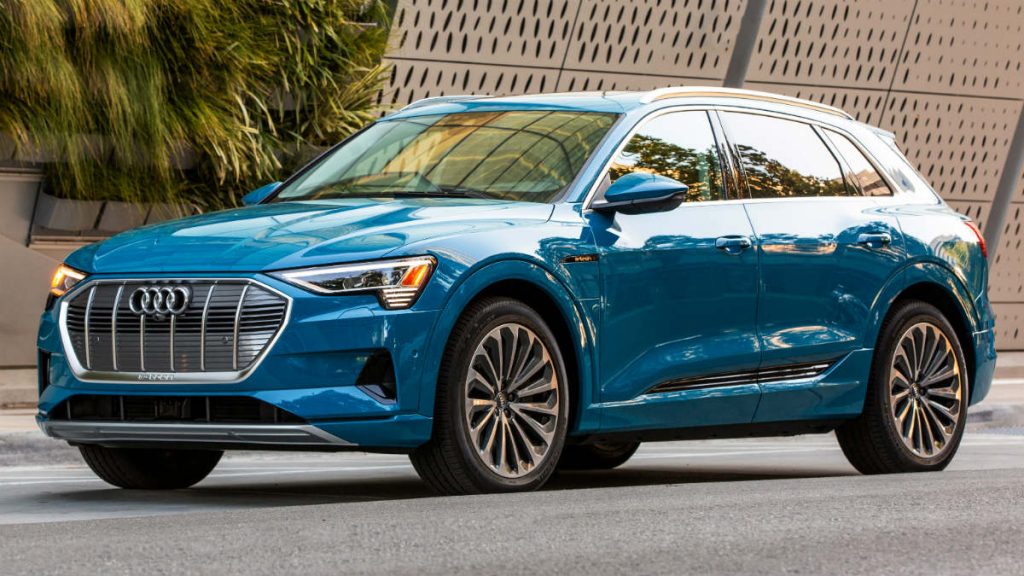
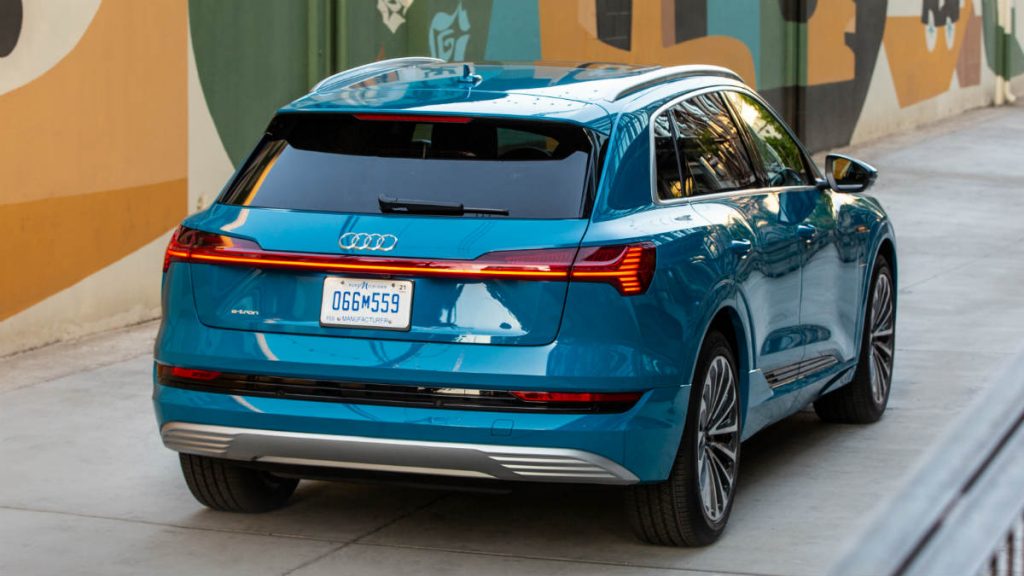
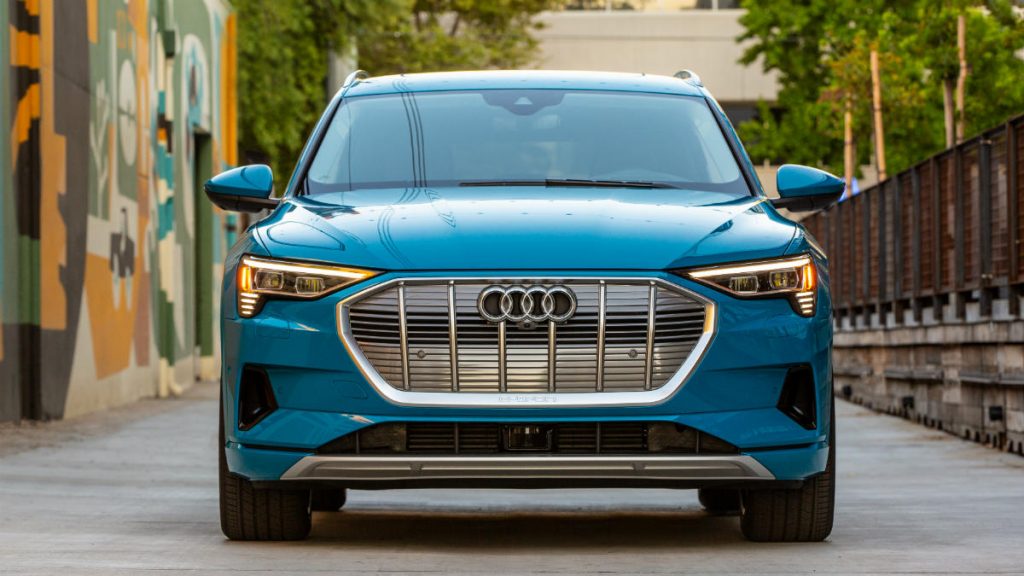
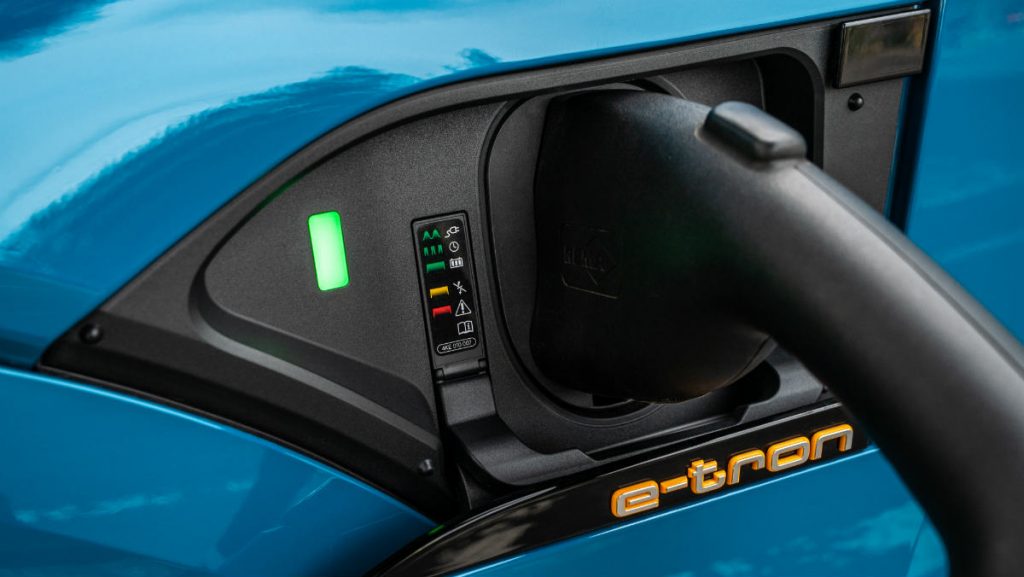
The e-tron occupies a familiar footprint. It sits in the mid-size luxury SUV segment that Audi already knows well, closer to the Q8 in proportions than the compact Q5. The wheelbase measures 2,928 mm, overall length comes to 4,901 mm, and the vehicle stands 1,616 mm tall. That translates into a cabin Audi claims can seat five adults comfortably alongside their luggage, with a panoramic glass sunroof stretching above their heads. The silhouette is deliberately conservative: Audi wanted the e-tron to look like an Audi first and an electric vehicle second. The octagonal Singleframe grille is closed off in traditional Audi fashion, painted in a platinum grey that sets it apart from the rest of the lineup. There are no fake vents, no gimmicky blue accents. The charging flap opens on the driver’s side front fender; a second one on the passenger side is available on higher trim levels. Small e-tron badges on the front doors and the rear liftgate mark the vehicle out, but the overall message is understatement.
Powertrain and Battery
Beneath the floor sits a 95 kWh lithium-ion battery pack, arranged in a honeycomb aluminum structure that Audi describes as a protective cage. The pack contributes substantially to the e-tron’s 2,585 kg (roughly 5,700 lb) curb weight, but it sits low enough to give the vehicle a centre of gravity Audi claims is closer to a sedan than a traditional SUV. To preserve long-term cell health, the e-tron’s battery management system deliberately limits usable capacity to around 88 percent of total—83.6 kWh of the 95 kWh gross. That is a deliberate trade-off: slightly less advertised range in exchange for cells that should last well beyond the typical ownership cycle without significant degradation. A separate cooling circuit keeps the battery modules at optimal temperature, with coolant running through channels that do not make direct contact with the cells themselves.
Two electric motors—one per axle—deliver the e-tron’s signature electric quattro all-wheel drive. The front motor produces 184 hp (135 kW), while the rear unit is the more powerful of the two at 224 hp (165 kW). Combined output in normal driving is 355 hp with 561 Nm (414 lb-ft) of torque. Engaging Boost Mode, accessed by pushing the gear selector past a detent in the Dynamic driving profile, unlocks a temporary overboost of 402 hp and 664 Nm (490 lb-ft) for up to 60 seconds. That is enough to shove the e-tron from standstill to 60 mph in 5.5 seconds, and on to an electronically limited top speed of 200 km/h (124 mph).
The torque distribution favours the rear axle under most conditions, which lends the e-tron a distinctly rear-biased feel through corners. When traction demands shift—rain, snow, aggressive acceleration—the front motor engages in milliseconds. Audi calls this system electric quattro, and while it operates without a mechanical centre differential, the response times are arguably faster than any torque-transfer clutch could manage.
Range, Charging and Efficiency
The EPA-rated range of 204 miles (328 km) is the number that dominates any conversation about the e-tron. Compared with the Tesla Model X Long Range, which offers well over 300 miles, and the Jaguar I-PACE at around 234 miles, the Audi’s figure sits at the conservative end. WLTP figures quoted for European markets paint a slightly rosier picture at over 400 km (about 250 miles), but American buyers rely on the EPA methodology and that is what appears on the window sticker.
Audi’s counterargument is charging speed. The e-tron supports up to 150 kW on DC fast chargers—a class-leading figure at launch—and can sustain close to that peak rate for a significant portion of the charge cycle. In practical terms, that means roughly 163 miles (262 km) of range can be added in about 30 minutes, or around 54 miles (87 km) in just ten minutes. This sustained charging performance, Audi argues, matters more on long trips than raw battery size. For home charging, a Level 2, 240-volt NEMA 14-50 outlet brings the battery from empty to full in approximately nine hours. Audi partnered with Amazon Home Services at US launch to offer professional in-home installation of Level 2 charging equipment, recognising that over 80 percent of EV charging happens at home.
The charging infrastructure piece is where Audi’s Volkswagen Group parent has been busy. Electrify America, the VW-owned charging network, was building out DC fast-charger stations along major US highway corridors throughout 2019, with planned locations no more than 120 miles apart on cross-country routes and as close as 70 miles apart on key East and West coast corridors. Early e-tron buyers received 1,000 kWh of complimentary Electrify America charging, enough to cover roughly 10,000 miles of driving.

Interior, Technology and Driver Assistance
Step inside and the e-tron presents a cabin that borrows heavily from the contemporary A6, A7 and A8 playbook. Two touchscreens dominate the centre stack: a 10.1-inch upper display for infotainment and navigation, and an 8.6-inch lower panel for climate controls and text input. Audi’s Virtual Cockpit—a 12.3-inch configurable digital instrument cluster—sits directly ahead of the driver, displaying speed, range, navigation and charging information in a format that feels purpose-built for electric driving.
The MMI touch response system is the e-tron’s command centre. A detailed range map shows exactly where the vehicle can travel on its current charge, and for longer journeys the navigation system suggests charging stations along the route with predicted state-of-charge upon arrival. Amazon Alexa is fully integrated into the cabin, allowing voice control of music, audiobooks, smart home devices and news updates from the steering wheel.
Standard equipment on the US-market e-tron includes heated and ventilated front seats, a head-up display, a 360-degree top-view camera system, leather upholstery and a panoramic glass roof. Available options push the luxury envelope further: multi-contour massaging front seats with several programs, a four-zone climate system with an in-cabin fragrance diffuser, a night vision assistant with pedestrian detection, and a Bang & Olufsen 3D sound system with 16 speakers. An ergonomically reshaped gear selector—a wide, flat pad the driver rests their hand on while selecting Drive or Reverse with a thumb toggle—replaces the conventional gear lever.

On the driver assistance front, the e-tron carries Audi’s Adaptive Cruise Assist, which combines adaptive cruise control with lane-keeping assistance into one integrated system. It handles stop-and-go highway traffic with genuine competence, maintaining following distance and lane position without fuss. Traffic Light Information (TLI) and Green Light Optimized Speed Advisory (GLOSA) are available where infrastructure supports them, and the e-tron is the first Audi to offer Toll Module Integration as standard—a small thing, but a welcome one for drivers on toll-heavy commutes.
Driving Dynamics
The e-tron’s weight is substantial but well managed. Standard adaptive air suspension lowers the body at higher speeds for improved aerodynamics and stability, and raises it for rougher ground or steep driveways. In Dynamic mode, the suspension firms up noticeably and body roll through corners is held in check with surprising discipline. The steering, while not the most communicative in the Audi range, carries enough weight and directness to inspire confidence. Electric power delivery is smooth and progressive—Audi has mapped the accelerator pedal to encourage measured inputs, so the full wallop of 490 lb-ft only arrives when the driver truly demands it.
One area where the e-tron diverges from some competitors is regenerative braking strategy. The default behaviour is to coast freely when the driver lifts off the accelerator, with no regeneration until the brake pedal is pressed. Two levels of lift-off recuperation are available through the MMI menus, but neither brings the vehicle to a complete stop. This means true one-pedal driving, as offered by the Nissan LEAF and the Chevrolet Bolt EV, is not part of the e-tron’s repertoire. Audi’s rationale is that most drivers expect coasting behaviour from a conventional car, and a gradual transition to electric driving should feel familiar rather than alien.
Practicality and Everyday Use
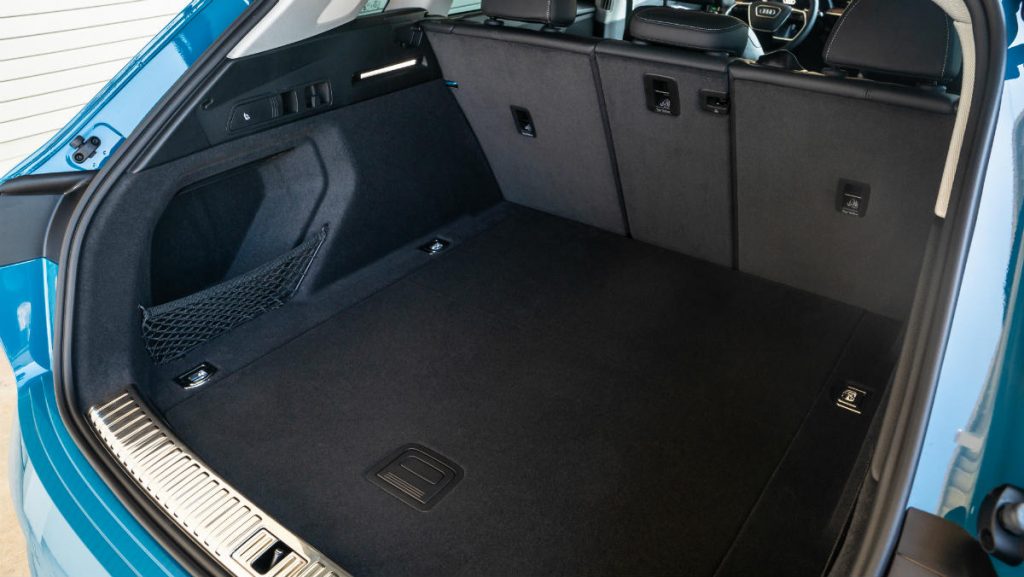
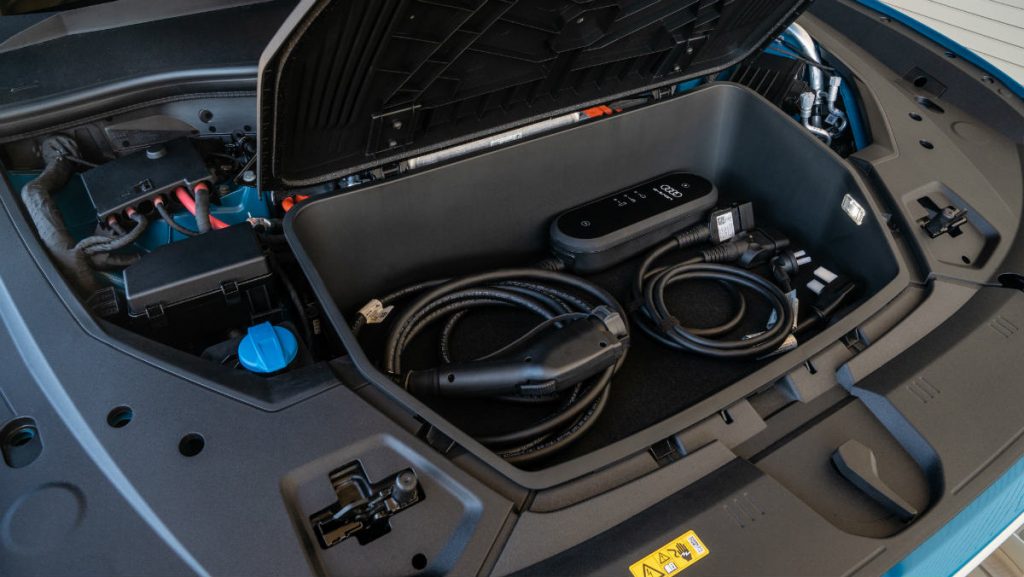
The boot offers 660 litres with the rear seats upright, expanding to 1,725 litres when folded flat. A small front trunk—the “frunk”—sits under the bonnet, sized to hold charging cables or a small bag. For SUV functionality, the e-tron can be specified with an available towing package and comes standard with roof rails. Average daily driving distances for premium vehicle owners sit well within the e-tron’s EPA range, and the vehicle’s home-charging capability means most owners start each morning with a full battery without ever visiting a public charger.
At launch, Audi positioned the e-tron Premium Plus at around $74,800 in the US market, with the Prestige trim climbing toward $81,000 before options. Federal and state incentives could reduce the effective cost significantly, and Audi bundled 1,000 kWh of Electrify America charging with every vehicle. The e-tron was not attempting to out-range the competition on paper; it was attempting to out-quality them on the road. For buyers who valued cabin materials, ride refinement and dealer relationships over headline range numbers, that pitch had real appeal.
Vehicle data
| Make | Audi |
| Model | e-tron |
| Model year(s) covered | 2019 |
| Body style | 5-door mid-size SUV |
| Powertrain / engine | Dual electric motors (one per axle), 95 kWh lithium-ion battery pack (83.6 kWh usable) |
| Power / torque | 355 hp / 561 Nm (414 lb-ft) standard; 402 hp / 664 Nm (490 lb-ft) Boost Mode |
| Transmission | Single-speed direct drive |
| Drivetrain | electric quattro all-wheel drive |
| Key performance figures | 0–60 mph: 5.5 sec (Boost Mode); top speed: 200 km/h (124 mph, electronically limited); EPA range: 204 miles (328 km); WLTP range: over 400 km |
| Price (as stated) | Premium Plus from approx. $74,800; Prestige approx. $81,000 (US launch, 2019) |
| On-sale / announcement period | European deliveries began late 2018; US market spring 2019 |
| Market | Global (US, Europe primary) |