

BMW Concept X7 iPerformance: Munich Previews Its Flagship SAV
When the BMW Concept X7 iPerformance rolled out under the bright hall lights of the IAA Cars 2017 show in Frankfurt, it did far more than preview an upcoming three-row sport activity vehicle. It laid out a completely new design manifesto for BMW’s upper tier. Munich is embarking on the largest model offensive in its history, aiming to sharply lift sales and presence in the global luxury bracket. At the pinnacle of that push stands the concept car before us: a bold, unapologetic study showing precisely what happens when BMW marries full-size SAV dimensions with plug-in hybrid eDrive technology and an architectural design philosophy.
For nearly two decades, BMW has defined its high-riding range through the Sports Activity Vehicle terminology introduced with the original E53 X5 back in 1999. Since then, the X portfolio has branched out in multiple directions, from the compact X1 to the athletic fastback silhouettes of the X6 and X4. Yet the Bavarian brand never fielded an entrant in the true three-row flagship class. The Concept X7 iPerformance fills that vacant territory, staking BMW’s claim at the very top of the segment while announcing the arrival of a production model slated for 2018.

A New Design Language and Imposing Exterior Presence
The visual impact of the BMW Concept X7 iPerformance centers on vertical stance and architectural restraint. Adrian van Hooydonk, Senior Vice President of BMW Group Design, and his team took a deliberate turn away from intricate body creases. Instead, the concept relies on broad surfaces and a minimal count of precise character lines to project authority. The tall silhouette and generous ground clearance unmistakably place the concept within BMW’s SAV family, yet its upright attitude separates it distinctly from the raked profiles of its smaller siblings.
Up front, the concept is dominated by an enormous, upright kidney grille. The frame and vertical bars appear machined from a single piece of solid metal, presenting matte internal surfaces set against polished outer edges. Flanking the massive grille are slender twin headlight assemblies equipped with BMW laser light. A bright blue X signature embedded within the lighting elements highlights the vehicle’s SAV lineage while reinforcing its electrified character. Underneath, a prominent crossbar spans the lower apron before rising vertically to border the outer cooling ducts, accompanied by upright aero lips that anchor the vehicle visually to the pavement.
The profile highlights the concept’s sheer scale. A high, continuous shoulder line stretches from the front lighting units to the tailgate, creating a clear boundary between the substantial metal body and the glasshouse above. Circular wheel arches appear on a BMW X vehicle for the first time, framing colossal 23-inch light-alloy wheels. The multi-spoke wheels incorporate aerodynamically optimized carbon inlays between the spokes to reduce turbulence and smooth airflow. Running along the rocker panels, an L-shaped chrome strip frames the vertical Air Breather outlets behind the front wheels before continuing straight toward the rear, establishing a low visual datum that stretches the vehicle’s stance.

Six Individual Seats and Architectural Cabin Craftsmanship
Step inside, and the Concept X7 iPerformance presents a lounge environment structured across three rows of two individual seats. Rather than crowding the floor with heavy hardware, BMW mounted the individual chairs on slender pedestal bases. This design choice opens up floor space and delivers generous foot room for occupants sitting directly behind. The seat bolsters are wrapped in dark olive-bronze leather treated with subtle gold pigmentation, contrasting sharply with the Smoke White leather across the main cushions and backrests. Even the seat shells receive tailored leather coverings, giving the interior a consistent, finished aesthetic.
Overhead, an immense panoramic glass roof floods the cabin with daylight. The glass canopy is anchored by a transparent Y-shaped support structure running rearward from behind the second-row seats, preserving an open sky view for passengers in all three rows. At night, embedded laser light strands within the glass roof work alongside contour and ambient cabin illumination to bathe the interior in gentle lighting. Dark-stained open-pore ash wood in a matte finish lines the primary horizontal elements, balanced by brushed and polished aluminum accents along the dash and door panels.

Driver Focus and Connected Digital Architecture
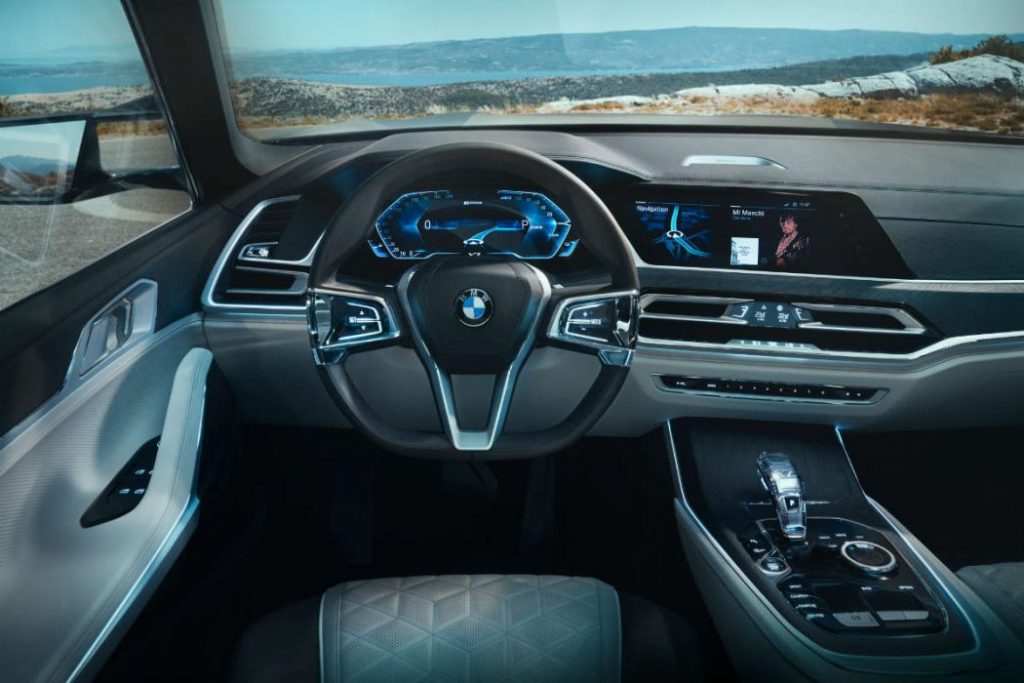
True to Munich tradition, the driver cockpit wraps around the helm. The command position is elevated, providing an authoritative view over the hood and surrounding road. Instrumentation is handled by a pair of 12.3-inch displays: a configurable digital gauge cluster and a central touchscreen infotainment panel placed side by side. The close proximity of the two screens creates the visual impression of a single wide display housing the operating system. Below the screens, secondary functions on the center stack and console are grouped tightly within cleanly faceted panels to eliminate clutter.
Tactile details receive special attention. The gear selector, iDrive rotary controller, and steering wheel switchgear feature backlit crystal glass tinted in dark Silver Night. In the second row, occupants enjoy individual touchscreen monitors tied into the BMW Connected digital ecosystem. Rear passengers can stream customized media, review business files, or share digital content across the cabin. An occupant can swipe a music track forward to the main audio system or beam a map destination directly to the navigation display. Interactive LED light patterns in the doors and dashboard choreograph these digital handoffs visually through the cabin.

Plug-in Hybrid Powertrain: BMW eDrive and TwinPower Turbo
The “iPerformance” designation on the tailgate indicates the presence of BMW’s plug-in hybrid architecture. The powertrain pairs a BMW TwinPower Turbo gasoline engine with an electric traction motor and high-voltage battery system derived from BMW eDrive engineering. While technical specifications such as battery capacity and exact engine displacement remain closely guarded study secrets in Frankfurt, the setup is engineered to support zero-local-emission driving in congested urban centers while retaining the cross-country flexibility expected of a grand tourer.
The concept’s rear treatment reinforces its electrified mission. The rear apron features a clean, continuous lower section completely devoid of exhaust tailpipes, signaling the vehicle’s zero-emission electric capability. Slim, three-dimensional L-shaped taillights span across the rear quarters, united by a crisp horizontal chrome bridge that echoes the visual width seen at the front. Vertical aero lips frame the corners of the rear bumper, guiding air smoothly away from the vehicle wake to optimize highway aerodynamics.
BMW’s Expanded Luxury Offensive
The introduction of the Concept X7 iPerformance at Frankfurt coincides with a broader restructuring of BMW’s elite portfolio. Ian Robertson, Member of the Board of Management of BMW AG responsible for Sales and Brand BMW, notes that the company is aiming to grow both volume and profitability at the top tier of its lineup. The planned production X7 will anchor this initiative alongside the 7 Series sedan, the upcoming 8 Series coupe, and the BMW i8 and upcoming i8 Roadster.
To distinguish these flagship models from the broader vehicle catalog, BMW is introducing a dedicated visual identity. Elite luxury models will carry a stylized emblem combining a monochrome black-and-white rendition of the Munich roundel with the full historical script “Bayerische Motoren Werke.” First utilized over a century ago, this heritage typography bridges Munich’s classic coachbuilding origins with forward-looking electrification. For BMW, the Frankfurt concept represents not simply an oversized crossover, but a technical showcase and design preview of what the production X7 will bring to showrooms in 2018.
Vehicle data
| Field | Value |
|---|---|
| Make | BMW |
| Model | Concept X7 iPerformance |
| Generation / chassis code | Concept (previews G07 X7) |
| Model year(s) covered | 2017 (Concept debut; 2018 production target) |
| Body style | Full-size luxury SUV / SAV concept (6-passenger, 3 rows) |
| Powertrain / engine | Plug-in hybrid (BMW TwinPower Turbo petrol engine with BMW eDrive electric motor) |
| Power / torque | Not stated in sources |
| Transmission | Not stated in sources |
| Drivetrain | All-wheel drive (xDrive) |
| Key performance figures | Zero local emissions capability in electric mode; specific acceleration and top speed not stated in sources |
| Price (as stated) | Not stated in sources (concept vehicle) |
| On-sale / announcement period | Unveiled September 2017 (IAA Frankfurt Motor Show); production scheduled for 2018 |
| Market | Global |