
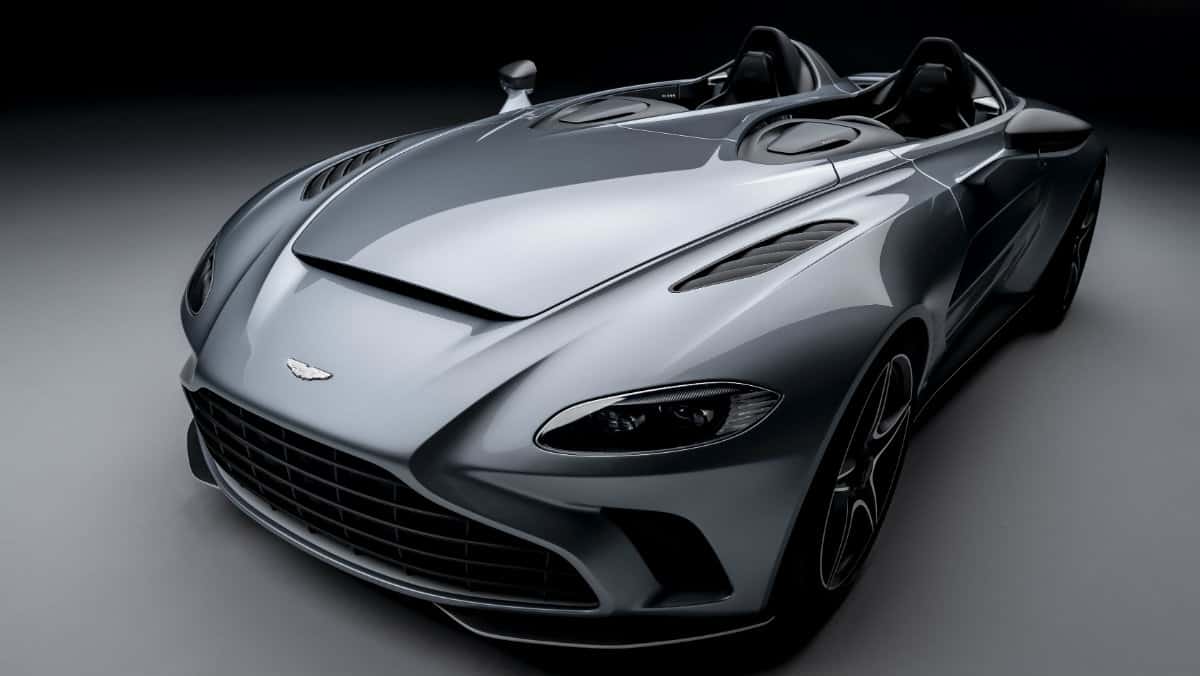
A Radical Roofless Vision
Aston Martin has drawn back the veil on one of the most uncompromising, puristic sports cars in its modern era: the Aston Martin V12 Speedster. Developed by the marque’s bespoke customization division, Q by Aston Martin, this open-cockpit two-seater enters the world as an ultra-exclusive production model strictly limited to 88 examples globally. Drawing direct lineage from Aston Martin’s rich motorsport heritage while simultaneously channeling cutting-edge aeronautical design, the V12 Speedster represents an unfiltered celebration of raw driver engagement, high-displacement combustion, and bespoke British coachbuilding.
The vehicle showcases an extraordinary development trajectory. Conceived roughly twelve months ago, the project accelerated from initial concept sketches to a fully realized production machine within a single calendar year. Rather than serving as a static styling exercise, the example presented at Aston Martin’s Gaydon headquarters is an authentic, road-ready demonstration of what Q by Aston Martin and the company’s core design department can achieve under concentrated focus. It stands as a vivid testament to the marque’s ongoing commitment to building evocative drivers’ cars underpinned by advanced lightweight materials, meticulous hand assembly, and dedicated structural engineering.

Reflecting on the reveal, Dr. Andy Palmer, President and Group Chief Executive Officer of Aston Martin Lagonda, noted the significance of the accomplishment: “It makes me enormously proud to reveal Aston Martin’s latest, most exciting special model today. The V12 Speedster is an incredible demonstration of the breadth of capability and determination from the ‘Q by Aston Martin’ team, who have worked tirelessly to create this stunning, two-seat sports car aimed at our most demanding and enthusiastic customers.”
Hybrid Architecture and Chassis Foundations
Beneath the sculptured exterior skin sits an ingenious bespoke platform forged from Aston Martin’s latest bonded aluminum architecture. Rather than carrying over an unmodified production underbody, engineers synthesized structural components from both the DBS Superleggera and the Vantage model lines. By fusing the high-performance longitudinal backbone of the DBS with the athletic dimensions of the Vantage, the engineering team achieved a tailored footprint suited specifically to the car’s open-top configuration and substantial front-mid mounted powerplant.
The chassis dynamics rely on an independent double-wishbone suspension setup at the front axle matched with a multi-link arrangement at the rear. Coil springs work alongside Aston Martin’s adaptive damping system, which gives the driver three selectable dynamic modes: Sport, Sport+, and Track. These settings recalibrate damper response to transition the car from poised road cruising to taut, high-load circuit duty. Each mode alters body control and roll stiffness to exploit the rigid aluminum tub while accommodating the unique aerodynamic loadings of a roofless silhouette.

Unsprung weight is strictly managed through the fitment of standard 21-inch forged alloy wheels equipped with central-locking hubs. Behind those lightweight rims sits a formidable carbon-ceramic braking package as standard specification. Measuring an immense 410 mm in diameter across the front axle and 360 mm at the rear, these carbon-composite discs deliver fade-resistant thermal capacity and relentless stopping power under track conditions. They also reduce rotational inertia at each hub, sharpening turn-in bite and steering clarity across every surface.

A Design Language Drawn from Racing Pedigree and Aviation
Clothed around this custom chassis is a lightweight body shell constructed almost entirely from bespoke carbon fiber. The bodywork dispenses with conventional pillars, side glass, and windshield entirely, creating a dramatic, low-slung wedge that places driver and co-driver in direct communion with the elements. Design Director Miles Nurnberger explains that the project purposely steps back into heritage while pushing bold proportions into the open air: “With the V12 Speedster we do go back a step and look into our past for inspiration. Since the DB11 launch, everything has been focused and very forward-looking. Here though, we find a different tempo. There’s a clear lineage from the 1959 Le Mans-winning DBR1 to our Centenary celebratory CC100 Speedster Concept in 2013. There is also a bit of 1953 DB3S in the mid-section, so it really is our latest incarnation of the Speedster concept. It’s also inspired by fighter jets as much as it is by our history, and it has been created to deliver an incredibly visceral experience, hence why it is a V12, rather than a V8. With the V12 Speedster, we are amplifying all the emotional strings that we can to the absolute maximum.”
The visual architecture centers on radical proportions: broad, muscular rear quarters, twin flying streamliner cowls rising behind the seat headrests, and a prominent structural spine that slices cleanly through the cockpit to separate driver from passenger. Up front, the nose is dominated by an enlarged, assertive radiator grille flanked by bespoke headlamp units and a prominent bonnet aperture. As Nurnberger points out: “No roof or screen, a big engine, low, with broad shoulders and exaggerated and emotional styling with twin humps and the spine separating the driver and passenger. The light, low, rear end contrasts with the bold, enlarged grille, unique headlights, and bonnet nostril at the front. Bonnet nostrils we haven’t done in a very long time, but we’ve brought them back. It’s a neat trick visually to allow us to win some space for the V12. It creates this iconic-looking vent.”
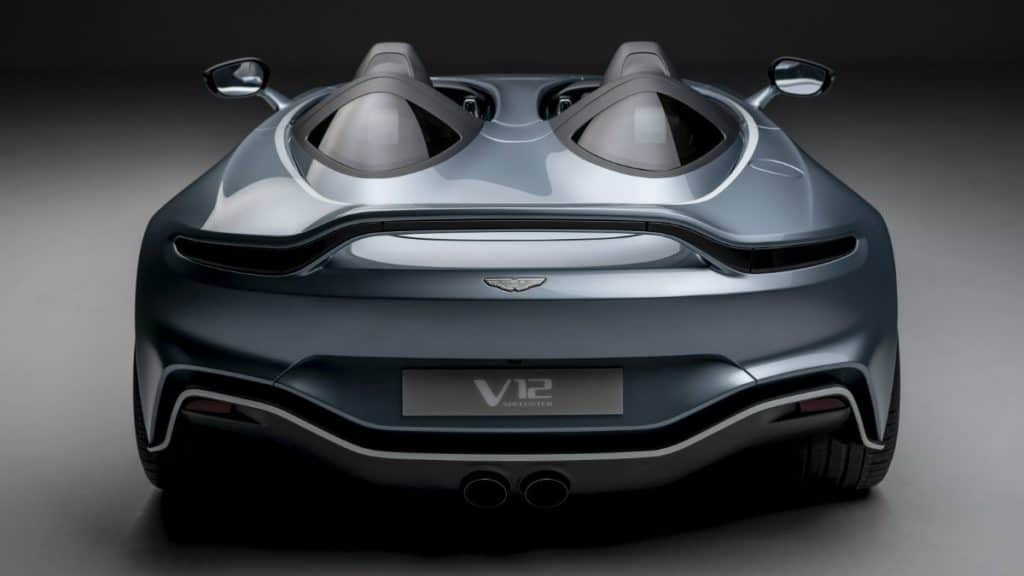
That distinctive bonnet nostril serves an essential technical function alongside its visual drama. Packaging a large-capacity, twin-turbocharged twelve-cylinder engine beneath a low, aerodynamic front deck presented tight clearance constraints. The nostril provides the critical millimeters of headroom required for intake and cooling plumbing, while evoking classic Aston Martin racing machinery where cooling cuts were cut directly into aluminum cowls out of pure necessity.

A Spartan Yet Exquisite Cockpit
Inside the cabin, the V12 Speedster blends high-tech minimalism with time-honored handcraftsmanship. The cockpit architecture strips away extraneous trim, letting structural satin carbon fiber form large sections of the passenger tub, dashboard, and central bridge. In contrast to this raw composite weave, traditional hand-crafted Saddle Leather lines key touchpoints, joined by brushed aluminum detailing, tactile chrome hardware, and 3D-printed rubber elements on functional components.
Every element inside the passenger cell serves a distinct purpose, eliminating excess weight without sacrificing the tactile quality expected of an Aston Martin flagship. In front of the passenger seat, a classic hinged glovebox has been replaced by a bespoke, removable leather bag that unclips from the dashboard bulkhead. For weekend getaways or track days, additional enclosed luggage compartments have been cleverly integrated beneath the aerodynamic rear fairing humps, providing secure dry storage shielded from wind buffeting.

The F/A-18 Conceptual Livery Collaboration
The debut car unveiled at Gaydon showcases an extraordinary conceptual specification inspired directly by the Boeing F/A-18 Hornet strike fighter. Born from an official design collaboration with Boeing and meticulously executed by Q by Aston Martin, this aeronautical theme will be available for discerning clients to commission. The carbon bodywork is coated in Skyfall Silver exterior paint, paired with contrasting satin black accents applied to the quad exhaust tips, cooling vent mesh, and aerodynamic vanes.
That military aviation aesthetic carries seamlessly into the open cockpit. Interior appointments incorporate satin dark chrome fittings, precision-machined aluminum accents, obsidian black leather upholstery, and tough technical textiles. Black floor carpets keep reflections minimal, while vibrant red Aston Martin scripted door pull straps punctuate the cockpit with an unmistakable cockpit ejection-handle flair. It is a purposeful, tactical execution that highlights the raw mechanical drama of a vehicle completely open to high-speed slipstreams.

Twin-Turbocharged 5.2-Liter V12 Performance
At the beating heart of the V12 Speedster is Aston Martin’s quad-cam 48-valve 5.2-liter twin-turbocharged V12 engine. Installed in a front-midship configuration well behind the front axle line, the all-alloy twelve-cylinder powerplant delivers 700 horsepower (515 kW) and a monumental 753 Nm (555 lb-ft) of torque. Output is fed through a torque-tube prop shaft into a rear-mounted ZF 8-speed automatic transmission paired with a mechanical limited-slip differential driving the rear wheels.
Straight-line acceleration is explosive: the V12 Speedster launches from 0 to 62 mph (100 km/h) in 3.5 seconds. Top speed is electronically limited to 186 mph (300 km/h)—an astonishing figure in a cockpit completely devoid of a windscreen, where aerodynamic helmets and protective eyewear are mandatory equipment. The combination of immediate forced-induction torque and multi-ratio ZF shifting ensures relentless mid-range thrust out of every corner.

Acoustic Tuning and Driver Engagement
In a car lacking a roof and glazing, acoustic character becomes an integral pillar of the sensory experience. To give the twin-turbo V12 an intoxicating voice worthy of its dramatic stance, Aston Martin engineers created a custom stainless-steel exhaust system. The pipes terminate centrally through the upper surface of the rear diffuser, allowing the twelve-cylinder exhaust pulses to resonate freely without acoustic muffling from a closed cabin structure.
Matt Becker, Aston Martin Chief Engineer, highlighted how the lack of insulation intensifies every dynamic reaction: “For raw, driving thrills the V12 Speedster is unparalleled, the fully open element of the car adding a new dimension to the experience. It engages on every level, delivering a precise, involving driving experience, with agility and poise backed by abundant power from Aston Martin’s twin-turbo 5.2-liter V12. Driving doesn’t get any purer than this.”
Dr. Andy Palmer echoed that conviction as customer reservations opened across global markets: “Nothing demonstrates Aston Martin’s commitment to providing unique, special models to its customers more than the V12 Speedster. The 88 hand-built cars will be sought after by driving enthusiasts and collectors alike all around the world. I’m excited not just about what they offer drivers, but about what it represents. The V12 Speedster not just showcases our incredible engineering capability and ambition, but also celebrates Aston Martin’s rich heritage.”

Vehicle data
| Field | Value |
|---|---|
| Make | Aston Martin |
| Model | V12 Speedster |
| Generation / chassis code | Bespoke bonded aluminum architecture (DBS Superleggera and Vantage hybrid) |
| Model year(s) covered | 2020–2021 (Announced March 2020) |
| Body style | Two-seat open speedster (roofless, screenless carbon fiber body) |
| Powertrain / engine | 5.2-liter twin-turbocharged 48-valve quad-cam all-alloy V12 |
| Power / torque | 700 hp (515 kW) / 753 Nm (555 lb-ft) |
| Transmission | ZF 8-speed automatic transmission with limited-slip differential |
| Drivetrain | Rear-wheel drive (front-mid mounted engine) |
| Key performance figures | 0–62 mph (0–100 km/h) in 3.5 seconds; top speed electronically limited to 186 mph (300 km/h) |
| Price (as stated) | Not stated in sources |
| On-sale / announcement period | March 2020 global reveal; production limited to 88 units |
| Market | Global |