
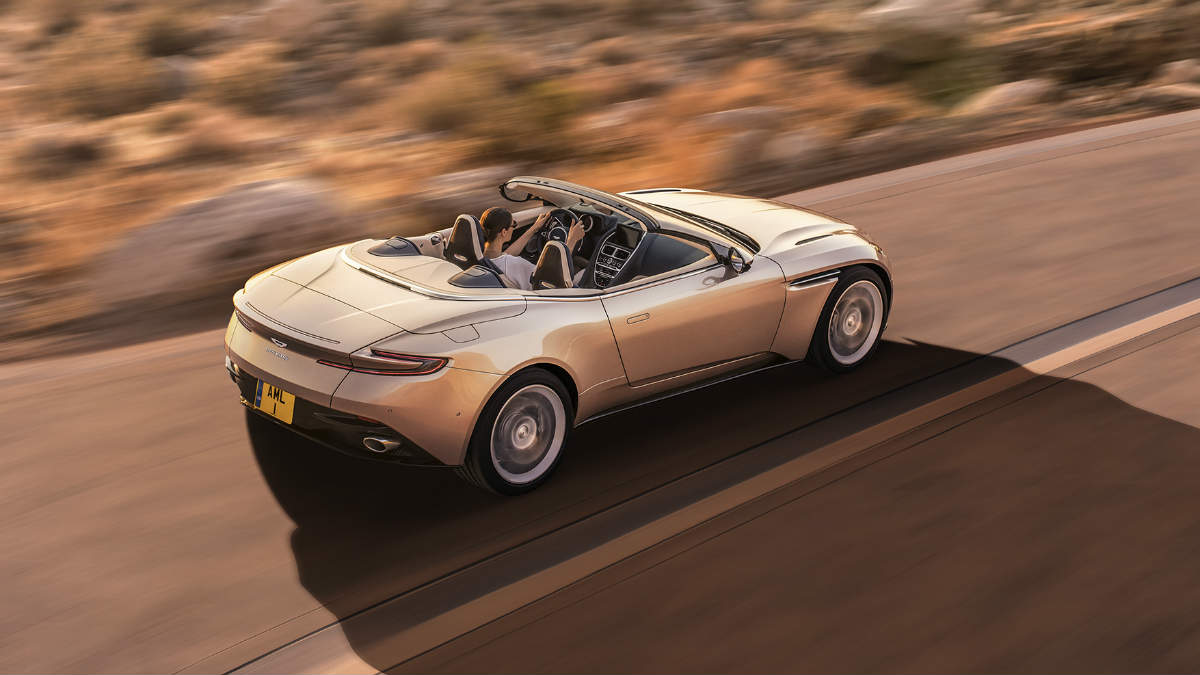
The Return of the Open-Top Sports GT
The arrival of the Aston Martin DB11 Volante marks a crucial turning point for the British marque’s open-cockpit grand tourers. Following the successful global introduction of the DB11 Coupe, Aston Martin has stripped away the fixed roof to create what Chief Executive Dr Andy Palmer describes as a car offering a rare synthesis of performance, sensory engagement, and uncompromising aesthetic elegance. For generations of Aston Martin enthusiasts, the Volante nameplate has stood as a benchmark for high-speed alfresco motoring, and this latest drop-top interpretation reasserts those core values while implementing the company’s freshest architectural and powertrain technologies.
At the center of this transformation is an all-new bonded aluminium structure, engineered from the ground up to eliminate the compromises that so frequently afflict luxury convertibles. Traditional convertibles often suffer from chassis shudder and excessive weight added by clumsy bracing, but Aston Martin’s lightweight bonded architecture counters both tendencies cleanly. Compared to the outgoing DB9 Volante it replaces, the new DB11 Volante structure is 26 kilograms lighter and delivers a five percent increase in torsional rigidity. By pairing this rigid underbody with an advanced three-stage powertrain and adaptive chassis control system, the Gaydon engineering team has produced an open sports car with an exceptionally wide operating envelope, capable of tranquil coastal cruising one moment and sharp, disciplined cross-country pace the next.

Engineering Integrity and Dynamic Capability
Converting a high-performance coupe into a soft-top demands intense mechanical discipline. As Max Szwaj, Aston Martin Chief Technical Officer, observed during the project’s development, the central conundrum is preserving dynamic agility while guarding structural solidity without encumbering the car with dead ballast. The DB11 platform provided an inherently stiff foundation, allowing the engineers to mount suspension hardware directly to rigid subframes and calibrate the springs and adaptive dampers specifically for open-air driving dynamics.
Under the clamshell bonnet resides a 4.0-litre twin-turbocharged V8, developed in partnership with Mercedes-AMG and specifically tuned by Aston Martin’s engineering staff to preserve the character, soundtrack, and throttle response expected of the brand. Producing 510 metric horsepower (503 bhp / 375 kW) and an authoritative 675 Nm (498 lb-ft) of torque across a broad mid-range plateau from 2,000 to 5,000 rpm, the force-fed engine gives the DB11 Volante tremendous reserves of effortless acceleration. The engine is set well back behind the front axle line, forming a front mid-mounted layout that yields balanced front-to-rear mass distribution.
Channeling that output to the rear wheels is a rear-mounted ZF eight-speed torque-converter automatic transmission, connected to the engine via a rigid carbon-fibre propeller shaft rotating inside a cast alloy torque tube. This transaxle arrangement sharpens chassis balance and provides rapid, intuitive shifts when commanded manually via steering-column-mounted paddle shifters. Working alongside an electronically controlled limited-slip differential with dynamic torque vectoring by braking, the driveline continuously regulates power across the rear axle. Drivers can actively modify the car’s personality through selectable drive modes—spanning GT, Sport, and Sport+ calibrations for both chassis damping and powertrain responsiveness—allowing swift adaptation from relaxed highway journeys to technical mountain passes.

Acoustic Refinement and Convertible Architecture
The focal point of any Volante is naturally its roof system, and Aston Martin has deliberately shunned heavy folding metal hardtops in favor of an impeccably tailored fabric canopy. This bespoke eight-layer folding roof incorporates advanced composite insulation and sound-deadening textiles, isolating the cabin from harsh road roar and bad weather when raised. In closed-roof configuration, passenger refinement approaches that of the fixed-roof coupe, transforming the cabin into a serene long-distance sanctuary.
When the sun emerges, the electro-hydraulic roof mechanism folds down completely in just 14 seconds, and raises back into place in 16 seconds. Operation can be initiated remotely via the key fob or directly from the center console at vehicle speeds of up to 31 mph (50 km/h), even against headwinds of equal magnitude. Compact mechanical engineering ensures the stowed fabric hood forms a class-leading stack height behind the rear seats, leaving a clean, low-profile rear silhouette that preserves the car’s flowing body contours.
Crucially, this packaging discipline yields tangible practical benefits for owners. Despite accommodating the stowage bay for the folding canopy, the rear luggage compartment offers 20 percent more cargo volume than that of the outgoing DB9 Volante. Long weekend luggage and bespoke travel bags fit without awkward negotiation, reinforcing the car’s genuine grand touring capabilities.

Exterior Styling and Aerodynamic Innovation
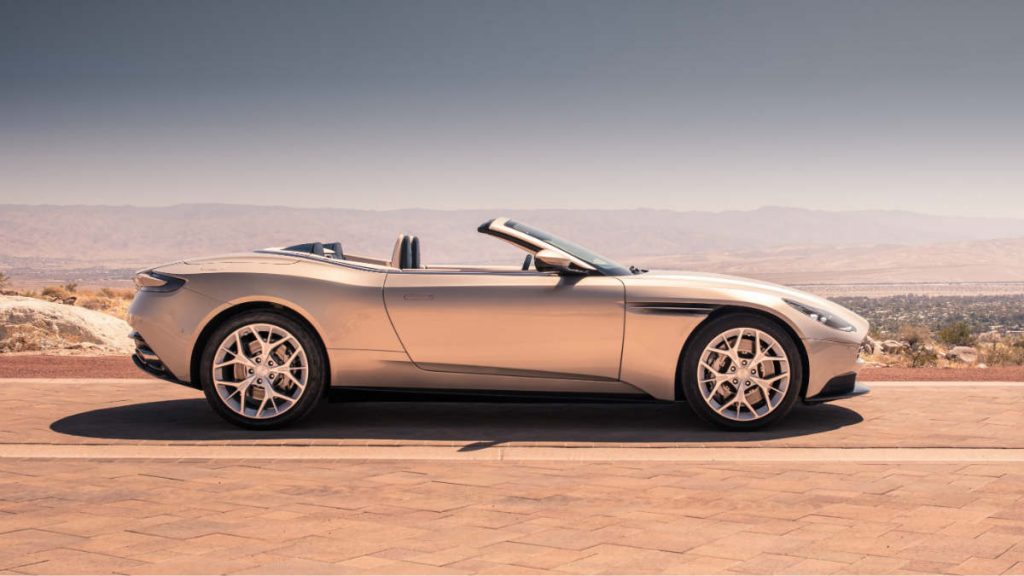
Visually, the DB11 Volante retains the proportions that defined the DB11 Coupe while introducing bespoke convertible styling elements. Up front, the dramatic single-piece aluminium clamshell bonnet curves cleanly over the front arches, minimizing unsightly shutlines and giving the nose a sculpted presence. Integrated behind the front wheel arches is Aston Martin’s functional ‘Curlicue’ aerodynamic vent, which vents turbulent air pressure from within the wheel wells through discreet gill openings along the flanks, reducing front-end lift at highway speeds.
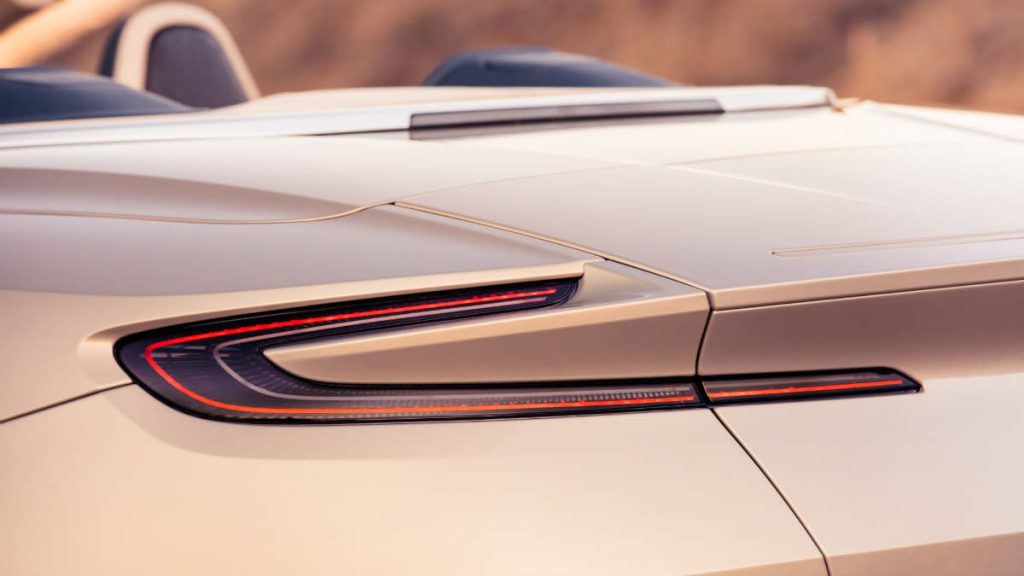
While the Coupe relies on the innovative roof-mounted AeroBlade airflow ducting system, the Volante adapts its rear deck aerodynamics to suit the soft-top layout. A subtle rear spoiler deploys automatically at elevated speeds to maintain rear-axle stability. The rear view is anchored by ultra-slim C-shaped light blade tail lamps that stretch across the tail in a sharp horizontal arc, accentuating the car’s broad muscular stance. Buyers can personalize the fabric roof with a choice of Bordeaux red, black silver, or grey silver weave fabrics, matched to newly designed forged alloy wheels that showcase the ventilated brake rotors within.

Interior Craftsmanship and Modern Practicality
Step past the swan-wing opening doors and the DB11 Volante presents an opulent cabin lined in rich leathers and intricate stitch patterns. The seating arrangement remains a classic 2+2 layout, but packaging enhancements create noticeably more breathing room for front occupants compared to previous-generation models. In an important nod to everyday usability, the DB11 Volante introduces rear seat ISOFIX child-seat mounting points—a first for an Aston Martin Volante model—allowing owners to safely secure young children in the rear quarters.
To celebrate the car’s open architecture when the canopy is lowered, Aston Martin designers have detailed the rear surfaces of the front seatbacks with elegant veneer wood or gloss carbon-fibre panels. When the top is stowed, these veneer shields catch the natural sunlight, mirroring the door card trim and providing a cohesive, bespoke appearance from behind. A heated steering wheel and heated seating elements ensure comfortable open-top journeys even through chilly autumn mornings or crisp early spring afternoons.
Behind the wheel, the digital instrument cluster and central infotainment screen utilize contemporary electronic architecture supplied through Aston Martin’s technical partnership with Daimler. The rotary control dial and touchpad interface make navigating satellite navigation, multimedia settings, and vehicle dynamics menus intuitive, freeing the dashboard from clutter while retaining physical switches for vital transmission and climate functions.
Punishing Validation and Extreme Testing
To ensure that the DB11 Volante could withstand the harsh realities of global climates without rattles, leaks, or mechanical failures, Aston Martin put the car through an aggressive durability regimen. Central to this program was the Life Cycle Durability (LCD) test for the roof assembly. Inside advanced climatic test chambers, engineers repeatedly cycled the electro-hydraulic canopy mechanism more than 100,000 times under brutal simulated environmental shifts, compressing a full decade of intensive customer operation into an intensive four-week trial.
Following laboratory validation, development prototypes were dispatched to the planet’s most demanding proving grounds. Test fleets underwent hot-weather thermal testing in the scorching heat of Death Valley, assessing engine cooling, hydraulic seals, and cabin climate performance under blistering sunshine. Simultaneously, engineering teams conducted cold-weather trials above the Arctic Circle, ensuring the fabric roof retained elasticity, insulation value, and rapid operational reliability in sub-zero snow and ice. This comprehensive real-world validation ensures the Volante delivers uncompromised durability regardless of geographic conditions.
Market Position and Deliveries
Aston Martin has opened order books for the DB11 Volante with customer deliveries scheduled to commence in spring 2018. In the United Kingdom, pricing starts at £159,900, while German pricing is set at €199,000 and the North American market carries a base price of $216,495. Positioned squarely against open-top grand tourers from Bentley, Ferrari, and Mercedes-AMG, the DB11 Volante establishes its presence through bespoke styling, a lighter structural foundation, and the visceral emotional engagement inherent to an open-cockpit V8 sports GT.
Vehicle data
| Field | Value |
|---|---|
| Make | Aston Martin |
| Model | DB11 Volante |
| Generation / chassis code | First generation (DB11) |
| Model year(s) covered | 2018 |
| Body style | 2+2 convertible / roadster |
| Powertrain / engine | 4.0-litre twin-turbocharged V8 (M177 derivative) |
| Power / torque | 510 PS (503 bhp / 375 kW) @ 6,000 rpm / 675 Nm (498 lb-ft) @ 2,000–5,000 rpm |
| Transmission | 8-speed paddle-shift automatic (rear mid-mounted ZF transaxle) |
| Drivetrain | Rear-wheel drive with limited-slip differential and dynamic torque vectoring |
| Key performance figures | 0–62 mph in 4.1 seconds; top speed 187 mph (300 km/h) |
| Price (as stated) | £159,900 (UK) / €199,000 (Germany) / $216,495 (USA) |
| On-sale / announcement period | Announced October 2017; deliveries commencing Spring 2018 |
| Market | Global (UK, Europe, North America) |