
The BMW 3 Series occupies a unique position in Bavarian motoring lore. Ever since Paul Bracq penned its taut two-door silhouette in the mid-1970s, the compact executive saloon has stood as the definitive template for rear-wheel-drive athletic balance. It arrived in the summer of 1975 to fill the enormous shoes of the legendary BMW 02 Series—a lineage that had saved BMW financially in the 1960s and defined the modern sports saloon ethos. What began four decades ago as a singular, driver-focused two-door notchback has expanded across six distinct generations into an international commercial powerhouse, defining Munich’s identity and pioneering mechanical benchmarks across the global automotive industry.

When the original BMW 3 Series broke cover at the 1975 International Motor Show (IAA) in Frankfurt, nobody could fully anticipate that this single model line would eventually account for roughly one in every four BMWs rolling out of showrooms worldwide. Today, as in 1975, purchasing a BMW 3 Series represents an unmistakable statement of intent: a demand for agile handling, enthusiasm for advanced powertrain engineering, and an appreciation of functional cockpit architecture. Across forty years of steady production, the 3 Series has served as Munich’s primary laboratory for chassis refinement, lightweight metallurgy, electronic engine management, and motorsport homologation.

Origins of an Icon: The E21 and the Birth of the Sports Saloon
The story began in the shadow of the 1973 oil crisis. BMW required a successor to the groundbreaking 1502–2002 series that could deliver genuine sporting capability while satisfying growing demands for passenger safety, structural rigidity, and fuel economy. Under the design direction of Paul Bracq, BMW created the internal chassis code E21. The car‘s front profile commanded immediate attention with its distinctive forward-canted “shark nose” front overhang, framed by BMW’s trademark kidney grille and twin round headlamps on upmarket versions.
Inside the cabin, the E21 introduced a design philosophy that would define BMW interiors for half a century: the center console angled purposefully toward the driver. Rather than treating driver and front passenger identically, Munich organized every switch, rotary dial, and vent around the person behind the steering wheel. Early models were powered by proven four-cylinder M10 engines in the 316, 318, and 320, with the 320i utilizing Bosch K-Jetronic mechanical fuel injection to produce an enthusiastic 125 horsepower.
The turning point for the E21 arrived in the autumn of 1977. At the Frankfurt Motor Show, BMW rewrote the expectations of the compact executive segment by introducing the 320/6 and the range-topping 323i. Powered by the newly developed M20 “baby six” inline-six engine, the 323i delivered 143 horsepower accompanied by a turbine-smooth exhaust note that established BMW’s six-cylinder supremacy in the mid-size bracket. Equipped with four-wheel disc brakes and a snappy five-speed manual gearbox, the 323i set a high-speed touring benchmark that rivals spent a decade attempting to match.

The E30 Era: Proliferation, All-Wheel Drive, and Motorsport Glory
In the autumn of 1982, the torch passed to the second-generation E30. Designed by Claus Luthe, the E30 refined the proportions of its predecessor while taking aerodynamics and interior room into serious account. Where the E21 had been strictly a two-door notchback, the E30 quickly expanded into a broad family of bodystyles. In 1983, BMW answered commercial demands from fleet buyers and growing families by launching a four-door saloon. By 1985, an in-house factory Convertible joined the catalog, eliminating the clumsy fixed roll hoops common among rival convertibles of the period.
The E30 also established two significant technical milestones for BMW. In 1985, Munich unveiled the 325iX, the company’s first series-production all-wheel-drive passenger vehicle. Distributing power through a permanent planetary gear center differential with a 37:63 front-to-rear torque split and viscous lockups, the 325iX proved that surefooted all-weather traction did not have to come at the expense of rear-wheel-drive steering purity. That same era brought the 324d, powered by a naturally aspirated 2.4-liter six-cylinder diesel, soon upgraded with a turbocharger to create the lively 324td in 1987.
No discussion of the E30 is complete without the car that cemented the 3 Series as an immortal racing icon: the original BMW M3. Introduced in 1985 for Group A touring car homologation, the M3 shared only its hood, roof panel, and sunroof mechanism with the standard two-door saloon. Box-flared blister fenders, an aerodynamic rear spoiler, and a raised trunk decklid framed a track-honed chassis. Under the hood lay the high-revving S14 four-cylinder engine—a masterpiece uniting the cast-iron M10 cylinder block with a trimmed-down four-valve cylinder head derived from the mid-engine M1 supercar. The E30 M3 became the most successful touring car in motorsport history, accumulating championship trophies in the World Touring Car Championship, European Touring Car Championship, and German DTM.
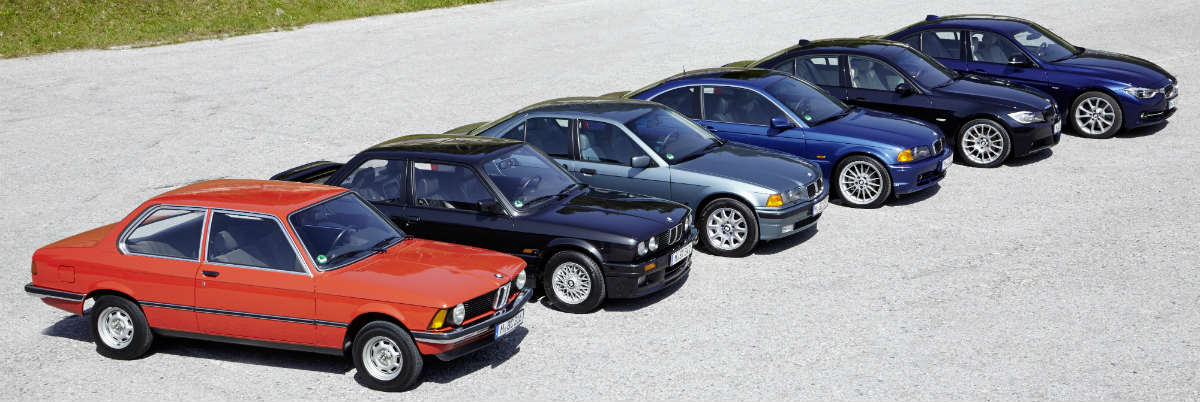
Evolution of the Species: E36 and E46 Generations
Arriving in late 1990, the third-generation E36 broke decisively with the classic upright aesthetic of the 1970s and 1980s. Pinky Lai and Boyke Boyer sculpted a wind-tunnel-honed wedge profile featuring enclosed twin headlamps under glass covers and an integrated bumper assembly. Mechanically, the E36 made an enormous leap forward with its “Z-axle” multi-link rear suspension, adapted from the bespoke Z1 roadster. This independent rear setup eliminated the trailing-arm snap oversteer tendencies of earlier cars, giving the 3 Series unparalleled roadholding and cornering stability.
The E36 lineup diversified further with a dedicated Coupe body that shared virtually no exterior sheet metal with the sedan, followed by the Convertible, the practical Touring, and the shortened three-door Compact. Variable valve timing made its debut on six-cylinder petrol engines in 1992 under the VANOS moniker, improving low-end torque while slashing exhaust emissions. The second-generation M3 arrived with silky smooth S50 and S52 inline-six power, expanding the model’s grand-touring breadth.

By 1998, Chris Bangle oversaw the launch of the fourth-generation E46. For many purists, the E46 represents the golden balance of mechanical feedback and everyday comfort. Its body displayed sculpted fender flares and subtle muscular surfaces, while aluminum suspension components reduced unsprung weight. In the 330i, the buttery M54 3.0-liter straight-six produced 228 horsepower, complemented by Double VANOS on both camshafts. The E46 M3, equipped with the glorious 338-horsepower S54 atmospheric engine screaming to an 8,000-rpm redline, earned immediate acclaim as one of the finest performance coupes ever engineered.

The Modern Era: E90 Turbocharging and F30 EfficientDynamics
When the fifth-generation E90 arrived in 2005, it heralded a revolution in BMW powertrain strategy. Magnesium-aluminum composite crankcases reduced engine weight, while the 2006 arrival of the 335i introduced twin-turbocharged direct injection via the N54 inline-six engine. Delivering 302 horsepower with virtually lag-free low-end pull, the 335i previewed BMW’s transition toward forced induction across its core portfolio. At the summit, the E90/E92/E93 M3 shocked the world by trading its traditional straight-six for a bespoke, high-revving 4.0-liter naturally aspirated S65 V8 generating 414 horsepower.

The sixth generation, coded F30 and launched for the 2012 model year, integrated BMW’s complete suite of EfficientDynamics innovations. Brake Energy Regeneration, Auto Start-Stop, and electric power steering paired with modular TwinPower Turbo four-cylinder and six-cylinder powerplants. In this generation, BMW restructured its mid-size naming architecture: the traditional two-door Coupe and Convertible variants broke away to form the distinct BMW 4 Series family, leaving the 3 Series to focus on four-door versatility with the Saloon, Touring wagon, and the elevated, long-wheelbase 3 Series Gran Turismo.

Chassis Dynamics, Weight Distribution, and xDrive Architecture
The continuous commercial dominance of the BMW 3 Series rests upon a steadfast chassis philosophy: near-perfect 50:50 front-to-rear static weight distribution. By pushing the engine far back behind the front axle centerline in a front-mid configuration, BMW engineers have consistently minimized the yaw moment of inertia. Drivers immediately notice the difference on twisty mountain passes and technical circuits. The car turns in without sluggish understeer, settling onto its outside tires with crisp poise.
Suspension architecture evolved from the MacPherson strut and semi-trailing arm layouts of the E21 and E30 into sophisticated double-pivot front struts paired with multi-link rear setups. This allows suspension engineers to decouple longitudinal compliance—essential for absorbing highway pavement seams—from lateral stiffness, which delivers razor-sharp steering feedback. Unlike front-wheel-drive competitors where driving torque tugs at the steering wheel, rear-wheel-drive 3 Series sedans preserve uncorrupted steering feel across rough asphalt.
For drivers confronting northern winters or heavy alpine snowfall, BMW’s xDrive intelligent all-wheel-drive system provides an active safety net. Rather than relying on heavy mechanical differentials, modern xDrive utilizes an electronically controlled multi-plate clutch within the transfer case. Operating in milliseconds, the system preemptively redistributes drive torque between axles before wheel slip occurs. In dry conditions, xDrive maintains a rearward torque bias to preserve the traditional rear-drive dynamic character drivers expect from a BMW.

Touring, Gran Turismo, and the Expanding Portfolio
The diversification of the 3 Series catalog is a fascinating study in customer-driven engineering. The original 3 Series Touring emerged not from a corporate boardroom presentation, but from the garage of BMW engineer Max Reisböck in the mid-1980s. Needing a car to haul his family and luggage on holiday without sacrificing the driving manners of his 3 Series, Reisböck bought a wrecked E30 sedan, moved the C-pillars, fabricated a tailgate, and built a bespoke estate car. When board members saw the prototype, they approved production with virtually no sheet-metal modifications.
That spirit of practical evolution continued with each passing generation. The Touring became a permanent fixture across Europe, offering estate practicality for active drivers who refused to climb into high-riding off-roaders. In the sixth generation, the 3 Series Gran Turismo introduced an elevated seating position, a longer wheelbase, and an expansive hatchback cargo bay, catering to transcontinental travellers. Together with the spin-off 4 Series family, Munich ensured that whether a driver wanted an everyday commuter, a family estate, an open-air convertible, or an apex-hunting sports car, the 3 Series platform possessed the flexibility to deliver.
Across forty years, six vehicle generations, and millions of sales, the BMW 3 Series has proven that automotive formulas work best when founded on uncompromising engineering principles. By honoring its heritage while systematically incorporating lighter alloys, forced induction, and advanced active chassis electronics, Munich’s quintessential sports sedan remains the benchmark against which every other premium compact car in the world is judged.
Vehicle data
| Field | Value |
|---|---|
| Make | BMW |
| Model | 3 Series |
| Generation / chassis code | E21, E30, E36, E46, E90/E91/E92/E93, F30/F31/F34 |
| Model year(s) covered | 1975–2015 |
| Body style | 2-door saloon/coupe, 4-door saloon, convertible, Touring (estate), Compact, Gran Turismo |
| Powertrain / engine | Inline-4, inline-6, and V8 petrol; inline-4 and inline-6 turbodiesel |
| Power / torque | Varies by model: 75 hp (E21 315) to 425 hp (F80 M3 TwinPower Turbo) |
| Transmission | 4-speed manual, 5-speed manual, 6-speed manual, 3-speed to 8-speed automatic, dual-clutch DCT |
| Drivetrain | Rear-wheel drive; all-wheel drive (325iX / xDrive) |
| Key performance figures | Near-perfect 50:50 axle weight distribution; DTM Championship winner 2014 |
| Price (as stated) | Not stated in sources |
| On-sale / announcement period | First unveiled July 1975 at Frankfurt IAA; celebrating 40 years |
| Market | Global / European focus |