
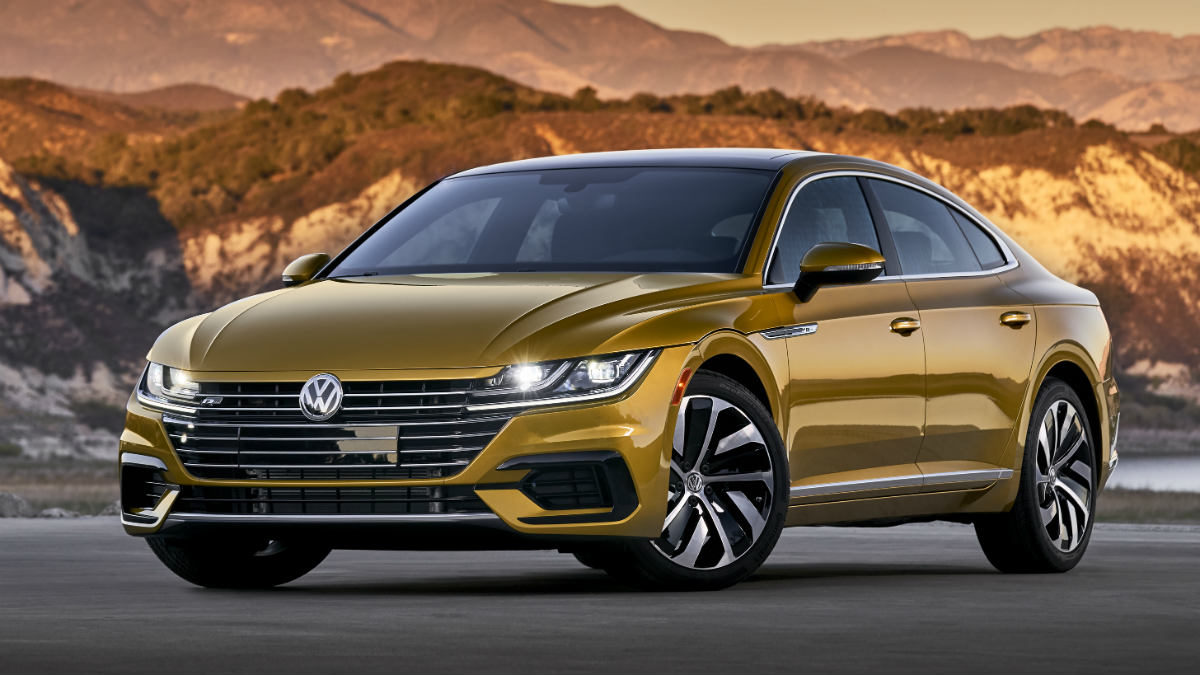
A Fastback Sedan That Punches Above Its Weight
Volkswagen’s Arteon landed in US showrooms for 2019 carrying a specific mandate: deliver the visual drama and driving refinement of a premium grand tourer without the premium badge or premium price tag. Built on the MQB architecture that underpins much of VW’s lineup, the Arteon distinguishes itself through a sleek fastback silhouette, a surprisingly spacious cabin, and a turbocharged powertrain that makes quick work of highway passing.
The strategy is straightforward. VW took the mechanical bones of its mainstream sedans, wrapped them in a body that turns heads, and loaded the upper trims with features typically reserved for German luxury competitors. Whether that formula succeeds depends on what buyers value most—and the Arteon makes a compelling case for those who want style and substance without stepping into Audi or BMW territory.

Design That Demands Attention
The Arteon’s front end establishes an immediate presence. The hood flows directly into a wide chrome grille, with LED headlights integrated into the design rather than bolted on as afterthoughts. The effect is low, wide, and purposeful—a clear departure from the conservative Passat and the discontinued CC that preceded it.
Move to the side profile and the fastback roofline becomes the defining feature. That steeply raked rear glass creates the coupe-like silhouette VW was chasing, while a character line runs from the front fender through the door handles and into the rear haunches. The wheelbase stretches longer than the CC’s, with shorter overhangs front and rear, giving the Arteon more athletic proportions than its predecessor.
The rear treatment finishes strong with broad shoulders and LED taillights that emphasize width. VW’s designers clearly studied the sports car playbook, and the result is a sedan that looks more expensive than it is. Aerodynamic efficiency backs up the visual appeal, with a 0.30 drag coefficient that contributes to both fuel economy and reduced wind noise at speed.

All Arteon models come standard with LED headlights, daytime running lights, and taillights. SEL and SEL Premium trims upgrade to adaptive front lighting that swivels the beams during cornering, while the top-tier SEL Premium adds puddle lamps in the side mirrors that illuminate when you unlock the doors. R-Line models distinguish themselves with unique 19- or 20-inch wheels, sport-tuned suspension, and aggressive body kit elements including a gloss-black rear spoiler and distinctive front bumper with larger air intakes.
Interior: Spacious and Well-Appointed
The fastback roofline might suggest compromised rear headroom, but VW’s engineers worked around that limitation. The long wheelbase translates to generous legroom for rear passengers, and the sloping roofline doesn’t significantly impact headroom for most adults. Cargo capacity benefits from the hatchback-style liftgate, which opens to reveal a large, practical load area. The 60:40 split rear seats fold flat when you need maximum hauling capability.

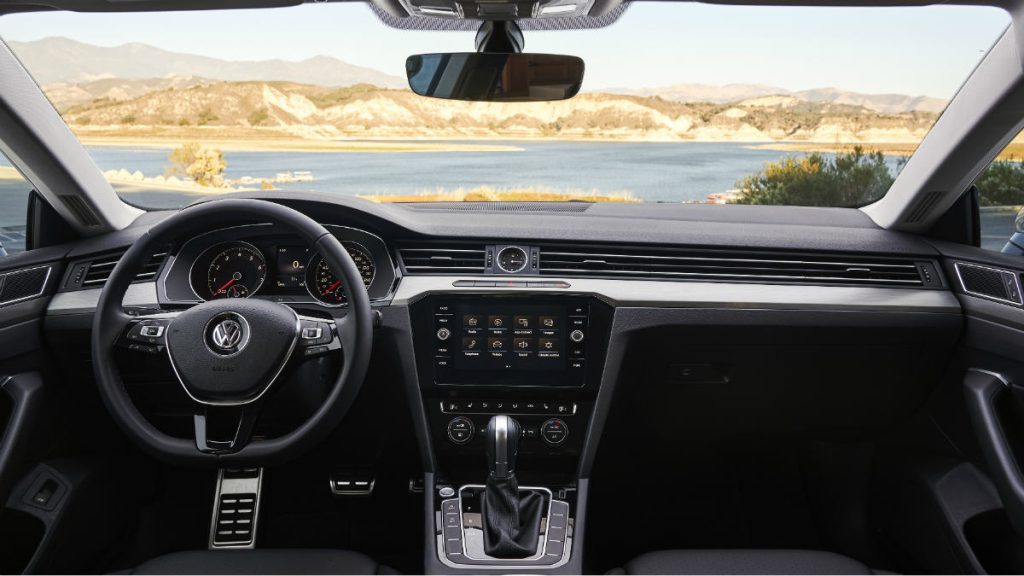
The dashboard follows a clean horizontal design with air vents stretching across the full width, creating a sense of spaciousness. Materials quality varies by trim level. Base SE models feature leatherette upholstery and 12-way power-adjustable front seats. SEL trims add genuine Nappa leather, while SEL Premium models include ventilated front seats, a massaging driver’s seat, and a heated steering wheel with paddle shifters.
Three-zone automatic climate control is standard across the range, as is keyless entry with push-button start. A panoramic sunroof comes standard on SEL and SEL Premium trims, flooding the cabin with natural light. The SEL Premium also includes a power-operated liftgate with hands-free operation—useful when your hands are full of groceries or luggage.
Technology and Infotainment
VW’s Digital Cockpit replaces traditional analog gauges with a 12.3-inch configurable display on SEL and SEL Premium models. Drivers can choose from multiple layouts including navigation-focused views that shrink the speedometer and tachometer to make room for the map. All trims include an 8.0-inch touchscreen with Apple CarPlay, Android Auto, Bluetooth, and HD Radio.
The infotainment system supports VW’s Car-Net connected services, which include automatic crash notification, remote vehicle access via smartphone app, and stolen vehicle assistance. SEL Premium models add real-time traffic, fuel prices, and weather data through the navigation system. A 700-watt Dynaudio premium sound system with 12 speakers is exclusive to the SEL Premium trim.

Powertrain and Performance
A single engine powers all Arteon variants: a 2.0-liter turbocharged four-cylinder making 268 horsepower and 258 lb-ft of torque. An eight-speed automatic transmission is standard, with front-wheel drive on SE and SEL models and VW’s 4Motion all-wheel-drive system available as an option (standard on SEL Premium).
The turbo four delivers strong acceleration from low rpm, thanks to peak torque arriving at just 1,950 rpm. Highway passing is effortless, and the engine remains refined throughout the rev range. Start-stop technology helps improve city fuel economy, though real-world efficiency in stop-and-go traffic remains modest for a vehicle of this size and weight.
The 4Motion all-wheel-drive system uses an electronically controlled clutch to distribute torque between front and rear axles, sending up to 50 percent rearward when traction demands it. The system operates transparently, intervening before wheelspin occurs rather than reacting after the fact.

Chassis and Ride Quality
McPherson struts handle front suspension duties while a four-link independent setup manages the rear. VW equipped the Arteon with its DCC adaptive damping system as standard equipment, allowing drivers to adjust suspension firmness across multiple modes from Comfort to Sport. SEL Premium models expand the adjustment range further, offering finer control over ride quality.
The chassis tuning strikes a reasonable balance between sportiness and comfort. The Arteon feels composed on twisty roads without transmitting every imperfection to the cabin. An electronic limited-slip differential (XDS+) helps reduce understeer during aggressive cornering by braking the inside front wheel, making the car feel more neutral than a typical front-drive sedan.
Body rigidity is notably high for a hatchback design, with VW claiming a 10 percent improvement over comparable notchback sedans. Hot-formed steel reinforces critical areas including the B-pillars, center tunnel, and roof rails, contributing to both crash safety and handling precision.
Safety and Driver Assistance
VW equipped the Arteon with a comprehensive suite of active and passive safety features. Eight airbags are standard, including front, side, and curtain protection. Automatic post-collision braking applies the brakes after an initial impact to reduce secondary collisions, while a reactive hood pops up during pedestrian impacts to create more crush space and reduce head injuries.
Forward collision warning with automatic emergency braking is standard on SEL and SEL Premium trims. Blind-spot monitoring with rear cross-traffic alert comes standard across all models, integrated into the side mirrors with visual warnings. Lane keeping assist can provide steering corrections to keep the car centered, and adaptive cruise control with stop-and-go functionality maintains set speed and following distance in traffic.

SEL Premium models add park assist with automatic steering for parallel and perpendicular parking, along with a 360-degree camera system and automatic high-beam headlamps. The overall safety package is competitive with luxury rivals, though some features require stepping up to higher trim levels.
Trim Levels and Value
The Arteon lineup consists of three main trims—SE, SEL, and SEL Premium—plus the sportier R-Line variant available on SE and SEL. Standard equipment on the SE includes 18-inch wheels, LED lighting, keyless entry, 12-way power seats, and an 8.0-inch touchscreen. The SEL adds adaptive cruise control, leather upholstery, the digital instrument cluster, panoramic sunroof, and 19-inch wheels. SEL Premium models bring the full suite of luxury features including ventilated and massaging front seats, the Dynaudio sound system, adaptive headlights, park assist, and the 360-degree camera.
Compared to similarly equipped luxury sedans from Audi, BMW, and Mercedes-Benz, the Arteon offers substantial savings while delivering comparable performance, technology, and refinement. The trade-off is badge prestige and some interior material quality, though the gap narrows significantly at the SEL Premium level.
Vehicle data
| Make | Volkswagen |
| Model | Arteon |
| Generation / chassis code | First generation (MQB platform) |
| Model year(s) covered | 2019 |
| Body style | 4-door fastback sedan |
| Powertrain / engine | 2.0-liter turbocharged inline-4 (TSI) |
| Power / torque | 268 hp / 258 lb-ft |
| Transmission | 8-speed automatic with Tiptronic |
| Drivetrain | Front-wheel drive (standard); 4Motion all-wheel drive (optional on SE/SEL, standard on SEL Premium) |
| Key performance figures | 0.30 Cd (drag coefficient) |
| Price (as stated) | Not stated in sources |
| On-sale / announcement period | 2019 model year, US market |
| Market | United States |