
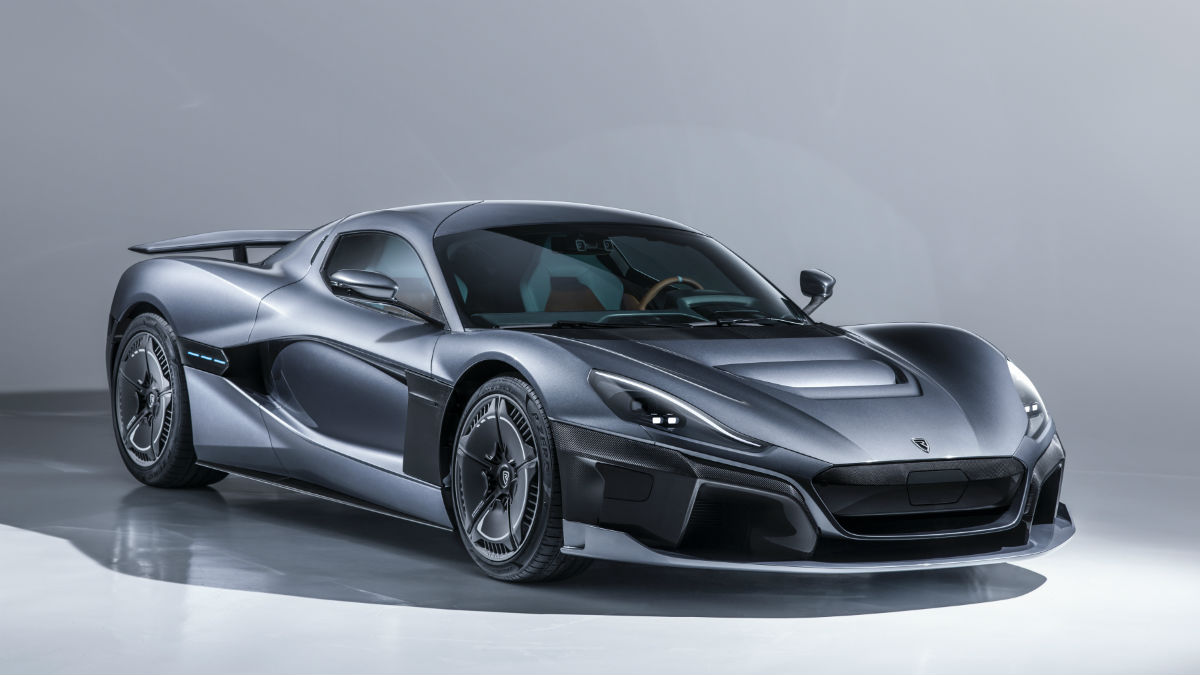
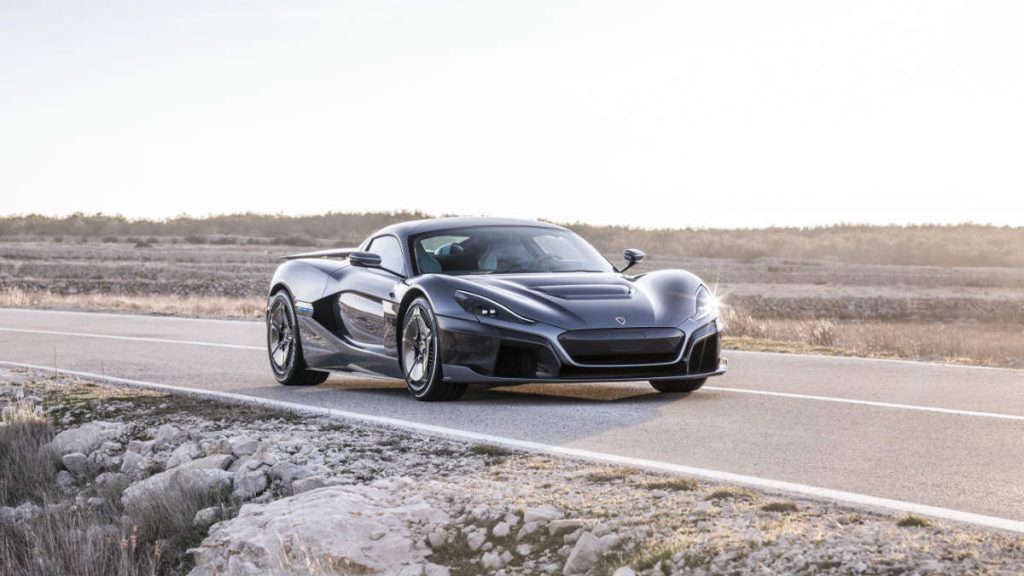
When Rimac Automobili pulled the silk off the C_Two at the 2018 Geneva International Motor Show, Mate Rimac’s Croatian outfit wasn’t merely presenting a successor to the boutique Concept_One. The Sveta Nedelja manufacturer was staking out a claim to the very frontier of hypercar performance. While mainstream legacy constructors spent the mid-2010s dipping toes into hybrid assist, Rimac bypassed combustion entirely to engineer a bespoke, ground-up electric grand touring projectile capable of bending comprehension.
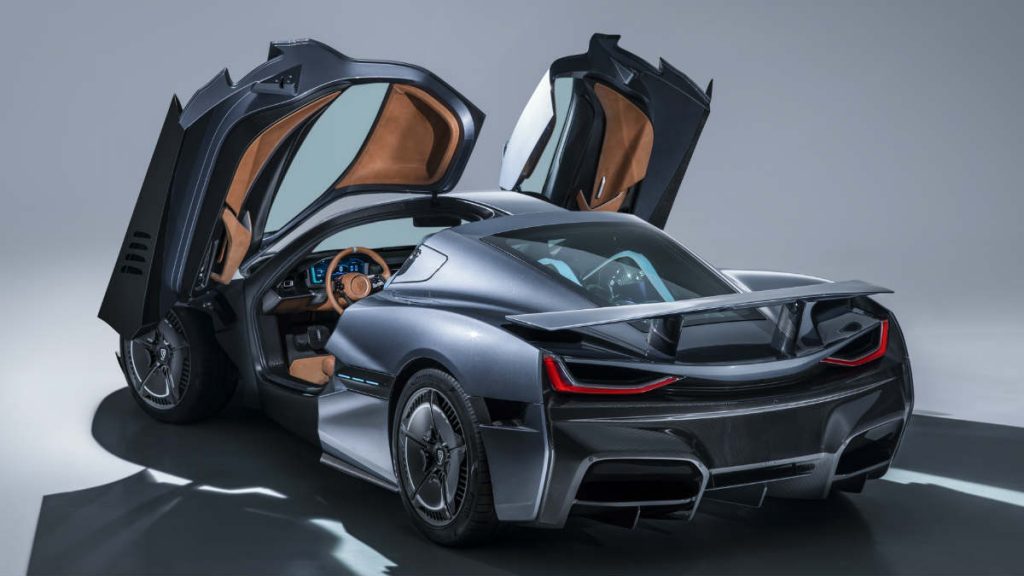
Bespoke Carbon Architecture and Chassis Dynamics
Building directly on the operational lessons gleaned from the Concept_One, the C_Two was conceived from a clean sheet of paper rather than modifying existing architectures. At the core of the machine sits a full carbon-fibre monocoque with an integrated structural battery pack, bonded carbon roof, and a merged rear carbon subframe. Crash structures front and rear are fabricated from lightweight aluminum, striking a calculated balance between extreme torsional rigidity and mandatory impact energy absorption. The outer skin is pure carbon fibre, giving the sculpted silhouette remarkable structural strength while keeping excess mass in check.
Underneath the carbon bodywork, Rimac engineers selected double-wishbone suspension at both axles, paired with electronically controlled adaptive dampers and active ride height adjustment. This hydraulic layout allows the chassis to transition on demand: sinking low to slice through turbulent air at autobahn velocities, or raising slightly to negotiate rough surfaces and urban transitions. Rather than settling for a compromised track-only setup, the Sveta Nedelja team focused heavily on long-distance compliance, creating a true gran turismo capable of crossing continents without punishing its occupants.

Four Motors, Four Wheels, and R-AWTV Torque Vectoring
The mechanical heart of the C_Two is an astonishing four-motor electric powertrain delivering 1,914 metric horsepower (1,408 kW) and a monumental 2,300 Nm (1,696 lb-ft) of instant torque. That represents two and a half times the twisting force produced by contemporary combustion-engined hypercars. Each wheel receives dedicated drive from its own bespoke permanent-magnet electric motor, granting engineers an unprecedented degree of dynamic authority.
Drivetrain packaging is equally unconventional. Up front, a pair of independent single-speed gearboxes transmit direct power to the front axle. At the rear, Rimac fitted twin independent two-speed gearboxes—one for each rear wheel. This multi-speed arrangement allows the C_Two to exploit explosive low-speed acceleration off the mark while reserving an elongated second gear to chase unprecedented hypercar velocities without running out of motor revolutions.
Harnessing nearly two thousand horsepower requires software of uncommon sophistication. Rimac’s proprietary All-Wheel Torque Vectoring (R-AWTV) supersedes traditional stability control and mechanical differentials. Calculating vehicle dynamics dozens of times per second, R-AWTV meters torque infinitely across all four corners. The system can dial in unyielding all-wheel-drive grip for lap-time extraction, or feed calibrated slip angles to the rear axle to allow progressive, controllable drifting when the driver demands theater.
Active Aerodynamics and Thermal Management
Managing the airflow around a vehicle capable of exceeding 250 mph demands an uncompromising aerodynamic layout. Integrated seamlessly into the body are multiple active aerodynamic surfaces. Electrically actuated flaps in the front bonnet modulate cooling air and front-axle downforce depending on steering angle and vehicle velocity. Beneath the vehicle, a completely flat underfloor terminates in an active rear venturi tunnel that shifts dynamically to pull the car onto the tarmac.
At the rear, a multi-position active carbon-fibre wing continuously alters its angle of attack relative to longitudinal and lateral accelerations. During sudden deceleration, it tilts into a full vertical airbrake position, altering the aerodynamic center of pressure to stabilize the tail under severe braking events. Even the lightweight forged alloy wheels serve a deliberate aerodynamic role: internal fan-style vanes evacuate turbulent air and channel cooling gusts directly across the brake hardware while smoothing flow down the car’s flanks.
Electric propulsion systems generate intense heat under sustained loads. To counteract thermal derating, Rimac engineered a comprehensive liquid cooling network for the motors, inverters, and battery chemistry. Active cooling channels open and shut automatically to optimize drag when cooling demands are modest. More significantly, Rimac designed the thermal management architecture so the C_Two can tackle two full consecutive laps of the gruelling Nürburgring Nordschleife at full attack with negligible power degradation—erasing the thermal limitations that plagued early high-performance EVs.
Benchmark Acceleration and Massive Carbon-Ceramic Stopping Power
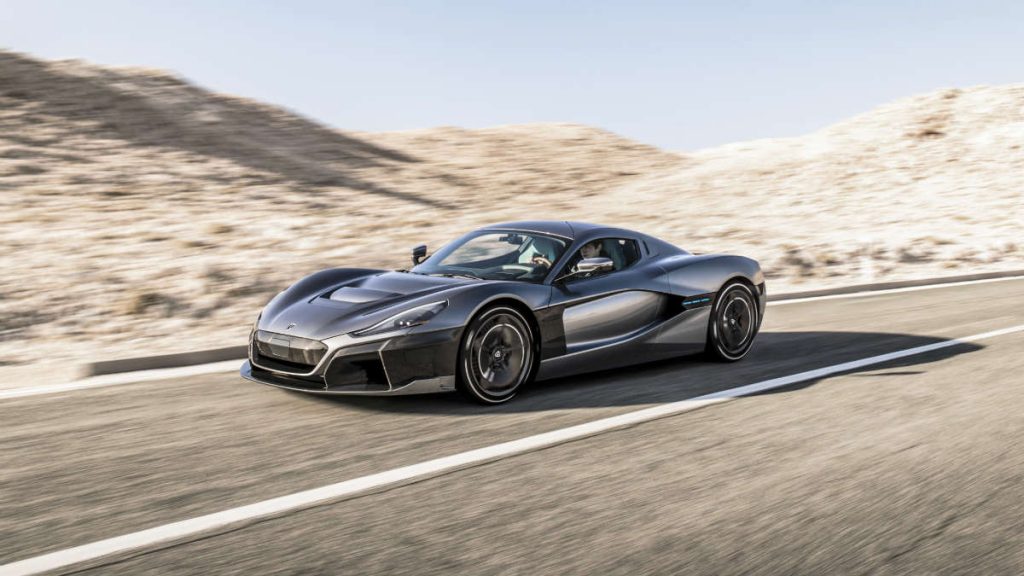
The straight-line metrics published by Rimac at Geneva read like simulation files rather than street-car specifications. The C_Two accelerates from zero to 60 mph in a blinding 1.85 seconds (reaching 100 km/h in 1.97 seconds). It blasts past 100 mph (161 km/h) in 4.3 seconds. Keep the throttle pinned and the speedometer crosses 186 mph (300 km/h) in 11.8 seconds, blasting through the standing quarter-mile in 9.1 seconds. Top speed is rated at an astonishing 258 mph (412 km/h).
These acceleration benchmarks rely heavily on bespoke Pirelli P Zero tires developed in conjunction with Rimac to withstand astronomical torque loads while ensuring lateral composure. To rein in such extreme kinetic energy, Rimac equipped the C_Two with 390 mm Brembo CCMR carbon-ceramic discs paired with rigid six-piston monobloc calipers on both front and rear axles. Working in seamless tandem with the friction brakes is a regenerative braking system delivering up to 150 kW of energy recovery, providing fade-free, neck-straining stopping consistency on track and road alike.
High-Voltage Battery, Fast Charging, and Touring Range
Underpinning the C_Two’s grand touring remit is a massive 120 kWh lithium-manganese-nickel battery pack. Packaged tightly within the central spine and floor of the carbon monocoque, the battery lowers the car’s center of gravity and serves as a structural reinforcement member for the entire vehicle tub.
Rimac rates the theoretical touring range of the C_Two at up to 650 kilometers (approximately 404 miles) under the NEDC test cycle. To support rapid highway turnarounds, the high-voltage architecture supports DC fast charging up to 250 kW. Hooked up to a sufficiently powerful high-output charger, the pack can replenish from near-empty to 80 percent state of charge in less than 30 minutes, allowing owners to embark on genuine intercontinental road trips without protracted downtime.

Analog Tactility Meets Digital Instrumentation
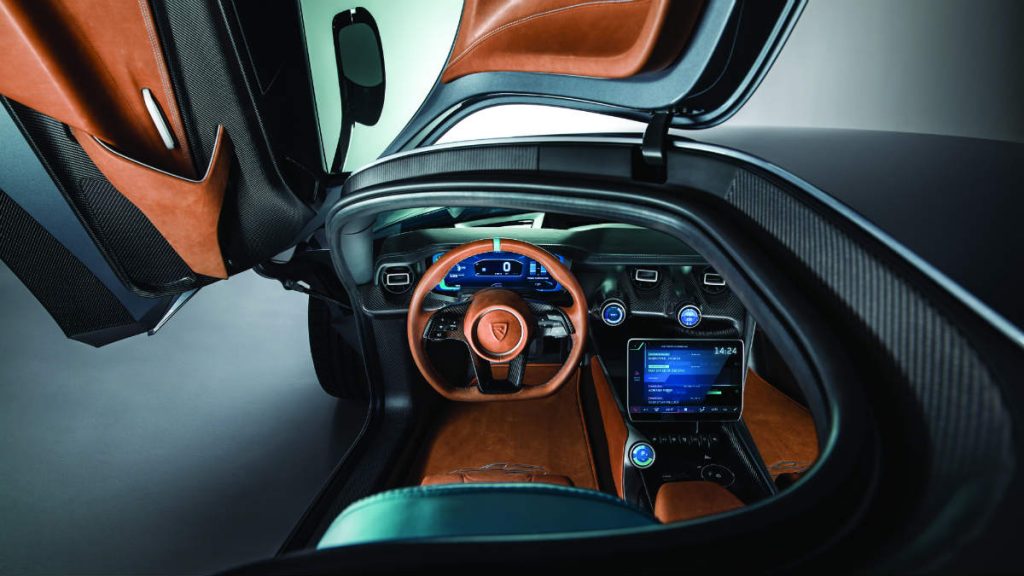
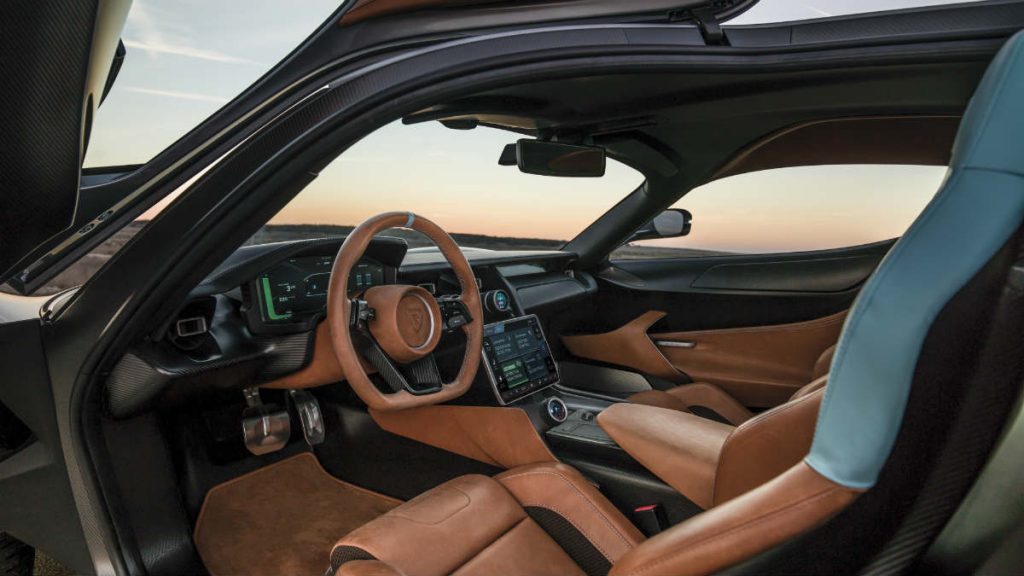
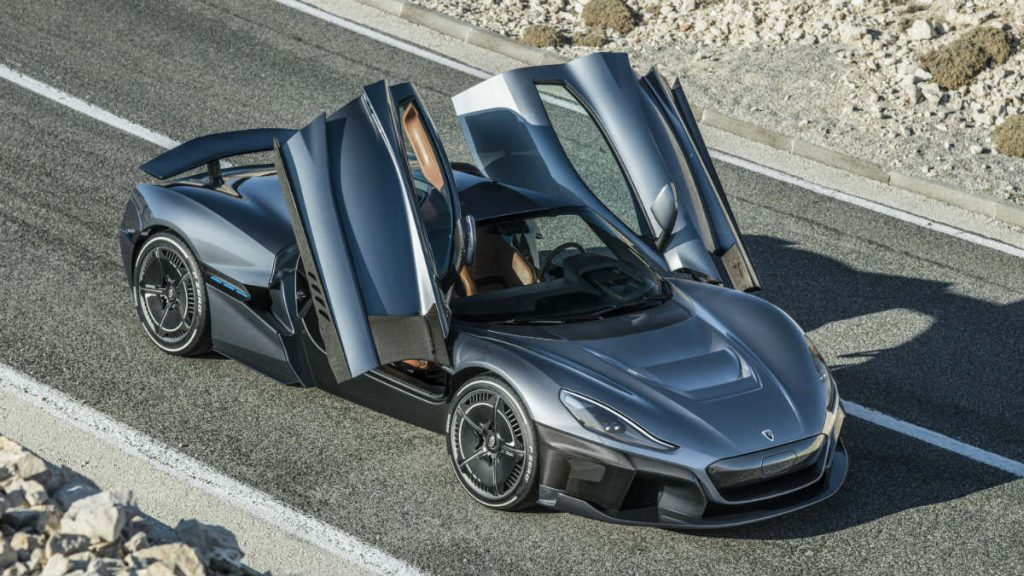
Inside the cabin, the C_Two avoids the sparse, clinical minimalism common in modern electric prototypes. The cockpit blends premium leather, exposed carbon weave, and machined metals. Dominating the driver’s field of vision is a trio of high-definition TFT displays: a reconfigurable digital instrument cluster directly behind the steering wheel, a central infotainment interface, and a dedicated passenger-side telemetry screen that presents real-time g-forces and velocity to the co-driver.
Crucially, physical interaction has not been discarded. Rimac fitted rotary switches machined from solid billet aluminum, three of which integrate embedded digital readout dials within the physical knobs. These knurled controls give drivers satisfying tactile feedback when adjusting power distribution, suspension firmness, or traction modes on the fly. Detailed onboard telemetry continuously logs vehicle performance, permitting track drivers to export datasets to a smartphone or computer for analytical review after completing laps.
Artificial Intelligence, ADAS, and the Virtual Driving Coach
The electronic nervous system of the C_Two features an ambitious suite of driver-assistance and artificial intelligence hardware. Backed by high-performance NVIDIA compute chips, the hypercar integrates an array of ultrasonic sensors, radar units, and optical cameras to enable Level 4 autonomous readiness and comprehensive Advanced Driver Assistance Systems (ADAS). On highway stretches, the platform offers adaptive cruise control with traffic pilot functionality, lane-keeping assistance, evasive maneuver assistance, collision risk mitigation, and blind-spot detection.
Equally intriguing is Rimac’s proprietary Driving Coach system. Targeted directly at track enthusiasts, the system overlays selected world-famous race circuits in real time. Combining onboard telemetry with computer vision, the Driving Coach projects optimal racing lines, braking markers, acceleration points, and steering turn-in angles through visual and auditory cues. It provides drivers with immediate feedback akin to a high-end racing simulator, helping them hone their circuit craft safely while unlocking the immense capabilities of nearly two thousand horsepower.

Production Plans and Bespoke Craftsmanship
Rimac planned a strictly limited production run of 150 units for the C_Two, with assembly taking place at the manufacturer’s facility in Sveta Nedelja, Croatia. Rather than buying an off-the-rack exotic, buyers are integrated directly into the build process through an exhaustive personalization program. Every single component—from bespoke cabin leathers, contrasting stitching, and custom carbon tints to tailored switchgear—is fashioned in-house under the client’s direct consultation.
For Mate Rimac and his engineering team, the C_Two stands as tangible proof that electrification need not be dull or soulless. By combining monumental performance figures, sophisticated all-wheel torque vectoring, genuine cross-continental touring comfort, and cutting-edge digital intelligence, the C_Two effectively redefined what an ultra-exclusive hypercar could achieve at its 2018 debut.
Vehicle data
| Field | Value |
|---|---|
| Make | Rimac |
| Model | C_Two |
| Generation / chassis code | First generation (Concept_Two) |
| Model year(s) covered | 2018 |
| Body style | 2-door hypercar coupe with butterfly doors |
| Powertrain / engine | Quad permanent-magnet electric motors with 120 kWh liquid-cooled lithium-manganese-nickel battery pack |
| Power / torque | 1,914 hp (1,408 kW) / 2,300 Nm (1,696 lb-ft) |
| Transmission | Twin independent single-speed gearboxes (front); twin independent two-speed gearboxes (rear) |
| Drivetrain | All-wheel drive with Rimac All-Wheel Torque Vectoring (R-AWTV) |
| Key performance figures | 0–60 mph: 1.85 s; 0–100 km/h: 1.97 s; 0–100 mph: 4.3 s; 0–186 mph (300 km/h): 11.8 s; 1/4 mile: 9.1 s; Top speed: 258 mph (412 km/h); Range: 650 km (NEDC) |
| Price (as stated) | Not stated in sources |
| On-sale / announcement period | Unveiled March 2018 (Geneva International Motor Show); 150 units planned |
| Market | Global |