

The Architecture of Luxury Goes All-Terrain
When Goodwood officially committed to Project Cullinan three years ago, the directive from clients was unambiguous: build the Rolls-Royce of SUVs. Not an adapted mass-market platform dressed up in rich veneers, and certainly not a compromising two-box shape where road drone reverberates through a cavernous estate compartment. Rolls-Royce buyers—increasingly younger, entrepreneurial, and seeking excursions far beyond manicured tarmac—demanded genuine off-road capability without surrendering the serene isolation that defines the marque. The resulting motor car, named after the 3,106-carat diamond uncovered in South Africa in 1905, marks the company’s first high-bodied, all-wheel-drive machine. It brings the brand’s celebrated Magic Carpet Ride directly onto gravel tracks, desert sand, and deep snow.
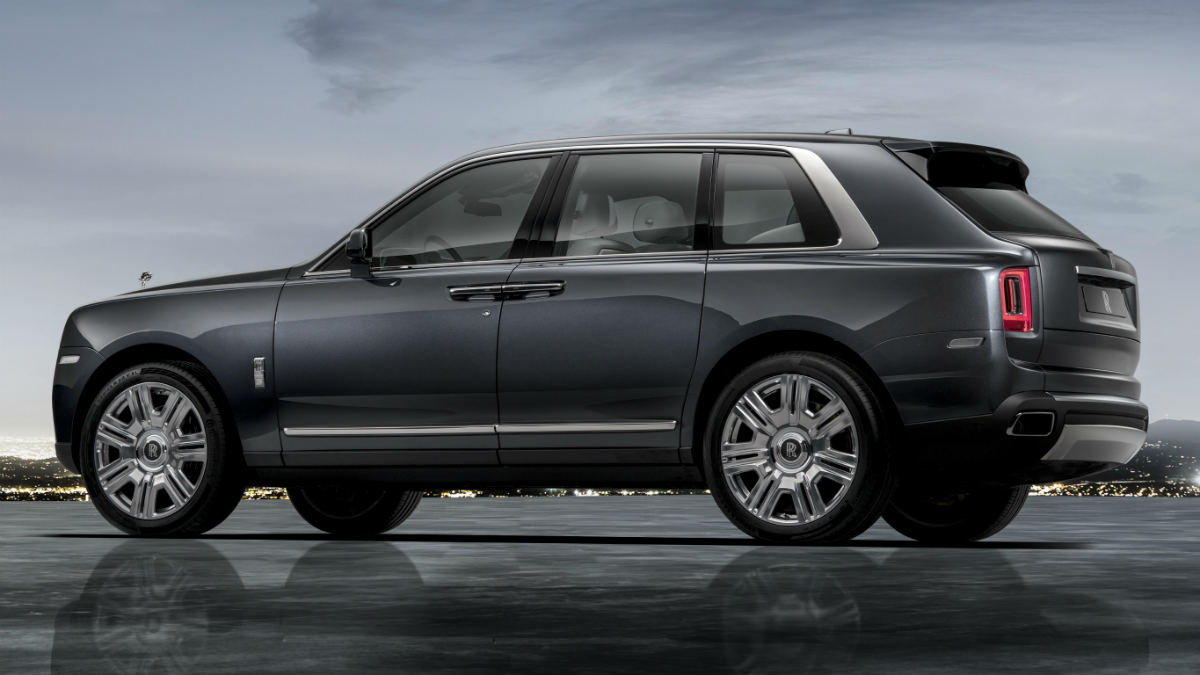
Standing 1,836 mm tall on an extensive 3,295 mm wheelbase, Cullinan does not blend into standard SUV proportions. Rolls-Royce deliberately avoided the sloping crossover profile that compromises rear passenger dignity. Instead, design director Giles Taylor and his team penned an unapologetic three-box silhouette, honoring the classic era of coachbuilding when luggage was strapped securely to an exterior shelf rather than riding among the occupants. The visual weight is commanding, dominated by a hand-polished stainless steel pantheon grille positioned proud of the surrounding bodywork, framed by Saxon-warrior brow lines and deep-set laser headlights.

The Clasp and the Three-Box Cabin Architecture
The rear silhouette introduces a functional breakthrough for Goodwood: a two-piece opening tailgate branded ‘The Clasp’. Inspired by vintage touring trunks that rode on external luggage racks to insulate passengers from travel gear, the split tailgate operates electro-mechanically via the key fob. The lower drop-tail section functions as a sturdy tailgate platform, while the upper glass section lifts clear to access the luggage area. Crucially, Cullinan revives the authentic three-box motor car architecture within an all-terrain profile by incorporating an optional glass partition between the passenger compartment and the luggage bay.
That glass partition creates an impenetrable thermal and acoustic sealed ecosystem. Rear passengers rest entirely undisturbed by exterior draughts or street clatter when the tailgate is opened in freezing sub-zero alpine conditions or under blistering Middle Eastern desert sun. Interior climate control remains utterly undisturbed, maintaining cabin calm at all times.

Rear Seating: Lounge Seats versus Individual Luxury
Rear accommodation in Cullinan offers two fundamentally distinct configurations tailored to how an owner intends to travel: Lounge Seats or Individual Seats. The Lounge configuration provides seating for three across the rear bench, making it the practical choice for owners traveling with family. In a landmark engineering decision for the Goodwood marque, the Lounge seatbacks fold down electrically at the press of a switch located inside the boot or the rear door pocket. As the backrests hinge down, the headrests motor upward automatically to prevent indentations against the plush seat cushions.
Both seat sections fold flat in a 2/3 and 1/3 split arrangement, extending practical usability while letting a rear occupant sit alongside longer leisure equipment. The carpeted reverse of the folded seatback can serve as a firm occasional surface for personal belongings. Because the base of the rear seats is elevated above the boot floor, items secured in the rear bay cannot slide forward inadvertently into the passenger space during heavy braking.
The luggage compartment offers 560 liters of volume under normal conditions, expanding to 600 liters when removing the parcel shelf. For larger cargo—such as commissioned fine art or archaeological specimens retrieved from far-flung expeditions—the load floor can be electronically raised to match the folded seat height. This forms an unbroken, flat surface measuring 2,245 mm in length with a total cargo capacity of 1,930 liters. That loading length surpasses a long-wheelbase Range Rover, giving Cullinan unmatched utility among ultraluxury conveyances.
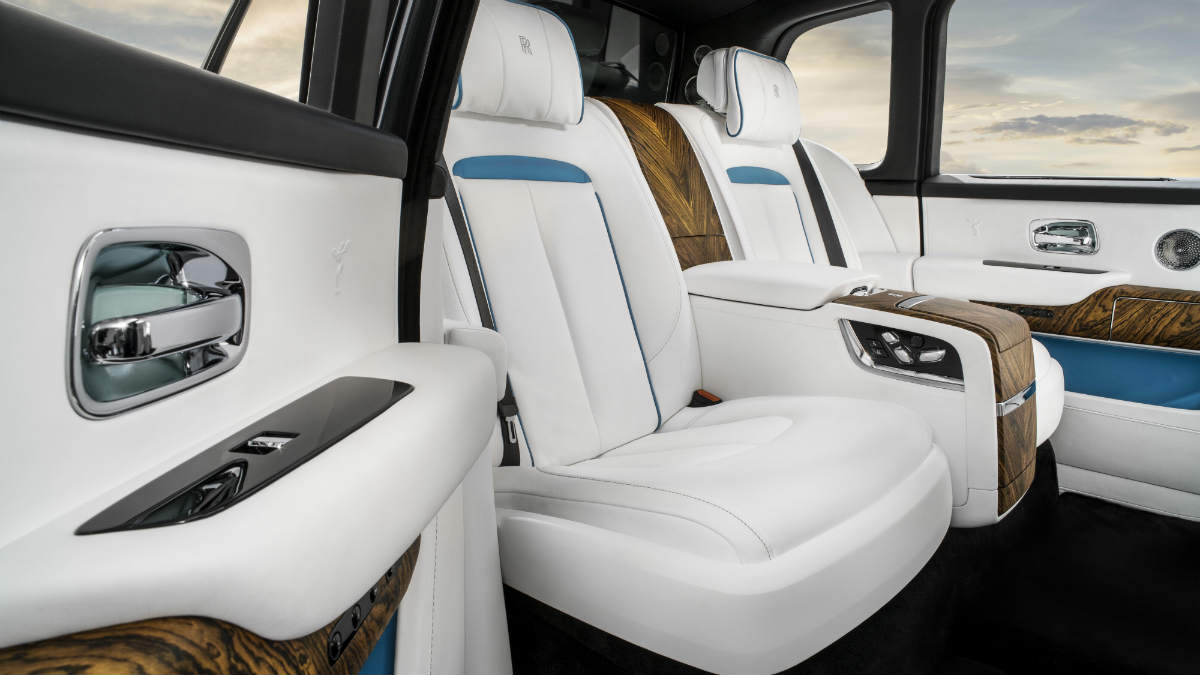
For patrons prioritizing pure indulgence over maximum cargo volume, the Individual Seat configuration equips the rear compartment with two dedicated armchairs separated by a wide, fixed center console. This sculpted wood and leather divider houses a refrigerated drinks cabinet, Rolls-Royce crystal whiskey decanter, tumblers, and bespoke champagne flutes. Each individual chair adjusts across multiple planes, offering backrest recline, cushion tilt, and heating or ventilation so rear occupants remain completely refreshed across thousand-mile continental transits.
The Ceremony of Entry and the Command Center
Approaching Cullinan initiates an orchestrated welcoming sequence. Touching the stainless steel door handle or pressing unlock on the key causes the air suspension to lower the body by 40 mm, presenting an effortless step-in threshold. Rolls-Royce’s signature rear-hinged coach doors swing wide to expose a completely flat floor, free from intrusive structural sills.
Both front and rear door apertures extend downward to wrap beneath the exterior sill, ensuring road grit, snow, and trail mud collect exclusively on the outer panels rather than dirtying trousers or hems upon exit. Once nestled inside the quiet cabin, occupants press tactile closing buttons on the dashboard or pillars to pull the coach doors shut automatically. Starting the ignition smoothly elevates the vehicle back to its standard ground clearance, positioning everyone in commanding sight of the road ahead.

Behind the wheel, Cullinan declares its driver-centric character through a thicker, slightly smaller-diameter steering rim wrapped in supple heated leather. The driver faces a thoroughly modern digital instrument display rendered with virtual needles, jewelry-style chrome chaplets, and crisp typography that preserves classic Goodwood instrument aesthetics. For the first time in a Rolls-Royce, the central infotainment display incorporates touch sensitivity, letting the driver tap through route planning and chassis telemetry on the move, while the tactile Spirit of Ecstasy rotary dial remains on the console for low-distraction operation.
Flanking the rotary controller are tactile buttons for Hill Descent Control, ride-height regulation, and the dedicated ‘Off-Road’ drive mode. Active driver aids include thermal Night Vision with daytime and nighttime wildlife and pedestrian recognition, an Alertness Assistant, active cruise control, cross-traffic warnings, lane departure assistance, and a high-definition 7×3-inch head-up display. A comprehensive four-camera surround network generates a bird’s-eye helicopter perspective, giving precise visibility around rocks, tight driveways, and mountain paths.

Rear passengers sit in elevated Pavilion Seating, placed deliberately higher than front occupants to guarantee unhindered forward and lateral views through vast side glass and the panoramic glazed sunroof. Rear infotainment displays allow passengers to pinpoint their position on dynamic trail maps, while five discrete USB ports and front wireless charging pads keep devices powered during long excursions away from major cities.
Engineering the Proprietary Architecture of Luxury
Rather than borrowing a shared corporate platform, Cullinan is built upon Rolls-Royce’s proprietary Architecture of Luxury. First introduced beneath the eighth-generation Phantom saloon, this all-aluminum spaceframe chassis was engineered specifically to scale across diverse body heights, vehicle wheelbases, and drivetrain arrangements without compromising torsional rigidity. For Cullinan, the spaceframe was reconfigured into a taller, more compact perimeter envelope that integrates an opening tailgate for the first time in series manufacture.
The aluminum sub-structure delivers structural stiffness that sets a new baseline for high-bodied luxury vehicles. By eliminating unyielding steel stampings and unwanted flex, the rigid spaceframe lets the suspension absorb harsh high-frequency road vibrations, insulating passengers from rutted washboard tracks and uneven surfaces without transmitting resonance through the body shell.
Twin-Turbo V12 Muscle and the ‘Everywhere’ Button
Under the high aluminum hood sits Rolls-Royce’s 6.75-liter twin-turbocharged V12 engine. Calibrated specifically for low-speed torque delivery across unpredictable surfaces, the twelve-cylinder powerplant produces 563 brake horsepower (571 PS / 420 kW) and a monumental 850 Nm (627 lb-ft) of pulling power starting at just 1,600 rpm. Power flows to all four wheels through an eight-speed automatic transmission connected to heavy-duty prop shafts and reinforced drive axles designed to withstand abrupt traction spikes on rocky climbs.
Chassis dynamics depend on a bespoke double-wishbone front suspension and a sophisticated five-link rear axle, augmented by active four-wheel steering. Large-volume self-leveling air struts cushion impact energy while electronic dampers react in milliseconds to inputs from body accelerometers, steering angles, and forward-facing stereo cameras. When driving over difficult terrain, the active suspension system uses air compression to push down firmly on any wheel losing grip, ensuring sustained tire contact and unbroken torque distribution.
Accessing the car’s complete all-terrain suite requires no complex differential levers or confusing sub-menus. Goodwood engineers condensed off-road control into a single physical control: the ‘Everywhere’ button on the center console. Pressing it marshals the engine, transmission, all-wheel drive, and air suspension into an uninterrupted rough-terrain mode. Drivers can tailor throttle progression across wet grass, gravel, deep mud, or desert sand. When encountering swollen rivers, Cullinan boasts a 540 mm wading depth, the highest of any ultraluxury sport-utility vehicle on the market.

Exterior Form and Giles Taylor’s Design Language
Visual presence on Cullinan is defined by resolute geometric clarity. Deeply recessed air intakes and laser headlights sit within bold vertical planes. A sharp brow line stretches over the top of the hand-polished stainless steel grille, presenting a disciplined expression inspired by Saxon armor. The iconic pantheon grille stands mounted proud of the surrounding front clip, projecting forward to emphasize the upright stance.
In profile, the sheer bonnet rises above sculpted front fenders, flowing into steep A-pillars before tracing an 1,836 mm roofline. Behind the B-pillars, the roof drops quickly to meet an angled rear backlight and a distinctive bustle boot lid reminiscent of 1930s touring saloons. Giles Taylor’s sweeping character line flows through 22-inch alloy wheels, accented by an honest stainless steel spear running along the lower door panels to visually balance the upright flanks. At the tail, two upright light clusters, a modest plinth for the interlocking RR badge, and polished dual exhaust finishers integrated into a metal skid plate ground the rear aesthetic.
Artisan Cockpit Materials and Recreation Modules
The interior architecture highlights structural symmetry and hand-finished materials. Durable black ‘Box Grain’ leather—a water-resistant boarded finish derived from heritage Italian luggage—wraps the upper dashboard, framing the classic analog clock and organ-stop air vents. Beneath, a three-dimensional sculpted band of open-pore wood spans outward to the center stack, while padded leather rolls form upper and lower knee buffers across the dash.
The seats feature a contemporary horseshoe pattern highlighting supportive lateral bolsters, with backrest panels meticulously crafted from unbroken single hides. Comfort extends beyond the cushions: heating elements warm the front door armrests, front center console lid, lower C-pillars, rear side armrests, and rear folding center divider.
Extending the vehicle’s versatility, Rolls-Royce offers motorized Recreation Modules engineered by the Bespoke Collective in Goodwood. Designed to slide neatly into the luggage floor, each self-contained module features a motorized drawer customized for specific outdoor pursuits—such as drone racing, alpine photography, fly fishing, rock climbing, or parascending. When opening the lower Clasp tailgate at a remote lookout point, patrons can also deploy the optional Cullinan Viewing Suite: two rear-facing leather armchairs and a cocktail table that motor silently out over the rear bumper, creating a grandstand seat for viewing the sunset over wild horizons.
Vehicle data
| Field | Value |
|---|---|
| Make | Rolls-Royce |
| Model | Cullinan |
| Generation / chassis code | First Generation (Architecture of Luxury) |
| Model year(s) covered | 2019 |
| Body style | 5-door ultra-luxury SUV |
| Powertrain / engine | 6.75-liter twin-turbocharged V12 |
| Power / torque | 563 bhp (571 PS / 420 kW) / 850 Nm (627 lb-ft) @ 1,600 rpm |
| Transmission | 8-speed automatic |
| Drivetrain | All-wheel drive with four-wheel steering |
| Key performance figures | Wading depth: 540 mm; Top speed: 155 mph (250 km/h, electronically limited) |
| Price (as stated) | Not stated in sources |
| On-sale / announcement period | May 2018 global debut; on-sale late 2018 |
| Market | Global |