

Introducing Range Rover Velar
There is a new Range Rover in the line-up, and it is called the Velar. The fourth member of the family slots between the Evoque and the Range Rover Sport, giving Land Rover a mid-size luxury SUV aimed at buyers who want the badge and the design without the bulk. It went on sale in the UK and Europe in mid-July 2017 and reaches more than 170 markets worldwide.
The name is not new. Velar was the badge worn by the original 1969 prototypes that disguised the very first Range Rover. Almost fifty years on it returns on a car with a different job: adding choice to a line-up that already spans the compact Evoque and the full-size flagship.
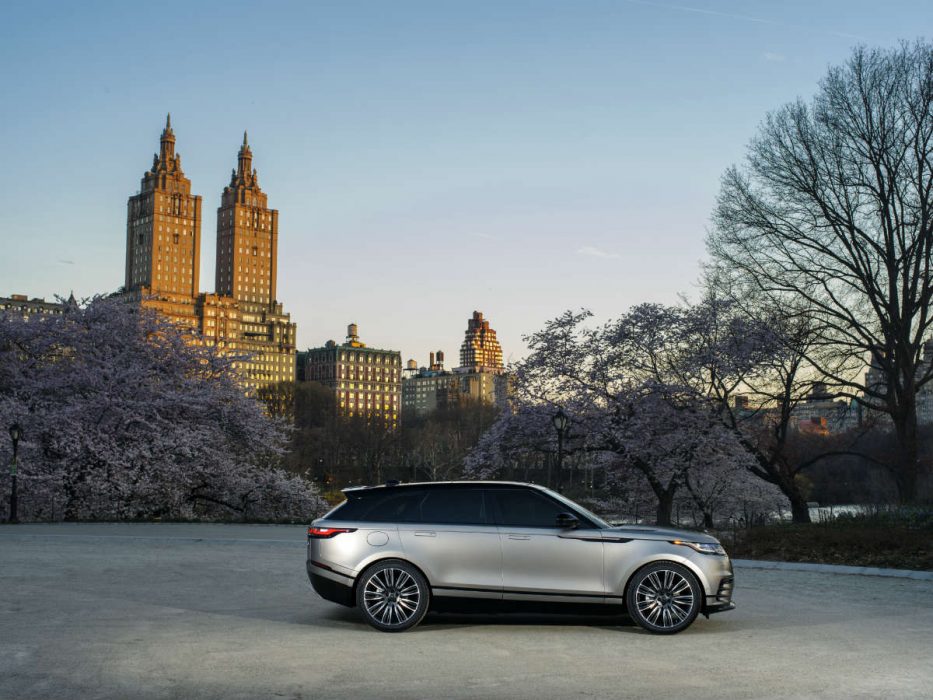
Jaguar Land Rover UK managing director Jeremy Hicks framed it as “a stunning addition to the Range Rover family” that broadens the line-up in a growing SUV market. Strip away the launch-day language and the brief is easy to read: look unmistakably like a Range Rover, add technology the older cars do not have, and do not tread on the toes of the models either side.
A new kind of Range Rover
The Velar’s design is built on reduction. Rather than layering on decoration, the team stripped detail back and let proportion do the talking. The wheelbase measures 2,874mm — between the Evoque’s 2,660mm and the Range Rover Sport’s 2,923mm — which gives the car a stretched, elegant stance and a genuinely roomy cabin.
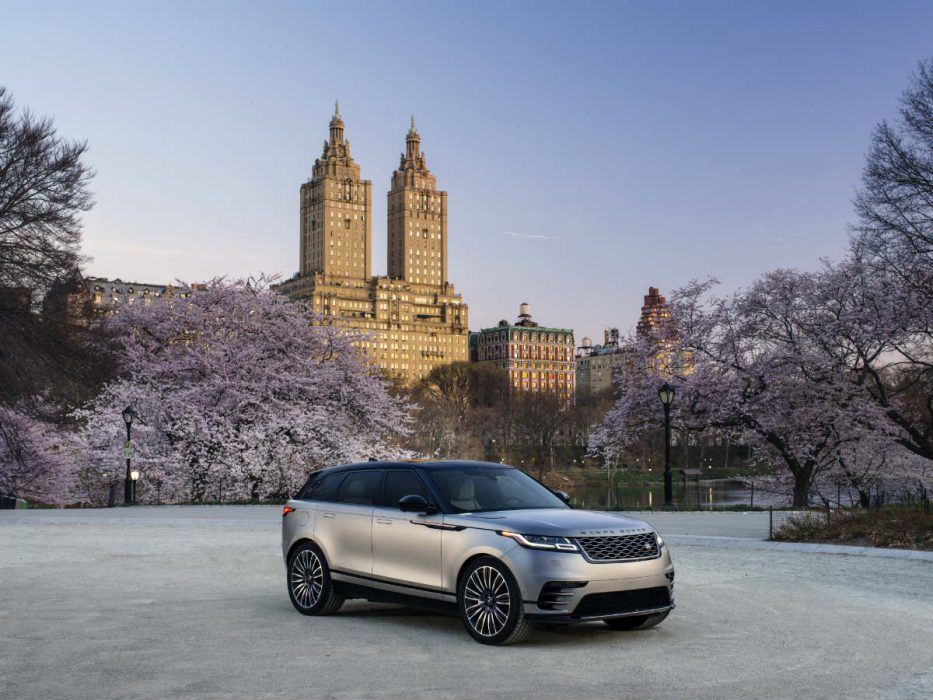
Large wheels do a lot of the work. Buyers can specify up to 22-inch rims, which fill the arches and sharpen the silhouette. A rising waistline and tapering glasshouse keep the shape taut, while the familiar floating roof and clamshell bonnet tie it back to the rest of the family. The short front overhang and slim headlights cut visual weight at the nose; a longer rear overhang balances the profile and carries a subtle kick, with twin chrome exhaust finishers set into the bumper.
Two details stand out. The first is the flush, deployable door handles — a Range Rover first. They retract when the car is locked or once it passes 5mph, and the LED-lit bodies pop out when you unlock it or press a button set into the handle. The payoff is part aesthetic, cleaning up the bodyside, and part aerodynamic. The second is the lighting. Every Velar gets LEDs, and the range-topping option is Matrix-Laser LED, which extends full beam to around 550 metres and dims individual diodes so oncoming traffic is not dazzled. The indicators sweep in the direction of travel, and a full-length high-level stop lamp stays hidden until it is lit.
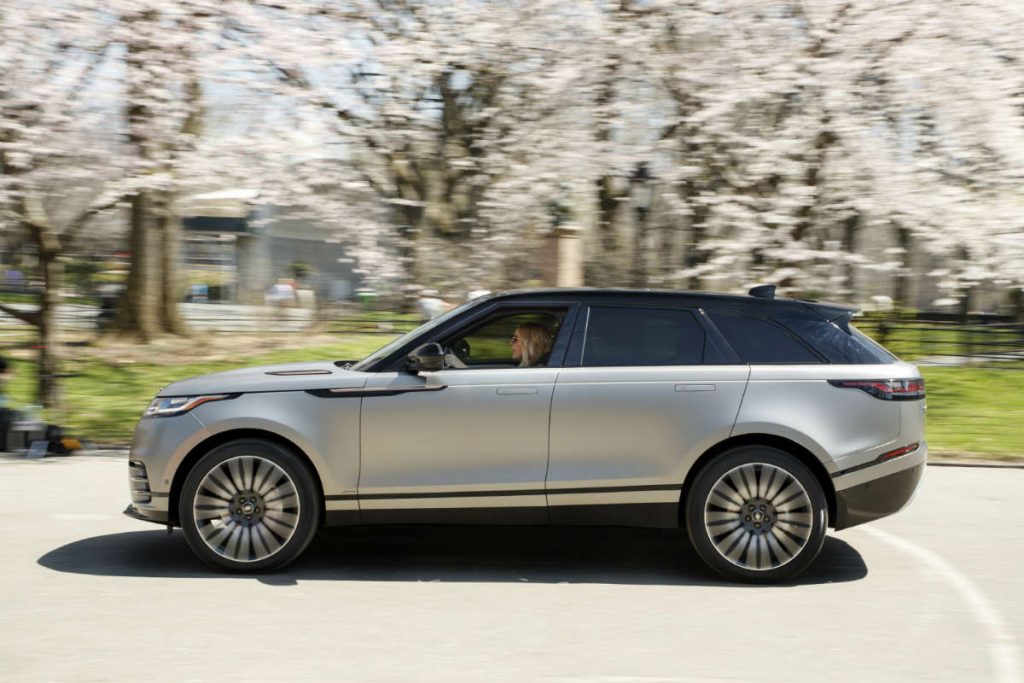
R-Dynamic models add a deeper front bumper with enlarged apertures, Burnished Copper detailing and Shadow Atlas Silver lettering. Black and Premium exterior packs offer further differentiation. Thirteen paint colours are listed, from Fuji White and Narvik Black through to Firenze Red and Aruba. The First Edition, described further down, gets an exclusive satin Flux Silver finish, hand-sprayed by Jaguar Land Rover’s Special Vehicle Operations division.
Inside: the Touch Pro Duo cabin
The cabin is where the Velar makes its boldest break with the past. The defining feature is Touch Pro Duo, a new infotainment system that debuts here and runs through two 10-inch high-definition touchscreens. The upper screen is set into a strong horizontal beam in the instrument panel and can tilt through 30 degrees; the lower one lives in the centre console and manages climate and Terrain Response functions. Fold those controls into the screen and you can delete the traditional dials and buttons, which is exactly what Land Rover did. Two rubberised rotary controllers, each with its own integrated display, sit below to handle the most-used functions.
The screens are only part of the story. Land Rover also offers, unusually for the segment, a premium textile seat material as an alternative to leather. Developed with the Danish textile house Kvadrat, it comes in a Dapple Grey wool blend with Suedecloth inserts, and the Suedecloth fibres are made from recycled plastic bottles. Standard cars use Suedecloth and Luxtec; S and SE step up to perforated grained leather; HSE brings perforated Windsor leather that extends to the instrument panel and door casings. A Cut Diamond motif runs through the cabin, from the dash to the doors and the speaker frets.
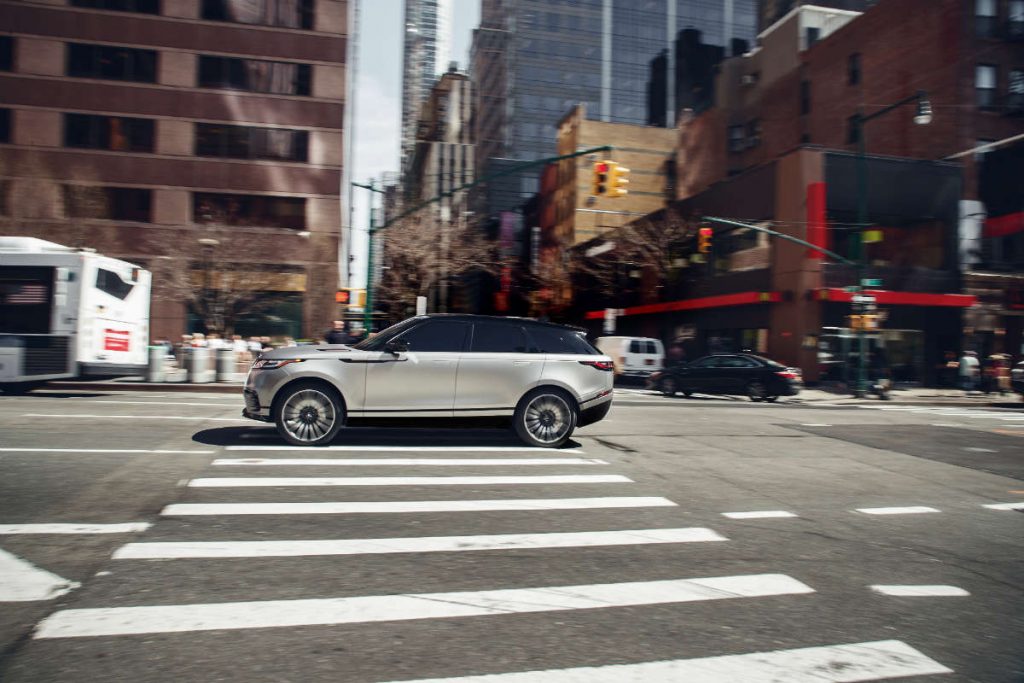
Space is generous. The long wheelbase and the aluminium architecture free up room for all occupants, and the boot holds 632 litres, or up to 1,731 litres with the 40:20:40 rear seats folded. Those seats have a ski flap for long items and remote release levers in the luggage compartment. Up front there is a split sliding armrest with a 4-litre cubby, a 7.5-litre glovebox that can be cooled, two USB ports and three 12V sockets, with more available for row two. Ahead of the driver, SE trim and above bring a 12.3-inch Interactive Driver Display in place of analogue dials.
Technology that keeps you connected
Touch Pro Duo is also built to keep the car online. With a Micro SIM and 4G, standard from S upward, the system can search for a destination, check whether you have enough fuel to reach it and flag filling stations on the route if you do not. Real-time traffic data helps reroute around jams, and Share ETA can send your arrival time to chosen contacts, updating them automatically if you slip behind. Commute Mode learns your regular drive; Arrival Mode shows a 360-degree view of your destination and can point you towards parking. A smartphone route-planning app uploads a route before you set off, and guidance can pass back to the phone for the final walk or bus leg.
The InControl Remote app lets owners lock and unlock the car, check fuel or location, and even start the engine and pre-set the climate control from a phone or smartwatch. Secure Tracker can help recover a stolen car, and SOS Emergency Call with Automatic Collision Detection contacts the emergency services if the worst happens. On the audio side there are four systems, topping out with a 1,600W Meridian Signature Sound System using 23 speakers and Trifield 3D processing. A rear-seat entertainment option adds two 8-inch screens and wireless headphones.
Safety and driver assistance
Much of the Velar’s safety kit leans on a forward-facing stereo camera behind the windscreen. Autonomous Emergency Braking uses it to brake automatically if a collision with a vehicle or pedestrian looks imminent, with visual and audible warnings first. The same camera feeds Lane Departure Warning and Lane Keep Assist, which can apply light counter-steering to hold the lane, and Traffic Sign Recognition, which reads speed limits and shows them in the instruments, adapting to temporary roadworks limits or the lower limits some countries apply in the wet. Driver Condition Monitoring watches steering, throttle and brake inputs and flashes a coffee-cup symbol if it detects drowsiness. Adaptive Cruise Control with Queue Assist can bring the car to a stop and pull away again with the traffic, while Reverse Traffic Detection watches for vehicles crossing behind you. A 360-degree Parking Aid with Park Assist can steer the car into parallel or perpendicular bays.
Practicality and towing
A Range Rover has to tow, and the Velar is rated to pull up to 2,500kg. Advanced Tow Assist takes much of the guesswork out of reversing with a trailer: rather than counter-steering by hand, the driver traces the trailer’s path on the touchscreen using the rotary controller and the system works out the steering, warning if an input risks a jackknife. Hitch Assist helps line the car up with a trailer in the first place, and a Trailer Light Test lets one person check the trailer lights from outside the car. A gesture-controlled power tailgate and the optional Activity Key — a waterproof, battery-free wristband that lets you leave the key fob behind — round out the practicality pitch.
Chassis, suspension and all-terrain ability
Underneath, the Velar uses double-wishbone front and Integral Link rear suspension, with aluminium used widely to save weight and steel lower control arms up front for durability off-road. Coil springs are standard on the four-cylinder models, giving 213mm of ground clearance. Four-corner air suspension is optional on the 240hp diesel and 300hp petrol, and standard on all six-cylinder cars; it drops 10mm at cruising speeds above 65mph to cut drag, and lowers 40mm at shutdown to help you climb out. Off-road mode raises it 46mm below 32mph for up to 251mm of clearance. Adaptive Dynamics damping is fitted across the range, and Configurable Dynamics lets drivers tailor throttle, gearshift, suspension and steering settings through the touchscreen.
Approach, breakover and departure angles run to 28.89, 23.5 and 29.5 degrees respectively, and wading depth is up to 650mm. Terrain Response, reached through the touchscreen rather than a dedicated dial, offers Eco, Comfort, Grass-Gravel-Snow, Mud-Ruts, Sand and — on R-Dynamic cars — Dynamic modes. The more advanced Terrain Response 2, standard on the First Edition and optional elsewhere, adds an automatic setting that picks the right mode for the surface. All Terrain Progress Control, a low-speed crawl control, runs from 2.2mph to 18mph and works in forward and reverse. Hill Descent Control manages steep descents with Gradient Release Control, and Low Traction Launch smooths pulling away on slippery ground.
Steering, all-wheel drive and grip
The Velar drives all four wheels through a torque-on-demand system built around a single-speed transfer case with a multi-plate wet clutch. Depending on conditions it can shift from a fully rear-biased set-up to locked in as little as 165 milliseconds. Intelligent Driveline Dynamics decides how much torque goes where, using steering angle, throttle, yaw rate and lateral acceleration to estimate available grip, and it works with the stability control and, on six-cylinder cars, an Active Locking Rear Differential. Electric power-assisted steering is tuned for feedback and, because it only draws energy when you turn, can save fuel, while Torque Vectoring by Braking is standard and brakes the inside wheels to tighten your line.
Six powertrains
Land Rover offers six engines, all with an eight-speed ZF automatic and all-wheel drive, and all meeting Euro 6. Two 2.0-litre Ingenium diesels open the range. The D180 makes 180hp and 430Nm, reaching 60mph in 8.4 seconds with 142g/km of CO2. The D240 adds a series-sequential twin-turbo set-up, a first for Jaguar Land Rover, for 240hp and 500Nm, cutting 0-60mph to 6.8 seconds and emitting 154g/km. Above them sits the 3.0-litre V6 diesel, the D300, with 300hp and a hefty 700Nm; it reaches 60mph in 6.1 seconds, runs on to 150mph and emits 167g/km.
On the petrol side, the 2.0-litre Ingenium units arrive here in two states of tune. The P250 develops 250hp and 365Nm, for 0-60mph in 6.4 seconds and 173g/km. The P300 pushes the same four-cylinder to 300hp and 400Nm — the most powerful four-cylinder ever fitted to a Land Rover. At the top of the range the supercharged 3.0-litre V6, the P380, delivers 380hp and 450Nm, good for 0-60mph in 5.3 seconds and an electronically limited 155mph, with an exhaust note deliberately tuned to stay discreet at a cruise.
Lightweight aluminium and aerodynamics
The body is built around Jaguar Land Rover’s Lightweight Aluminium Architecture. Aluminium alloys make up more than 81 per cent of the body-in-white, helped by high-strength 6000-series bodysides that let panel thickness drop from 1.5mm to 1.1mm. Magnesium is used for the front-end carrier and cross-car beam, high-strength steels for selected rear sections, and the tailgate is composite. Six airbags and a rigid passenger cell provide the crash protection, and the aluminium bonnet is shaped to absorb pedestrian impacts. The work pays off aerodynamically too: with a drag coefficient of 0.32, the Velar is the most aerodynamic Land Rover yet, aided by active cooling vanes, air channels in the rear spoiler and a 50:50 front-to-rear lift balance.
The most exclusive Velar is the First Edition, sold worldwide but strictly for one model year only. It is powered solely by the 3.0-litre V6 petrol and diesel and adds extended leather trim, a 1,600W Meridian Signature audio system, Matrix-Laser LED headlights, 22-inch split-spoke wheels and that hand-finished Flux Silver paint.
Vehicle data
| Field | Value |
|---|---|
| Make | Land Rover |
| Model | Range Rover Velar |
| Generation / chassis code | Not stated in sources |
| Model year(s) covered | 2017 (first model year; on sale from mid-July 2017) |
| Body style | Five-door mid-size luxury SUV |
| Powertrain / engine | 2.0-litre four-cylinder Ingenium diesel (D180, D240); 3.0-litre V6 diesel (D300); 2.0-litre four-cylinder Ingenium petrol (P250, P300); 3.0-litre supercharged V6 petrol (P380) |
| Power / torque | D180 180hp / 430Nm; D240 240hp / 500Nm; D300 300hp / 700Nm; P250 250hp / 365Nm; P300 300hp / 400Nm; P380 380hp / 450Nm |
| Transmission | Eight-speed ZF automatic with paddleshift |
| Drivetrain | All-wheel drive with Intelligent Driveline Dynamics |
| Key performance figures | 0-60mph from 5.3 seconds (P380) to 8.4 seconds (D180); top speed up to 155mph (P380, electronically limited) |
| Price (as stated) | Not stated in sources |
| On-sale / announcement period | On sale mid-July 2017 in the UK and Europe; 170+ markets |
| Market | United Kingdom, Europe and over 170 markets worldwide |