

Track-Ready Technology and Specs
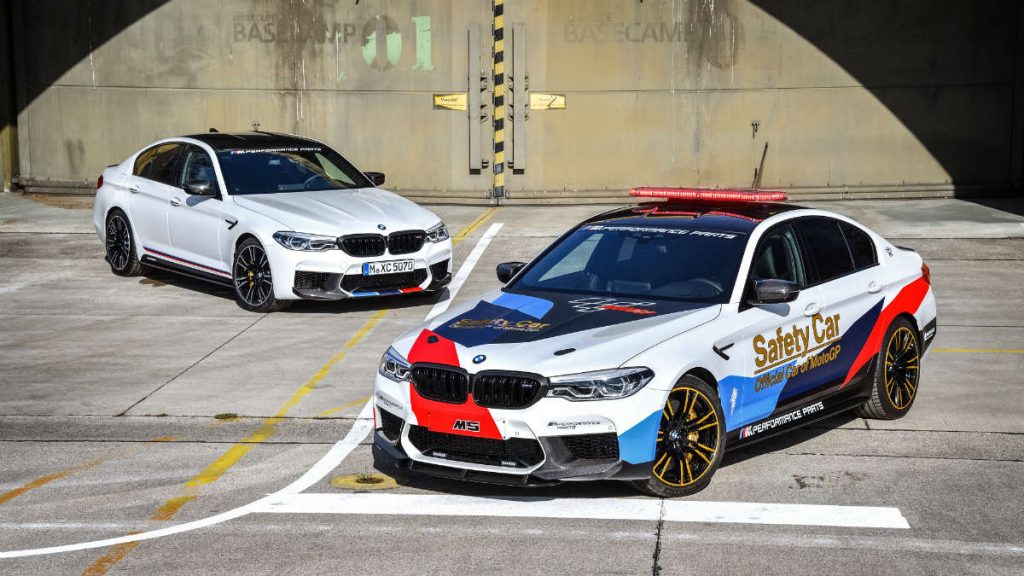
High-performance engineering tailored for track safety has anchored the operational partnership between BMW M GmbH and MotoGP rights holder Dorna Sports for nearly two decades. Serving continuously as the Official Car of MotoGP since 1999, the Bavarian division has regularly deployed its newest production flagships into the high-stress environment of premier motorcycle grand prix racing. In late 2017, BMW M unveiled the new spearhead of its official intervention fleet: the BMW M5 MotoGP Safety Car. Hand-assembled at the BMW M Manufaktur facility in Garching, Germany, this specialized course car took the newly revealed F90-generation BMW M5 super saloon and equipped it with competition hardware, bespoke aerodynamic components, and track-specific signaling systems ahead of full-time deployment for the 2018 MotoGP World Championship.
The safety car made its dynamic public debut at the Circuit Ricardo Tormo during the 2017 MotoGP season finale in Valencia, Spain, held from November 10 to 12. Slotting ahead of the world’s most demanding motorcycle racing grid requires a vehicle capable of extraordinary sustained speed, immediate thermal readiness, and unflinching chassis control across diverse track conditions. Prototype grand prix machines produce upwards of 250 horsepower, weigh scarcely 157 kilograms, and generate cornering velocities that quickly expose any sluggish course vehicle. As Frank van Meel, President of BMW M GmbH, highlighted during the car’s introduction in Valencia, guiding a field of fragile, ultra-fast racing prototypes safely around a damp or debris-strewn circuit requires genuine racing-derived dynamics rather than cosmetic upgrades.
Powertrain Engineering: The TwinPower Turbo S63 V8
Underneath the aluminum hood rests a comprehensively redesigned 4.4-liter V8 engine utilizing BMW M TwinPower Turbo technology. Designated internally as the S63B44T4, this high-revving 90-degree eight-cylinder unit underwent extensive redevelopment for the F90 generation. BMW M power unit engineers integrated newly designed twin-scroll turbochargers positioned within the hot-V between the cylinder banks, optimizing throttle response and exhaust gas pulse scavenging. An upgraded cross-bank exhaust manifold ensures instantaneous turbine spooling by pairing exhaust pulses from opposing cylinders, virtually eliminating perceptible turbo lag.
Thermal management received equal priority, given that safety cars are frequently subjected to abrupt cycles of wide-open-throttle acceleration followed by prolonged idling in the pit lane. The S63 engine employs an advanced indirect charge air cooling layout with an independent low-temperature coolant circuit, keeping intake manifold temperatures tightly regulated under hard track driving. High-precision direct fuel injection operates at pressures of up to 350 bar, atomizing fuel into finer droplets to maximize combustion efficiency, output, and emissions compliance across all operating conditions.
In standard production specification, the revised powertrain develops 441 kW (600 hp) between 5,600 and 6,700 rpm, alongside an immense torque output of 750 Nm (553 lb-ft) available continuously from 1,800 to 5,600 rpm. When launched from a standstill, the F90 M5 bolts from zero to 100 km/h (62 mph) in just 3.4 seconds, with 200 km/h arriving in 11.1 seconds. These rapid acceleration figures are critical on track when the safety car must pull cleanly clear of a fast-charging field of MotoGP prototypes emerging from pit exit or yellow flag zones.
Drivetrain Revolution: M xDrive and Eight-Speed M Steptronic
The sixth-generation M5 introduced a foundational shift in BMW M engineering philosophy: the arrival of M xDrive all-wheel drive. While every preceding generation of the M5 relied solely on rear-wheel traction, the escalated power figures of modern forced-induction engines demanded an intelligent all-wheel-drive system to translate 750 Nm of torque into consistent forward momentum, particularly in cold, slick, or rain-swept track scenarios.
Engineered entirely under the supervision of BMW M, the M xDrive system operates through an electronically regulated central transfer case containing an active multi-plate wet clutch. Working in concert with the Active M Differential on the rear axle, the central controller calculates yaw rate, steering angle, wheel slip, and throttle position every few milliseconds to distribute drive torque seamlessly and continuously between the front and rear axles. Under typical cruising or steady cornering, the system directs all tractive effort to the rear wheels, only funneling drive forward when the rear tires approach their slip limit. This architecture preserves the intuitive steering feedback and rear-biased agility expected of a BMW M car, while delivering unmatched all-weather propulsion.
Backing the all-wheel-drive architecture is an eight-speed M Steptronic transmission with Drivelogic. Replacing the previous generation’s seven-speed dual-clutch transmission, this torque-converter gearbox was retuned specifically by M engineers for immediate shift response and ultra-short shift times. The transmission’s three-stage Drivelogic rocker switch on the gear selector enables the driver to modulate shift speed and aggressiveness, ranging from smooth highway cadence to immediate, violent gear changes with automatic throttle-blipping on downshifts. The planetary gear configuration also provides a broad ratio spread, combining short ratios in lower gears for explosive track acceleration with tall overdrive gearing for highway transit.
Chassis Kinematics and Lightweight Construction
Underpinning the safety car is a heavily modified double-wishbone front and five-link rear suspension arrangement. BMW M chassis technicians developed proprietary elastokinematics for the F90 platform, utilizing stiffer suspension bushings, solid ball joints on the lower rear control arms, and newly configured anti-roll bars to resist roll deflection under heavy lateral loads. The variable-damping shock absorbers can be adjusted across three distinct profiles—Comfort, Sport, and Sport Plus—enabling the safety car driver to dial in the damping characteristics to suit varying circuit asphalt textures.
To offset the structural mass of the all-wheel-drive hardware and executive saloon footprint, BMW M invested heavily in intelligent lightweight design. The roof panel is crafted entirely from visible carbon-fiber-reinforced plastic (CFRP), shedding nearly ten kilograms from the highest point of the vehicle to lower its center of gravity. The front bonnet and front side fenders are formed from lightweight aluminum alloys, improving front-to-rear axle weight distribution. Inside the wheel arches, the vehicle utilizes lightweight compound braking systems with cross-drilled, ventilated rotors clamped by six-piston fixed front calipers, providing fade-resistant stopping force when slowing rapidly from circuit speeds.

Bespoke Conversion at BMW M Manufaktur
Transforming a high-performance production saloon into an official grand prix safety car is an intensive, painstaking manual process undertaken at the BMW M Manufaktur workshop in Garching, outside Munich. Here, master technicians disassemble production vehicles to integrate competition safety features, custom electrical harnesses, auxiliary control panels, and motorsport-grade aero equipment.
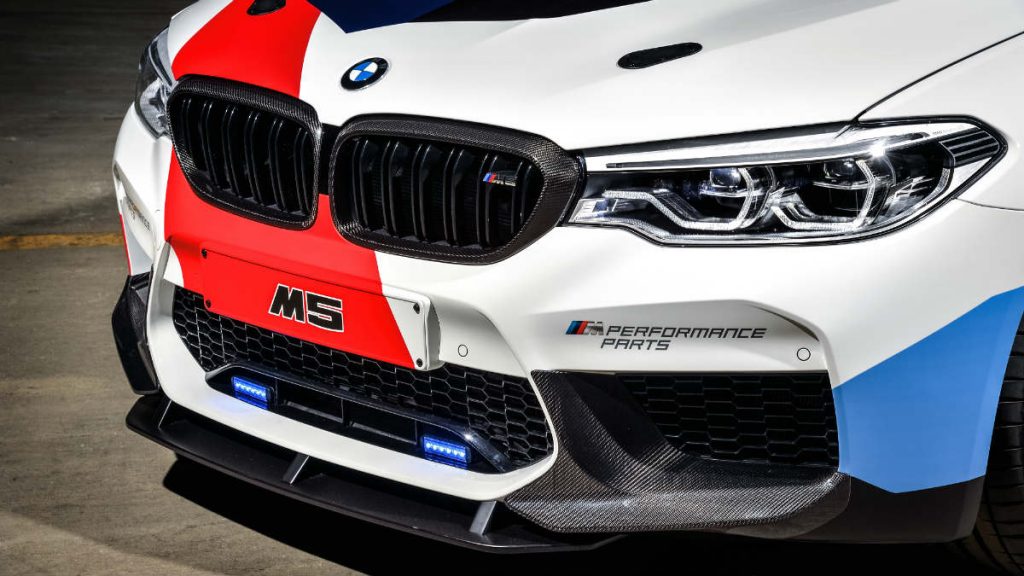
The safety car served simultaneously as a dynamic showcase for the newly expanded portfolio of BMW M Performance Parts developed for the F90 M5. Each exterior aero component fitted to the safety car is aerodynamically functional, meticulously wind-tunnel tested to reduce front-axle lift and balance high-speed airflow. The exterior carbon suite includes carbon-fiber side sill skirts, a pronounced carbon rear diffuser, a carbon boot lid spoiler, carbon-fiber front kidney grille surrounds, air breather fender trim, and carbon mirror caps.
At the front fascia, BMW M engineers created a unique carbon-fiber front splitter prototype exclusively for this MotoGP safety vehicle. The splitter channels high-velocity airflow underneath the car while generating substantial downforce across the front axle to keep steering response laser-sharp during triple-digit cornering maneuvers. The composite engine bonnet features external quick-release racing latches derived directly from factory touring car and GT competition programs, ensuring positive mechanical fastening during high-speed track running.
Acoustic and thermal performance benefit from an all-titanium BMW M Performance sport exhaust system. Finished with carbon-fiber quad exhaust tips, this specialized exhaust system reduces backpressure, significantly reduces weight over the rear axle, and delivers an authoritative, open-pipe V8 sound that cuts through ambient circuit noise.
Cockpit Conversion and Intervention Systems
While the standard production BMW M5 provides an executive interior lined in supple Merino leather with ambient lighting and massage seats, the MotoGP Safety Car cockpit was heavily transformed into a functional command center. Technicians removed the luxury front seating in favor of lightweight, rigid composite bucket seats adopted directly from the limited-edition BMW M4 GTS track car. These deep-sided bucket seats are fitted with multi-point Schroth racing harnesses, anchoring the driver and race control co-pilot securely into place against violent lateral and longitudinal g-forces.
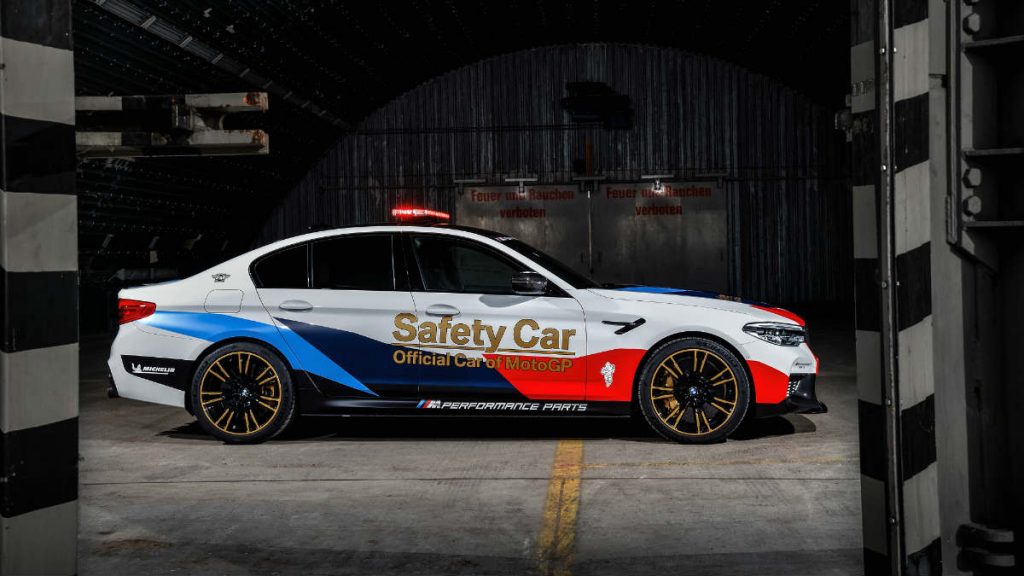
High-visibility signaling is crucial when orchestrating safety protocols during a grand prix weekend. Mounted flush to the carbon roof panel is an aerodynamic, low-profile LED light bar designed to minimize wind resistance and turbulence at speed. The light bar is operated via an integrated, custom-fabricated control panel nestled in the center console. The safety car driver and passenger can toggle various flash sequences, strobe frequencies, and light functions to alert motorcycle racers on track.

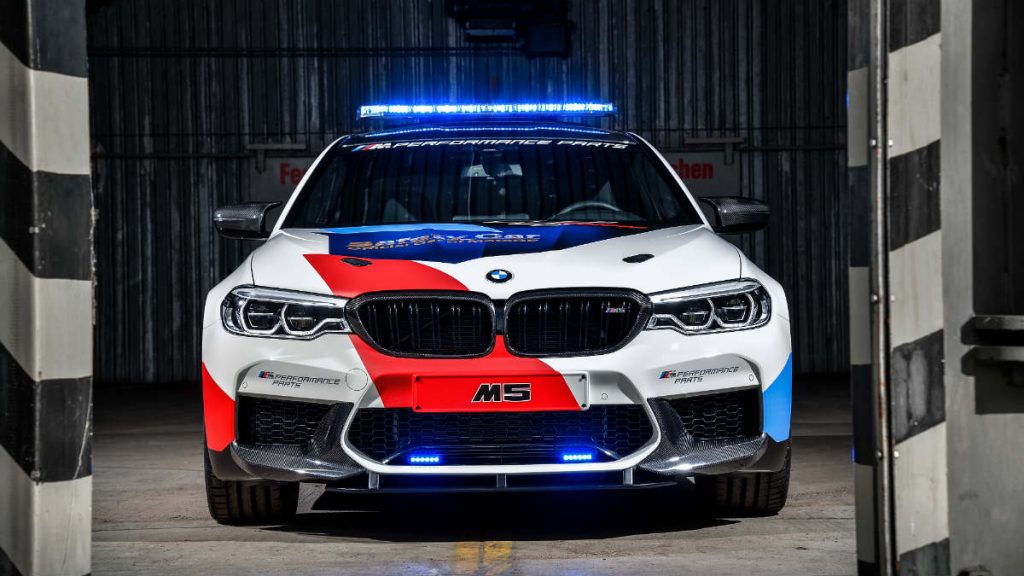
Supplemental front signaling is built into the car’s front-end lighting architecture. High-output blue LED emergency strobes are integrated inside the black kidney grilles, while the iconic BMW corona rings within the adaptive LED headlights are programmed to pulse in alternating emergency flash sequences. A dedicated two-way race control radio system connects the safety car occupants directly to the Dorna race direction team and FIM marshals, ensuring instantaneous coordination during track incidents, wet race restarts, or red-flag stoppages.

Motorsport Livery: The BMW M8 GTE Connection
The exterior livery of the BMW M5 MotoGP Safety Car is more than mere cosmetic branding; it serves as a visual celebration of BMW Motorsport’s global racing campaigns. Finished in a brilliant alpine white base, the safety car is wrapped in dynamic tricolor racing stripes consisting of light blue, dark blue, and red. This graphic layout was inspired directly by the BMW M8 GTE, BMW Motorsport’s clean-sheet endurance racer developed to contest the FIA World Endurance Championship and the 24 Hours of Le Mans in 2018.
Road car engineers from BMW M in Garching worked closely with race car designers from BMW Motorsport in Munich throughout the parallel development of the M5 road car, the M5 safety car, and the M8 GTE endurance car. Aerodynamic CFD data, cooling concepts, and chassis tuning methodologies flowed freely between both programs. The resulting visual harmony between the M5 Safety Car and the M8 GTE reflects this close cross-pollination across production and motorsport disciplines.
Dorna Sports and the Evolution of BMW M Safety Fleets
The association between Dorna Sports and BMW M dates back to 1999, establishing one of the longest continuous commercial partnerships in motorsport. Over the span of two decades, Munich has provided an unbroken lineage of performance machinery to serve as the Official Car of MotoGP. Legendary models such as the BMW Z8, the E39 M5, the E46 M3, the V10-powered E60 M5, the 1 Series M Coupe, the M4 Coupe with innovative water injection, and the compact M2 have each taken turns leading the grand prix field.
The safety car fleet in MotoGP encompasses an extensive ecosystem of track and service support vehicles. Alongside the primary M5 safety car, the fleet includes additional BMW M intervention vehicles, specialized medical cars equipped with mobile emergency trauma response gear, safety officer vehicles, and a fleet of BMW S 1000 RR high-performance safety bikes operated by Dorna track marshals.
Beyond course duties, the partnership extends into multiple paddock activations. Since 2003, the BMW M Award has recognized the best qualifying rider in the MotoGP premier class at the end of each season. Riding legends like Valentino Rossi, Casey Stoner, and Marc Marquez have repeatedly taken home bespoke BMW M production road cars for claiming pole position honors throughout the calendar year. For enthusiasts and VIP guests, the BMW M MotoGP Experience provides behind-the-scenes access to the paddock, garage tours, and high-speed passenger laps alongside experienced racing instructors on selected race weekends.
Today, BMW M GmbH manages five distinct business units: BMW M Automobiles and BMW M Performance Automobiles, BMW Individual bespoke customization, M Sports equipment packages, BMW Group Driving Experience driver training academies, and specialized commercial and emergency vehicles. Established in 1972 as BMW Motorsport GmbH, the division continues to use high-pressure motorsport environments like MotoGP to prove the mechanical integrity and thermal resilience of its road-going hardware. The F90 M5 MotoGP Safety Car represents the culmination of that heritage, demonstrating that an executive four-door saloon can seamlessly bridge the divide between luxury road transport and the demanding limits of a grand prix circuit.
Vehicle data
| Field | Value |
|---|---|
| Make | BMW |
| Model | M5 MotoGP Safety Car (F90) |
| Generation / chassis code | 6th generation / F90 |
| Model year(s) covered | 2018 |
| Body style | 4-door high-performance sedan / safety car |
| Powertrain / engine | 4.4-liter (4,395 cc) BMW M TwinPower Turbo V8 (S63B44T4) |
| Power / torque | 441 kW (600 hp) @ 5,600–6,700 rpm / 750 Nm (553 lb-ft) @ 1,800–5,600 rpm |
| Transmission | 8-speed M Steptronic with Drivelogic |
| Drivetrain | All-wheel drive (M xDrive with Active M Differential) |
| Key performance figures | 0–100 km/h in 3.4 seconds; 0–200 km/h in 11.1 seconds |
| Price (as stated) | Not stated in sources (Official track vehicle / prototype) |
| On-sale / announcement period | Announced October 2017; Track debut November 2017 (Valencia); Official duty 2018 season |
| Market | Global / International MotoGP Championship |