

The Return of the Twin-Turbo V6 Icon
A practical sports car comes of age. Exactly eighteen years after the original B5 RS4 burst onto European asphalt, Audi Sport introduced the fourth generation of its definitive family-hauling missile at the 2017 International Motor Show (IAA) in Frankfurt am Main. The Audi RS 4 Avant has always occupied a distinct niche in high-performance motoring, merging outright supercar pace with the uncompromised cargo utility of a five-door estate. In its latest B9 guise, the sporting spearhead of the A4 model line trades the screaming atmospheric V8 of its predecessor for an engineered twin-turbo V6 that brings massive low-end torque, razor-sharp responses, and significant weight savings.
Stephan Winkelmann, then Managing Director at Audi Sport GmbH, summarized the philosophy behind the wagon during its Frankfurt debut: “The Audi RS 4 Avant is our RS icon with an incomparable history. As with all our RS models, it combines excellent driving performance with maximum everyday usability. In China, the Audi RS 4 will drive forward new growth in its segment as a unique high-performance Avant.” That dual personality remains the model’s defining characteristic. Rather than building a high-strung track special that punishes occupants over expansion joints, Audi Sport developed the B9 RS 4 Avant to cross continents in bad weather, swallow a family’s vacation gear, and still outrun purpose-built sports coupés when roads turn technical.

Motorsport Heritage and Muscular Styling
When the design team in Ingolstadt set out to sketch the B9 RS 4 Avant, they deliberately looked backward to one of the brand’s most aggressive competition machines: the Audi 90 Quattro IMSA GTO that dominated North American road courses in the late 1980s. That racing pedigree translates directly into bodywork that looks significantly more athletic and planted than the standard production estate. The front apron is dominated by massive, sculpted air intakes framed by a honeycomb lattice typical of RS flagships. Above them sits a wider, flatter Singleframe radiator grille finished in high-gloss treatment, giving the estate an intimidating forward stance.
Flanking that broad grille are optional Matrix LED headlights featuring darkened, shaded housing trims that visually distinguish the RS model from distance. Move along the flanks, and the family connection to motorsport becomes unmistakable: the wheel arches have been broadened by 30 millimeters (1.2 inches) on each side compared to an ordinary Audi A4 Avant. These flared body panels are emphasized by sharp Quattro blisters over the arches—a retro styling cue that proudly honors the brand’s all-wheel-drive rally ancestry.
At the rear, the high-performance treatment is equally purposeful. A substantial RS roof spoiler extends outward to manage boundary-layer airflow and reduce lift at high autobahn velocities. Lower down, a model-specific aerodynamic diffuser insert integrates two oversized oval tailpipes that produce the signature RS exhaust note. For enthusiasts with an eye for history, Audi Exclusive offers a bespoke Nogaro Blue Pearl Effect exterior finish—an explicit tribute to the original 1999 B5 RS4 Avant. Under the widened arches, 19-inch forged aluminum-alloy wheels come standard, with optional 20-inch milled alloys available in multiple finishes to showcase the substantial braking hardware beneath.

Twin-Turbo V6 Power: The 2.9 TFSI Heart
Under the creased aluminum hood of the RS 4 Avant sits a completely newly developed 2.9-liter TFSI biturbo V6 engine. Purists who revered the 4.2-liter naturally aspirated V8 of the preceding B8 generation might have initially wondered about the downsizing, but the new powerplant delivers improvements across every measurable performance metric. Developed from scratch, this twin-turbo unit pushes out 331 kW (450 hp) and generates a monumental 600 Nm (442.5 lb-ft) of torque.
That torque figure represents a massive leap of 170 Nm over the atmospheric V8 it replaces. Even more important is how early and broadly that muscle arrives. While the old engine required high engine speeds to extract its full momentum, the 2.9 TFSI delivers peak torque across a vast plateau stretching from 1,900 rpm all the way up to 5,000 rpm. The turbos are mounted centrally inside the 90-degree cylinder bank—a “hot-V” layout that guarantees ultra-short gas flow paths between exhaust ports and turbine wheels, virtually eliminating throttle lag.
The straight-line numbers tell the story of that effortless shove. Hooked up through its standard launch system, the Audi RS 4 Avant rockets from 0 to 100 km/h (0 to 62 mph) in just 4.1 seconds—shaving nearly half a second off the B8 model’s benchmark time. The wagon pulls relentlessly toward its electronically limited top speed of 250 km/h (155.3 mph). For drivers planning regular excursions to de-restricted sections of the German autobahn, ordering the optional RS Dynamic Package raises that electronic ceiling to 280 km/h (174 mph).

Drivetrain Engineering, Chassis Dynamics, and Weight Loss
Sending 600 Nm of torque through four driven wheels requires a transmission built for immediate response and heavy thermal loads. Audi Sport paired the 2.9 TFSI with an eight-speed Tiptronic torque-converter automatic transmission, retuned specifically for fast, crisp shift times during aggressive driving while retaining velvet-smooth behavior around town. Power flows through a mechanical center differential in the permanent Quattro all-wheel-drive system, which routes drive with a rear-biased default split to ensure agile turn-in behavior.
To further heighten lateral agility, buyers can select the optional sport differential on the rear axle. When cornering hard under load, the sport differential actively distributes torque between the inner and outer rear wheels via two multi-plate clutches. By overdriving the outside rear wheel, the system counteracts understeer at corner entry, pitching the wagon into apexes with sports car precision. Traction out of wet or gravel-strewn turns is instantaneous and predictable.
Chassis engineering received an equally thorough overhaul. The B9 RS 4 Avant tips the scales at 1,790 kilograms (3,946.3 lbs). Through lightweight construction techniques and a substantially lighter engine block over the front axle, the new car sheds 80 kilograms (176.4 lbs) compared to its V8 predecessor. Removing that weight from ahead of the front strut towers transforms steering feel and directional changes. Despite that added performance, efficiency jumps noticeably: average combined fuel consumption sits at 8.8 liters per 100 kilometers (26.7 US mpg), with CO2 emissions rated between 200 and 199 g/km. That marks a 17 percent improvement in fuel efficiency compared to the previous model generation.
Suspension duties are handled as standard by an RS sports suspension featuring redesigned five-link axles front and rear. This setup drops ride height by seven millimeters (0.3 inches) compared to the base S4 Avant fitted with sport springs. Enthusiasts seeking ultimate cornering discipline can option the RS Sports Suspension Plus with Dynamic Ride Control (DRC). DRC uses steel springs alongside diagonally interconnected three-stage dampers, using central hydraulic valves to mechanically resist pitch and roll without requiring electronic servos. Drivers can alter steering weighting, transmission mapping, differential response, and damper firmness on the fly via the standard Audi Drive Select system. Lightweight carbon-ceramic front brake discs and RS dynamic steering remain available on the options sheet for dedicated track use.

Driver-Focused Cockpit and RS Technology
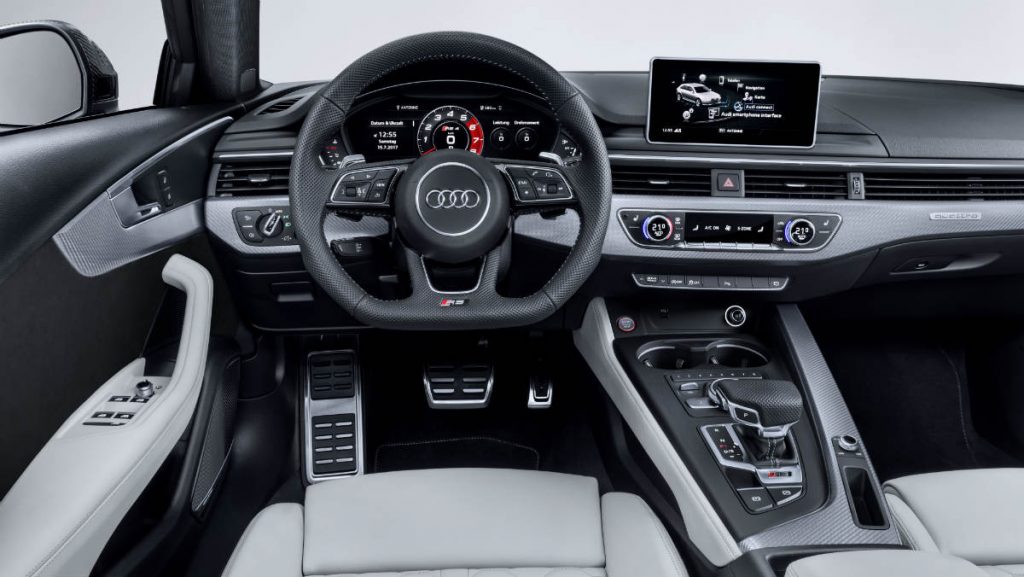
Step inside, and the cabin of the Audi RS 4 Avant strikes an immediate balance between digital sophistication and driver engagement. The interior environment is finished predominantly in deep black, punctuated by aluminum highlights, contrast stitching, and RS emblems on the steering wheel, illuminated doorsill plates, and transmission selector. Heavily bolstered RS sport seats provide outstanding lateral support during high-G maneuvers, and buyers can upgrade to fine Nappa leather featuring ornate honeycomb quilt stitching.
A flat-bottomed RS leather multifunction steering wheel anchors the driving position, putting paddles, driving mode switches, and instrument controls right at the fingertips. Behind the rim sits the standard Audi Virtual Cockpit. In the RS 4, this high-resolution 12.3-inch digital gauge cluster includes dedicated RS performance menus displaying real-time data on lateral and longitudinal G-forces, instantaneous power and torque output, boost pressure, and individual tire pressure alongside tire temperature. A color head-up display projects road speed, navigation arrows, and shift light prompts directly onto the windshield.
Buyers looking to tailor the exterior aesthetics to their personal taste can pick from three comprehensive optic packages: Gloss Black, Carbon with aluminum attachments, or Carbon with black attachments. These packages alter the front blade, side sill inserts, roof rails, window surrounds, and rear diffuser trim, allowing owners to choose between subdued executive stealth or unapologetic motorsport aggression.

Real-World Versatility and Daily Utility
The enduring appeal of the RS 4 Avant lies in the fact that it requires zero lifestyle compromises. While a two-door sports car demands second-vehicle compromises, this super-estate functions seamlessly as a primary family runabout. In its standard five-seat layout, the luggage compartment offers 505 liters (17.8 cubic feet) of cargo capacity beneath the retractable parcel shelf. Fold the 40:20:40 split rear seatbacks flat into the floor, and total cargo volume expands to 1,510 liters (53.3 cubic feet)—more than enough room for sports equipment, luggage, or bulky cargo.
Access to the luggage bay is straightforward thanks to an electrically operated tailgate that comes fitted as standard equipment. Hands-free sensor operation is optional, allowing drivers carrying heavy gear to open or close the rear door simply by waving a foot beneath the rear bumper. Broadening its versatility even further, the B9 RS 4 Avant can be ordered with a factory-fitted trailer hitch for the first time in the model’s history. The tow hitch unlocks electrically from behind the bumper at the touch of a button inside the boot, turning this 450-hp sports wagon into a capable lifestyle towing platform.
By blending IMSA-inspired styling cues, a lightweight chassis, 600 Nm of twin-turbo torque, and genuine five-door practical usability, the fourth-generation Audi RS 4 Avant reclaims its status as the definitive benchmark among high-performance everyday wagons. It honors its historic roots while delivering the digital precision and mid-range punch required in a modern high-performance estate.
Vehicle data
| Field | Value |
|---|---|
| Make | Audi |
| Model | RS 4 Avant |
| Generation / chassis code | B9 (Fourth generation) |
| Model year(s) covered | 2018 |
| Body style | 5-door estate / wagon |
| Powertrain / engine | 2.9-liter TFSI twin-turbo V6 |
| Power / torque | 331 kW (450 hp) / 600 Nm (442.5 lb-ft) @ 1,900–5,000 rpm |
| Transmission | 8-speed Tiptronic automatic |
| Drivetrain | Quattro permanent all-wheel drive (optional rear sport differential) |
| Key performance figures | 0–100 km/h in 4.1 s; top speed 250 km/h (155.3 mph), 280 km/h (174 mph) with RS dynamics package |
| Price (as stated) | Not stated in sources |
| On-sale / announcement period | Debuted September 2017 (IAA Frankfurt), European market rollout 2018 |
| Market | Europe / Global (including China) |