
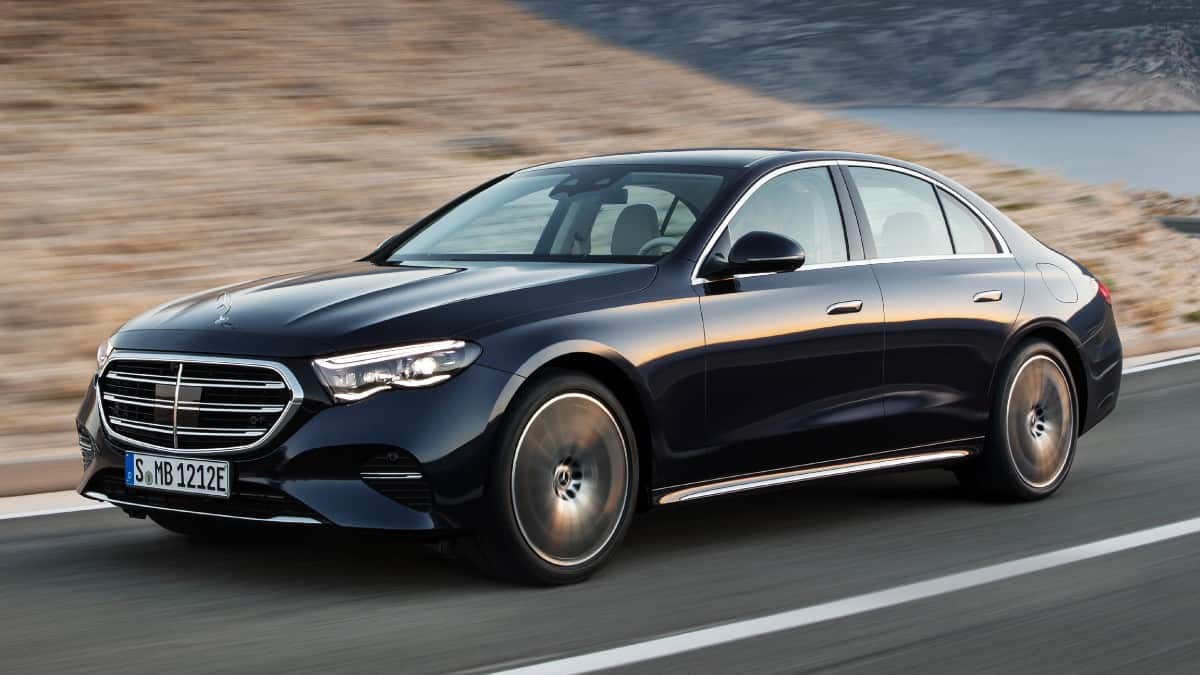
For more than seven decades, the Mercedes-Benz E-Class has stood as an unwavering pillar of automotive excellence, quietly defining the mid-size luxury sedan segment through successive waves of industry transformation. When Mercedes-Benz pulled the covers off the sixth-generation E-Class—internally designated as the W214—in early 2023, the stakes were remarkably high. This was not merely another evolutionary update to a familiar fleet favorite; it was a transitional milestone bridging classic internal combustion refinement with Stuttgart’s emerging software-defined architecture.
Positioned squarely between the compact C-Class and the flagship S-Class, the W214 E-Class arrived with the heavy burden of carrying forward an executive lineage tracing through the legendary W124, W210, W211, and the outgoing W213. Yet, rather than adopting the controversial jelly-bean silhouette of the brand’s purely electric EQ models, Stuttgart’s designers made a deliberate choice to preserve the classic three-box proportions executive sedan buyers demand. The outcome is a poised, confident stance that manages to look resolutely modern while honoring its lineage.
Exterior Evolution: Classic Proportions Meet Modern Detailing
A walkaround of the W214 reveals subtle dimensional growth over the outgoing model. The wheelbase has expanded by nearly an inch to 116.6 inches, yielding noticeably better rear legroom and knee clearance. Overall length now measures 194.8 inches, while width spans 74.0 inches, establishing a lower and broader visual baseline on the pavement.
Up front, the fascia introduces a bold styling motif that nods to the EQ generation without abandoning conventional radiator airflow. A high-gloss black radiator grille frame links the front aperture directly to the LED headlamp housings, echoing the dark glass paneling seen on Stuttgart’s battery-electric vehicles. Buyers choose between two distinct front-end characters: the Avantgarde line sports an integrated central star flanked by twin chrome louvers with miniature star-pattern mesh, while the traditional Exclusive line features an upright three-pointed star perched gracefully atop the hood, accompanied by three horizontal louvers.
Standard illumination comes courtesy of High Performance LED units, with the option to equip Mercedes-Benz’s DIGITAL LIGHT system. Using a matrix of over one million micro-mirrors per headlamp, the system projects guidance guidelines, lane symbols, and pedestrian alerts directly onto the road surface at night. Down the flanks, sharp creases have been smoothed out in favor of soft, natural light reflections, while flush-fitting exterior door handles glide out as the driver approaches. These aerodynamic enhancements deliver an outstanding drag coefficient of just 0.23, cutting wind resistance at sustained highway speeds. At the tail, twin-section LED taillights conceal an eye-catching three-pointed star light motif inside each housing—a confident design statement that leaves zero doubt as to what just passed you.
The Interior Sanctuary: The Superscreen Era
Step through the wide-opening doors, and the cabin makes clear that Stuttgart has moved the goalposts for mid-size executive luxury. Front and center is the optional MBUX Superscreen. Taking cues from the monolithic Hyperscreen fitted to the EQS and S-Class, the Superscreen integrates a high-resolution central media display and a dedicated front passenger display beneath a single contoured glass panel. A separate, freestanding high-resolution digital gauge cluster sits behind the leather-wrapped steering wheel, offering customizable display profiles from classic twin dials to minimal navigation views.
Mercedes-Benz rebuilt the underlying electronic architecture for the W214, consolidating dozens of distributed control modules into a powerful centralized domain computing setup. The hardware leap makes the interface noticeably more responsive. For the first time, third-party software can run directly on the native infotainment system without needing phone tethering. Drivers and passengers can access productivity and social platforms including Zoom, Webex, TikTok, Angry Birds, and the Vivaldi web browser. A dashboard-mounted video and selfie camera lets occupants join video conferences when parked, or capture cabin memories.
Safety has not been compromised in the pursuit of screens. Mercedes-Benz introduced an intelligent visual privacy shielding system for the passenger screen. Using dual light-directing filters and a driver-facing stereo camera, the display monitors the driver’s gaze. If it detects the driver looking over toward video content while the car is moving, it instantly dims the passenger display from the driver’s perspective while keeping it bright and visible to the front passenger.
Comfort details abound throughout the cabin. Active Ambient Lighting wraps around the upper dash and door sills, coordinating with the 17-speaker Burmester 4D surround sound system. Transducers mounted directly into the front seatbacks pulsate with low-end audio frequencies, allowing occupants to feel the music. Meanwhile, the ENERGIZING COMFORT programs synchronize lighting, climate, seat heating, ventilation, and massage functions into relaxing or invigorating wellness routines.
Powertrain Strategy: Mild Hybrids and Advanced Plug-in Hybrids
Under the sculpted aluminum hood, the W214 lineup adopts a thoroughly electrified engine roster. Every internal combustion engine offered in the global catalog features hybrid assistance, balancing spirited throttle response with stringent emissions targets.
In North America, the entry point is the E 350. It pairs a 2.0-liter turbocharged four-cylinder engine (M254) with a second-generation integrated starter-generator (ISG) nestled inside the transmission bellhousing. Supported by a dedicated 48-volt electrical architecture, the electric motor contributes an instantaneous 23 horsepower and 148 lb-ft of torque for low-end punch. The total combined output reaches 255 horsepower and 295 lb-ft of torque. Power delivery is handled by the smooth 9G-TRONIC nine-speed automatic transmission, sending power to either the rear wheels or the optional 4MATIC all-wheel-drive system.
Those wanting the classic velvet surge of a six-cylinder can step up to the E 450. Under its hood lies the turbocharged 3.0-liter inline-six (M256M), also boosted by the 48-volt ISG system. It produces 375 horsepower and 369 lb-ft of torque, propelling the executive cruiser with effortless grace. Passing maneuvers on two-lane roads require nothing more than a gentle flex of the right ankle, accompanied by a quiet, cultured six-cylinder purr.
European and international markets also receive fourth-generation plug-in hybrid options, including the E 300 e and E 400 e. Combining the 2.0-liter gasoline four-cylinder with a 127-horsepower permanently excited synchronous electric motor and a 25.4-kWh lithium-ion battery, these plug-in variants deliver over 60 miles of pure electric driving range on the WLTP cycle. For city commutes, the car functions as an emission-free electric vehicle, with standard 11 kW AC charging and optional 55 kW DC fast charging that replenishes an empty battery in around thirty minutes.
Chassis Dynamics and Suspension Engineering
The hallmark of any great Mercedes-Benz sedan has always been its ability to isolate occupants from choppy pavement while maintaining composure through fast sweeping bends. The W214 chassis relies on a five-link front suspension and a five-link independent rear axle, delivering precise wheel control under dynamic cornering loads.
While the standard steel-spring suspension incorporates frequency-selective damping to filter out high-frequency road vibrations, discerning drivers will want the optional Technology Package. This bundle brings the AIRMATIC air suspension setup with ADS+ continuous damping adjustment, along with rear-axle steering. AIRMATIC constantly adapts shock stiffness at each individual wheel, keeping the sedan level regardless of passenger or cargo loads.
The optional rear-axle steering turns the rear wheels up to 4.5 degrees. At urban speeds under 37 mph, the rear wheels steer opposite to the front wheels, shrinking the turning circle by nearly three feet down to 36.4 feet. Navigating multi-level parking garages or executing tight U-turns suddenly feels like driving a compact C-Class. Above 37 mph, the rear wheels steer in phase with the front wheels, creating an elongated virtual wheelbase that gives lane changes exceptional directional calm and stability.
Driver Assistance and Active Safety Systems
Active and passive safety remains central to the E-Class identity. The W214 debuts an upgraded suite of Driving Assistance Plus systems that leverage stereo cameras, multiple radar sensors, and advanced computer vision. Active Distance Assist DISTRONIC maintains following distance naturally in stop-and-go traffic, while Active Steering Assist keeps the car centered on both highways and secondary country roads lacking clear lane markings.
The E-Class is also ready for Automated Valet Parking (SAE Level 4). Equipped with the optional INTELLIGENT PARK PILOT hardware and corresponding infrastructure clearance, the sedan can enter equipped parking garages, drop off its driver, proceed unmanned to an empty parking space, and return automatically when summoned via smartphone.
Inside the cabin, the updated PRE-SAFE systems stand guard. If an unavoidable side collision is detected, the front seat bolsters inflate within milliseconds to push the occupant toward the center of the vehicle, away from the door panel. Simultaneously, PRE-SAFE Sound emits a brief pink noise burst through the speakers, triggering a protective reflex in the human inner ear that dampens acoustic trauma from collision noise.
Market Positioning and Legacy
As the automotive industry navigates tectonic shifts toward software-defined architectures and full electrification, the Mercedes-Benz E-Class W214 demonstrates exceptional engineering balance. It avoids the temptation to discard decades of ergonomic wisdom and mechanical refinement for novelty’s sake. Instead, it pairs the stately silhouette and grand-touring composure that executives have long relied on with modern computing power and electrification.
Whether cruising down the autobahn at three-digit speeds or sitting silently in city traffic, the W214 stands as a testament to Mercedes-Benz’s core engineering values, retaining its crown as the standard bearer among mid-size luxury sedans.
Vehicle data
| Make | Mercedes-Benz |
| Model | E-Class |
| Generation / chassis code | W214 |
| Model year(s) covered | 2024 |
| Body style | Sedan |
| Powertrain / engine | 2.0L Turbocharged I4 Mild Hybrid (E 350) / 3.0L Turbocharged I6 Mild Hybrid (E 450) / 2.0L Turbocharged I4 Plug-in Hybrid (E 400 e) |
| Power / torque | 255 hp / 295 lb-ft (E 350); 375 hp / 369 lb-ft (E 450); 375 hp combined (E 400 e) |
| Transmission | 9G-TRONIC 9-speed automatic |
| Drivetrain | Rear-wheel drive / 4MATIC all-wheel drive |
| Key performance figures | 0-60 mph in approx. 6.1s (E 350) / 4.4s (E 450); top speed electronically limited to 130 mph (US) / 155 mph |
| Price (as stated) | Not stated in sources |
| On-sale / announcement period | Spring 2023 world premiere, market launch late 2023 / early 2024 |
| Market | Global / North America / Europe |