

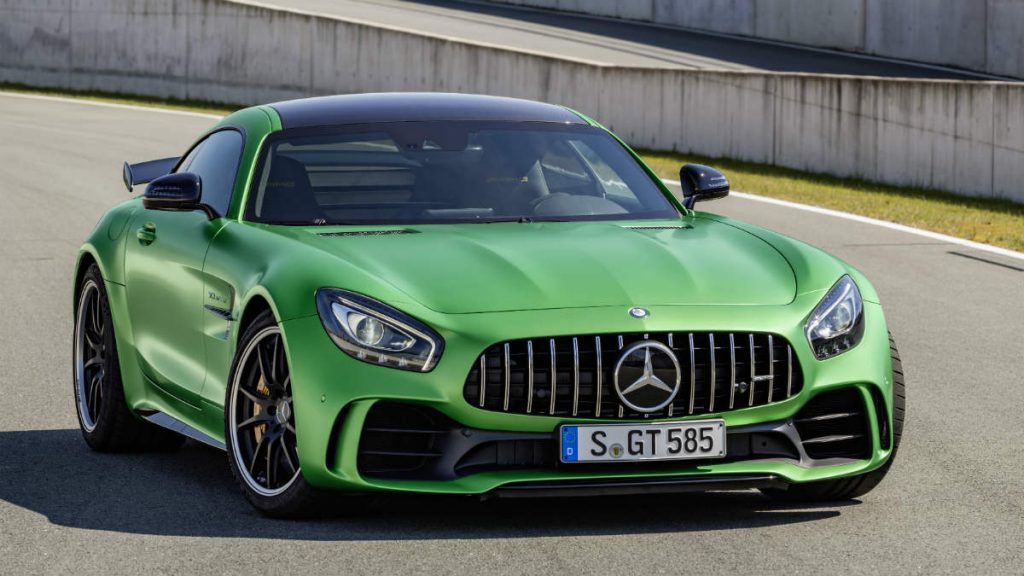
The Nürburgring Nordschleife earned its nickname the hard way. Jackie Stewart called it the Green Hell, and anyone who has watched a lap of it knows why: 20.8 kilometres of blind crests, changing surfaces and almost no room for error. It is the place Mercedes-AMG chose to develop its most focused road car yet, and the place that gave the Mercedes-AMG GT R its signature colour – “AMG green hell magno”.
The GT R is the third member of the AMG GT family and the new spearhead of the AMG range. Where the GT and GT S were grand tourers with a track habit, the R flips the idea: it is a track car that happens to be road legal. AMG lifted technology straight from its GT3 customer-racing programme and its DTM effort, then tuned every one of those systems to work together. On paper the result is 3.6 seconds to 100 km/h, a 318 km/h top speed and a power-to-weight ratio of 2.66 kilograms per horsepower – a figure AMG says puts it at the top of its class.

A third GT, and the most serious one yet
Mercedes-AMG continues to grow, and the GT R expands the top end of the range. The company is blunt about where it comes from. “Our sports-car and performance brand AMG has its roots in motorsport and, ever since its formation, has repeatedly faced up to the competition on the racetrack. These genes are particularly prevalent in the new AMG GT R. Boasting a wealth of technological innovations, the new top-of-the-range model is proof of the close collaboration between our constructors of racing cars and road-going vehicles,” says Professor Thomas Weber, Member of the Board of Management of Daimler AG responsible for Group Research and Mercedes-Benz Cars Development.
Tobias Moers, CEO of Mercedes-AMG GmbH, is even more direct about what buyers get. “With the new Mercedes-AMG GT R, we have reached the next level of driving performance. This road-going sports car with motor-racing genes and innovative technical solutions offers an ultimate driving experience that allows people to feel our motorsport origins in every fiber. It combines the driving dynamics of our AMG GT3 racing car with the everyday practicality of the AMG GT. Those with petrol in their veins will be thrilled by the radical longitudinal and lateral acceleration, the precise turn-in, and the sensational grip. We have modified all performance-relevant components and linked them together intelligently for maximum driving dynamics.”
The GT R was designed with racetrack use firmly in mind, and its development leaned heavily on AMG’s GT3 customer-sport experience and the German Touring Car Masters. The fundamentals are shared with the GT and GT S: a front mid-engine layout with the transmission in a transaxle at the rear axle, which gives a rear-biased weight distribution of 47.3 to 52.7. Combine that with a low centre of gravity and you get eager turn-in and high cornering speeds. Everything else – the lightweight construction, the extra body-shell reinforcement, the uprated engine, the revised seven-speed dual-clutch gearbox, the active aerodynamics and the new suspension with rear-wheel steering and uniball joints – is there to sharpen that base.
The new exclusive colour does the marketing on its own. “AMG green hell magno” ties the car visually to the North Loop, the legendary Nordschleife, and makes the point that this is not a styling exercise. It is a statement of intent about where the GT R was honed.

The engine: 4.0 litres, two turbos, 585 hp
The heart of the GT R is the AMG 4.0-litre twin-turbo V8, and in this tune it makes 430 kW (585 hp). That is 55 kW (75 hp) more than the previous top-of-the-range engine in the GT S. Peak torque is 700 Nm, available from 1,900 to 5,500 rpm, which is exactly the kind of flat, fat curve that makes a car feel strong everywhere rather than only near the redline.
AMG found the extra power the old-fashioned way. New turbochargers run modified compressor machining, a smaller wastegate aneroid capsule and sharper engine mapping. Boost rises from 1.2 bar in the AMG GT to 1.35 bar in the R. The exhaust ports were optimised, the compression ratio changed, and the whole combustion process retuned. Accelerator response, charge-pressure build-up and transmission parameters were recalibrated together so the engine reacts faster to load changes and shifts happen quicker. The two-mass flywheel is 0.7 kilograms lighter than the GT S item, which helps the engine feel more alert.
The character matters as much as the number. AMG describes the eight-cylinder unit as having spontaneous response, precisely measured power output and linear delivery with thrust in every engine-speed range – all of which makes it easier to place the car at the limit rather than harder. The engine electronics even take the current driving state into account, shaping accelerator characteristics as a function of the lateral forces being generated.
Hot inside V, and the details that make it work
The twin turbochargers are not bolted to the outside of the cylinder banks. They sit inside the V, a layout AMG calls “hot inside V”. The benefits are a compact engine, sharper turbo response and lower emissions thanks to short, direct airflow to the close-coupled catalytic converters. For the GT R the principle was pushed further. Maximum charge pressure is 1.35 bar, and the turbochargers spin up to 186,000 rpm.
Keeping intake temperatures down matters when you are asking this much of a turbo V8. AMG uses an indirect air-to-water intercooler with a separate, two-stage low-temperature water circuit. The first stage is two parallel coolers tucked into the left and right wheel arches; the second is a large radiator at the front of the car. AMG says the setup is more effective than the GT S arrangement. Short charge-air ducting keeps response sharp.
Fuel is delivered by spray-guided direct injection through fast, precise piezo injectors at pressures between 100 and 200 bar, with multiple injections on demand for a homogeneous mixture. The aluminium crankcase is sand-cast with a closed-deck design, which keeps strength high and weight low while allowing injection pressures up to 140 bar. The cylinder liners wear a NANOSLIDE coating – the same technology used in the Formula One engines of MERCEDES AMG PETRONAS. It is harder than a conventional grey cast-iron liner and less prone to wear, and its lower friction, paired with aluminium forged pistons, helps efficiency. Four overhead camshafts control 32 valves, with adjustment on both intake and exhaust sides. Dry-sump lubrication keeps oil pressure steady even under high lateral loads and lets the engine sit lower, dropping the centre of gravity closer to the road.
Then there is the detail that AMG owners like to talk about. Each GT R engine is assembled by hand in the hand-finishing section at Affalterbach under the “One Man – One Engine” philosophy. One builder fits the crankshaft, assembles the camshafts, wires the engine and fills it with oil, then signs the AMG engine badge. It is theatre, but it is also accountability.
Transmission and drivetrain
The AMG SPEEDSHIFT DCT seven-speed dual-clutch transmission sits in the familiar transaxle position at the rear axle, and it was revised in both hardware and software for track duty. First gear is longer, while seventh gear and the final drive are shorter, which gives more urgent acceleration overall and a livelier response to quick pedal movements. AMG extended the previous limits on shift speed and response time. RACE START is punchier too, helped by higher starting revs, more sensitive wheel-slip control and the standard track-ready tyres. Transmission cooling was upgraded to cope with sustained lapping.
Drivers pick their mood through the AMG DYNAMIC SELECT controller: “C” (Comfort), “S” (Sport), “S+” (Sport Plus) and “I” (Individual), plus a “RACE” mode that tailors shift strategy to the circuit – shortest shift times included, along with a very deliberate soundtrack. A separate “M” button on the centre console switches to manual mode in any drive mode.
Engine and transmission mounts are dynamic and fitted as standard. In a transaxle car the mounts are a genuine compromise: soft mounts quieten noise and vibration, stiff mounts sharpen handling. AMG’s answer is mounts that adjust their stiffness continuously, almost instantaneously, based on CAN data and their link to the electronic limited-slip rear differential. The GT R goes further still: the engine and transmission mounts are actuated independently of each other, which AMG says adds a further, substantial improvement in driving precision and lateral dynamics.
Aerodynamics: form that actually does something
Aerodynamics engineers and designers worked together more closely than ever on the GT R. The AMG design idiom of “Dynamic Presence” shapes the more expressive look, but every element earns its place: the aero team made the designers’ wishes real without abandoning function. That collaboration even produced an innovation with a patent pending.
The most recognisable piece is the AMG Panamericana grille. Its 15 chrome-plated vertical fins echo the look of the AMG GT3 racing car, and the basic form goes back to the Mercedes-Benz 300 SL that won the Panamericana road race in Mexico in 1952. This is its first appearance on a series-production AMG. The low, forward-leaning nose and that grille create a distinctive “shark nose” stance, and the shape also lowers the car’s back-pressure point, improving cooling airflow. A front fascia with a new jet-wing design (based on the A-wing) widens the visual stance, while the large outer air intakes – shaped like jet-engine inlets – feed the engine’s higher cooling demand through two horizontal fins instead of mesh.

A wide front splitter cuts front-axle lift, and Air Curtains on the outside of the fascia calm the airflow and improve the drag coefficient. Their narrow vertical openings also channel air towards the wheel arches, and unique wheel-arch liners with cooling-air slits help feed the twin wheel-arch radiators.
The invisible flap under the car
The cleverest piece of the GT R’s aero package is one you will never see. A carbon aerodynamics profile is concealed almost invisibly in the underbody ahead of the engine. At 80 km/h in RACE mode it drops by about 40 millimetres, weighing only about two kilograms, and changes the airflow under the car dramatically. The resulting Venturi effect helps suck the car onto the road, cutting front-axle lift by around 40 kilograms at 250 km/h. You feel it through the steering: the GT R turns in with more precision and holds its line better at speed, and the drag coefficient improves at the same time, so rear-axle downforce stays high.
The system was developed first in computer simulation, then refined over many hours in the wind tunnel, and confirmed in extensive test drives – including on the North Loop of the Nürburgring. When the electrically operated profile extends, a radiator air outlet opens at the front and guides air towards the double rear diffuser, which improves rear-axle stability and lowers the temperature of hot spots at the back. It also routes more cold air to the brake discs. Because it sits low, the profile is spring-mounted so it can flex upward if it takes a hit.
Then there is the active air management system: vertical louvres in the lower area just behind the front fascia, opened and closed by an electric motor in about a second. They normally stay shut – even at top speed, under braking and in fast corners – which cuts drag and lets air be routed to the underbody to reduce front lift further. Only when key components reach certain temperatures and cooling demand spikes do they open to send maximum air to the heat exchangers. It is a fast, intelligent bit of control, and the overall package balances lift and downforce in every state while reducing drag versus the AMG GT.
Wider, lower, and visibly angrier
Super-light carbon front wings add a total of 46 millimetres to the GT R’s width at the front, making room for the wider track and bigger wheel-and-tyre packages, and the sculpted shape emphasises the car’s longitudinal punch. A special wing signet with a perforated fin and a large air outlet lets engine-bay waste heat escape, and the fin carries the AMG diamond logo with five slats. The side view also gains optional AMG Performance forged wheels in matt black – a lightweight 10-spoke design exclusive to the GT R, with a drop-centre rim, a milled groove and two high-sheen rim rings. Front wheels measure 10.0 J x 19 ET56; rears are 12.0 J x 20 ET52. Lighter wheels reduce overall weight, rotating mass and unsprung mass, which sharpens suspension and steering response.
Those open spokes show off brake calipers painted yellow exclusively for the GT R. New side sills drop the visual stance further, with high-gloss black inserts and matching mirror caps, and a carbon roof is standard. At the back, aluminium side walls add 57 millimetres of width for the 20-inch wheels and wider track – both helping traction and cornering speed. The wider rear fascia, with large outer vents and vertical swaging, improves rear airflow along with the double diffuser. Heat from the silencers is exhausted through the diffuser while driving, and a small outlet between the tail lamps helps dissipate more.
The signature rear detail is the large central exhaust tip with a centre spar, flanked by two black tips in the diffuser. The big rear wing is rigidly mounted to the hatch to add rear-axle downforce; the mounts are body-coloured while the blade is high-gloss black, and the blade angle can be adjusted by hand to suit conditions – another motorsport touch.
Add it all up and AMG says the aerodynamic measures increase surface contact at top speed by 155 kilograms compared with the AMG GT. Despite more power, extra width, chunkier tyres, a bigger rear aerofoil, higher cooling demand and more downforce, the GT R still has a lower drag coefficient than the GT.

Chassis and suspension built for the limit
The suspension is as track-focused as the aero. Wishbones, steering knuckles and hub carriers at both ends are forged entirely from aluminium to cut unsprung mass. The double-wishbone layout locates each wheel firmly with minimal elastic movement, and the high camber and toe-in stability deliver high cornering speeds plus a clear feel for the road at the limit. The lower wishbones of the rear axle use uniball spherical bearings, again borrowed from motorsport. They are far more wear-resistant than conventional bushings and have no play by design, so toe-in and camber stay put even under heavy loads.
The rear axle also gets a thicker tubular anti-roll bar, tuned for the GT R’s higher demands and hollow to save weight. The AMG coil-over suspension was designed specifically for this car: as in professional motorsport, the driver can select a personal setup and infinitely adjust spring pre-load by hand, influencing dive, roll and grip to suit a preference or a particular circuit. It is combined with AMG RIDE CONTROL, a continuously variable adaptive damping system that adjusts each wheel automatically to the handling situation, speed and road surface. Two separate valves per damper handle rebound and compression forces, and the damping is modulated quickly and precisely – stiffer under cornering and braking to reduce roll, and continuously adapting to speed for the best possible road contact.
You change that damping at the touch of a button on the AMG DRIVE UNIT, or via the AMG DYNAMIC SELECT modes. Three settings are offered: “Comfort”, “Sport” and “Sport Plus”. Comfort suits public roads. Sport is the pick for tracks like the Nordschleife – undulating, fast and demanding maximum ground contact. Sport Plus is aimed at flatter, modern Grand Prix circuits such as Hockenheim, where a high degree of structural rigidity pays off.
Conventional chassis measures include the wider front and rear track and standard-fit Michelin Pilot Sport Cup 2 tyres, sized 275/35 ZR 19 at the front and 325/30 ZR 20 at the rear. These street-legal racing tyres allow faster laps and up to 50 percent more mileage on track, which matters if you actually use the car the way AMG intends.

Rear-wheel steering, nine-stage traction control
The GT R is the first Mercedes-AMG model to use standard-fit active rear-wheel steering. It promises the combination that engineers usually cannot have: agility and stability at the same time. Two electro-mechanical actuators (electric motors with jackscrews) replace the conventional rear control arms. They are not mechanically connected to the steering wheel – this is a by-wire system – and they adjust the rear wheels within a predefined operating map. Maximum toe change at the rear is 1.5 degrees.
Below 100 km/h the rear wheels turn opposite to the front wheels, effectively shortening the wheelbase. The payoff is a car that dives into bends with far less steering effort, which is most obvious on tight, twisty roads, narrow circuits with lots of direction changes, or slalom courses. It also improves manoeuvrability and tightens the turning circle in everyday situations like parking. Above 100 km/h the rear wheels turn with the front wheels, effectively lengthening the wheelbase for stability. Lateral force at the rear builds faster when changing direction, so responses feel quicker, and the GT R keeps massive rear grip without the twitchiness you might expect.
Beyond cornering, the system helps in sudden evasive manoeuvres, which makes the car easier to control at the limit and adds active safety. The standard three-stage ESP – “ESP ON”, “ESP SPORT Handling Mode” and “ESP OFF” – works with the limited-slip differential and is tuned to the GT R’s dynamics. The ESP OFF programming is taken from the AMG GT3.
With ESP off, the AMG TRACTION CONTROL system – also lifted from motorsport – lets the driver pre-select slip at the driven rear axle in nine levels. Like the current AMG GT3, it isolates grip on the driven wheels without affecting ESP stabilisation, using characteristic maps programmed into the electronics. Control is via a rotary switch on the centre console below the ventilation outlets, with a band of LEDs showing the setting (a display logic with motorsport roots) and a readout on the instrument cluster.
Level 1 is set up for wet driving with high safety reserves; level 9 allows maximum slip at the rear. The system’s advantage over conventional traction control is that it anticipates situations using a virtual µ (mu) simulator and other data processed by a control unit within fractions of a second. It calculates the permissible slip for the chosen level and modulates engine output so that level is not exceeded, while also factoring in the electronic limited-slip differential. Control happens without lag, which AMG says sharpens both enjoyment and performance. In practice it helps with one of the hardest jobs in fast driving: choosing the optimum engine torque and torque build-up when accelerating out of a corner.
The GT R also has an electronically controlled limited-slip differential on the rear axle as standard, integrated into the compact transmission housing. Its rapid, sensitive control raises the handling limits, improves grip at the driven wheels and increases cornering speeds, with a variable locking effect under acceleration and overrun. The speed-sensitive sports steering uses a variable ratio, and its power assistance responds not just to road speed but also to current lateral acceleration and the selected AMG DYNAMIC SELECT mode – which is why the driver gets such direct feedback from the road.
Wheels, tyres and brakes
Stopping power comes from a high-performance composite brake system with internally ventilated and perforated discs measuring 390 millimetres at the front and 360 millimetres at the rear, gripped by yellow calipers. A ceramic high-performance composite system is optional, saving 17 kilograms, lasting longer and resisting fade even better, with 402-millimetre front discs and 360-millimetre rears. Between the Cup 2 tyres and the aero package’s extra cooling air to the discs, the GT R is set up to keep stopping hard lap after lap.
Lightweight construction: carbon, magnesium and a 13.9 kg torque tube
Weight is a performance figure too, and AMG attacks it with an intelligent material mix: various aluminium alloys for the chassis and body, steel for the boot lid and magnesium for the front deck. That magnesium element up front cuts inertia ahead of the front axle and improves agility. The weight-optimised spaceframe uses die-cast and extruded aluminium sections, and its high bending and torsional strength lets it absorb and transfer the extreme forces from the drivetrain and suspension without unwanted flex, which is what makes the car respond so precisely.
Carbon fibre – the motorsport material – is used for the front wings, the roof and the torque tube between engine and transmission. The carbon torque tube now weighs just 13.9 kilograms, about 40 percent lighter than the already optimised aluminium part in the AMG GT. As a structural component of the transaxle drivetrain it connects engine and transmission with extreme flexural and torsional stiffness, keeps the drivetrain connection direct and helps the balanced weight distribution. Standard forged wheels, a titanium rear silencer and reduced soundproofing add more savings. Overall the GT R is 15 kilograms lighter than the AMG GT S – despite carrying far more hardware, including the large rear aerofoil, rear-wheel steering, active aerodynamics and the body and chassis reinforcements.
There is a neat detail in how AMG found that weight. The carbon-fibre tunnel cross replaces three different aluminium components from the GT. Mounted under the exhaust system and the torque tube, it braces the two sides of the car against each other more effectively in the tunnel area, raising torsional rigidity by around 7.5 percent – a notable gain given how stiff the standard AMG GT already was. The benefit is a precise feel from the first few metres and a more composed body under load, which means better control on difficult track surfaces like fast, bumpy corners and less steering effort. Two diagonal braces in the engine bay, also carbon fibre, stiffen the front end and save roughly 50 percent versus steel.
AMG also uses a composite material for the so-called wheel-catch struts. In a crash these help guide the front wheels onto the side members and hold them there as part of the intended crash kinematics. The composite struts are about 50 percent lighter than steel equivalents and, compared with carbon fibre, are significantly more deformable while still offering good strength – the right trade-off for a component whose job is to absorb an impact.
Inside: bucket seats, yellow accents, a hint of aviation
The cabin follows the same motorsport-first logic. Extremely light, manually adjustable AMG sports bucket seats upholstered in nappa leather and DINAMICA microfibre come as standard and hold you in place even in extreme manoeuvres. Alternatively, the tried-and-tested AMG performance seats can be ordered at no extra cost. Optional yellow seat belts and dials with yellow highlights, the AMG Interior Piano Lacquer package and specific controls – including those for the new AMG TRACTION CONTROL – set the GT R apart.
The wide-looking dashboard is shaped like a wing and carries the aviation theme through the cabin, with four central spotlight-style vents plus individual vents at each end. High beltlines, concave door panelling and a low seat position wrap the driver into the cockpit. The dominant centre console is shaped like a NACA air intake, and the materials look borrowed straight from motor racing. A free-standing central display sits proudly on top, and the AMG DRIVE UNIT controls are arranged like eight cylinders in a V layout, a small but deliberate nod to what is under the bonnet.
The AMG Interior Night package is standard, finishing the shift paddles, steering wheel bezel, door sills and boot cross member in high-gloss black, which teams up with the standard Piano Lacquer package to underline the sporty intent. Buyers who want something different can option the trim in matt black carbon fibre.
Exhaust and sound
The exhaust was developed to sound like a racing car and to save weight while doing it. Titanium for the rear silencer and thin-walled stainless steel up front trim around six kilograms compared with the AMG GT S. The hexagonal central tailpipe in the rear fascia makes the car’s motorsport character obvious, with two more tailpipes left and right in the diffuser, their tips sheathed in carbon fibre to protect the diffuser from exhaust heat. Two infinitely variable exhaust flaps are standard and have a direct influence on the sound.
The flaps open and close according to the selected AMG DYNAMIC SELECT mode, though a separate button on the AMG DRIVE UNIT lets you control them independently. In Comfort and Sport the low-frequency V8 rumble is tuned for comfort; in Sport Plus and RACE the soundtrack turns far more aggressive. It is a fitting end to a car whose whole reason for existing is the lap time, not the pose.
Key figures at a glance (2017)
- Engine: AMG 4.0-litre V8 biturbo, “hot inside V”, hand-built at Affalterbach
- Output: 430 kW (585 hp) – 55 kW (75 hp) more than the GT S
- Torque: 700 Nm from 1,900 to 5,500 rpm
- Boost pressure: 1.35 bar (up from 1.2 bar in the AMG GT)
- Acceleration: 0–100 km/h in 3.6 seconds
- Top speed: 318 km/h
- Power-to-weight: 2.66 kg/hp
- Weight distribution: 47.3 : 52.7 (front : rear)
- Transmission: AMG SPEEDSHIFT DCT 7-speed dual-clutch, transaxle
- Rear-wheel steering: max 1.5 degrees toe change; opposite-phase below 100 km/h
- Tyres: Michelin Pilot Sport Cup 2, 275/35 ZR 19 front / 325/30 ZR 20 rear
- Brakes: 390 mm front / 360 mm rear composite; optional ceramic 402 mm front
- Downforce: +155 kg surface contact at top speed versus the AMG GT
That is the GT R as AMG launched it: a GT with the volume turned up on every system that affects a lap time, and just enough everyday usability left to justify the number plate. It is the point where the Green Hell stopped being a nickname and became a specification.
Vehicle data (article timeframe)
Figures below reflect the article’s original timeframe only and are provided for reference and citation.
| Field | Value |
|---|---|
| Make | Mercedes-AMG (Mercedes-Benz) |
| Model | AMG GT R |
| Generation / chassis code | AMG GT (C190) – third member of the AMG GT family |
| Model year(s) covered | 2017 (launch period; article dated 15 August 2017) |
| Body style | Two-door sports coupé, front mid-engine, transaxle |
| Powertrain / engine | AMG 4.0-litre V8 biturbo (“hot inside V”), hand-built in Affalterbach |
| Power / torque | 430 kW (585 hp); 700 Nm from 1,900–5,500 rpm |
| Transmission | AMG SPEEDSHIFT DCT 7-speed dual-clutch, transaxle layout |
| Drivetrain | Rear-wheel drive; electronically controlled limited-slip differential |
| Key performance figures | 0–100 km/h in 3.6 s; top speed 318 km/h; power-to-weight 2.66 kg/hp; weight distribution 47.3:52.7; +155 kg downforce vs AMG GT |
| Price (as stated, with currency/market) | Not stated in sources |
| On-sale / announcement period | Announced 2016; on sale 2017 (article dated August 2017) |
| Market | Global (article in English; European power/torque figures) |
| Source notes | Article body + Mercedes-AMG press material (media.mbusa.com, 2016) and emercedesbenz.com (2016) / pocket-lint first drive (Aug 2017) |