
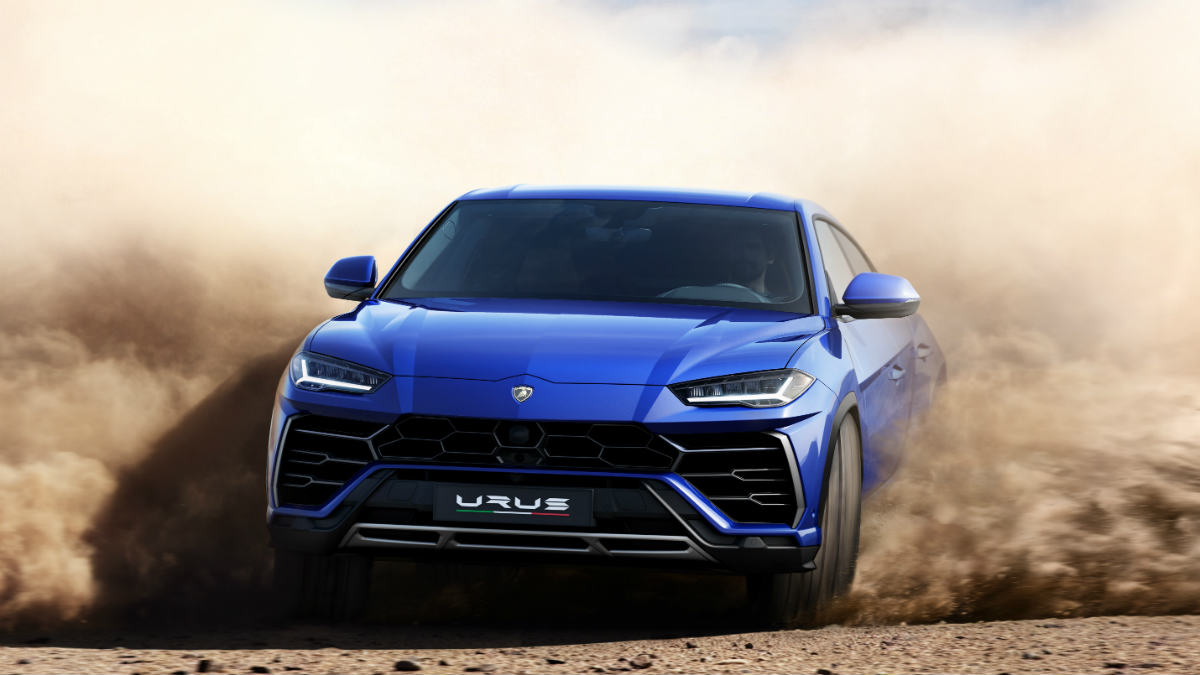
The 650 hp Super SUV
When Automobili Lamborghini pulled the silk off the production Urus at its Sant’Agata Bolognese headquarters, the Italian marque wasn’t just introducing a third model line alongside the Aventador and Huracán. It was effectively defining a brand-new automotive tier: the Super Sport Utility Vehicle. Conceived to deliver the blistering track-bred dynamics of an Italian supercar while maintaining genuine everyday usability, five-passenger seating, and genuine off-road capability, the Urus is Sant’Agata’s most ambitious production gambit since the legendary LM002 of the 1980s.
In Lamborghini tradition, the moniker traces back to fighting stock. The Urus, historically known as the Aurochs, was a massive, wild horned ancestor of modern domestic cattle, whose physical traits persist in Spanish fighting bulls. That raw strength is mirrored in the sheet metal: sharp, low-slung, and unmistakably aggressive.
Twin-Turbo V8: A Departure From Tradition
At the mechanical core of the Lamborghini Urus sits a front-mounted 4.0-liter twin-turbo aluminum V8. The decision to adopt forced induction—marking the very first turbocharged production power plant in Lamborghini’s history—was driven directly by operational requirements. High-revving, naturally aspirated V10 and V12 engines may define Sant’Agata’s track cars, but an all-terrain vehicle demands huge low-end torque. Traversing loose sand dunes, heavy mud, or steep inclines requires instant twist right off idle, something only twin turbocharging could reliably guarantee across diverse conditions.
The numbers speak with absolute clarity. The all-aluminum 3,996 cc unit develops 650 hp (478 kW) at 6,000 rpm, with a hard redline at 6,800 rpm. Peak torque arrives with immense muscle: 850 Nm (627 lb-ft), available on a wide plateau from 2,250 rpm straight through to 4,500 rpm. That produces a specific power output of 162.7 hp per liter. Because dry curb weight has been reined in below 2,200 kg, the Urus claims an exceptional weight-to-power ratio of 3.38 kg/hp, setting a benchmark for the performance SUV segment.
Engine packaging within the chassis is engineered to lower the center of gravity as much as possible. The V8 is mounted low and pushed back in the bay. Central twin-scroll turbochargers sit nestled directly inside the ‘hot V’ close to the combustion chambers, ensuring immediate throttle pick-up and minimizing turbo lag. Parallel twin-scroll units deliver sustained boost under heavy loads, ensuring effortless pull throughout the mid-range. Two separate exhaust runners correspond with cylinder firing order to eliminate pulse interference in the gas cycle. Double overhead camshafts with variable valve timing work alongside lightweight cylinder liners, while an integrated cylinder deactivation system shuts down half the bank under light throttle cruising to trim fuel consumption.
Supercar Acceleration and Deceleration
On open pavement, the performance figures defy typical utility vehicle geometry. The Urus sprints from 0 to 100 km/h (62 mph) in a staggering 3.6 seconds, blows past 200 km/h (124 mph) in 12.8 seconds, and continues pulling cleanly to a top speed of 305 km/h (190 mph). Those metrics establish it as one of the fastest SUVs ever brought to market.
Hauling a high-riding machine down from triple-digit speeds demands equivalent thermal resilience. Lamborghini equipped the Urus with massive carbon ceramic brakes as standard equipment. Clamped by ten-piston monobloc front calipers over 440 mm carbon ceramic discs, with 370 mm discs at the rear, the braking hardware brings the Urus from 100 km/h to a dead stop in just 33.7 meters. The pedal feel remains firm and predictable, avoiding the spongy fade often experienced when bringing heavy performance machinery down from autobahn velocities.
Drivetrain and Four-Wheel Steering Architecture
Harnessing 650 horsepower across wet asphalt, loose gravel, and tarmac requires an intricate driveline. Power routes through an electro-hydraulically controlled 8-speed automatic gearbox. The transmission features tightly spaced ratios in the lower gears to maximize initial launch response, while taller upper overdrive gears keep engine revs low and refined during high-speed highway cruising. A slip-controlled torque converter lock-up clutch ensures an uncompromising mechanical hookup.
Full-time four-wheel drive uses a Torsen central self-locking differential. Under normal driving conditions, torque distribution splits 40/60 between front and rear axles, giving the Urus an engaging rear-biased dynamic balance. When traction conditions shift or hard lateral cornering demands intervention, the system can instantly direct up to 70 percent of torque to the front wheels or up to 87 percent to the rear axle. Active rear torque vectoring further sharpens agility by channeling power across the rear wheels via an active mechanical differential, actively combating understeer on corner entry and pushing the car out on throttle exit.
Complementing the all-wheel drive system is rear-wheel steering borrowed directly from the Aventador S. Across the entire speed envelope, the rear wheels can angle up to plus or minus 3.0 degrees. At low speeds, the rear wheels turn in counter-phase to the front wheels, effectively shortening the wheelbase by up to 600 mm for tighter turning circles, nimble low-speed parking, and sharp urban agility. At higher velocities, the rear wheels steer in phase with the front wheels, virtually lengthening the wheelbase to deliver rock-solid high-speed lane stability and sweeping corner composure.
Tamburo Driving Dynamics: Six Personas
The technological centerpiece of the cabin interface is the Tamburo driving mode selector, located prominently on the center console. The selector allows the driver to command the car’s personality across six distinct driving modes, recalibrating the engine response, transmission logic, steering weight, active damping, four-wheel drive split, and exhaust acoustics.
For everyday pavement driving, three core modes define the vehicle’s character:
STRADA: Tailored for daily driving comfort and relaxed urban transit. Suspension damping softens, exhaust valves remain quiet, throttle maps provide smooth progression, and ride height optimizes stability and passenger ride ease.
SPORT: The chassis lowers, suspension firming up to suppress body roll. The steering tightens and the gearbox holds gears aggressively, while the exhaust opens up for an immediate, throaty V8 soundtrack.
CORSA: Tuned purely for maximum track attack and lap-time precision. Ride height settles to its lowest aerodynamic stance, roll stiffness maxes out via active roll stabilization, the all-wheel drive system optimizes rear slip angles, and manual shift paddles trigger near-instantaneous upshifts.
Equipped with the available off-road package, the Tamburo controller unlocks three specialized off-road settings:
TERRA: Engineered for rugged trails, dirt roads, and unpaved terrain. The adaptive air suspension raises ground clearance while the stability systems allow controlled wheel slip to keep forward momentum moving over ruts and loose gravel.
SABBIA: Programmed specifically for deep sand and dunes. Differential calibrations lock appropriately and throttle response stays linear to avoid bogging down, maximizing traction across soft, yielding surfaces.
NEVE: Optimized for snow, ice, and winter driving. All-wheel drive splits favor immediate front-axle traction and throttle response is carefully moderated to prevent wheelspin on low-friction road surfaces.
Alongside the Tamburo lever sits the EGO selector, enabling the driver to customize steering, powertrain, and suspension settings independently according to personal preference.
Exterior Styling: The Supercar Silhouette
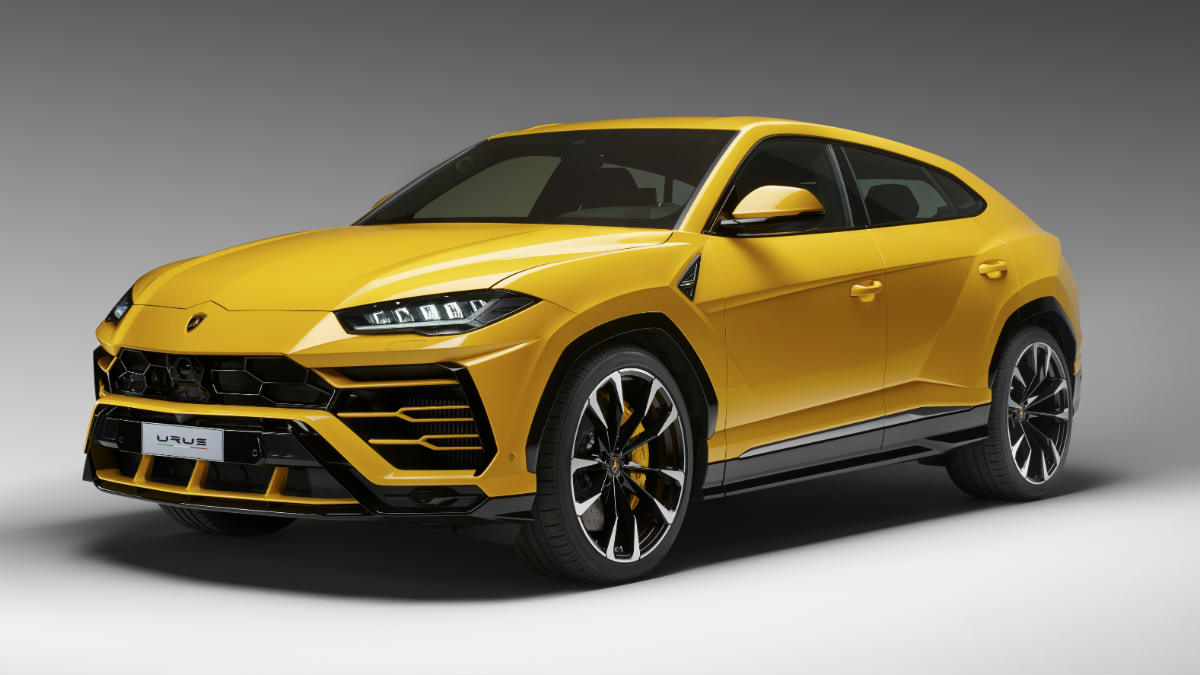
Sculpted at the Centro Stile Lamborghini, the Urus carries clear visual genetics from both the Countach and the LM002. The exterior stance follows a strict 2/3 body to 1/3 window ratio, mirroring the profile proportions of Lamborghini’s mid-engine super sports cars. The front fascia is dominated by substantial hexagonal air intakes feeding air into the intercoolers and radiator matrix, framed by a sleek front splitter and slim LED headlights featuring the signature Y-shaped daytime running light motif.
Along the flanks, muscular hexagonal wheel arches shelter wheel options ranging from 21 inches up to 23 inches in diameter, wrapped in bespoke Pirelli P Zero or Pirelli Scorpion tires developed specifically for this application. The roofline slopes dramatically toward the rear, resolving in a fastback tailgate with an integrated roof spoiler and an aerodynamic lip spoiler. Beneath the rear bumper, a broad diffuser surrounds quad round exhaust outlets that bellow the twin-turbo V8’s firing order.
Cabin Luxury and Lamborghini Infotainment System III
Step inside through the frameless doors, and the interior immediately combines motorsport geometry with plush craftsmanship. Lamborghini’s hallmark hexagonal motif repeats across the air vents, door handles, cup holders, and steering wheel center. A low seating position embeds the driver deep into the cockpit, facing a flat-bottomed multifunction steering wheel and a fully digital TFT instrument cluster.
The centerpiece of the dashboard is the Lamborghini Infotainment System III (LIS III). Two intuitive touchscreen displays stack elegantly down the center stack: the upper screen handles media, navigation, telephone integration, and vehicle setup, while the lower screen features a virtual keyboard and handwriting recognition for entering destinations, managing automatic climate control, and adjusting seat heating. Upholstery choices span fine Italian leather, Alcantara, carbon fiber trim, brushed aluminum, and open-pore wood finishes.
Seating can be configured either as a practical five-seat arrangement with a folding rear bench or an ultra-exclusive four-seat configuration with two individual rear sport seats. Cargo volume measures a practical 616 liters with all seats upright, expanding to 1,596 liters when the rear seats are folded flat. A rear suspension lowering button inside the luggage compartment eases the loading of luggage and equipment, underlining that everyday utility was central to the vehicle’s engineering brief.
Production Expansion at Sant’Agata Bolognese
The launch of the Urus represents a generational transformation for Automobili Lamborghini’s industrial manufacturing footprint. To build the Super SUV, Lamborghini completely overhauled its headquarters at Sant’Agata Bolognese, doubling the factory site from 80,000 square meters to 160,000 square meters. The expansion introduced the Manifattura Lamborghini assembly line, integrating Industry 4.0 production principles with classic hand assembly, alongside a dedicated test track and paint facility.
With production underway, the Urus is projected to double the company’s annual vehicle output, opening up customer demographics that previously looked beyond Sant’Agata due to the tight passenger and luggage constraints of two-seat supercars. With initial pricing set at approximately $200,000 in North America and 171,429 euros in Europe (before taxes), the Urus enters the global stage not merely as a high-powered SUV, but as a bold statement of modern Italian high-performance engineering.
Vehicle data
| Field | Value |
| Make | Lamborghini |
| Model | Urus |
| Generation / chassis code | First generation |
| Model year(s) covered | 2018–2019 |
| Body style | 5-door SUV |
| Powertrain / engine | 4.0-liter (3,996 cc) twin-turbo petrol V8 |
| Power / torque | 650 hp (478 kW) @ 6,000 rpm / 850 Nm (627 lb-ft) @ 2,250–4,500 rpm |
| Transmission | 8-speed automatic |
| Drivetrain | All-wheel drive with Torsen central self-locking differential and rear torque vectoring |
| Key performance figures | 0–100 km/h in 3.6 s; 0–200 km/h in 12.8 s; top speed 305 km/h (190 mph); 100–0 km/h in 33.7 m |
| Price (as stated) | $200,000 USD (USA) / €171,429 (Europe, excluding taxes) |
| On-sale / announcement period | Unveiled December 2017; market deliveries commencing spring 2018 |
| Market | Global |