
Open-Air Track Weapon
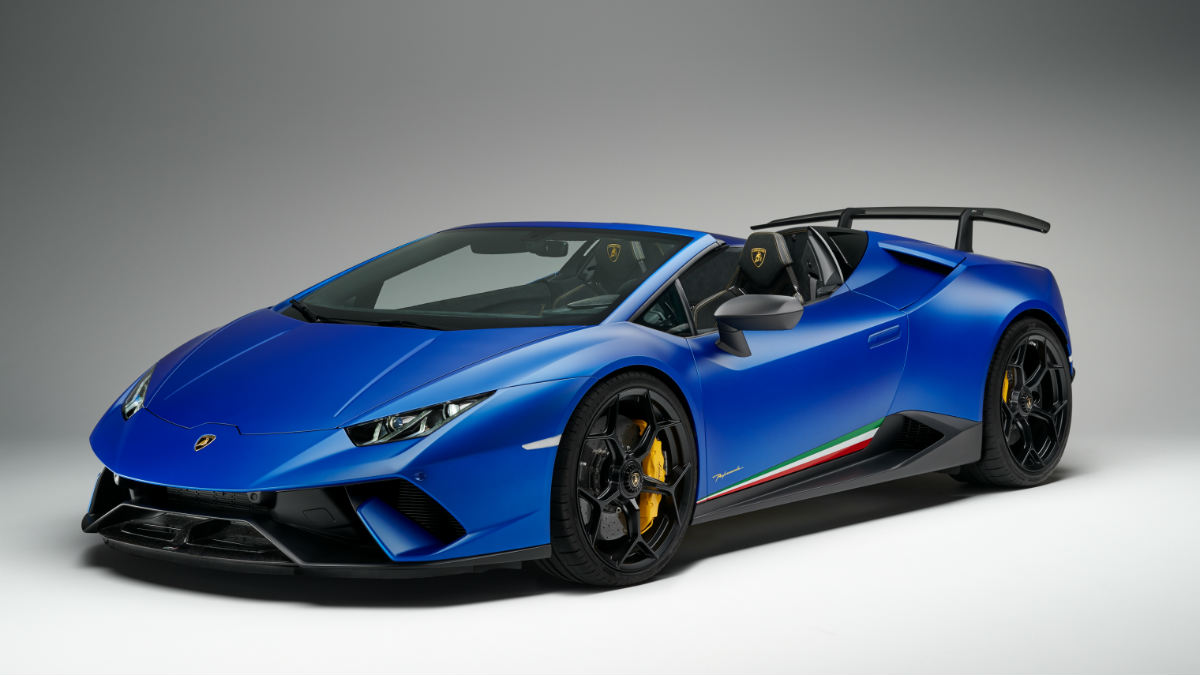
When Lamborghini took the wraps off the Huracán Performante CCoupéat Geneva in 2017, the Italian automaker sent an unmistakable shockwave through the supercar hierarchy. Securing a headline-grabbing 6:52.01 Nürburgring lap time, the lightweight, high-downforce machine proved that Sant’Agata Bolognese was determined to dominate circuit lap times through aerodynamic ingenuity rather than pure brute displacement alone. Exactly twelve months later at the 2018 Geneva International Motor Show, Lamborghini chairman and CEO Stefano Domenicali stepped onto the stand to introduce the inevitable, open-cockpit sibling: the Lamborghini Huracan Performante Spyder.
Merging the sensory rush of top-down motoring with the focused track-bred hardware of the Performante Coupé, the new Spyder delivers a visceral blend of sound, speed, and active downforce management. Powered by an unyielding, free-breathing 5.2-liter V10 and underpinned by an electrohydraulic soft-top roof mechanism, the Huracán Performante Spyder proves that dropping the top does not require conceding motorsport-grade dynamics.
Naturally Aspirated V10: Uncompromised Mechanical Tenacity
At the mechanical core of the Huracán Performante Spyder sits the finest iteration of Lamborghini’s celebrated 5.2-liter naturally aspirated ten-cylinder powerplant. In an era when competitors are pivoting rapidly to turbocharging and hybrid assistance to satisfy regulatory constraints, Sant’Agata remains fiercely dedicated to the linear power delivery and instantaneous throttle response that only atmospheric induction can provide. Calibrated to match the benchmark figures of the fixed-roof Performante, the V10 develops 640 hp (470 kW) at a soaring 8,000 rpm, alongside 600 Nm of torque at 6,500 rpm. Crucially for real-world drivability and explosive corner-exit speed, over 70 percent of peak torque is on tap starting from just 1,000 rpm.
Translating this muscular output into forward momentum is a seven-speed dual-clutch transmission—Lamborghini Doppia Frizione (LDF)—paired with a permanent all-wheel-drive system utilizing an electronically controlled mechanical self-locking rear differential. The dry weight of the open-air model checks in at 1,507 kg, yielding a lean power-to-weight ratio of 2.35 kg/hp with a 43/57 percent front-to-rear static weight distribution. Standing starts see the Performante Spyder launch from zero to 100 km/h (62 mph) in a blistering 3.1 seconds, hitting 200 km/h (124 mph) in 9.3 seconds before topping out at 325 km/h (202 mph). Braking back to a dead stop from 100 km/h requires just 31.5 meters, courtesy of ventilated and cross-drilled carbon-ceramic brake discs clamped by six-piston calipers up front and four-piston calipers at the rear.

The acoustic experience of this powertrain takes on an entirely new dimension in the Spyder. With the fabric top lowered—or simply with the power rear glass dropped down independently—the revised exhaust system channels raw mechanical resonance straight into the cabin. The redesigned pipe routing features reduced backpressure and lightened silencers, projecting an unmuted metallic howl through the twin central tailpipes that intensifies steadily toward the 8,500 rpm redline.
Forged Composites and Aerodinamica Lamborghini Attiva
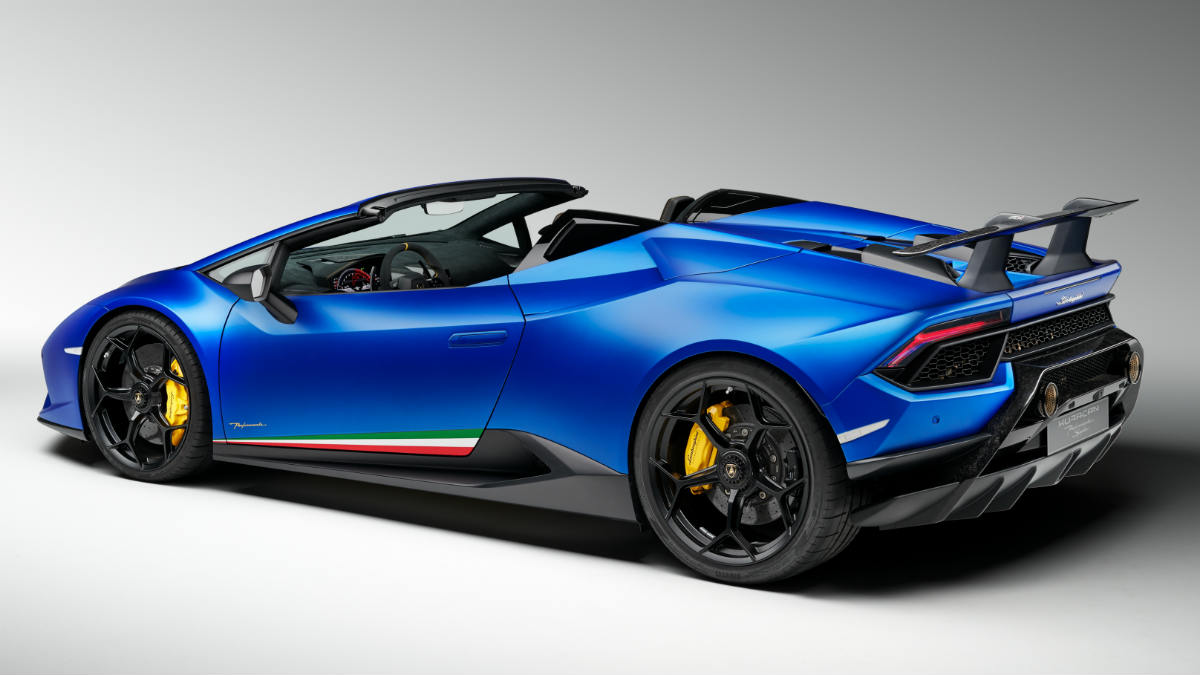
The visual identity of the Huracán Performante Spyder draws inspiration directly from Lamborghini’s Super Trofeo one-make race series and high-performance naked streetfighter motorcycles. Sharp, exposed surfaces emphasize function over ornament. Integral to both the aesthetics and performance envelope is Lamborghini’s patented Forged Composite technology. Unlike traditional woven carbon fiber fabrics that require lengthy manual layup in pre-impregnated sheets, Forged Composite consists of chopped carbon fibers soaked in resin and pressed into heated steel molds. This manufacturing method allows engineers to create intricate three-dimensional geometries with varying wall thicknesses, achieving immense torsional stiffness while stripping excess mass.

Forged Composite elements dominate the exterior: the aggressive front splitter, complete engine cover bonnet, sculpted rear bumper, massive underbody diffuser, and the towering hollow rear wing. Together with lightweight aluminum body stampings and high-strength hybrid chassis construction, these components contribute to a net weight reduction of 35 kg compared to the standard Huracán Spyder, directly sharpening chassis responsiveness.
These composite panels are not merely passive styling features; they form the operational foundation of Aerodinamica Lamborghini Attiva (ALA). First introduced on the Performante Coupé, ALA is an active aerodynamic management system that alters downforce and drag configurations electro-mechanically rather than via heavy hydraulic rams. The entire system is overseen by the Lamborghini Piattaforma Inerziale (LPI), a cluster of three-axis gyroscopes and accelerometers placed at the vehicle’s center of gravity. LPI monitors dynamic attitudes continuously, commanding ALA actuators to cycle between low-drag and high-downforce states in less than 500 milliseconds.

Under heavy braking and tight cornering, the front flaps shut completely, maximizing vertical aerodynamic load across the nose. Concurrently, internal valves in the rear wing pylons close, forcing air over the top surface of the wing profile to generate maximum vertical downforce—up to 750 percent more than a standard Huracán Coupé. When accelerating hard in a straight line, the front flaps open to channel air beneath the chassis, while the rear valves direct air into the hollow uprights and out through narrow slots beneath the wing surface. This introduces air into the boundary layer, stalling the wing and dramatically dropping drag for higher terminal velocity.
Even more remarkably, ALA executes aerodynamic vectoring during high-speed cornering. By opening the inner wing flap and keeping the outer wing flap closed, LPI channels downforce exclusively onto the inside rear wheel. This creates an aerodynamic turning moment that counteracts centrifugal load, sharpening turn-in, reducing steering angle demands, and enhancing high-speed stability through fast sweeping bends.
Chassis Dynamics and the Calibrated ANIMA System
Harnessing active aerodynamics and 640 hp demands a comprehensively retuned chassis architecture. The Performante Spyder rides on double-wishbone aluminum suspension at all four corners, featuring steel coil springs that are 10 percent stiffer vertically and 15 percent stiffer roll-wise than the standard Huracán Spyder. Radial and axial arm bushings are stiffened by 50 percent, virtually eradicating unwanted suspension geometry deflection under intense lateral g-forces.
Drivers can specify optional magnetorheological dampers, which continuously adjust fluid viscosity in response to road texture and lateral inputs. Steering is handled by an electromechanical setup or the optional Lamborghini Dynamic Steering (LDS) variable-ratio rack, both recalibrated to deliver sharper on-center bite and transparent front-tire feedback. Standard forged 20-inch Narvi wheels or optional center-lock Loge wheels come wrapped in sticky Pirelli P Zero Corsa rubber, developed specifically for the vehicle’s high-downforce footprint, with road-legal Pirelli P Zero Trofeo R track tires available as an extreme track option.

Controlling this mechanical cohesion is Lamborghini’s ANIMA selector (Adaptive Network Intelligent Management), positioned at the base of the steering wheel. ANIMA alters the behavior of the electronic stability control, all-wheel-drive torque distribution, damper stiffness, throttle map, and steering assistance across three distinct driving modes:
In STRADA mode, the powertrain emphasizes composure, daily compliance, and safety. Traction is divided with an emphasis on neutral understeer prevention, exhaust bypass valves remain closed at lower engine speeds, and the transmission shifts smoothly through automatic gear transitions.
Selecting SPORT mode shifts the all-wheel-drive bias heavily toward the rear axle, allowing controlled oversteer slides while providing immediate torque vectoring to pull the car out of bends. The throttle mapping sharpens, gearshifts execute with aggressive rev-matched blips, and exhaust flaps open wide to unleash the full vocal fury of the V10.
CORSA represents the ultimate circuit setting. Calibrated for maximum grip and optimal lap times, CORSA locks the suspension into its firmest damping program, stiffens steering resistance, commands instantaneous manual-paddle gearshifts with pronounced mechanical engagement, and operates the ALA active aero system for pure downforce generation and aero vectoring efficiency.
Acoustic Refinement and Roof Engineering
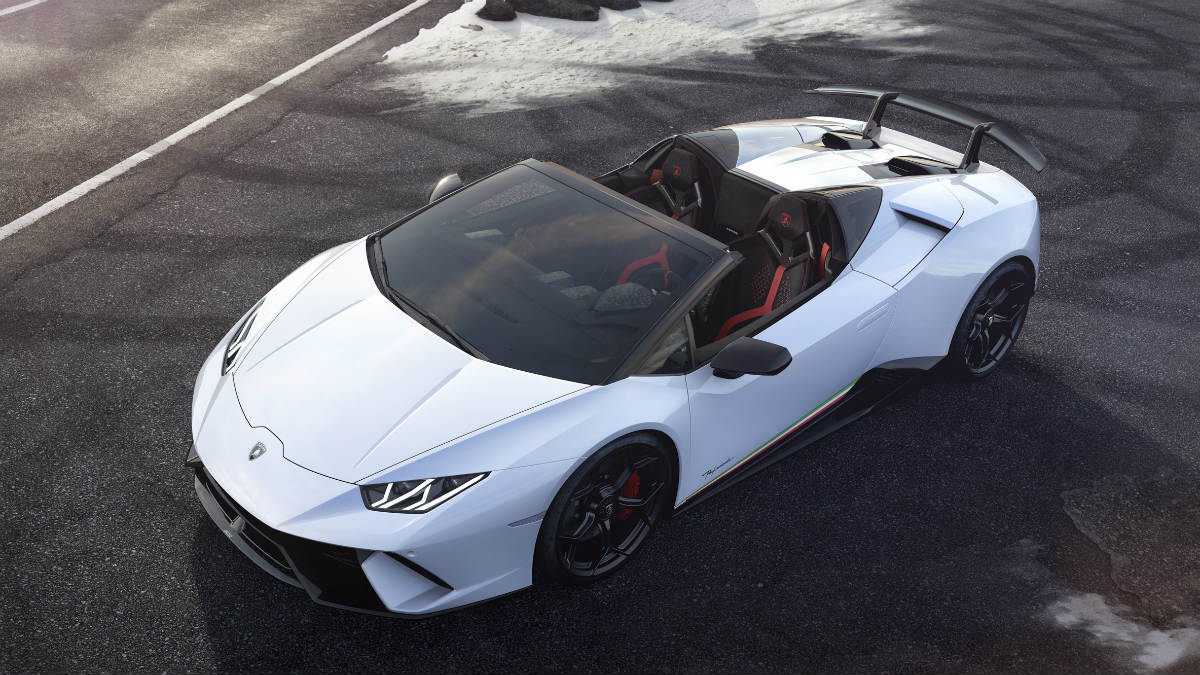
Creating an open-top variant of a track-focused weapon introduces distinct structural and aerodynamic challenges. Lamborghini engineers engineered a lightweight electrohydraulic roof mechanism that retracts into a compact rear storage compartment in just 17 seconds at driving speeds up to 50 km/h (30 mph). Crucially, the roof mechanism is packaged so that center-of-gravity height and weight distribution remain balanced whether the fabric top is deployed or folded away.

When lowered, two sculpted fins emerge automatically from the roof casing, flowing backward from the seat headrests toward the rear decklid. These fins preserve the aggressive fastback profile of the coupé while housing integrated aerodynamic channels that bleed off high-pressure air, drastically cutting cockpit turbulence at high cruising speeds. Removable lateral wind deflectors dampen acoustic pulsations, allowing driver and passenger to converse at highway velocity without shouting.
The cabin architecture mirrors the performance minimalism seen outside. Lightweight Alcantara swathes the dashboard, sports seats, and door panels, while Forged Composite highlights the air vents, center console toggles, door handles, and large steering-column paddles. Behind the flat-bottom steering wheel sits a 12.3-inch configurable TFT digital instrument cluster, programmed to display real-time ALA actuation readouts and circuit telemetry alongside essential instrumentation.

Lamborghini scheduled initial deliveries of the Huracán Performante Spyder for summer 2018. Base pricing was confirmed at €219,585 in Europe, £195,078 in the United Kingdom, and $308,859 in the United States, before regional taxes and destination charges. Sitting at the pinnacle of Sant’Agata’s mid-engine V10 range, the Performante Spyder stands as an uncompromising marriage of motorsport engineering, atmospheric engine character, and open-cockpit theatre.
Vehicle data
| Make | Lamborghini |
| Model | Huracán Performante Spyder |
| Generation / chassis code | First generation (LP 640-4) |
| Model year(s) covered | 2018–2019 |
| Body style | 2-door, 2-seat roadster / convertible with electrohydraulic soft top |
| Powertrain / engine | 5.2-liter naturally aspirated 90-degree V10 (5,204 cc) |
| Power / torque | 640 hp (470 kW) @ 8,000 rpm / 600 Nm (443 lb-ft) @ 6,500 rpm |
| Transmission | 7-speed dual-clutch transmission (Lamborghini Doppia Frizione – LDF) |
| Drivetrain | Permanent all-wheel drive with mechanical self-locking rear differential |
| Key performance figures | 0–100 km/h in 3.1 s; 0–200 km/h in 9.3 s; 100–0 km/h braking in 31.5 m; top speed 325 km/h (202 mph) |
| Price (as stated) | €219,585 (Europe excl. taxes) / £195,078 (UK excl. taxes) / $308,859 (US excl. taxes) |
| On-sale / announcement period | Announced March 2018 (Geneva Motor Show); customer deliveries summer 2018 |
| Market | Global (Europe, UK, North America) |