

Open-air driving fun and freedom – Lamborghini Huracán EVO Rear-Wheel Drive
Automobili Lamborghini presented the new Huracán EVO Rear-Wheel Drive Spyder at a digital launch event in early May 2020, bringing its most driver-focused roadster configuration to customers worldwide. The car represents the latest evolution of Lamborghini’s front-engine V10 architecture, first launched in 2014 and comprehensively revised as the “EVO” variant in November 2017 at the Geneva Motor Show.

The introduction of a dedicated rear-wheel-drive variant sits squarely within Lamborghini’s strategy to offer buyers increasingly direct levels of driver involvement — a philosophy growing ever rarer in the supercar segment where quattro systems and electronic safety nets dominate every powertrain equation. Stefano Domenicali, then Chairman and CEO of Automobili Lamborghini, described the Huracán EVO RWD Spyder as doubling the driving pleasure compared to earlier models while simultaneously allowing owners to celebrate life outside the cockpit. He emphasised that drivers experience direct mechanical feedback from the rear-wheel-drive layout with minimal electronic intrusion, paired with the unique sense of freedom only open-top grand touring can deliver. The RWD designation marks Lamborghini’s most committed step yet toward analogue driving purity on the Huracán platform, targeting enthusiasts who prioritise physical connection over brute acceleration metrics.
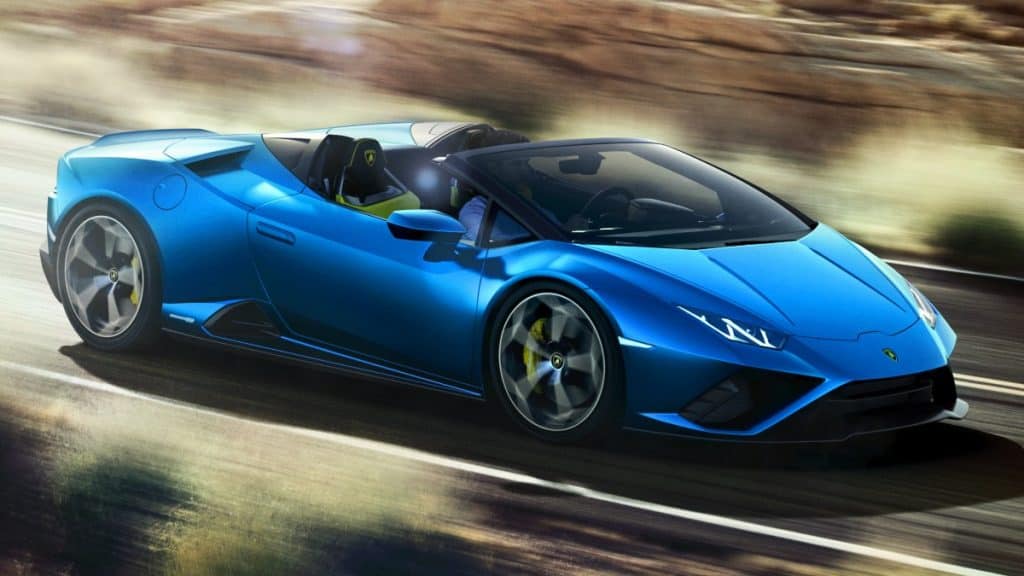
At the heart of every Huracán EVO lies the L940 engine code — Lamborghini’s familiar yet increasingly refined 5.2-litre naturally aspirated V10. Displacing 5,204 cubic centimetres with an 86.4 mm bore and 70.1 mm stroke, the unit produces 610 hp at 8,000 rpm and peaks at 560 Nm between 6,500 and 8,000 rpm. Direct injection operates at 200 bar, variable valve timing covers both camshafts, and the redline climbs cleanly to 8,000 rpm without artificial restriction. Power routes through a seven-speed dual-clutch transmission shifting under 150 milliseconds, sending rotation exclusively to the rear axle via a limited-slip differential calibrated for the RWD drivetrain’s distinctive character. The naturally aspirated architecture means throttle response remains instantaneous and linear across the entire rev range, unlike turbocharged rivals whose power delivery can feel stepped or interrupted during boost transitions and gear changes.
With zero-to-one-hundred kilometres in just 3.5 seconds and a top speed of 324 km/h, like its coupé stablemcoupéhe Spyder remains instinctively tied to analogue driver engagement rather than digital overcompensation. The retuned Performance Traction Control System generates genuine adrenaline-producing performance across varied conditions, consistently modulating torque delivery even during sharp cornering entry, mid-corner throttle application, or deliberate drift initiation — especially with the roof retracted, where the V10’s acoustic response to throttle inputs becomes a primary sensory narrative element not found in electronically managed four-wheel-drive alternatives or forced-induction competitors.

The ANIMA button mounted on the steering wheel puts the pilot in full control of driving modes, each calibrated for distinct personality curves tailored specifically to the RWD drivetrain’s characteristics. STRADA mode prioritises stability and safety by minimising rear-wheel slippage and managing torque proactively on low-adhesion surfaces, making daily usability more approachable than previous Huracán variants and suitable for wet conditions or poor road surfaces. SPORT mode rewards piloting skill by permitting controlled slides during acceleration phases, limiting torque delivery only when oversteer angles increase too rapidly so the driver retains ultimate authority over vehicle dynamics and can appreciate the subtle art of weight transfer management. CORSA mode optimises traction and agility for high-performance corner exit scenarios, maximising outright speed and mechanical grip when operating near the limit on track environments or empty public roads demanding maximum commitment.

The aluminium and thermoplastic resin body sits upon a lightweight hybrid chassis combining aluminium structural elements with carbon-fibre reinforcements achieving a dry weight of 1,509 kg and producing a remarkable weight-to-power ratio of 2.47 kilograms per horsepower that belies the car’s exotic positioning. Front-to-rear weight distribution holds at a sporting 40/60 bias thanks to mid-mounted engine placement, supported by double-wishbone suspension geometry with overlapped quadrilaterals at both corners and passive shock absorbers tuned specifically for the RWD variant’s different load and inertia characteristics compared to the quattro model. Ventilated and cross-drilled steel brake discs measure substantial dimensions up front, feeding into 19-inch Kari forged alloy rims shod with purpose-developed Pirelli P Zero rubber sized 245/30 ZR19 at the front axle and 305/30 ZR20 at the rear, with optional 20-inch wheels and carbon-ceramic braking available for customers seeking additional fade resistance during repeated high-speed deceleration sequences.

Exterior design differentiates the RWD Spyder clearly from its quattro-drive counterpart along several key visual axes beyond the obvious lack of wider rear haunches. New front splitter geometry frames larger air intakes with vertical fins integrated directly into the bumper structure to improve cooling airflow directed toward the mid-mounted powerplant and transmission oil coolers. The rear bumper finished in high-gloss black incorporates a diffuser pattern unique to this RWD model, extracting fast-moving airflow beneath the chassis to increase high-speed downforce without adding drag-inducing appendages or increasing frontal area. The soft-top mechanism deploys or retracts within 17 seconds at speeds up to 50 km/h using electrohydraulic actuators, stowing neatly beneath the rear deck panel while maintaining structural rigidity in the closed position. Electronically actuated rear window functions as a windscreen when raised and drops down completely to amplify the V10’s acoustic signature through the open cabin. Two removable lateral windshields mount between seats and door sills, reducing aerodynamic buffeting and wind noise at highway speeds without compromising the authentic open-air driving experience that defines this category.
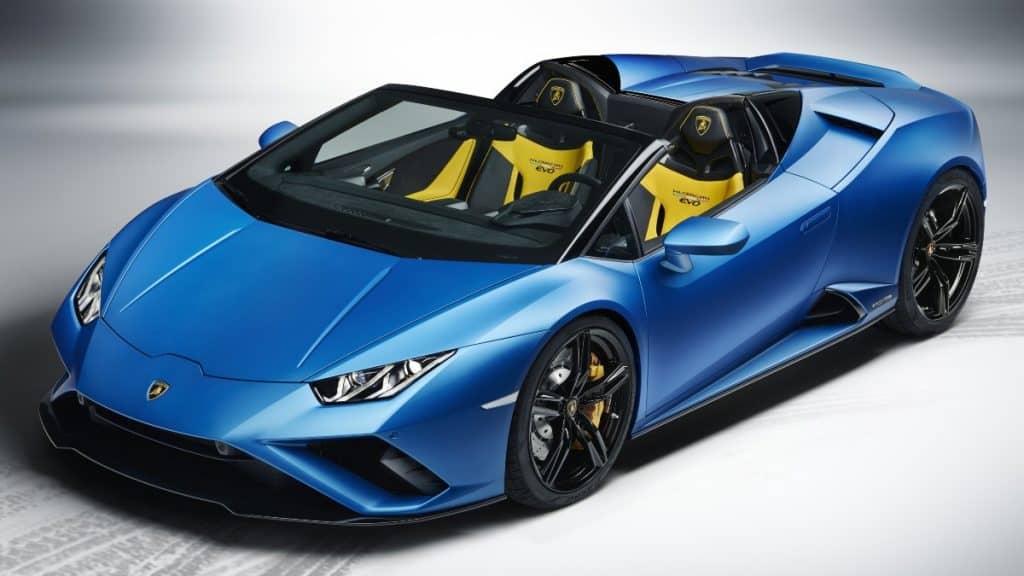
Inside, the centre console houses an 8.4-inch high-resolution touchscreen running the latest iteration of Lamborghini’s infotainment software stack, supporting Apple CarPlay integration, Bluetooth telephone connectivity, and internet access alongside comprehensive vehicle controls including drive mode selection, chassis stiffness adjustments, exhaust flap configuration, and media management from USB sources or connected devices. Every example benefits from Lamborghini’s Ad Personam personalisation programme, which offers virtually limitless colour and trim combinations ranging from exterior paint finishes through interior leather selections sourced from specific cattle breeds, contrast stitching patterns matching customer preferences, instrument cluster graphic themes, paddle shift colours, and brake caliper paint accents — ensuring no two commission sheets share identical specification lists and giving ownership a deeply individual character from the moment of delivery.
In the competitive landscape of mid-engined convertibles available during spring 2020, the Huracán EVO RWD Spyder positioned itself against Ferrari’s 488 Pista Spider wielding 710 hp from its twin-turbo V8, McLaren’s 720S Spider offering slightly less peak power but notably lower kerb weight, and Porsche’s 911 Turbo S Cabriolet trading forced induction and all-wheel drive for everyday usability and refinement. Where rivals leaned heavily on turbochargers and sophisticated quattro systems for their headline acceleration figures, the Lamborghini relied on atmospheric aspiration, rear-wheel-drive dynamics, and handcrafted interior appointments to differentiate itself philosophically as much as mechanically. Early press commentary from spring 2020 test drives noted the RWD layout demanded greater attention from competent drivers but rewarded that attention with genuinely communicative steering feedback, predictable breakaway behaviour, and a physical connection to road surface irregularities absent from the all-wheel-drive Huracán variants or turbocharged competitors that insulate occupants behind layers of isolation technology.
Vehicle data
| Make | Lamborghini |
| Model | Huracán EVO RWD Spyder |
| Generation / chassis code | EVO (LP 640-4 successor) |
| Model year(s) covered | 2020 |
| Body style | Rear-wheel-drive convertible roadster |
| Powertrain / engine | 5.2-litre naturally aspirated V10 (L940) |
| Power / torque | 610 hp @ 8,000 rpm / 560 Nm @ 6,500–8,000 rpm |
| Transmission | 7-speed dual-clutch |
| Drivetrain | Rear-wheel drive |
| Key performance figures | 0–100 km/h: 3.5 s; top speed: 324 km/h; dry weight: 1,509 kg; ratio: 2.47 kg/hp |
| Price (as stated) | Not stated in sources |
| On-sale / announcement period | Announced May 2020 |
| Market | Global |