

Memories of the Classic Grand Tourer: Kia Stinger Arrives in the UK
The arrival of the Kia Stinger marks a defining threshold in modern automotive product planning. As the company’s first purpose-built gran turismo and its maiden rear-wheel-drive production car in the United Kingdom, Stinger lands with clear ambitions. Order books are officially open across British showrooms, backed by comprehensive trim specifications and competitive pricing designed to challenge established European executive machinery. Rather than pitching itself as a track-focused sports car, Stinger consciously revives the romance of traditional long-distance continent-crossing motoring. It recalls the golden era of grand tourers—a time when the journey held equal billing with the destination, where effortless high-speed legs swallowed hundreds of miles without battering the driver’s composure.
This rear-wheel-drive fastback has been six full years in gestation. The project began publicly with the well-received Kia GT Concept at the 2011 Frankfurt Motor Show (IAA). Throughout the intervening seasons, observers wondered whether the ambitious low-slung concept would survive the realities of volume production. Kia’s senior leadership held firm, safeguarding the car’s fundamental rear-wheel-drive architecture until the manufacturing base and international retail climate could support a high-end halo vehicle. Now, the finished fastback is ready for British roads, demonstrating that Kia’s historic reputation for practical, value-led family runabouts can comfortably co-exist with a genuine luxury-performance flagship.
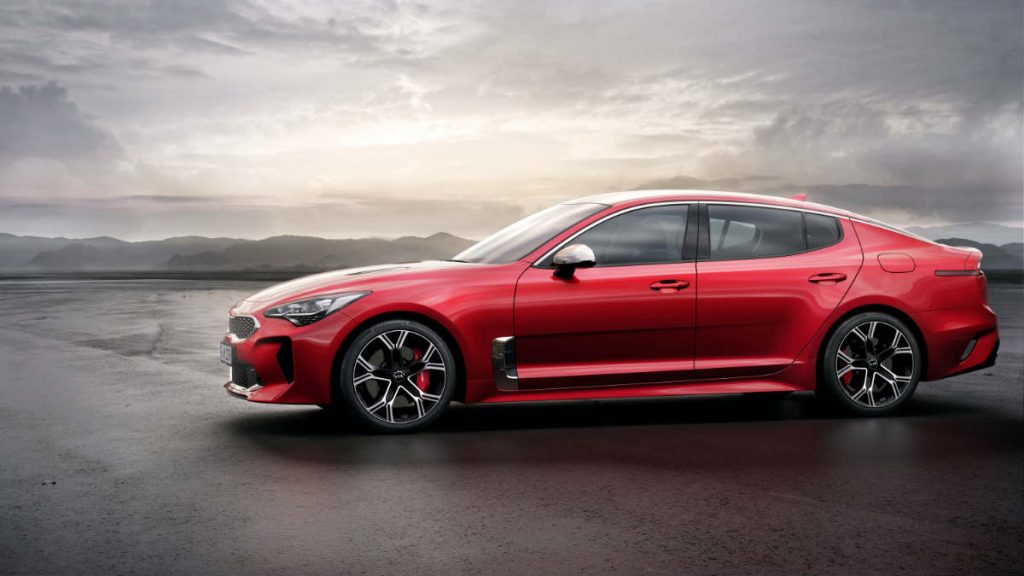
Design Pedigree: Classic Gran Turismo Proportions
Creating a legitimate gran turismo requires strict adherence to classical stance and silhouette. Peter Schreyer, Chief Design Officer of Kia Motors, alongside Gregory Guillaume, Chief Designer at Kia Motors Europe, ensured that the production fastback remained exceptionally faithful to the athletic proportions previewed by the 2011 concept car. Drawing inspiration from 1970s grand tourers like the original Maserati Ghibli, Guillaume set out to craft a contemporary four-door interpretation with genuine road presence.
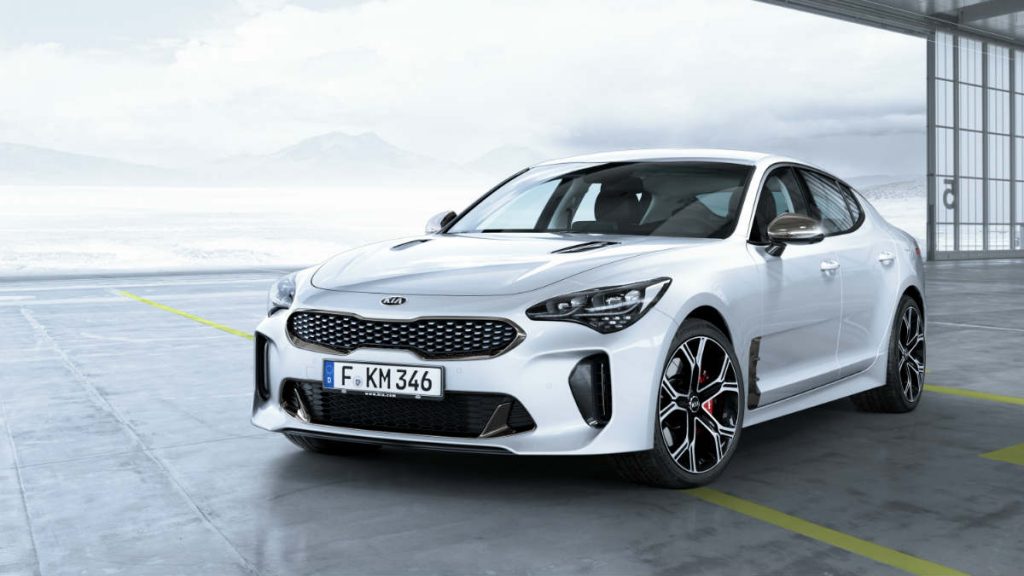
The shift to a dedicated front-engine, rear-wheel-drive platform was instrumental in establishing those classic proportions. Moving the front axle forward created a short front overhang and an expansive distance between the front wheel center and the dashboard cowl—the traditional visual cue of a thoroughbred performance saloon. An extended wheelbase provides stability and substantial cabin room, while the long rear overhang finishes in muscular, broad rear haunches. A sleek, cab-backward fastback roofline sweeps smoothly into an integrated ducktail boot lip, outlined by a distinctive chrome moulding that arcs along the roof edge from the A-pillar to the base of the rear window glass. From head-on, Kia’s signature ‘tiger-nose’ grille sits flanked by functional air curtain vents and sculpted engine bay heat extractors, giving Stinger an unmistakably assertive face without resorting to gratuitous aerodynamic gimmicks.

Chassis Engineering and Development Under Albert Biermann
A true GT must strike a delicate dynamic compromise: sharp body control during enthusiastic cross-country progress paired with supple isolation over broken asphalt. To oversee the mechanical development of the platform, Kia entrusted former BMW M engineering boss Albert Biermann. Under Biermann’s direction, the development team subjected prototype vehicles to rigorous durability and handling regimes, including gruelling development sessions around the Nürburgring Nordschleife as well as winter testing on frozen lakes in Arjeplog, Sweden.
The foundation rests on a heavily adapted rear-drive architecture built with 55 per cent advanced high-strength steel. Up front, MacPherson strut suspension operates with carefully calibrated geometry, while the rear axle uses a five-link independent arrangement. In flagship GT-S specification, the setup incorporates Dynamic Stability Damping Control (DSDC)—an adaptive electronically controlled suspension system that adjusts damper valving through five user-selectable driving modes: Eco, Comfort, Smart, Sport, and Sport+. Furthermore, GT-S models incorporate a Variable Gear Ratio (VGR) rack-mounted motor-driven power steering system, quickening turn-in responsiveness while preserving straight-line high-speed serenity on motorways.
Three Turbocharged Powertrains: From Efficient Diesel to Twin-Turbo V6
Kia structures the UK line-up around five distinct derivatives spread across three engine options and three trim designations: GT-Line, GT-Line S, and the range-topping GT-S. Crucially, every single version sends its drive exclusively to the rear wheels via an in-house eight-speed automatic transmission featuring an oil-cooled electronic torque converter and steering wheel paddle shifters.
Opening the range are two four-cylinder powerplants available in GT-Line and GT-Line S grades. The petrol option is a 2.0-litre T-GDi turbocharged direct-injection four-cylinder developing 244 bhp (247 PS) at 6,200 rpm and 260 lb-ft (353 Nm) of torque across an accessible rev shelf spanning 1,400 to 4,000 rpm. For high-mileage grand touring, the 2.2-litre CRDi turbodiesel four-cylinder puts out 197 bhp (200 PS) at 3,800 rpm and a substantial 325 lb-ft (440 Nm) of pulling power between 1,750 and 2,750 rpm. Capable of returning up to 50.4 mpg on the official combined cycle, this oil-burner endows Stinger with a cruising range exceeding 600 miles per tank.
At the apex of the family sits the ferocious Stinger GT-S. Propelled by Kia’s 3.3-litre twin-turbocharged V6 T-GDi unit, the flagship delivers 365 bhp (370 PS) at 6,000 rpm and 376 lb-ft (510 Nm) of torque from just 1,300 rpm through 4,500 rpm. That immediate low-end torque launches the GT-S from 0 to 60 mph in 4.7 seconds (0–62 mph in 5.1 seconds), before running out of steam at an unrestricted top speed of 168 mph. To harness this performance, GT-S models feature a mechanical limited-slip differential on the rear axle as standard equipment, along with heavy-duty Brembo ventilated disc brakes featuring four-piston front calipers and two-piston rear calipers gripping oversized rotors.
Cabin Luxury, Craftsmanship, and On-Board Technology
Inside, the Stinger represents a substantial leap forward for the brand’s interior design and material execution. The dashboard layout places controls on a clean, horizontal architecture dominated by three circular aircraft-style turbine air vents set into the center fascia. Standard equipment across all versions includes an 8.0-inch touchscreen infotainment display floating above the dash, programmed with European satellite navigation and European Traffic Messaging Channel (TMC) services. Kia Connected Services powered by TomTom supplies live traffic updates, local weather forecasts, points of interest, and speed camera warnings. Both Apple CarPlay and Android Auto integration come standard, alongside Bluetooth phone pairing with voice recognition.
In front of the driver, an aeronautical-themed instrument cluster combines crisp analog gauges with a central 7.0-inch Thin Film Transistor (TFT) supervision display. A configurable Head-Up Display (HUD) projects vehicle speed, turn-by-turn navigation arrows, and cruise control settings directly onto the windscreen glass—a feature debuting for the very first time on a UK-market Kia. While base GT-Line models rely on a nine-speaker audio setup with an under-seat subwoofer, GT-Line S and GT-S grades upgrade to a concert-grade 15-speaker Harman/Kardon surround sound system producing 720 watts through an external amplifier and specialized Clari-Fi music restoration software.
Equipment Grades, Safety Systems, and UK Pricing Structure
Driver and passenger comfort receive rigorous attention across all trim lines. Leather upholstery comes standard on GT-Line and GT-Line S (offered in black, grey, or deep red), while the GT-S receives supple, perforated Nappa leather. Front bucket seats provide eight-way electrical adjustment with driver’s memory positioning and a two-way extendable thigh support cushion. The GT-S bolsters this setup further with pneumatic side bolster adjustment. Seat heating is fitted to the front chairs on all models, while GT-Line S and GT-S add seat heating for outer rear passengers and seat ventilation up front. A leather-wrapped, flat-bottom D-shaped steering wheel incorporates electrical tilt and telescopic adjustment across the board.
Every derivative is outfitted with an extensive suite of active safety technologies. Autonomous Emergency Braking (AEB), Lane Keep Assist (LKA), Driver Attention Warning (DAW), and Speed Limit Information Function (SLIF) are standard equipment. To safeguard vulnerable road users, Kia fits an Active Bonnet system that automatically pops the rear hinge line of the bonnet upward in a frontal pedestrian collision to provide an energy-absorbing crumple cushion over hard engine parts. GT-Line S and GT-S grades enhance driver awareness with Blind Spot Detection (BSD), Rear Cross-Traffic Alert (RCTA), and a 360-degree Around View Monitor.
Visually, the GT-Line and GT-Line S ride on 18-inch alloy wheels wrapped in 225/45 R18 tyres, utilizing projection headlamps on GT-Line and full twin-projector LED headlights on higher grades. The GT-S gains staggered 19-inch alloys wearing high-performance tyres (225/40 R19 at the front, 225/35 R19 at the rear), dark chrome exterior brightwork, and quad oval exhaust outlets. The exterior palette begins with standard Sunset Yellow, complemented by premium optional metallic hues: Pearl White, Midnight Black, Ceramic Silver, HiChroma Red, and Panthera Metal.
In the British market, Kia positions Stinger with exceptionally keen pricing. The range commences at £31,995 on-the-road for the 2.0 T-GDi GT-Line, with the 2.2 CRDi GT-Line listed at £33,595. Stepping up to GT-Line S commands £35,495 for the 2.0 petrol and £37,095 for the diesel. The range-topping 3.3-litre twin-turbo V6 GT-S enters the ring at £40,495. This retail positioning places the Stinger significantly below comparably equipped German four-door rivals such as the BMW 440i Gran Coupé and Audi S5 Sportback, offering a Coupélling blend of space, equipment, and authentic rear-drive dynamics backed by Kia’s signature seven-year, 100,000-mile warranty.
Vehicle data
| Field | Value |
|---|---|
| Make | Kia |
| Model | Stinger Gran Turismo (GT-Line, GT-Line S, GT-S) |
| Generation / chassis code | First generation (CK) |
| Model year(s) covered | 2018 |
| Body style | 5-door fastback gran turismo |
| Powertrain / engine | 2.0-litre 4-cyl T-GDi petrol; 2.2-litre 4-cyl CRDi turbodiesel; 3.3-litre twin-turbo V6 T-GDi petrol |
| Power / torque | 2.0 T-GDi: 244 bhp / 260 lb-ft; 2.2 CRDi: 197 bhp / 325 lb-ft; 3.3 T-GDi V6: 365 bhp / 376 lb-ft |
| Transmission | 8-speed automatic with paddle shifters |
| Drivetrain | Rear-wheel drive (mechanical LSD standard on GT-S) |
| Key performance figures | 3.3 V6: 0-60 mph in 4.7 s, 0-62 mph in 5.1 s, top speed 168 mph; 2.2 CRDi: 0-62 mph in 8.5 s, top speed 140 mph, up to 50.4 mpg |
| Price (as stated) | £31,995 (2.0 GT-Line) to £40,495 (3.3 GT-S) |
| On-sale / announcement period | October 2017 (UK order books open; launch deliveries early 2018) |
| Market | United Kingdom |