
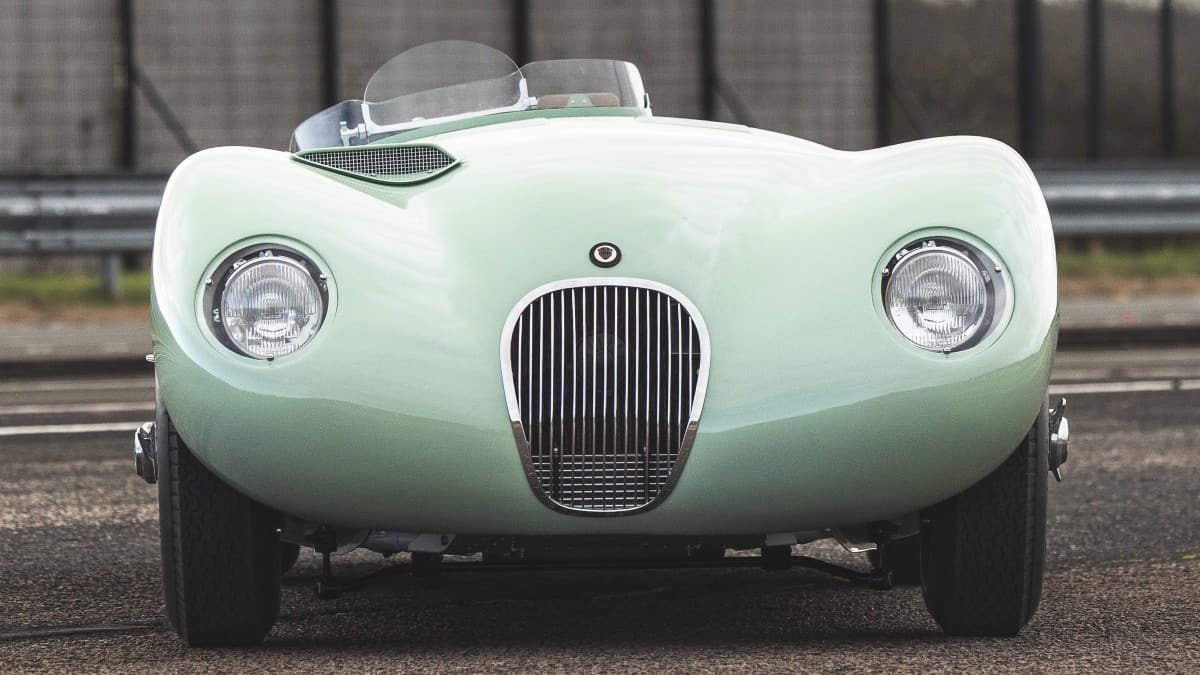
The First Production Jaguar C-Type Continuation Completes Its Shakedown
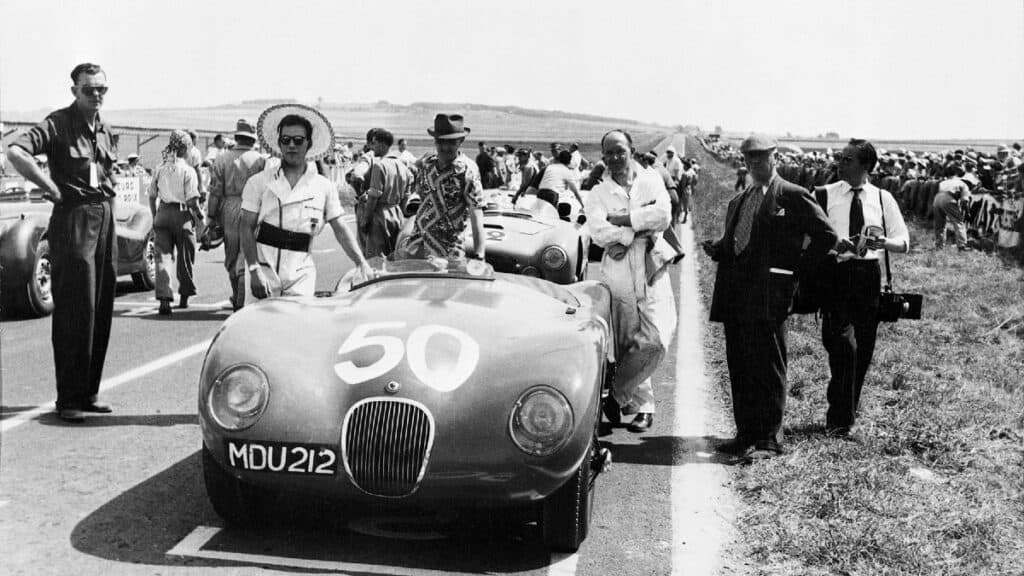
Jaguar Classic has finished manufacturing the first customer C-Type Continuation at its dedicated Classic Works facility in Coventry. The hand-built sports racer has completed its required shakedown testing program and stands prepped for delivery to its owner. Before any Continuation chassis leaves the workshop, Jaguar Classic engineers put each car through a physical test regime covering at least 250 miles of dynamic validation. This inaugural customer car arrives wearing period Pastel Green paint over Suede Green leather upholstery, an exact visual tribute to the factory car that Sir Stirling Moss drove to a landmark sports car victory at the Reims Grand Prix on June 29, 1952.
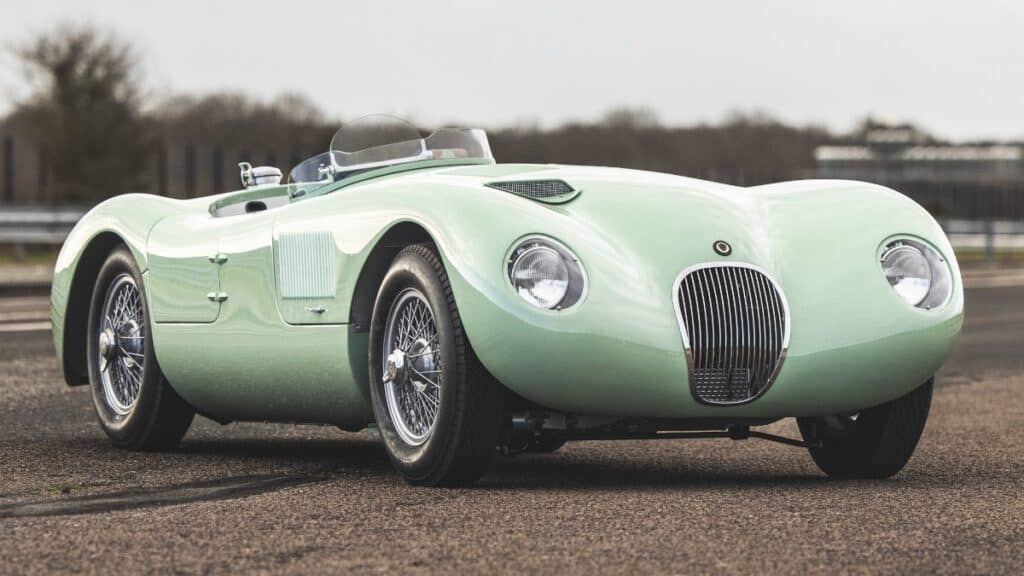
That 1952 triumph across 50 laps and 224 miles around the high-speed triangular Reims circuit was a watershed moment for competitive motorsport: it marked the first time a racing car running disc brakes won an international contest. Moss had actively pushed Jaguar engineering boss William Heynes to fit the experimental Dunlop disc brake setup in competition conditions. The Reims victory demonstrated the heat dissipation and late-braking endurance that would turn the C-Type into the dominant force at the 24 Hours of Le Mans the following season.
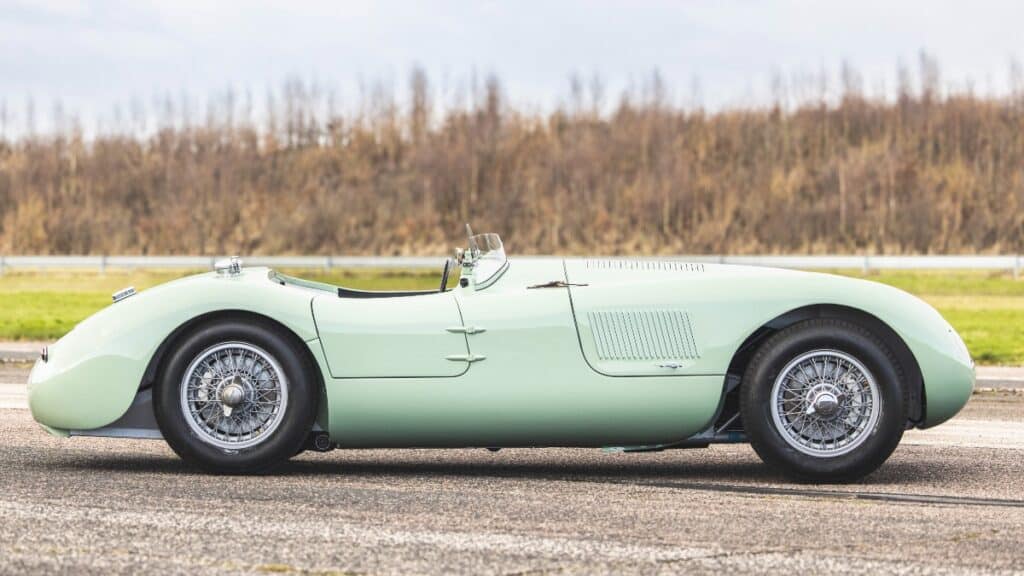
Handcrafted in Coventry to Exact 1953 Works Specifications
Assembling a Jaguar C-Type Continuation is an exercise in period accuracy and intense craftsmanship. Each car demands roughly 3,000 hours of skilled bench work inside the Coventry workshop. Rather than taking modern shortcuts or redesigning the car from scratch, the engineering team at Jaguar Classic consulted original engineering ledgers, factory archive drawings, and period competition records kept from the 1950s Works racing department under Chief Engineer William Heynes.
The build specification reproduces the definitive 1953 Le Mans team configuration down to its plumbing, hardware, and fasteners. That year, Jaguar’s lightweight Works entries swept the Circuit de la Sarthe, finishing first, second, and fourth while becoming the first cars to average over 100 mph for the entire 24 hours. The Continuation chassis relies on the same triangulated multi-tubular steel spaceframe layout engineered by Malcolm Sayer and Bob Knight, preserving the exact torsional characteristics and suspension geometry of the 1953 factory race cars.
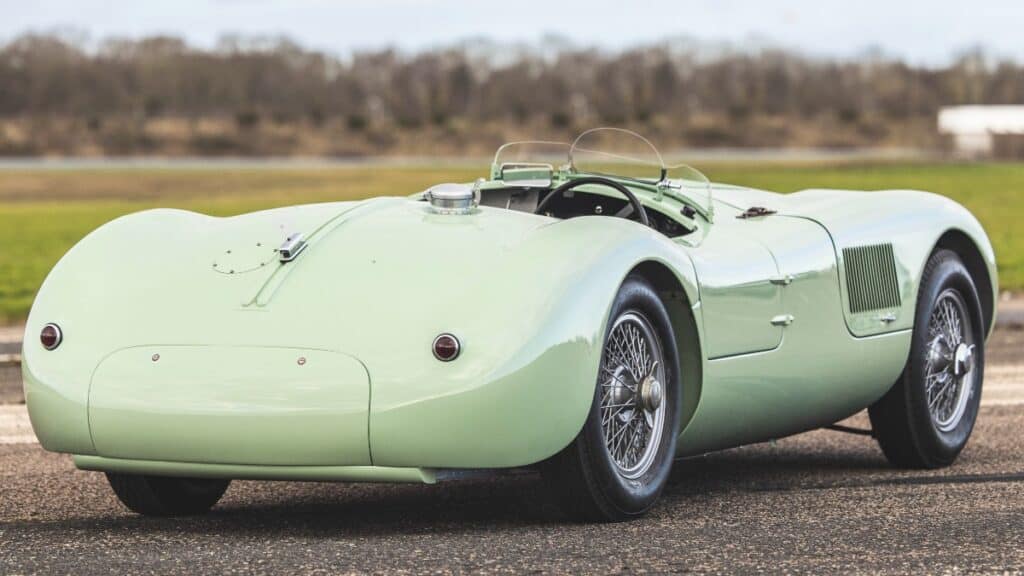
To ensure absolute geometric accuracy across the limited run, the Classic team digitized an original 1953 Works C-Type using precision 3D CAD modeling. This digital master provided a definitive reference coordinate system for the hand-wheeled 16-gauge aluminum body panels. Coachbuilders roll and shape the aluminum over wooden bucks using traditional English wheels and planishing hammers. The resulting skin displays the fluid, aerodynamic lines drafted by Malcolm Sayer, whose background in aeronautical design gave the C-Type its slippery drag profile and unmistakable stance.
The Mechanical Heart: A Period-Correct 3.4-Litre XK Straight-Six
Under the forward-tilting aluminum bonnet sits a brand-new, remanufactured 3.4-litre dual-overhead-cam straight-six XK engine, built strictly to 1953 Works competition tune. Each cast-iron engine block is machined to original tolerances and fitted with a high-compression cylinder head, competition camshaft profiles, and sodium-filled exhaust valves designed to withstand sustained high-rpm racing. Fuel delivery is handled by a triple bank of twin-choke Weber 40DCO3 carburetors, recreating the induction roar and throttle response of the 1953 works racers that displaced the twin SU setup used on earlier 1951 customer cars.
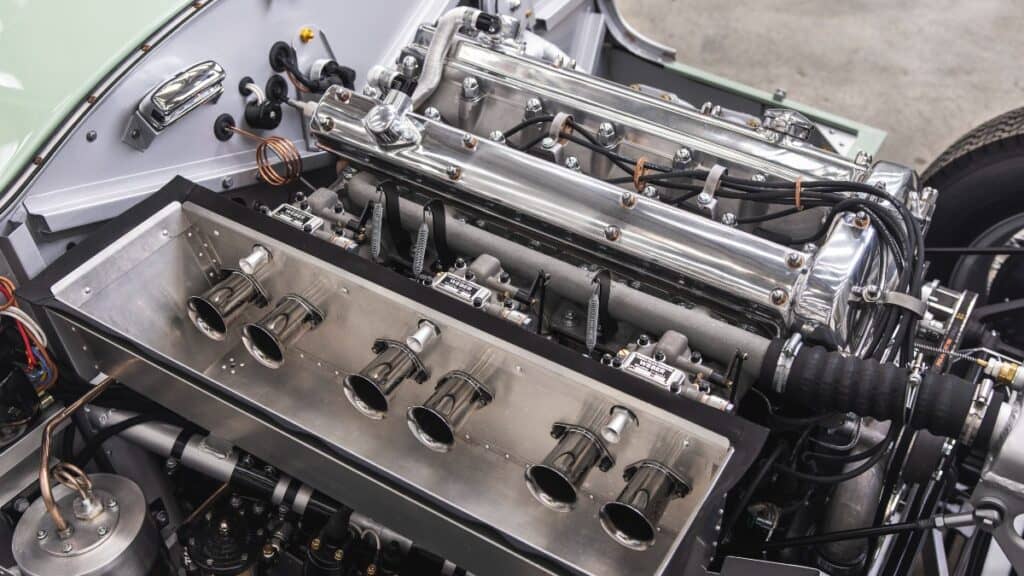
In this high-performance specification, the XK engine generates 220 brake horsepower at 5,800 rpm, breathing through an unbaffled competition side-exit exhaust system. Power routes rearward through a period-correct, close-ratio four-speed manual gearbox with straight-cut gears, driving a Salisbury rear axle. The cooling circuit includes a lightweight aluminum radiator and an engine oil cooler tucked into the nose air intake, matching the cooling arrangements that kept Moss, Duncan Hamilton, and Tony Rolt running cool through summer heat at Reims and Le Mans.
Stopping power is provided by the historic crowning jewel of the 1953 specification: all-round Dunlop four-wheel disc brakes clamped by race-spec calipers. When first run in international competition, these brakes gave Jaguar drivers a tremendous tactical advantage, allowing them to brake dozens of yards later into corners than rivals reliant on fading drum assemblies. On the Continuation model, these discs provide authentic, repeatable pedal feel and uncompromised deceleration on modern historic circuits.
Period Cockpit Details and Bespoke Specification
Step inside the open cockpit, and the driving environment strips away extraneous comforts in favor of purposeful 1953 racing equipment. The driver sits low in an aluminum bucket seat trimmed in supple leather, gripping a thin-rimmed wood-and-aluminum three-spoke steering wheel. Directly ahead sits a period-faithful black crackle-finish dashboard face housing authentic Smiths gauges, including a reverse-sweep rev counter, oil pressure indicator, water temperature gauge, and ammeter.
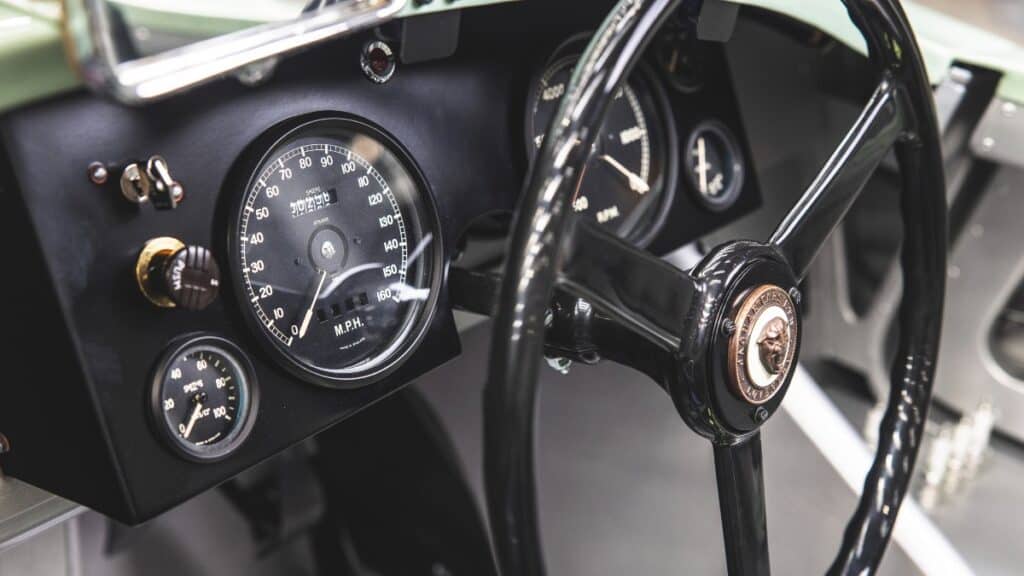
For buyers configuring a Continuation, Jaguar Classic offers 12 period exterior finishes. These include classic hues such as Pastel Green, British Racing Green, Pastel Blue, Silver, Birch Grey, and Gunmetal, available with optional painted roundels and contrasting nose badges. The cabin upholstery can be specified in eight distinctive leather shades, ranging from Suede Green and Cream to Biscuit, Red, and Black. Every car incorporates period-correct Lucas switchgear, safety harnesses certified for historic motorsport, and a discreet, plumbed-in fire suppression system built to meet modern competition safety regulations without disrupting the original dashboard layout.
FIA Historic Racing Homologation and Track Readiness
Unlike display showpieces or non-functional replicas, every Jaguar C-Type Continuation is built as a genuine competition vehicle. The cars carry full FIA Historic Technical Passport (HTP) homologation, granting them entry into premier historic motorsport events worldwide. Owners can campaign their cars wheel-to-wheel in series like the Jaguar Classic Challenge, competing at historic venues including Le Mans, Silverstone, and Spa-Francorchamps.
Each Continuation undergoes rigorous track and road shakedown testing prior to handoff. Factory test drivers run each chassis through high-speed straight-line checks, brake bedding cycles, suspension damping adjustments, and cornering balance assessments across at least 250 miles of dynamic running. This ensures that every vehicle delivered from Coventry delivers the raw mechanical soundtrack, crisp throttle response, and communicative chassis dynamics that defined Jaguar’s legendary 1950s sports racing program.
Vehicle data
| Field | Value |
| Make | Jaguar |
| Model | C-Type Continuation |
| Generation / chassis code | Continuation series (built to 1953 Works specification) |
| Model year(s) covered | 1953 (original Works specification), 2022–2023 (Continuation build) |
| Body style | 2-door competition roadster, 16-gauge aluminum bodywork |
| Powertrain / engine | 3.4-litre (3,442 cc) DOHC straight-six XK engine, triple Weber 40DCO3 carburetors |
| Power / torque | 220 bhp @ 5,800 rpm / torque not stated in sources |
| Transmission | 4-speed close-ratio manual gearbox |
| Drivetrain | Front-engine, rear-wheel drive (Salisbury rear axle) |
| Key performance figures | Dunlop four-wheel disc brakes; top speed ~150 mph; FIA Historic Technical Passport (HTP) approved |
| Price (as stated) | Not stated in sources (available on application to Jaguar Classic) |
| On-sale / announcement period | Production run underway at Coventry; first customer delivery May 2023 |
| Market | Global (hand-built by Jaguar Classic Works, Coventry, UK) |